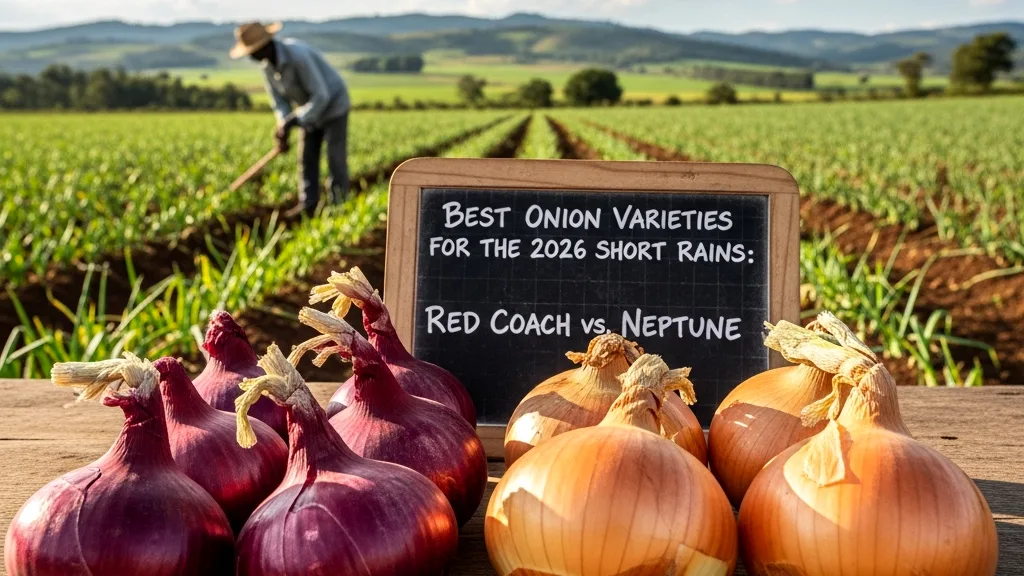

For the 2026 short rains season in Kenya, the choice between Red Coach F1 and Neptune F1 hinges on your specific location’s rainfall intensity and soil drainage capabilities. Red Coach F1 offers superior early maturity and deep red color preferred by Nairobi markets, making it ideal for farmers targeting early harvest windows to beat supply gluts. Conversely, Neptune F1 demonstrates higher resilience to fungal diseases like Downy Mildew, offering better security for farmers in wetter zones or those lacking advanced irrigation infrastructure.
Table of Contents
Farming in 2026 requires a data-driven approach to seed selection. The predicted weather patterns suggest erratic rainfall distribution during October and November. This variability forces farmers to prioritize either speed to market or crop resilience.
Red Coach F1 is the sprinter, designed for quick turnover and high aesthetic appeal. Neptune F1 is the marathon runner, built to withstand environmental stress and deliver bulk tonnage. Your specific soil pH and altitude should be the final tie-breakers in this decision.
What are the critical performance differences between Red Coach and Neptune for 2026?
Red Coach F1 matures faster (80-90 days). and yields approximately 25-30 tonnes per acre, excelling in areas with moderate rainfall and requiring shorter field exposure. Neptune F1 is a slightly longer-duration variety (90-100 days) but compensates with robust foliage. that resists fungal attacks common during heavier short rains, potentially yielding up to 35 tonnes per acre under optimal management.
Module A: Technical Deep-Dive & Best Varieties Analysis
The 2026 farming landscape in Kenya is defined by unpredictable weather patterns, making seed selection the single most critical decision for profitability. When targeting the short rains (typically October to December), your onion crop faces the dual challenge of sufficient moisture for bulb formation and the risk of fungal rot during curing. Here is how the two heavyweights stack up.
Red Coach F1: The Market Favorite
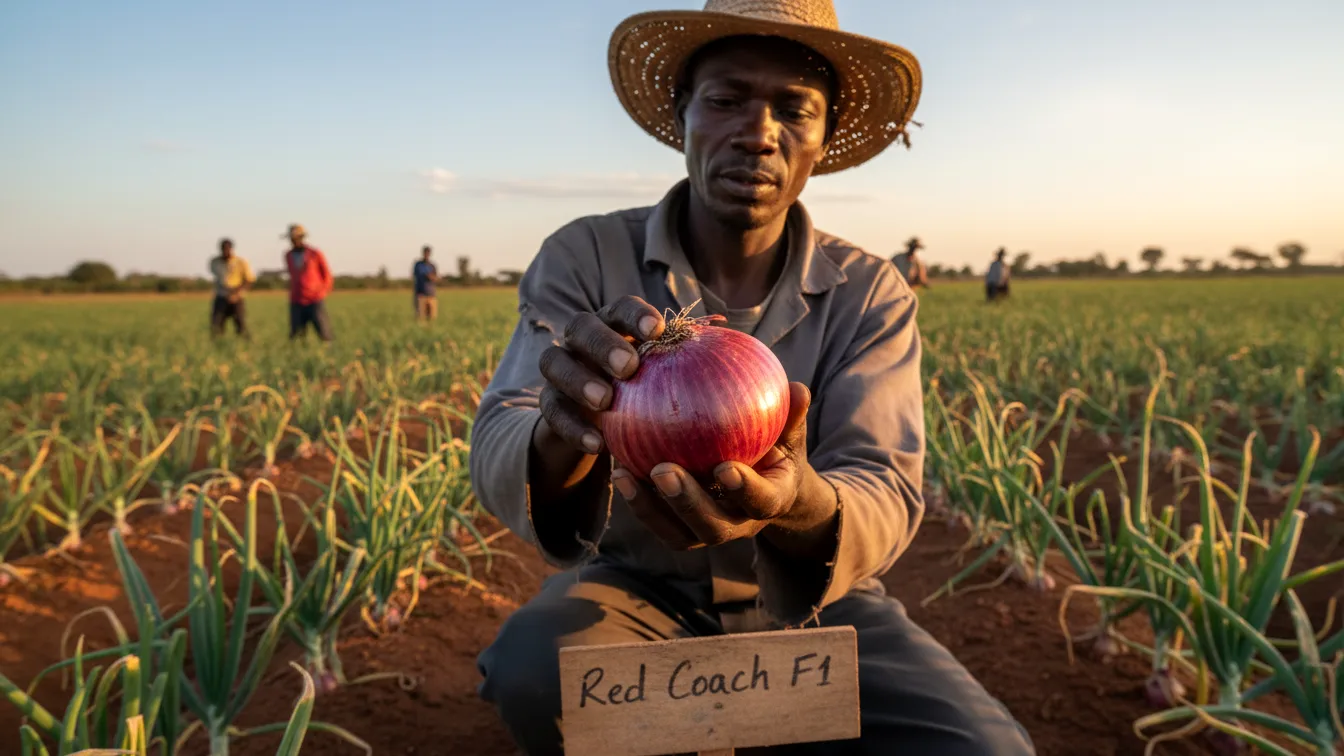
Red Coach F1 remains the industry standard for shamba owners targeting the high-end Nairobi and Mombasa markets. Its defining characteristic is the deep, attractive red to violet color and a flat-globe shape that brokers actively seek. For the 2026 short rains, this variety is advantageous because of its early maturity.
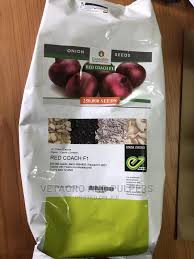
If you transplant in late September, you can be harvesting by late December or early January. This timing allows you to cure the onions during the hot, dry start of the year (January/February), significantly reducing post-harvest losses. However, Red Coach requires strict adherence to a spray program against Purple Blotch if the rains extend longer than expected.
The skin retention of Red Coach F1 is moderate. It requires careful handling during harvest to prevent skin peeling. Farmers in lower altitudes find that this variety responds exceptionally well to calcium fertilizers, which boost skin quality.
Neptune F1: The Resilient Yielder
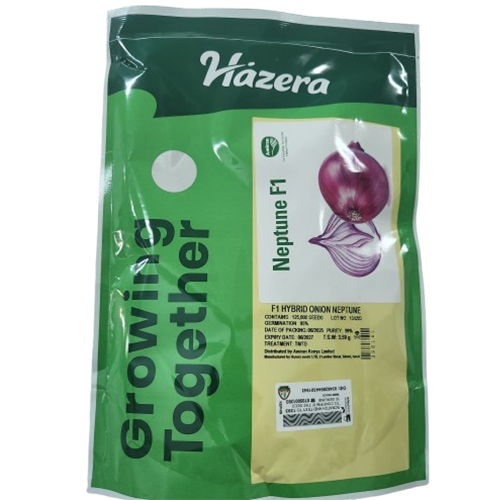
Neptune F1 has gained massive traction in counties like Meru and Nyeri due to its vegetative vigor. The plant develops a strong, waxy canopy that naturally repels water, making it less susceptible to foliar diseases compared to thinner-skinned varieties. For the 2026 season, where climate models predict erratic heavy downpours, Neptune acts as an insurance policy.
Read Also: How to Start Bulb Onion Farming in Kenya: Complete 2026 Guide, Costs & Profit Per Acre
While it stays in the field 10-14 days longer than Red Coach, the yield potential is significantly higher due to larger bulb expansion. The skin retention on Neptune is excellent, which is crucial for transport from remote farms to urban centers without damaging the produce. It is the superior choice if your farm has heavy clay-loam soils that retain moisture, as its root system is aggressive.
Neptune F1 also boasts a higher dry matter content. This internal density translates to better weight per bag. When selling by the kilogram, as opposed to the bag, this density directly increases your revenue.
How does the curing process differ for these varieties?
Red Coach F1 has a thinner neck that dries rapidly, allowing for a quicker curing period of 10-14 days in field windrows, provided the weather is dry. Neptune F1 possesses a thicker neck and robust outer scales, requiring a prolonged curing phase of 18-21 days to ensure the neck is completely sealed against bacterial soft rot before storage or bagging.
Where to Buy Best Onion Varieties in Kenya 2026.
You can purchase authentic certified seeds from Simlaw Seeds (for Red Coach) and authorized distributors of Amiran Kenya or Elgon Kenya (for Neptune). In 2026, digital platforms like DigiFarm and iShamba offer verified procurement channels to avoid fakes. Always verify the seed lot number via SMS validation codes provided on the packaging before leaving the agrovet.
Procurement Strategy & Buyer’s Caution
Buying onion seeds in Kenya requires vigilance due to the prevalence of counterfeit packaging. For the 2026 season, the price for a 1kg tin of hybrid onion seeds ranges between KES 32,000 and KES 42,000 depending on the variety and supplier. Do not be tempted by “loose seeds” sold in unlabeled nylon bags at open-air markets.
These loose options are often second-generation (F2) seeds. They will result in non-bulbing thick necks or split bulbs. Investing in certified F1 hybrid seeds is the only way to guarantee genetic potential.
Verified Suppliers for 2026:
- Simlaw Seeds: Nairobi HQ (Kijabe Street) and countrywide stockists. Primary source for Red Coach F1.
- Amiran Kenya: North Airport Road, Nairobi. Key distributor for Neptune F1 and accompanying irrigation kits.
- Kenya Seed Company: Stockists in Kitale, Nakuru, and Eldoret often carry a wide range of certified hybrid onions.
- Online: Mkulima Young marketplace (verify seller reviews) or direct orders via local Agrovets linked to major suppliers.
When purchasing, check the batch number printed on the bottom of the tin. Cross-reference this with the manufacturer’s database if an SMS verification service is available. Ensure the tin has no signs of tampering or re-sealing.
Additionally, ask for a receipt that specifically details the variety and batch number. This document is essential if you experience germination failure and need to file a complaint. Quality control in 2026 is better, but due diligence remains the farmer’s responsibility.

Module C: Regional Comparative Analysis
The performance of Red Coach and Neptune varies significantly across Kenya’s diverse agro-ecological zones. Soil composition, altitude, and micro-climates dictate which seed will thrive. Here is how they compare in three key production hubs for the 2026 short rains.
1. Kajiado County (Oloitoktok / Kimana)
Dominant Variety: Red Coach F1.
The volcanic soils and warmer temperatures of Oloitoktok favor the early maturity of Red Coach. Farmers here rely heavily on irrigation, allowing them to control water intake precisely. Neptune performs well, but the market links in this region are historically biased towards the dark red appearance of Red Coach for the Mombasa market.
The high evapotranspiration rates in Kajiado mean Red Coach dries down very fast. This speed is crucial for clearing fields for the next rotation. Farmers here appreciate the quick cash flow cycle that Red Coach provides.
2. Nyeri County (Kieni West / East)
Dominant Variety: Neptune F1.
Kieni is known for cooler temperatures and black cotton soils that can become waterlogged. Neptune’s disease resistance is critical here. The variety’s ability to withstand the misty, humid mornings of Nyeri without succumbing to aggressive Downy Mildew gives it the edge over Red Coach in this specific micro-climate.
The black soil retains moisture for long periods. Red Coach often struggles with skin staining in these soils. Neptune’s tougher outer skin resists staining better, ensuring a cleaner market presentation.
3. Meru County (Timau / Isiolo Border)
Dominant Variety: Mixed / Neptune Lean.
This region combines high altitude with large-scale production. Neptune is preferred for its high tonnage per acre, as farmers here often sell by weight to bulk aggregators. However, Red Coach is gaining ground for farmers targeting the premium grocery market in Nairobi who demand specific aesthetic qualities.
Timau’s cold nights can slow down growth. Neptune is more cold-tolerant and maintains vegetative growth even when temperatures drop. This makes it a safer bet for the higher altitudes of Meru.
What is the optimal planting schedule for the 2026 Short Rains?
To hit the peak price window in January/February 2027, prepare your nursery in mid-August 2026 and transplant seedlings to the main field by early October 2026. This aligns the vegetative stage with the onset of rains, reducing irrigation costs, while ensuring maturity coincides with the dry spell in January for optimal curing and harvesting.
Module D: 12-Month Farming Calendar (2026-2027)
Successful onion farming requires backward planning from the target market date. The following calendar targets a harvest during the high-price window of January/February 2027. Sticking to this schedule minimizes weather risks.
Read Also: How to Grow Dwarf Papaya Trees in Containers for Massive Harvests in Kenya 2026
- August 2026 (Nursery Est.): Prepare raised nursery beds to ensure good drainage. Solarize soil to kill nematodes and weed seeds. Sow seeds in rows (not broadcast) to ensure strong stems and easier management.
- September 2026 (Land Prep): Plough the main field deeply to break any hardpan. Incorporate well-decomposed manure (10 tonnes/acre) to improve soil structure. Install drip irrigation lines and test the system for leaks.
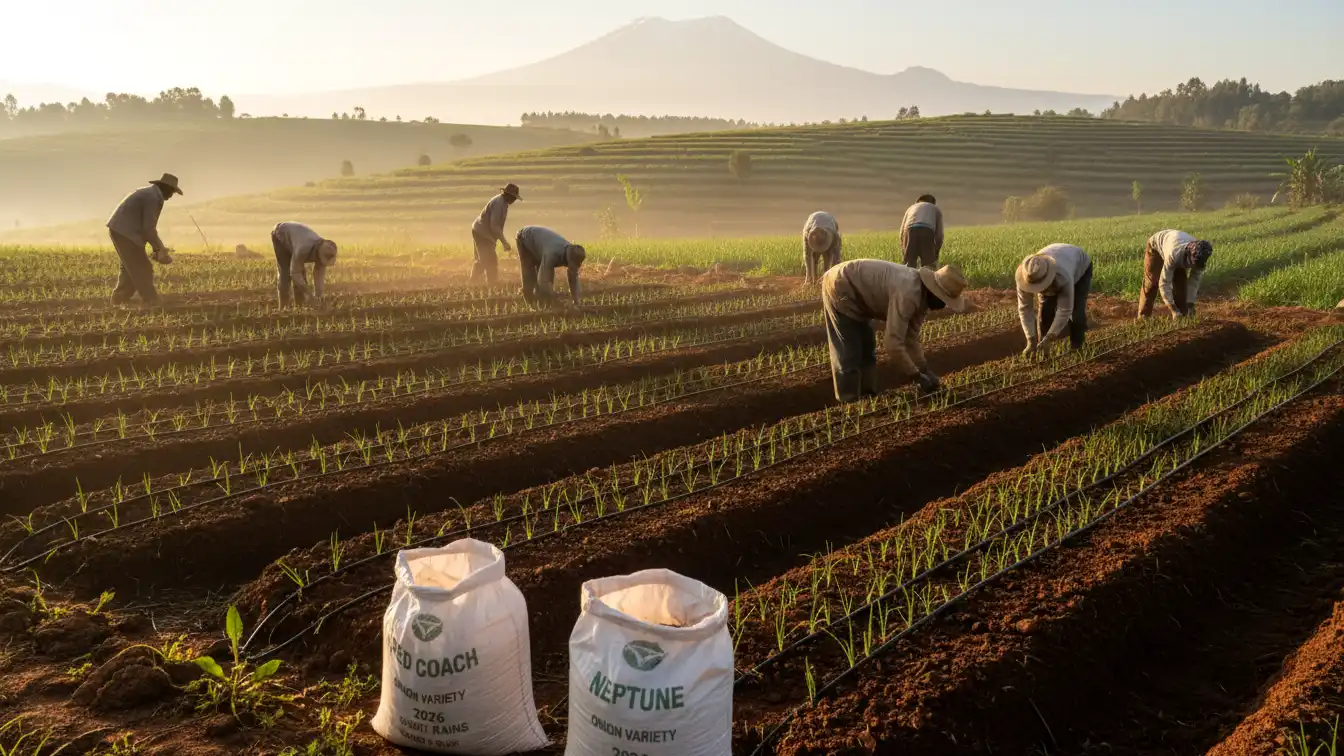
- October 2026 (Transplanting): Transplant 6-week-old seedlings when they are pencil-thick. Spacing should be 8cm between plants and 30cm between rows. Apply DAP fertilizer during transplanting to boost root development.
- November 2026 (Vegetative Growth): Top dress with CAN (Calcium Ammonium Nitrate) at week 3 and week 6. Aggressive scouting for Thrips and fungal infections is mandatory. Weed control must be thorough to prevent competition.
- December 2026 (Bulb Formation): Switch to high-Potassium fertilizers (N-P-K 17:17:17 or Potassium Sulphate) to boost bulb expansion. Stop Nitrogen application completely to prevent thick necks. Ensure consistent moisture to prevent splitting.
- January 2027 (Maturity & Harvest): When 50% of tops fall over (“neck fall”), stop watering completely. Harvest after 1 week of drying in the soil. Begin field curing by windrowing the onions.
- February 2027 (Sales): Grade, sort, and net the onions into appropriate bags. Dispatch to market when prices typically peak due to lower supply from Tanzania. Negotiate prices based on quality and curing status.
The critical phase in this calendar is the transition from November to December. This is when the plant shifts from leaf growth to bulb formation. Missing the fertilizer switch from Nitrogen to Potassium can ruin the crop yield.
Monitor the short rains closely during November. If the rains are heavy, skip irrigation cycles to prevent waterlogging. Conversely, if there is a dry spell, supplement immediately to avoid moisture stress.
Module E: Deep-Dive Financials (2026 Projections)
Farming onions is capital intensive and requires a significant upfront investment. In 2026, the cost of inputs such as fuel, labor, and certified seeds has adjusted upwards due to inflation. Below is a realistic break-even analysis for 1 Acre of Hybrid Onions (Red Coach/Neptune) under drip irrigation.
| Expense Item | Estimated Cost (KES) | Notes |
|---|---|---|
| Land Lease & Prep | 15,000 – 25,000 | Includes ploughing, harrowing, and bed making. |
| Seeds (1kg Hybrid) | 35,000 – 42,000 | Prices for premium F1 seeds in 2026. |
| Nursery Management | 10,000 | Covers labor, soil treatment, and starter fertilizer. |
| Fertilizers (Base & Top) | 35,000 | Includes DAP, CAN, NPK, and foliar feeds. |
| Crop Protection | 30,000 | Fungicides (Ridomil/Ortiva) & Pesticides (Thunder/Escort). |
| Labor (Weeding/Transplant) | 30,000 | Manual labor rates have risen to ~500 KES/day. |
| Irrigation (Fuel/Water) | 20,000 | Pumping costs for 3 months (Petrol/Diesel). |
| Harvesting & Curing | 15,000 | Lifting, cutting tops, and bagging labor. |
| Miscellaneous | 10,000 | Transport, empty sacks, and contingencies. |
| TOTAL COST PER ACRE | ~200,000 – 220,000 | High investment, high potential return. |
Revenue Analysis
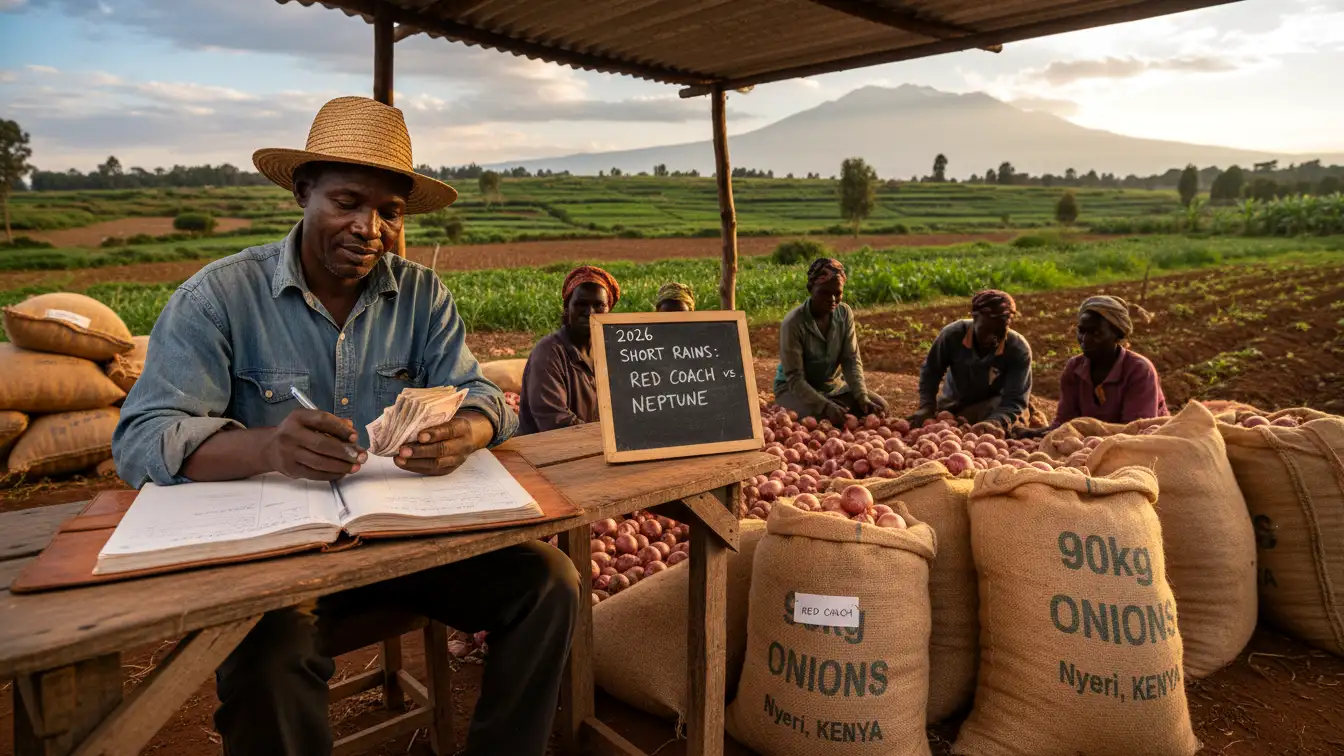
Yield Scenario: A well-managed acre of Neptune or Red Coach in 2026 should yield between 15,000kg to 20,000kg (15-20 tonnes). This assumes good agricultural practices and disease control.
- Conservative Price: 40 KES/kg (Farm gate). Revenue = 600,000 KES. Profit: ~380,000 KES.
- Good Market Price: 60 KES/kg. Revenue = 900,000 KES. Profit: ~680,000 KES.
- Glut Price: 25 KES/kg. Revenue = 375,000 KES. Profit: ~155,000 KES.
The “Short Rains” crop harvested in Jan/Feb usually avoids the worst gluts. This timing positions you closer to the “Good Market Price” tier. However, market prices fluctuate daily based on supply from Tanzania.
Your break-even price is roughly 15 KES per kg. Any sale above this covers your production costs. Targeting a sale price of 40 KES+ is the key to sustainable growth.
How do value addition and supply chains impact profitability?
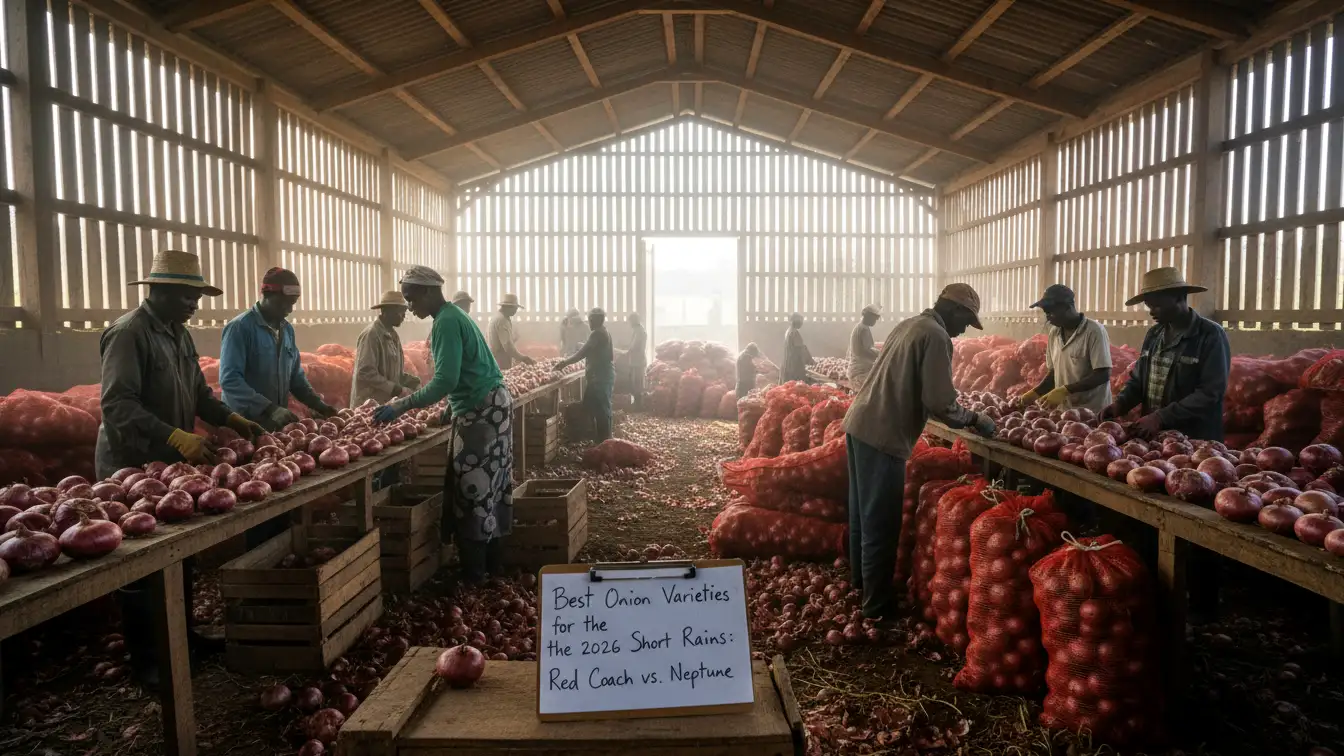
Selling immediately at harvest (farm gate) yields the lowest margin as brokers dictate prices. Curing onions properly allows you to store them for 2-3 months in a well-ventilated structure (onion store), enabling you to bypass market gluts and sell when prices rise, often increasing revenue by 30-40% compared to raw harvest sales.
Module F: Supply Chain & Value Addition
The journey from the shamba to the plate involves several critical steps where value can be lost or gained. For 2026, the trend is moving away from the traditional 90kg bag towards selling by kilogram weight. The “extended bag” practice is slowly being phased out in organized markets.
Read Also: 10 Most Profitable Farming Ventures in Kenya for 2026
Correct Curing is Key
Value addition in onions starts with curing. Uncured onions have a high moisture content and rot quickly. By constructing a simple, aerated wooden store raised off the ground, you can hold your harvest.
Red Coach stores moderately well, usually up to 3 months. Neptune is a storage champion due to its hard skin and can last 4 months. Storing your crop until March or April 2027 could see prices jump from 50 KES to 80 KES per kg.
Proper curing involves drying the neck completely until it is wiry and tight. If the neck remains soft, pathogens will enter the bulb. This process happens best in the field, but final curing can happen in the store.
Market Brokers vs. Direct Sales
Brokers from Wakulima Market (Marikiti) or Kongowea play a vital role in moving volume, but they take a significant cut. In 2026, consider forming aggregation groups with neighboring farmers. A 10-tonne truckload commands better negotiation power than a few bags.
Alternatively, target institutions like schools and hospitals. Fast-food chains such as KFC or Java House supply chains also require consistent, high-quality bulbs. These buyers often offer fixed contracts which provide price stability.
Using digital platforms to check daily market prices is essential. Apps like Sokopepe can give you real-time data on Nairobi vs. Mombasa prices. Knowledge of the current market rate is your best negotiation tool against brokers.
2026 Outlook & Conclusion
As we approach the 2026 Short Rains, the battle between Red Coach and Neptune is ultimately a decision about risk management. If your priority is speed to market and meeting the specific aesthetic demands of high-end Nairobi greengrocers, Red Coach F1 is your winner. If your priority is minimizing the risk of fungal disease in a wet season and maximizing tonnage for bulk sales, Neptune F1 is the superior strategic choice.
Farming is a business, not a hobby. Invest in soil testing before you plant to ensure your pH is between 6.0 and 6.8. Use genuine certified seeds and adhere to a strict crop protection schedule to protect your investment.
The potential for a net profit of over 400,000 KES per acre is real. It is reserved for those who treat their onion production with professional discipline. Do not cut corners on inputs or labor if you want premium results.
Call to Action: Don’t wait for the rains to start. Secure your seeds from verified stockists today and begin your nursery preparations by mid-August to capitalize on the lucrative early 2027 market window.
Farmers Also Ask (FAQ)
1. Which onion variety is better for storing, Red Coach or Neptune?
Neptune F1 generally offers better storage qualities due to its thicker skin and tighter neck closure. While Red Coach stores well for 2-3 months, Neptune can often remain viable for 3-4 months under proper ventilation, making it ideal for farmers planning to wait for better market prices.
2. Can I plant onions during the long rains instead of short rains?
Yes, but the risks are significantly higher. Long rains (March-May) are typically heavier, increasing the risk of fungal diseases and rotting bulbs. If you plant during long rains, you must budget significantly more for fungicides and ensure your field has excellent drainage to prevent waterlogging.
3. How many seeds do I need for one acre of onions?
You need approximately 1kg (1,000 grams) of high-quality hybrid seed per acre. If using a precision planter or highly efficient nursery trays, you might use slightly less (800g), but budgeting for 1kg accounts for germination gaps and nursery losses.
4. What is the best fertilizer for onion bulb formation?
During the bulbing stage (from week 8 onwards), onions need Potassium. Use a fertilizer like NPK 17:17:17, Winner, or Potassium Sulphate. Avoid Calcium Ammonium Nitrate (CAN) or Urea at this stage, as excess Nitrogen will cause “thick necks” and reduce shelf life.
5. How do I control Thrips in my onion farm?
Thrips are the #1 pest for onions. Control them by alternating active ingredients to prevent resistance. Effective chemicals include Acetamiprid, Imidacloprid, or Spinetoram (Radiant). Always spray early in the morning or late evening, and use a sticker/spreader since onion leaves are waxy.
6. Why do my onions develop thick necks?
Thick necks are caused by excessive Nitrogen application late in the season, irregular watering, or planting the wrong variety for your latitude. To prevent this, cut off Nitrogen supply at least 4 weeks before harvest and ensure consistent irrigation until the final curing phase.
7. What is the current price of Red Coach F1 seeds in 2026?
In 2026, a 1kg tin of genuine Red Coach F1 seeds retails between KES 32,000 and KES 36,000. Prices vary slightly between distributors like Simlaw and local agrovets. Always beware of significantly cheaper offers as they may be counterfeits.
8. Is drip irrigation mandatory for onion farming?
While not strictly mandatory, drip irrigation is highly recommended for commercial success. It prevents water from touching the leaves (reducing fungal disease) and saves water/fertilizer costs. Overhead sprinklers can be used but increase the risk of Downy Mildew and Purple Blotch.
9. How long does it take for onions to mature in Kenya?
Hybrid onions like Red Coach and Neptune typically mature in 3 to 3.5 months (90-105 days) after transplanting. However, this varies by altitude; farms in cooler areas like Timau may take 2-3 weeks longer than farms in hotter areas like Oloitoktok.
10. Can I intercrop onions with other crops?
Commercial onion farming is best done as a mono-crop to allow for specific chemical spraying and fertilizer management. Intercropping complicates weed control and canopy management. If necessary, onions can be intercropped with slow-growing crops like sugarcane, but this is not recommended for high-yield commercial ventures.
11. How can I distinguish between F1 and F2 seeds?
F1 seeds are uniform in size, often treated with a fungicide (colored coating), and sold in sealed, branded tins. F2 seeds are often uneven, uncoated, and sold loose in clear bags. F2 seeds will produce a crop with high variability, many thick necks, and poor storage qualities.