
Table of Contents
Growing Clover seed in Kenya is a strategic 2026 venture, offering dual revenue from high-protein livestock fodder and premium certified seeds. With a short maturity period of 4-5 months, farmers in high-altitude zones can harvest up to 300kg of seed per acre. This significantly reduces reliance on expensive commercial dairy meal. This comprehensive guide covers agronomy, regional analysis, and profitability.
The Kenyan dairy sector faces a critical challenge in 2026 due to the escalating costs of commercial protein concentrates. Astute farmers are shifting towards on-farm protein production to sustain profitability. Clover (Trifolium spp.) has emerged as the premier solution for nitrogen fixation and high-protein forage.
Producing your own seed is the ultimate step toward farm independence and sustainability. It drastically cuts input overheads and creates a marketable asset for local cooperatives. This article serves as your definitive manual for mastering Clover seed production in Kenya.
Why is Clover seed farming considered profitable in 2026?
Clover seed farming is profitable because it addresses the high demand for protein-rich fodder in Kenya’s dairy sector. Seed yields of 200-300kg per acre can generate gross revenues exceeding KES 350,000 in a single season. Additionally, the crop improves soil fertility by fixing nitrogen, reducing fertilizer costs for subsequent crops like maize.
The profitability of clover stems from its dual-purpose nature. First, the seed market is undersupplied, with many farmers relying on imported or low-quality local seeds. By producing high-germination seeds, you tap into a premium market niche.
Read also: Top 5 Profitable Dairy Cow Breeds for Successful Farming in Kenya (2026 Guide)
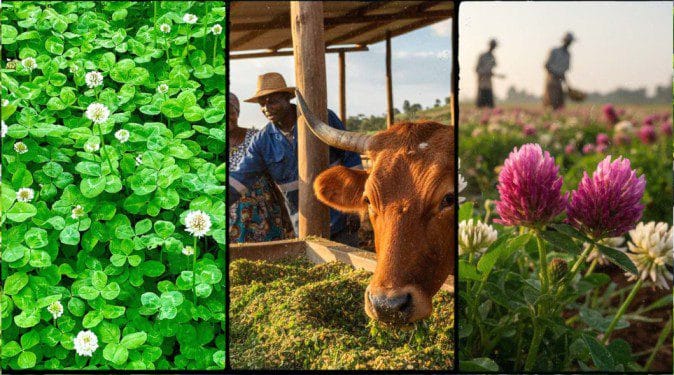
Second, the vegetative biomass remaining after seed harvest is not waste. It forms high-quality hay that rivals Lucerne in protein content. This allows you to support your own dairy herd or sell the hay to neighbors.
Third, the agronomic benefits to your soil are immense. Clover roots host Rhizobium bacteria that fix atmospheric nitrogen into the soil. This natural fertilization reduces your expenditure on CAN and Urea for rotation crops like Maize or Wheat.
Which Clover varieties are best suited for Kenya?
The best varieties for Kenya are:
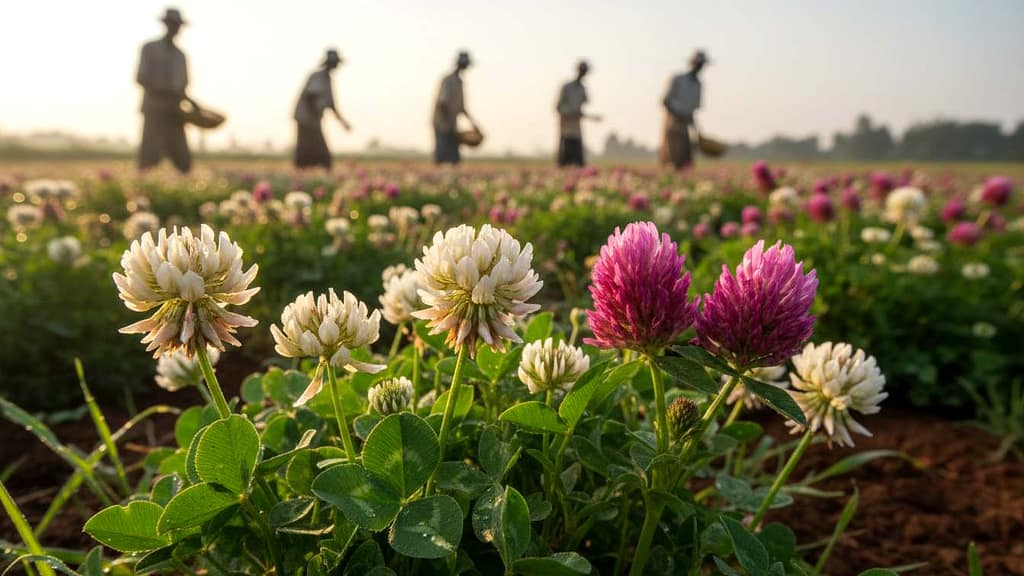
Kenya White Clover (Trifolium semipilosum) for grazing and medium altitudes, and
Red Clover (Trifolium pratense) for hay production in high-altitude zones.
Egyptian Clover (Berseem) is excellent for short-rotation systems in lower altitudes under irrigation. Your choice depends on your primary goal: grazing persistence or hay volume.
Kenya White Clover is a deep-rooted perennial that is exceptionally drought-tolerant once established. It is ideal for the Rift Valley highlands where rainfall can be erratic. It spreads by stolons, making it resilient to heavy grazing pressure.
Red Clover is a short-lived perennial, typically lasting 2-3 years. It grows upright, making it easier to cut for hay or silage. It performs best in the cool, wet highlands of Nyandarua and Kericho.
Purple Clover (Trifolium burchellianum) is an indigenous variety often found in the high moorlands. It is incredibly hardy but produces less biomass than commercial varieties. It is suitable for extremely high altitudes above 2,800m
What are the best climatic conditions for growing Clover in Kenya?
Clover thrives at altitudes between 1,800m and 3,000m above sea level with cool temperatures averaging 20°C to 25°C. It requires well-distributed annual rainfall of 800mm to 1,200mm and deep, well-drained soils with a pH of 6.0 to 7.0. Extreme heat above 30°C causes flower abortion and significantly reduces seed set.
Clover is strictly a high-potential zone crop in the Kenyan context. It flourishes in the cool highlands where dairy farming is dominant. Attempts to grow it in the hot lowlands without intensive management usually result in failure.
Temperature regulation is critical for the reproductive phase. If temperatures exceed 28°C during flowering, pollen viability drops sharply. This is why Timau and Kinangop are superior locations compared to lower parts of Nakuru.
Soil drainage is non-negotiable for healthy root development. Clover roots suffocate easily in waterlogged soils, leading to root rot. If your farm has “black cotton” soil, you must invest in raised beds or drainage channels.
*Expert Tip:* Soil pH is the silent killer of clover yields. In acidic soils (pH < 5.5) common in Kisii, aluminum toxicity stunts root growth. Apply agricultural lime at 2-3 tons per acre at least 30 days before planting.
Which regions in Kenya are best for Clover seed production?

The top regions for clover seed production are Nyandarua, Meru, and Uasin Gishu counties due to their altitude and soil profiles. Nyandarua offers the ideal cool climate for flowering. Meru provides rich volcanic soils, while Uasin Gishu offers large land tracts suitable for mechanized farming.
1. Nyandarua County: The High-Altitude Leader
Nyandarua is arguably the best county for temperate fodder crops. Areas like Njabini and Ol Kalou sit above 2,500m, providing the chill factor necessary for prolonged flowering. Pest pressure is also lower here due to the cold nights.
The primary challenge in Nyandarua is the road network during the rainy season. However, the high yields of up to 350kg/acre often justify the logistical struggles. Farmers here typically use Red Clover for cut-and-carry systems.
2. Meru County: The Volcanic Fertility Hub
Meru, particularly the Buuri and Imenti sub-counties, boasts rich volcanic soil that clover loves. The soil pH is naturally closer to neutral compared to other highlands. This reduces the cost of liming amendments significantly.
Competition for land is high due to horticulture export crops. Labor costs in Meru are generally 15% higher than in the Rift Valley. Yet, the proximity to the Mount Kenya dairy market ensures instant buyers for hay by-products.
3. Uasin Gishu County: The Mechanization Giant
Uasin Gishu is the home of large-scale farming in Kenya. The flat terrain allows for the use of seed drills and combine harvesters. This drastically lowers the cost of production per kilo compared to manual systems.
Read also: DAIRY GOAT FARMING IN KENYA: THE 2026 MASTER GUIDE TO PROFITABLE BREEDS, HOUSING, AND MILK PRODUCTION
Farmers here must plant early to utilize the long rains effectively. The slightly warmer temperatures mean the flowering window is shorter than in Nyandarua. Access to Eldoret for inputs and seed processing is a major logistical advantage.
What is the step-by-step land preparation and planting process?
Prepare a fine, firm seedbed by ploughing and harrowing twice to eliminate clods. Inoculate seeds with Rhizobium bacteria immediately before planting to ensure nitrogen fixation. Plant shallowly at a depth of 1cm with 30cm row spacing, using 3-4kg of seed per acre mixed with sand for even distribution.
Land preparation for clover requires more precision than maize. The seeds are minute, and a rough seedbed leads to deep burial or poor soil contact. You should aim for a “garden-like” tilth free of trash and large stones.
Plough your shamba at least four weeks before the onset of rains. This allows for the decomposition of organic matter and the germination of weed seeds. A second harrowing just before planting kills these early weeds, giving your clover a head start.
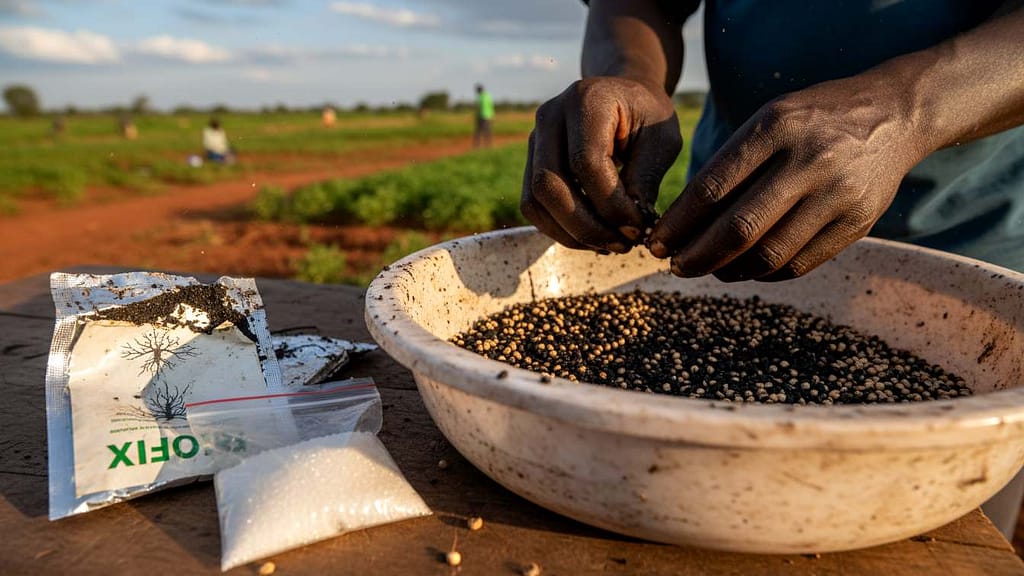
Inoculation is the most critical biological step. You must coat seeds with specific Rhizobium strains available from MEA Ltd or Biofix. Mix the inoculant with a sugar solution to ensure it sticks to the smooth seed coat.
Planting depth is the most common point of failure. If buried deeper than 1.5cm, the seedling will exhaust its energy before reaching the surface. Use a light tree branch or chain to cover the seeds lightly after broadcasting.
What is the 12-Month Farming Calendar for Clover?
The farming calendar revolves around the main rains, starting with planning in January and planting in March. Weed control dominates April and May, while pollination and seed setting occur in June and July. Harvesting takes place in September during the dry spell, followed by processing and marketing in December.
January: Planning & Procurement.
This is the dry season. Conduct soil tests via CropNuts or KALRO. Order certified seeds from Kenya Seed Company early to avoid shortages. Secure limestone if your pH is low.
February: Land Preparation.
Deep plough the field to expose soil pests. Apply lime now to allow it 30 days to react with the soil. Purchase Phosphorus fertilizers like TSP or DAP.
March: Planting.
Wait for the rains to stabilize. Harrow the soil to a fine tilth. Inoculate seeds in the shade and plant immediately. Apply DAP at a rate of 50kg per acre.
April: Establishment & Gapping.
Monitor for germination. Gap any empty spaces within 14 days. Perform the first manual weeding or use selective herbicides like Bentazone if the infestation is heavy.
May: Vegetative Growth.
The crop covers the ground. Top dress with a Potassium-rich foliar feed to boost stem strength. Avoid Nitrogen fertilizers as they suppress nodulation.
June: Flowering & Pollination.
Bees are essential now. Introduce beehives if possible. Avoid all insecticide sprays during the day. Kenya White Clover depends entirely on bee pollination for seed set.
July: Seed Filling.
The crop is in full bloom. Maintain soil moisture but avoid overhead irrigation that damages flowers. Scout daily for pod-boring pests.
August: Desiccation.
As rains subside, the plants begin to dry. Stop irrigation completely. This stress signals the plant to mature its seeds.
September: Harvesting.
Harvest when 90% of heads are brown. Cut manually with sickles or use a specialized combine. Cure the cut crop in windrows for 3-4 days.
October: Threshing & Drying.
Thresh the cured crop. Winnow to remove chaff. Dry seeds on tarpaulins to 10-12% moisture content. Treat with Actellic Super to prevent weevil damage.
November: Residue Management.
Bale the remaining straw for hay. It is still protein-rich. Graze the stubble lightly with sheep or calves.
December: Marketing.
Clean and package your seeds. Market to local dairy cooperatives. Prices typically peak in January before the next planting season.
How do you manage weeds and pests without destroying the crop?
Manage weeds with selective herbicides like Bentazone or Imazethapyr, specifically safe for legumes. Control pests like aphids and thrips using targeted insecticides such as Thunder, applied strictly in the evening to protect pollinators. Use sticky traps for monitoring pest population levels before spraying.
Weeds are the arch-nemesis of clover during the establishment phase. Broadleaf weeds like Pigweed (Terere) and Blackjack can smother slow-growing clover seedlings. Early hand weeding is recommended for small plots.
For larger farms, chemical control is necessary but risky. You must use legume-safe herbicides. Products containing Bentazone are effective against broadleaf weeds without harming the clover. Always spot-test before spraying the entire field.
Pest management requires a delicate balance due to pollinators. The Clover Weevil feeds on leaves, while Thrips attack the flowers. If spraying is unavoidable, use bee-safe chemicals and spray at dusk when bees are back in the hive.
What are the costs and profits of Clover farming?
Farming one acre of clover seed costs approximately KES 46,700 in 2026. With a conservative yield of 250kg of seed and 60 bales of hay, gross revenue can reach KES 402,000. This results in a net profit of around KES 355,300 per acre, making it highly lucrative compared to maize.
Farming is a business, and 2026 input costs reflect inflation. The following breakdown assumes you own the land. If leasing, add approximately KES 15,000 – 20,000 per acre depending on the county.
2026 Production Costs (Per Acre)
| Activity / Item | Unit Cost (KES) | Quantity | Total (KES) |
|---|---|---|---|
| Ploughing & Harrowing | 4,500 | 2 Passes | 9,000 |
| Certified Seed | 1,800 | 4 kg | 7,200 |
| Rhizobium Inoculant | 800 | 1 Pack | 800 |
| Fertilizer (DAP) | 6,200 | 1 Bag | 6,200 |
| Labour (Weeding/Planting) | 500 | 20 Days | 10,000 |
| Pest Control Chemicals | Various | Lump Sum | 4,000 |
| Harvesting Labour | 600 | 15 Days | 9,000 |
| Packaging Materials | 50 | 10 Bags | 500 |
| TOTAL EXPENSES | 46,700 |
Revenue Analysis
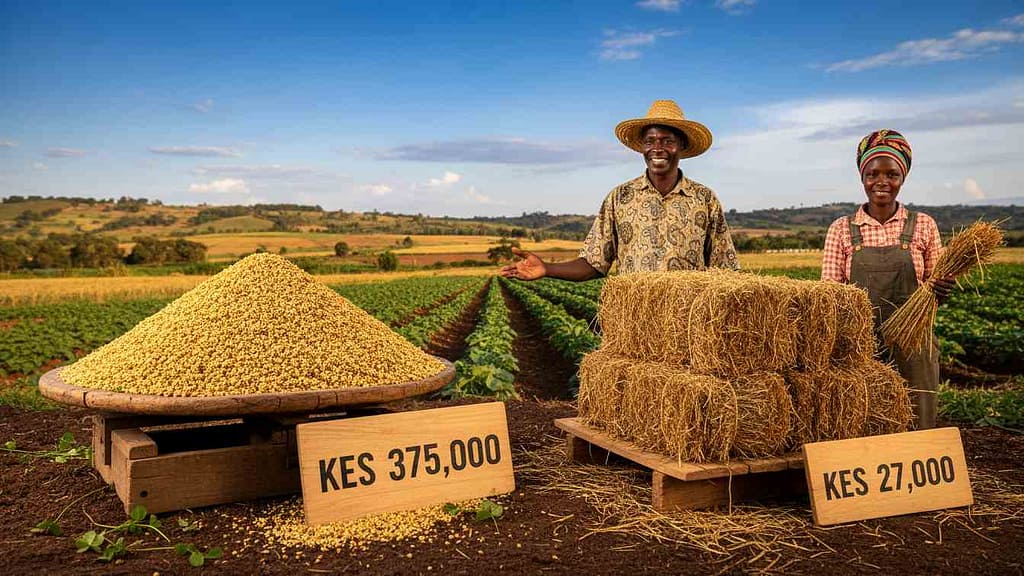
Revenue Stream 1: Certified Seeds
A well-managed acre yields 250kg of clean seed. The farmgate price for quality clover seed is KES 1,500/kg.
Calculation: 250 kg × KES 1,500 = KES 375,000.
Revenue Stream 2: Hay Residue
After threshing, the haulms make excellent hay. Expect about 60 bales.
Calculation: 60 bales × KES 450 = KES 27,000.
Total Net Profit:
KES 402,000 (Revenue) – KES 46,700 (Cost) = KES 355,300.
How do you harvest and process Clover seed efficiently?
Harvest when seed heads turn brown and brittle. Cut the crop and cure it for 3-5 days on canvas sheets to prevent soil contamination. Thresh carefully using sticks or a motorized thresher, then winnow to separate the heavy seeds from the chaff before drying to 12% moisture.
Timing determines your yield. Harvesting too early results in shriveled, non-viable seeds. Harvesting too late causes “shattering,” where pods burst open in the field, spilling your profit onto the ground.
Read also: Dairy Farming in Kenya: Complete Beginner’s Guide, Costs, Profits and Best Breeds
Use the “Brown Head” rule: wait until 90% of the flower heads are brown and the stems are dry. Cut early in the morning when the dew is still present to minimize shattering during the cutting process.
Post-harvest hygiene is paramount. Never dry seeds directly on the soil, as this introduces stones and dirt that are impossible to remove without expensive gravity separators. Always use heavy-duty tarpaulins or concrete drying floors.
How can you add value to Clover farming? (Module E)
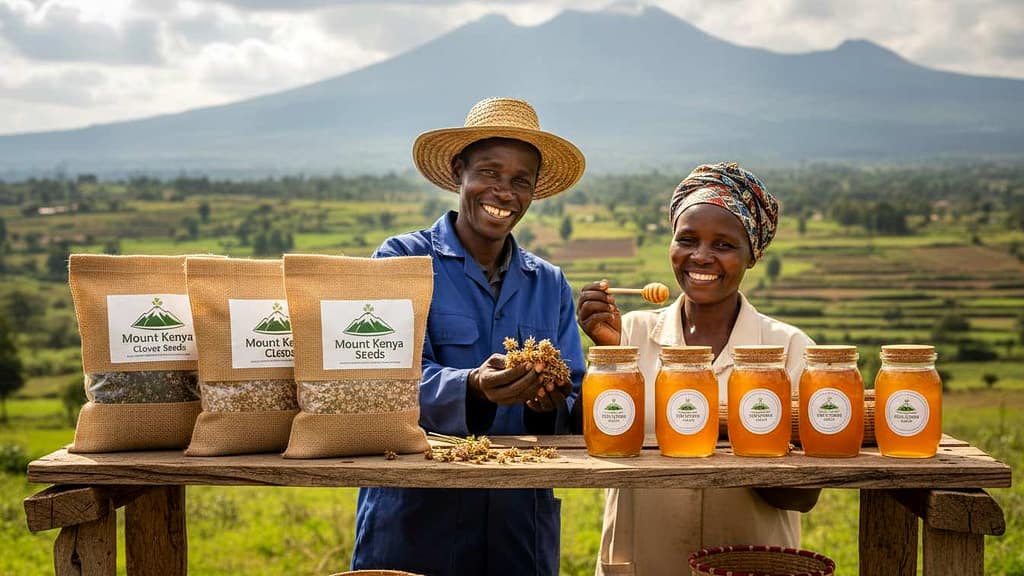
Value addition involves cleaning and packaging seeds into branded 1kg packs for smallholders, pelleting hay residues for rabbit and calf feed, and integrating apiculture to produce premium Clover Honey. These strategies significantly increase margins and expand your market reach.
1. Seed Cleaning and Branding
Raw seed usually contains 20% chaff. By using a simple electric winnower, you can upgrade to 99% purity. Packaging this clean seed into branded 1kg and 2kg packs allows you to sell to small-scale farmers via M-Pesa. A 1kg pack can retail for KES 2,000.
2. Pelleting for Feed
Clover hay is brittle and leafy, leading to high wastage during feeding. Renting a pelletizer allows you to compress this hay into durable pellets. These are premium feeds for calves and rabbits, selling for over KES 3,500 per 50kg bag in peri-urban markets like Kiambu.
3. Clover Honey Production
Clover is a top-tier nectar source. Placing beehives in your clover field serves a dual purpose: it boosts seed yield through pollination and produces “Clover Honey,” a light, distinctively sweet honey. This niche product fetches a premium price in Nairobi supermarkets.
Frequently Asked Questions about Clover Farming
Common questions revolve around yellowing leaves (nitrogen deficiency), bloat risks (needs wilting), and intercropping (possible with maize). Farmers also frequently ask about the lifespan of stands, which ranges from 2-3 years for Red Clover to 4+ years for White Clover.
1. Why are my clover plants turning yellow?
Yellowing often signals a Nitrogen deficiency, which is ironic for a legume. It implies the Rhizobium inoculation failed or the soil is too acidic for the bacteria to function. Dig up a root; if the nodules are white inside instead of pink, the bacteria are inactive.
2.Does feeding fresh clover cause bloat?
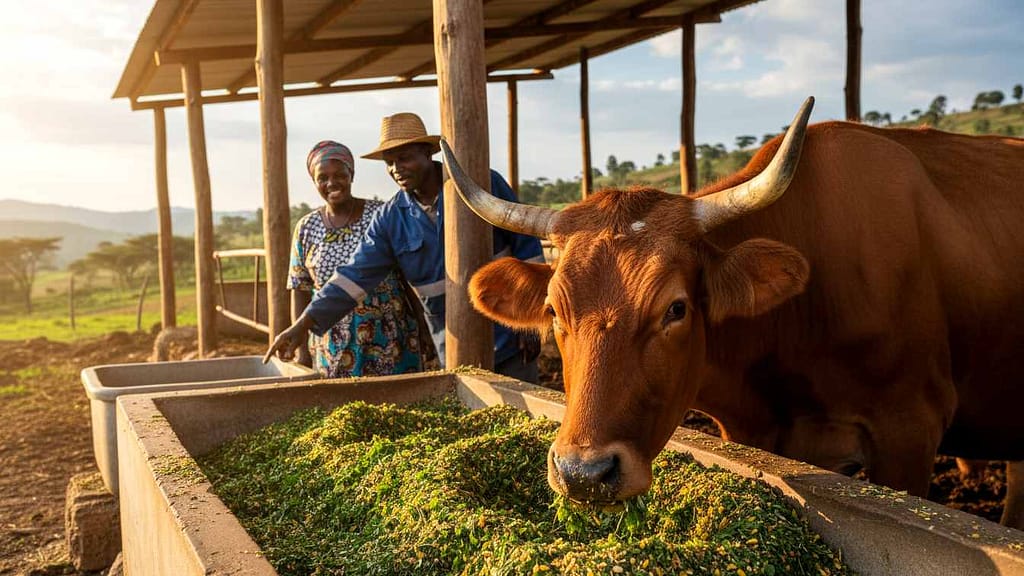
Yes, fresh, lush clover can cause fatal bloat in cattle due to rapid gas fermentation. Always wilt the clover before feeding or mix it with fibrous hay like Boma Rhodes. Never let hungry cows graze pure clover stands early in the morning.
3. Can I intercrop Clover with Maize?
Absolutely. This is known as undersowing. Plant clover when the maize is knee-high. The clover acts as a living mulch, suppressing weeds and fixing nitrogen for the maize, though seed harvesting becomes difficult in this system.
4. Where can I buy certified Clover seeds?
Stick to reputable suppliers. Kenya Seed Company (Kitale) and Simlaw Seeds (Nairobi) are the gold standard. Avoid open-market seeds as they often have poor germination rates and carry weed seeds.
5. How long does a Clover stand last?
Red Clover is a short-term perennial lasting 2-3 years. White Clover is more persistent and can last 4-5 years if not overgrazed. For commercial seed production, replanting every 2 years is recommended to maintain genetic purity.
Conclusion & Key Contacts
Growing Clover seed in 2026 is a smart diversification strategy for Kenyan farmers. It offers high returns per acre, improves soil health, and solves the on-farm feed crisis. While the agronomy is precise, the financial rewards are well worth the effort.
Key Contacts for 2026:
- Kenya Seed Company: 0722 205 144 (Kitale HQ) – For certified seed inquiries.
- Simlaw Seeds: 0722 200 545 (Nairobi) – For small packs and vegetable seeds.
- KALRO: www.kalro.org – For soil testing and technical advice.
- MEA Ltd: For Rhizobium inoculant supplies.