
Table of Contents
Is strawberry farming in Kenya a profitable venture in 2026?
Yes, strawberry farming remains one of the most lucrative agribusinesses in Kenya for 2026. With high demand in Nairobi, Nakuru, and Mombasa for fresh fruit, yoghurt processing, and baking, farmers in suitable zones like Kiambu, Naivasha, and Uasin Gishu are seeing returns of up to KES 100,000 per month from just an eighth of an acre when managed correctly.
Introduction to the Red Gold of Kenyan Agriculture
Strawberry farming in Kenya has evolved from a backyard hobby into a serious commercial enterprise. As we enter the 2026 farming season, the market appetite for strawberries has never been higher. Urbanization and a growing middle class with a taste for healthy smoothies, desserts, and fresh salads have driven demand through the roof.
For a beginner farmer, the strawberry offers a unique advantage. It is a high-value crop that requires a small land size but delivers continuous cash flow. Unlike maize or wheat which take months to harvest once, strawberries can be harvested weekly for up to three years.
However, this is not a plant and forget crop. It requires technical precision, discipline, and a clear understanding of the market. This guide draws on fifteen years of agronomy experience to walk you through every step, ensuring you avoid the common pitfalls that bankrupt new farmers.
Read more: HOW TO EXPORT HASS AVOCADOS FROM KENYA IN 2026: A STEP-BY-STEP GUIDE
Ecological Requirements for Strawberries in Kenya
Which areas in Kenya are best for growing strawberries? Strawberries are temperate crops that have adapted well to tropical high-altitude areas. They thrive in cooler environments. If you are in a very hot coastal region like Mombasa, this crop will struggle without expensive climate-controlled greenhouses.
The ideal temperatures range between 15 degrees Celsius and 30 degrees Celsius. Temperatures above 30 degrees inhibit flower formation and result in small, sour berries.
Altitude plays a significant role. The crop performs exceptionally well in areas ranging from 1,500 to 2,200 meters above sea level. This makes counties like Kiambu, Nyeri, Meru, Uasin Gishu, Trans Nzoia, Nakuru (specifically Bahati and Molo), and parts of Machakos ideal hubs.
Rainfall is less of a concern if you have a reliable irrigation system. In fact, excessive rain can be detrimental as it encourages fungal diseases like botrytis. A constant supply of water is more important than heavy seasonal rain.
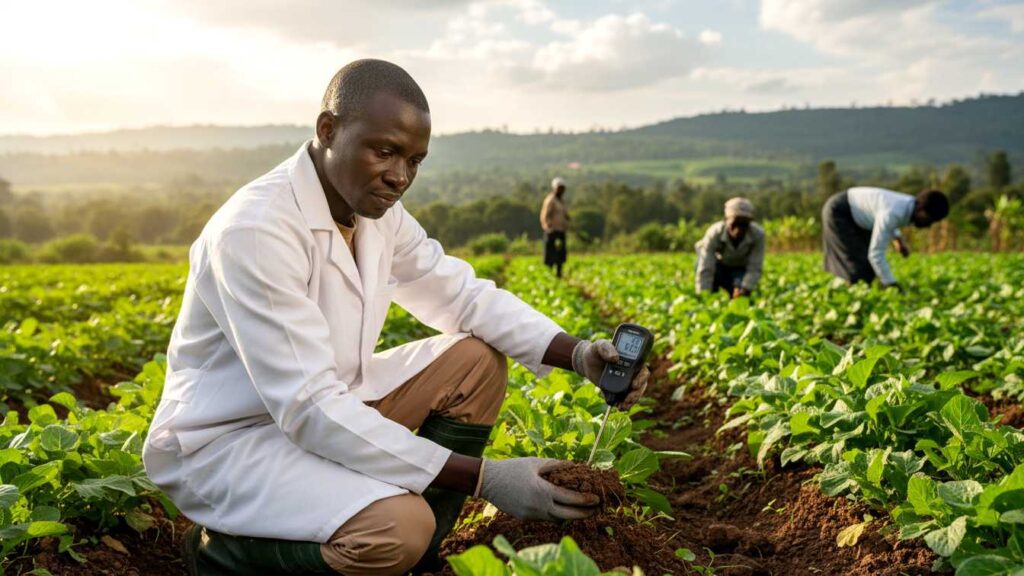
Soil requirements are strict. Strawberries need well-drained, sandy-loam soil rich in organic matter. The pH level is critical. The soil must be slightly acidic, between pH 5.5 and 6.5. If your soil is too alkaline, the plants will suffer from stunted growth and yellowing leaves.
Tip: Always conduct a soil test before buying seedlings. Adjusting pH with agricultural lime or gypsum takes time, so start this process at least two months before planting.
Choosing the Right Strawberry Variety
What are the best strawberry varieties to grow in Kenya? Choosing the right seed or split variety determines 50 percent of your success. In 2026, the market favors large, sweet, and firm berries that can withstand transportation to markets in Nairobi or export channels.
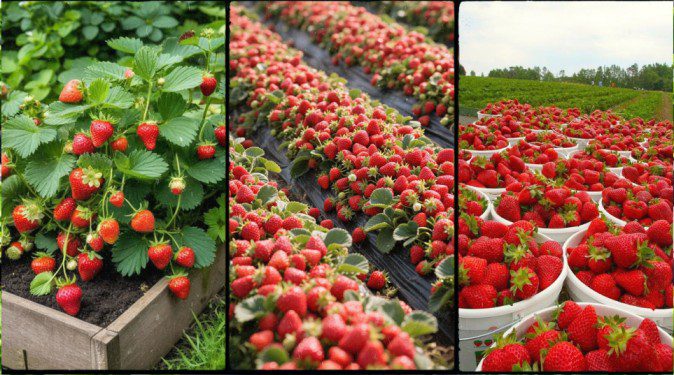
This is the undisputed king of Kenyan strawberries. It is a vigorous grower that produces large, firm fruits with an excellent dessert quality. It is hardy and resists many local pests. For beginners, Chandler is the safest and most profitable bet.
Pajaro produces very attractive, uniform, and symmetrical fruits. It is highly favored by supermarkets and high-end greengrocers. The skin is firm, giving it a longer shelf life than most other varieties.
This is a day-neutral variety, meaning it is less sensitive to the length of daylight and produces fruit continuously throughout the year. It is excellent for off-season production when prices are highest.
Douglas is known for its high yield per plant. However, the fruit is slightly softer than Chandler, making it better suited for the local jam and juice processing market rather than long-distance fresh sales.
Warning: Avoid buying seedlings from roadside sellers with unknown history. Always source splits or tissue culture seedlings from certified nurseries or reputable farmers who can verify the variety.
Land Preparation and Planting
How do you prepare land for planting strawberries? Land preparation must be thorough. Strawberries have a shallow root system, so the top 30cm of soil must be loose, aerated, and rich in nutrients.
Start by ploughing the land deep to break any hard pans. Harrow the soil to a fine tilth. Incorporate well-decomposed manure during the second ploughing. You will need roughly 10 to 15 tons of manure per acre.
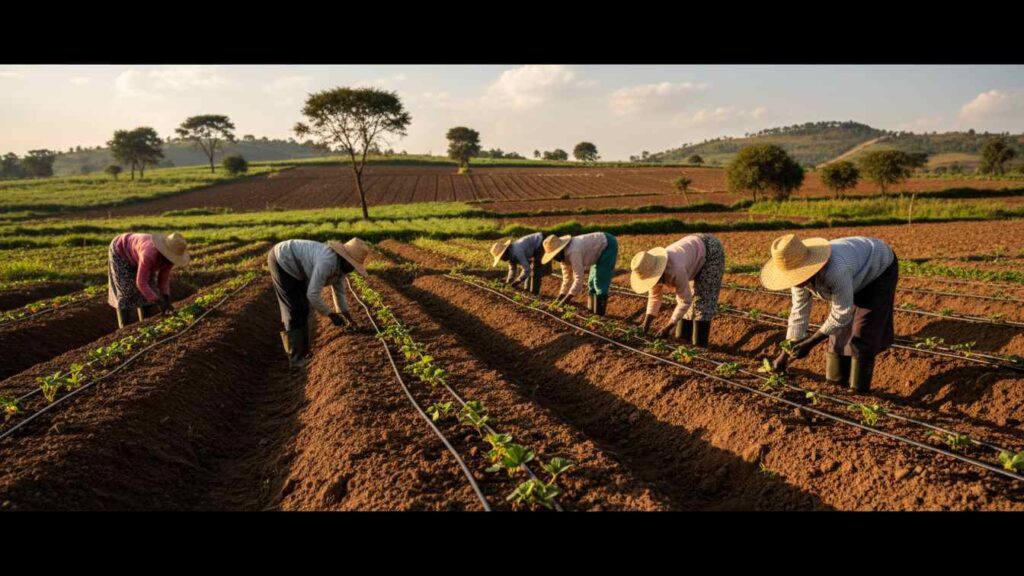
You must plant strawberries on raised beds. This is non-negotiable. Raised beds improve drainage, increase root aeration, and make harvesting easier. Beds should be 1 meter wide and raised 20 to 30cm high. Leave a walking path of 40cm to 50cm between the beds.
Read more: Best Greenhouse Farming Guide in Kenya: Profits, Costs, and Beginner Mistakes to Avoid in 2026
Drip irrigation is the only recommended watering method. Overhead sprinklers wet the leaves and flowers, which leads to fungal diseases and flower abortion. Lay two lines of drip tape on each 1-meter bed.
Spacing depends on the variety, but the standard for Kenya is 30cm by 30cm. On a 1-meter bed with two drip lines, you will plant three rows in a triangular pattern to maximize space.
Holes should be deep enough to accommodate the roots without bending them. Do not bury the crown (the center part where leaves sprout). Burying the crown causes rotting, while planting too shallow dries out the roots.
The Importance of Mulching
You cannot grow commercial strawberries without mulching. Mulching involves covering the soil around the plants with dry grass, wheat straw, or black plastic sheeting.
Mulching serves three critical purposes. First, it keeps the fruit clean; if a berry touches the soil, it will rot or become dirty, making it unsellable. Second, it suppresses weeds. Strawberries are poor competitors against weeds. Third, it retains soil moisture, reducing your water bill.
In Kenya, black plastic mulch is becoming popular because it also warms the soil, encouraging faster growth. However, organic dry grass mulch is cheaper and adds organic matter to the soil as it decomposes.
Crop Management and Pruning
How do you maintain a strawberry farm for maximum yield? Once planted, the work begins. The first two months are vegetative. You want the plant to establish a strong root system.
For the first 4 to 6 weeks, remove any flowers that appear. This sounds counter-intuitive, but if you let the young plant fruit too early, it will stunt. You need a big, leafy plant to support a heavy harvest later.
Strawberries send out runners or stolons to create new baby plants. Unless you are propagating seedlings for sale, cut these runners off immediately. They suck energy away from fruit production.
Weeding must be done by hand. Do not use herbicides on strawberries as they are very sensitive to chemicals. If you have mulched well, weeds should be minimal.
Strawberries are thirsty plants. In the dry season, water them daily in the late afternoon or early morning. The soil should remain moist but not waterlogged. Inconsistent watering leads to cracked fruit.
Pest and Disease Control
What are the common strawberry pests in Kenya?
Red Spider Mites
These are the biggest enemy. They are tiny red pests that suck sap from the leaves, causing them to turn yellow and silvery. They thrive in dusty, hot conditions. Control them by keeping the field moist as mites hate humidity, and use specific miticides like Dynamec or organic neem oil.
Thrips
These insects attack the flowers, causing the fruit to be deformed and brown. Use blue sticky traps to monitor populations and spray Spinosad-based insecticides in the evening when bees are not active.
Botrytis (Grey Mold)
This is a fungal disease that covers the berries in a grey, fuzzy mold. It occurs during wet, cold weather. Improve air circulation by proper spacing and remove rotting fruit immediately. Use fungicides like Ridomil during the rainy season, observing Pre-Harvest Intervals strictly.
Slugs and Snails
These eat holes in the ripe fruit. Control them using physical traps or scatter snail bait pellets around the perimeter of the field.
Warning: Strawberries are eaten raw and often unpeeled. You must be extremely careful with chemical use. Adhere to PHI (Pre-Harvest Interval) dates. If a chemical says 7 days PHI, do not harvest until 7 days after spraying.
Harvesting and Post-Harvest Handling
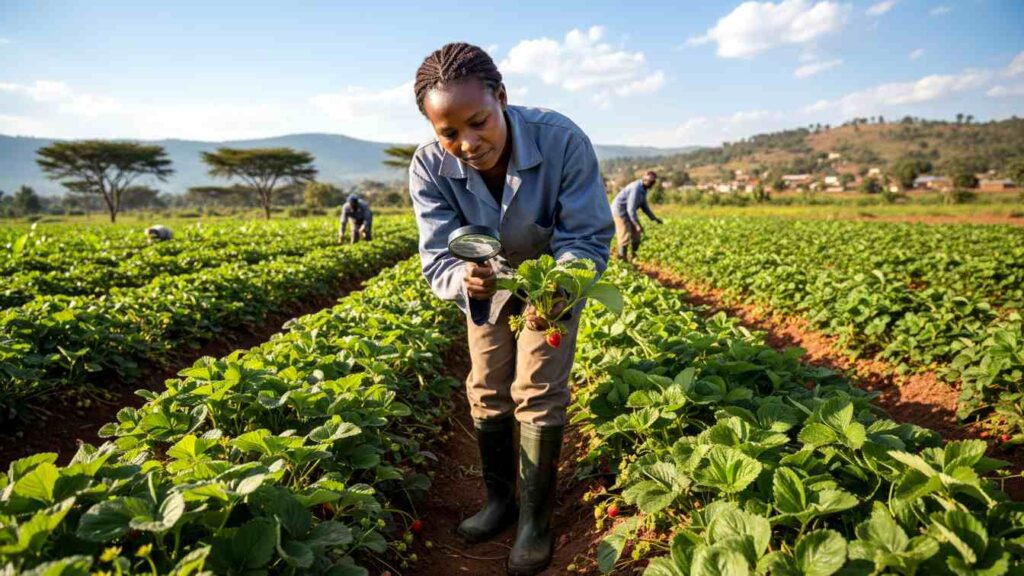
Harvesting is labor-intensive. In peak season, you may need to harvest every two days.
The best time to harvest is early morning, as soon as the dew has dried but before the sun gets hot. Heat softens the berries.
Pick the fruit with the green calyx (the leafy cap) attached. Pinch the stem about 1cm above the fruit. Do not pull the berry itself.
Grading happens in the field. Grade A fruits are large, uniform, and red all over; these are sold to supermarkets and high-end hotels. Grade B fruits are smaller but good quality and are sold in local markets. Grade C fruits are overripe or slightly misshapen and are sold for juice or jam making.
Place the fruits directly into the punnets (plastic containers) you will sell them in. Excessive handling bruises the fruit. A standard punnet in Kenya weighs 250 grams.
Market Analysis and Sales Channels
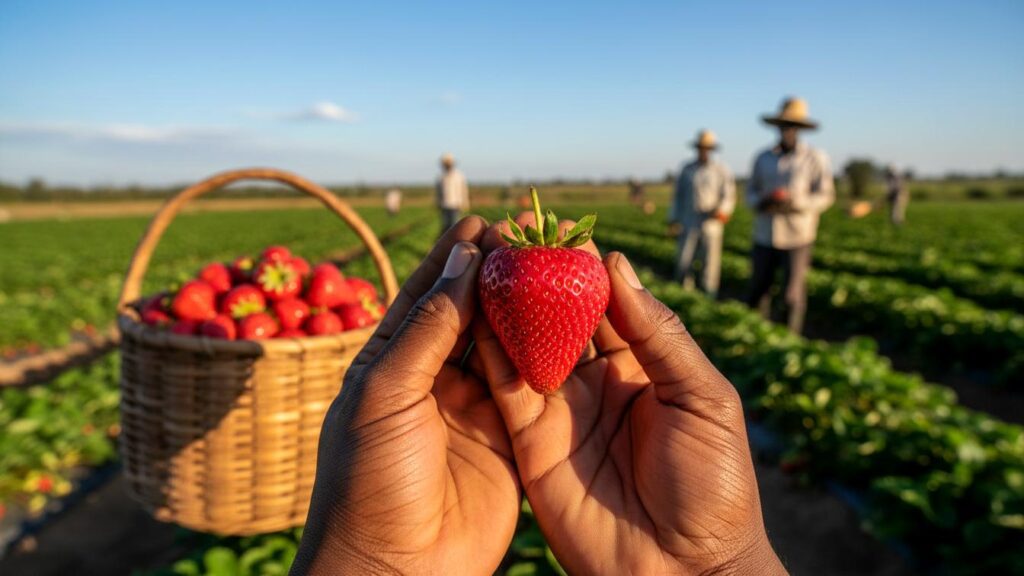
Where can I sell strawberries in Kenya? The market is vast if you are proactive. Do not wait for brokers to come to your farm; they will offer rock-bottom prices.
Supermarkets like Naivas, Carrefour, and Quickmart require consistency and high quality. You will need a supply contract. They pay well but often on credit terms ranging from 30 to 60 days.
Cake houses and bakeries are a hidden gem. Bakeries use strawberries daily for cake decoration. Visit local bakeries in your nearest town and offer a direct supply.
If your farm is near a major highway like the Nairobi-Nakuru highway, direct sales to motorists offer the highest profit margin as you cut out all middlemen.
If you have a surplus or Grade C fruit, make strawberry jam or yoghurt topping. A jar of homemade jam sells for KES 300 to 500 and has a long shelf life.
Financial Breakdown and Profitability in 2026
How much does it cost to start strawberry farming in Kenya? Let us analyze the costs for an eighth of an acre, which is a common starting point for beginners.
Land Preparation including Labour and Manure: KES 10,000
Drip Irrigation Kit for 1/8th acre: KES 15,000
Seedlings/Splits (3,000 plants @ KES 15): KES 45,000
Mulching Material (Black plastic or organic): KES 5,000
Fertilizers and Chemicals (Initial stock): KES 10,000
Miscellaneous (Transport/Tools): KES 5,000
Total Initial Capital: Approximately KES 90,000.
A well-maintained single plant can produce 500 grams to 1kg of fruit per year. Let us be conservative and assume 500 grams (0.5kg) per plant per year.
Total Plants: 3,000
Total Yield: 1,500 kg per year.
The price fluctuates between KES 200 and KES 400 per kg depending on the season. Let us use a conservative average of KES 300 per kg.
Gross Revenue: 1,500 kg x KES 300 = KES 450,000 per year.
Net Profit Calculation:
Gross Revenue (450,000) minus Expenses (90,000 setup plus 60,000 ongoing maintenance) equals KES 300,000.
This translates to roughly KES 25,000 per month net profit from just an eighth of an acre. If you scale up to one acre, the economies of scale improve, and profits can exceed KES 150,000 per month.
Tip: The first year involves high capital setup. The second and third years have much lower costs since the plants and drip lines are already in place, significantly increasing your profit margins.
Future Trends for 2026 and Beyond
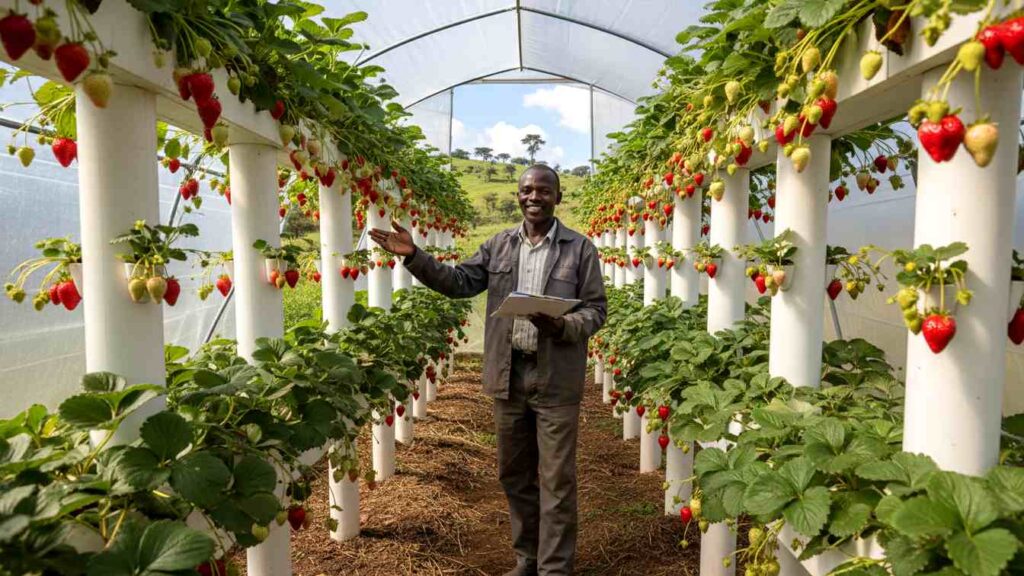
Farming is changing. In 2026, we are seeing a shift toward Vertical Farming for strawberries. This involves stacking strawberries in hydroponic towers or PVC pipes.
Vertical farming allows you to plant 10,000 plants on an eighth of an acre instead of 3,000. While the setup cost is higher because it requires a greenhouse and hydroponic system, the returns are triple that of open-field farming. This is the future for urban farmers in Nairobi and Kiambu where land is expensive.
Recap Key Takeaways for Success
Location is key so ensure you are in a cool area with access to water.
Variety matters so start with Chandler for reliability.
Do not skip the drip because irrigation is the lifeline of the crop.
Mulch is mandatory as it keeps fruit clean and marketable.
Market first and identify where you will sell before you plant.
Frequently Asked Questions
How long does a strawberry plant last?
A strawberry plant can produce fruit for 3 to 4 years. However, commercial farmers usually replace plants every 2 years because yields tend to drop significantly after the second year.
Can strawberries grow in hot areas like Mombasa or Kisumu?
It is very difficult to grow them in open fields in these areas due to the heat. However, it is possible if you use a greenhouse with temperature control and misting systems, but the cost of production will be higher.
How many strawberry plants fit in an acre?
In an open field using proper spacing (30cm x 30cm) and paths, you can fit between 25,000 and 30,000 plants per acre.
Where can I buy certified strawberry seedlings in Kenya?
You should source seedlings from KALRO (Kenya Agricultural and Livestock Research Organization) or certified horticultural nurseries in Kiambu and Naivasha. Avoid roadside sellers to prevent bringing diseases to your farm.
How do I sweeten my strawberries naturally?
Strawberries need Potassium to become sweet. Ensure you use a fertilizer rich in Potassium (like NPK 17:17:17 or Murate of Potash) during the flowering and fruiting stage. Also, ensure they get enough sunlight.
Strawberry farming in Kenya will keep rewarding serious farmers in 2026 and beyond, but only those who treat it as a business, not a casual side project. By choosing the right cool location, starting with certified Chandler or other proven varieties, investing in drip irrigation and proper mulching, and securing reliable buyers before planting, you turn a small piece of land into a steady monthly income stream. With rising demand from supermarkets, bakeries and processors, plus new vertical and hydroponic systems boosting yields, now is the best time to refine your skills, start small, then scale your strawberry enterprise confidently.