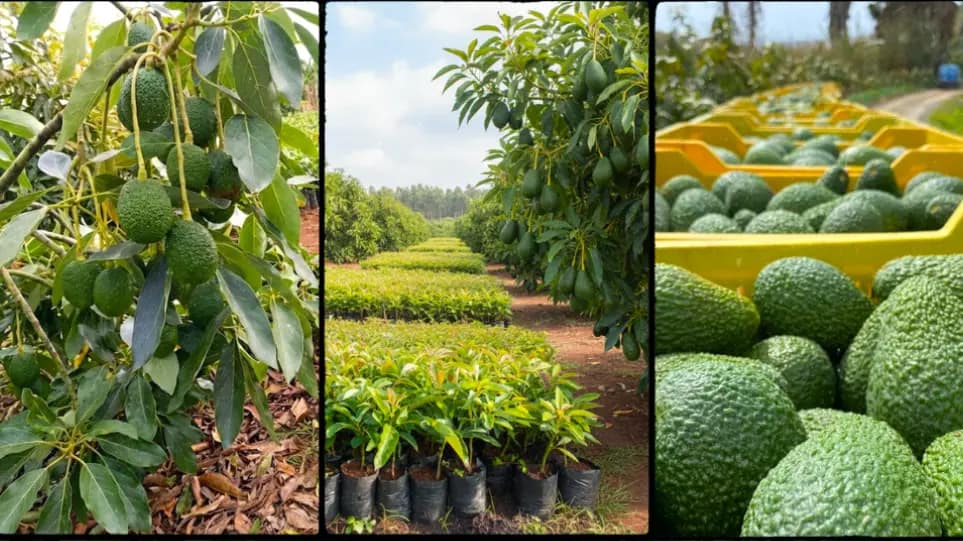

Hass avocado farming remains the undisputed “Green Gold” of Kenyan agribusiness. but the landscape has shifted significantly as we enter 2026. Profitability now hinges entirely on seedling genetic purity. advanced canopy management, and strict adherence to new export-quality standards for the Chinese and European markets. This guide provides a verified roadmap for sourcing KEPHIS-certified seedlings, understanding current spacing protocols, and navigating the financial realities of establishing a commercial orchard.
Table of Contents
The era of “plant and forget” is over. Modern avocado farming in Kenya requires a data-driven approach, starting with the selection of certified plant material. Farmers who compromise on seedling quality in 2026 will face rejection at the export gate in 2029.
What Are the Best Avocado Varieties for Kenyan Farmers in 2026?
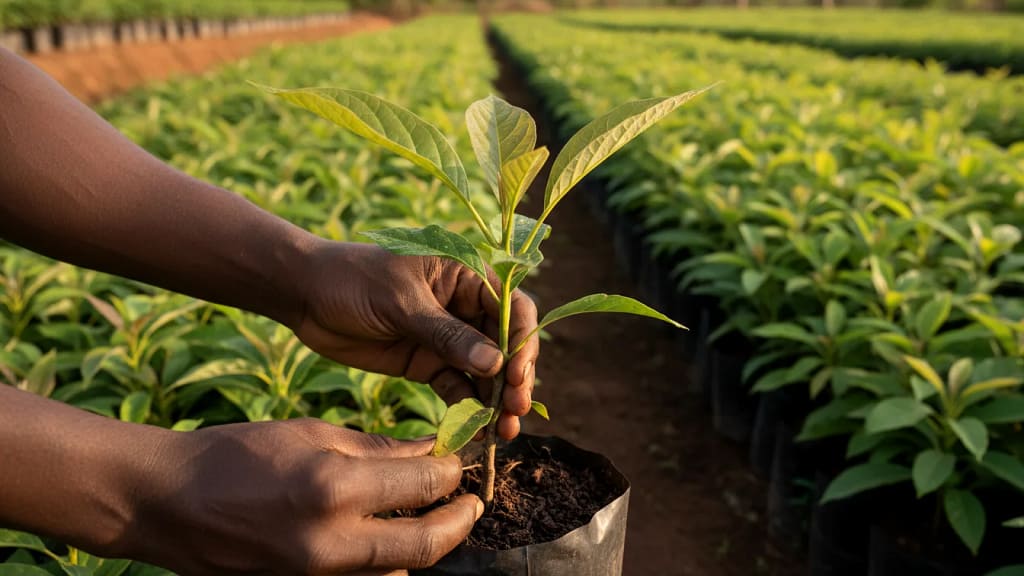
In 2026, Hass remains the primary export variety due to its tough skin, long shelf life, and high oil content preferred by global markets. However, a viable commercial orchard must include Fuerte trees (approximately 10-15%) to act as pollinators. Emerging varieties like Pinkerton and Jumbo are gaining traction for the local market but do not yet match the export volume of Hass.
Read Also: Exporting Hass Avocados from Kenya: A Step-by-Step 2026 Guide
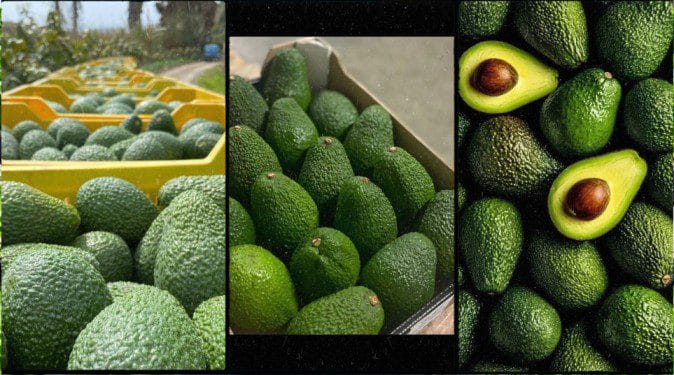
Choosing the right variety is the single most critical decision a farmer makes before breaking ground. In Kenya, the market is sharply divided between export-grade fruit and varieties consumed locally. The Hass avocado accounts for over 75% of national exports because its skin turns pebbly black when ripe, effectively masking minor handling bruises during shipping.

However, an orchard cannot thrive on Hass trees alone. You must integrate “Type B” pollinators to ensure maximum fruit set. The Fuerte variety is the standard pollinator in regions like Murang’a and Kiambu. It flowers at a complementary time to the Hass (Type A), significantly boosting the yield per tree.
For rootstocks, knowledgeable farmers are moving away from general local seeds collected from markets. The industry now prefers Puebla or Zutano rootstocks for their vigor. These indigenous Mexican varieties offer superior resistance to Phytophthora root rot, a major killer of avocado trees in heavy clay soils.
The Rise of Pinkerton and Reed
While Hass is king, the Pinkerton variety is carving a niche in high-altitude areas. It produces an elongated, pear-shaped fruit that is popular in the domestic hospitality sector. Similarly, the Reed variety serves as a late-season crop, fetching high prices in local markets when Hass is out of season.
Where to Buy Hass Avocado Seedlings in Kenya 2026
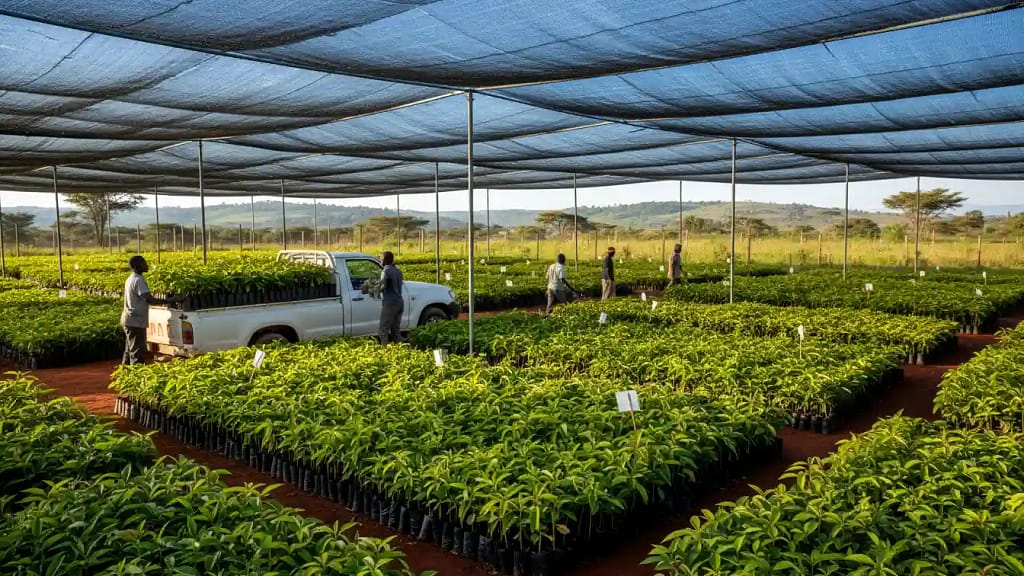
Certified grafted seedlings in 2026 typically cost between KES 250 and KES 450 depending on seedling age and order volume. Authentic sourcing is limited to KEPHIS-registered nurseries like KALRO, Kakuzi, and verified private propagators. Purchasing undocumented roadside seedlings is the leading cause of orchard failure due to genetic dilution and viral diseases.
1. Government and Research Institutions
The safest source for “clean” planting material remains government-backed research centers. They maintain the original mother blocks, ensuring 100% genetic purity.
KALRO (Kenya Agricultural and Livestock Research Organization): Their centers in Kandara and Thika are the primary sources for foundation stock.
KEPHIS (Kenya Plant Health Inspectorate Service): While they are a regulator, their headquarters in Karen can provide the current list of certified nurseries in your specific county.
2. Trusted Commercial Aggregators
Private sector players often offer better stock availability and logistical support for large-scale orders.
Kakuzi PLC: Located in Murang’a, they are the gold standard for export-quality seedlings and often sell to contracted out-growers.
Oxfarm Organic: A leading private nursery that provides agronomic support alongside seedling sales, helping farmers with initial establishment.
Safaricom DigiFarm: This digital platform connects farmers to vetted input suppliers, reducing the risk of fraud significantly.
3. Buyer’s Caution: The “Roadside” Risk
Never buy seedlings from unmarked roadside vendors or unverified sellers on social media without seeing a valid KEPHIS nursery certificate. Fake seedlings often fail to fruit after 3 years or produce “blind” varieties that the export market rejects.
Verification Checklist:
1. Check the graft union; it should be fully healed and V-shaped, not tied with cheap masking tape.
2. Demand a KEPHIS nursery registration number and verify it via SMS.
3. Inspect leaves for yellowing, which is a sign of root rot or severe nutrient deficiency.
What Climatic Conditions and Soil Types Favor Hass Avocados?
Hass avocados thrive in altitudes between 1,000m and 2,000m above sea level with temperatures ranging from 20°C to 30°C. They require well-drained, deep, aerated soil with a pH of 5.5 to 6.5. Areas with waterlogging or saline soils are unsuitable as avocado roots are highly sensitive to suffocation and salt burn.
The “Green Gold” does not grow everywhere. Hass avocados require specific ecological zones to produce export-grade fruit with high oil content. Regions with extremely high temperatures, like the coastal belt, are generally unsuitable for Hass, though they may support tropical varieties.
Read Also: Hass Avocado Price in Kenya 2026: Seedlings & Market Guide
Rainfall Requirements:
The trees need well-distributed rainfall of 1,000mm to 1,200mm annually. In zones like Uasin Gishu or parts of Eastern Kenya where rain is seasonal, supplemental irrigation is mandatory. Two months of drought during the flowering stage can cause massive flower abortion.
Soil Depth and Drainage:
Avocado roots are shallow and brittle. They require at least 1 meter of loose topsoil to anchor effectively. Farmers in areas with “Black Cotton” soil must avoid planting directly, as this soil expands and cracks, damaging roots and causing waterlogging.
What Is the Recommended Spacing and Planting Protocol?
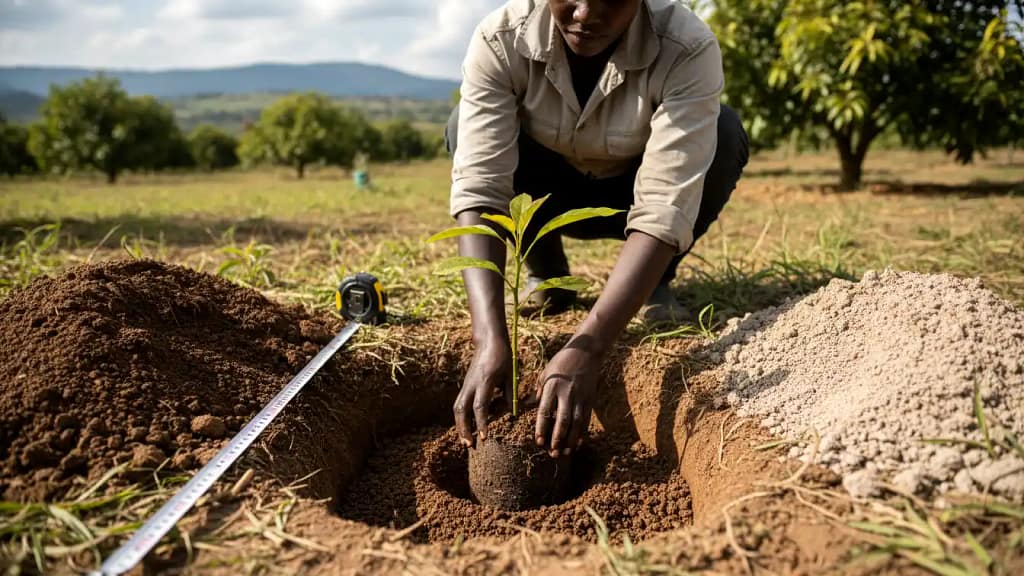
The standard commercial spacing for Hass avocado in Kenya is 5 meters by 5 meters, allowing for approximately 150 to 160 trees per acre. High-density planting (3m x 3m) is possible but requires advanced canopy management and frequent pruning. Planting holes should be dug 2ft x 2ft x 2ft, separating topsoil from subsoil to ensure loose aeration for root expansion.
Proper spacing dictates your yield per acre and ease of tractor or machinery access. The traditional 7m x 7m spacing is outdated for modern commercial farming as it wastes valuable land. The 2026 standard of 5m x 5m maximizes land use while allowing enough sunlight penetration to prevent fungal diseases like Anthracnose.
The Planting Mixture:
Mix the excavated topsoil with 2 debes (approx. 40kg) of well-decomposed manure and 200g of DAP fertilizer. If your soil is acidic (common in Kisii and Central Kenya), add agricultural lime to neutralize the pH. Fill the hole and water it for two days before planting the seedling to settle the soil and prevent air pockets.
Planting Depth:
Plant the seedling so that the soil level in the nursery bag matches the ground level. Ensure the graft union is at least 6 inches above the soil surface. Burying the graft union leads to infection and can cause the scion to root, bypassing the disease-resistant rootstock.
How Do You Manage Pests and Diseases in a Commercial Orchard?
Major threats include Phytophthora root rot, Anthracnose, and pests like the False Codling Moth (FCM) and Thrips. Management requires an Integrated Pest Management (IPM) approach combining biological traps, copper-based fungicides, and strict field sanitation. FCM is a quarantine pest that can lead to total export bans if detected in shipments.
Read Also: How to Start Bulb Onion Farming in Kenya: Complete 2026 Guide, Costs & Profit Per Acre
Pest control is the biggest barrier to the export market. The False Codling Moth is particularly dangerous because its larvae burrow inside the fruit, making them invisible during external inspections. Farmers must use pheromone traps to monitor moth populations and apply targeted sprays only when thresholds are breached.
Disease Control:
Anthracnose appears as black sunken spots on the fruit, rendering it unsellable. Regular sprays of copper fungicides during the wet season create a protective barrier. Root Rot is prevented by ensuring drainage and treating infected trees with Phosphonate injections.
Thrips Management:
Thrips attack the fruit when it is small, causing corky, scabby scars on the skin as it expands. This damage is purely cosmetic but disqualifies the fruit from Grade 1 export status. manage thrips by spraying spinosad-based products early in the flowering stage.
How Do Different Regions Compare for Avocado Farming?
Murang’a remains the market leader with established logistics, but land is expensive and fragmented. Kisii offers lower production costs due to natural fertility but struggles with road infrastructure. Uasin Gishu is the emerging frontier, offering vast tracts of land for mechanized, large-scale avocado farming ideal for export aggregation.
| Region | Pros | Cons | 2026 Suitability |
|---|---|---|---|
| Murang’a / Kiambu | Proximity to Nairobi (JKIA); heavy concentration of exporters; ideal altitude. | High land prices; risk of theft due to population density; smaller land sizes. | Best for: Intensive, high-tech farming on small plots (1-5 acres). |
| Kisii / Nyamira | High rainfall (less irrigation cost); naturally fertile soils. | High humidity increases fungal disease risk; poor feeder roads delay transport. | Best for: Low-input organic farming, provided logistics are secured. |
| Rift Valley (Uasin Gishu/Trans Nzoia) | Large flat lands suitable for mechanization; less disease pressure. | Requires heavy investment in irrigation (drier seasons); frost risk in some belts. | Best for: Large-scale commercial investors (10+ acres). |
| Nakuru / Naivasha | Good logistics; volcanic soils; proximity to processing hubs. | Water scarcity in some zones; requires borehole investment. | Best for: Mid-sized commercial farms with irrigation capacity. |
What Does the 12-Month Farming Calendar Look Like?
The Kenyan avocado calendar revolves around two rainy seasons. April is the peak planting month. July to September is the main harvesting window for export. December to February requires heavy irrigation and flower induction management. Pruning must be done immediately after harvesting to prepare the canopy for the next season.
First Quarter (Jan – Mar): Irrigation & Flowering
This is typically the dry season in most avocado zones. Mature trees are flowering or setting small fruit (pinhead stage). Water stress at this stage causes flower abortion, so irrigation is non-negotiable. Mulching should be applied heavily to retain soil moisture and suppress weeds.
Read Also: How to Grow Dwarf Papaya Trees in Containers for Massive Harvests in Kenya 2026
Second Quarter (Apr – Jun): Planting & Fruit Development
The long rains arrive, making this the best time to transplant new seedlings. For mature trees, the fruit is expanding rapidly. Apply Calcium and Boron foliar feeds to strengthen fruit structure and cell walls. Nitrogen application should be controlled to avoid excessive vegetative growth at the expense of fruit development.
Third Quarter (Jul – Sep): The Harvest
This is the main export window for Hass avocados. Fruits are harvested when the dry matter content reaches 23%. Handle fruits with extreme care; use clippers to cut the stalk, never pull fruit by hand. Immediately after harvest, prune the trees to open the canopy and remove dead wood.
Fourth Quarter (Oct – Dec): Vegetative Growth
The short rains stimulate new shoot growth. Apply well-composted manure now to prepare the tree for the next flowering cycle. Monitor for false codling moth as the weather warms up. This is also a good time to repair irrigation lines and prepare for the dry January.
Is Hass Avocado Farming Profitable? (Financial Deep Dive)
Yes, but it is a long-term investment. Initial establishment costs are roughly KES 150,000 per acre. Trees become commercially viable in Year 3. By Year 5, a well-managed acre can generate KES 600,000 to KES 1,000,000 annually, assuming export quality compliance. The break-even point is typically mid-Year 4.
Many “agri-influencers” exaggerate returns, promising millions in the first year. The reality is that avocado farming requires patience and capital. Below is a realistic breakdown for 1 acre (150 trees) in 2026, assuming you own the land.
| Item / Activity | Year 1 Cost (KES) | Year 3 Cost (KES) | Notes |
|---|---|---|---|
| Land Prep & Hole Digging | 25,000 | 5,000 (Maintenance) | Labor for standard 2x2ft holes. |
| Certified Seedlings | 52,500 | 3,500 (Gapping) | @ KES 350 per seedling. |
| Manure & Fertilizer | 30,000 | 45,000 | Input needs increase as trees grow. |
| Labor & Management | 40,000 | 60,000 | Weeding, spraying, pruning. |
| Pest Control | 15,000 | 30,000 | Higher canopy requires more volume. |
| TOTAL COST | 162,500 | 143,500 | Does not include irrigation setup. |
Revenue Projections (Year 5 Peak):
At peak maturity, one tree produces approx. 500-800 fruits (roughly 100kg-150kg).
Conservative Estimate: 150 trees x 80kg x KES 60 (Export Farm Gate Price) = KES 720,000 per acre.
Note: Rejects (Grade 2) sold locally fetch significantly less (KES 10-20/kg), which covers operational costs.
How Does the Supply Chain and Value Addition Work?
The supply chain moves from Farmer > Aggregator/Co-op > Exporter > International Market. In 2026, strict traceability means exporters contract farmers directly. Value addition involves processing “Grade 2” or rejected avocados into crude avocado oil for the cosmetic and culinary industries, a rapidly growing secondary market.
The days of selling to random brokers are fading fast. To access the lucrative Chinese and European markets, your farm must often be audited for “Good Agricultural Practices” (GAP). Major exporters like Kakuzi, Vegpro, and Keitt now register farmers and issue codes to trace fruit back to the specific shamba.
The Role of Cooperatives:
Small-scale farmers in counties like Murang’a have formed powerful cooperatives. These groups aggregate volumes to negotiate better prices directly with exporters, bypassing middlemen. Joining a cooperative also provides access to subsidized inputs and agronomic training.
Read Also: Strawberry Farming in Kenya: Step‑by‑Step Guide, Costs, Best Seed Varieties and Profits in 2026
Value Addition: The Oil Opportunity
Roughly 20-30% of any harvest will be rejected for export due to size issues or skin blemishes. Instead of letting these rot, farmers are increasingly taking them to community oil presses. It takes roughly 4-5kg of fruit to produce 250ml of oil, which retails for over KES 800 in high-end Nairobi stores.
2026 Outlook and Conclusion
The “Green Gold” rush has matured into a serious industry. 2026 is no longer about just planting trees; it is about professional canopy management and compliance. With the opening of the Chinese market to fresh Kenyan avocados, demand is at an all-time high, but so are the phytosanitary standards.
Actionable Advice: Start small but start right. Do not compromise on seedling quality or soil preparation. A KES 100 saving on a roadside seedling today will cost you millions in lost revenue five years from now. Join a cooperative to gain bargaining power and ensure you have a market before you even plant.
Farmers Also Ask: Troubleshooting FAQ
Why are my avocado leaves turning yellow?
Yellowing leaves usually indicate two things: root rot (Phytophthora) caused by waterlogging, or nitrogen deficiency. If the soil is wet, improve drainage immediately and apply a copper-based fungicide. If dry, apply CAN fertilizer or foliar feeds rich in Zinc and Iron.
How long does it take for a Hass avocado tree to fruit?
A grafted Hass avocado tree typically begins to fruit in 2.5 to 3 years. However, professional agronomists recommend removing the first flowers (deflowering) to allow the tree to build structural strength. This practice pushes the first commercial harvest to Year 4 but ensures a longer lifespan.
Do I need a male and female tree for avocados?
Avocados have complex flowering patterns (Type A and Type B), not strict male/female trees. A single Hass tree can self-pollinate, but the yield will be low. Planting Fuerte (Type B) alongside Hass (Type A) ensures cross-pollination and maximizes fruit set.
How much water does an avocado tree need per day?
A mature tree needs about 50 to 80 liters of water per week during the dry season. Drip irrigation is the most efficient method to deliver this. Over-watering is more dangerous than under-watering as avocados are highly susceptible to root rot.
Can I intercrop beans or maize with avocados?
You can intercrop short-term crops like beans, cabbages, or potatoes during the first 2-3 years while the canopy is open. Avoid maize as it competes heavily for nitrogen and grows tall enough to shade young seedlings. Never dig deep near the avocado drip line when weeding intercrops.
What is the current price of a 90kg bag of avocados?
Avocados are rarely sold in 90kg bags for commercial trade; they are sold by the crate (approx 20-22kg) or per kg. However, in local markets, a “bag” equivalent of Grade 2 fruit might fetch KES 2,500 – 4,000 depending on the season. Export fruit is strictly priced per kg (approx KES 50-90/kg).
How do I control fruit flies in my orchard?
Fruit flies are a quarantine pest that can get your export license banned. Use pheromone traps (like Bactro-traps) to monitor and catch males. Ensure field sanitation by burying all fallen or rotting fruit at least 2 feet deep to kill larvae.
Is organic avocado farming viable in Kenya?
Yes, and it fetches a premium price (approx. 20-30% higher) in Europe. However, it requires strict certification fees and usage of expensive organic inputs. It is best suited for Kisii and Nyamira where chemical usage has historically been lower.
What causes avocado flowers to drop off without forming fruit?
Flower abortion is caused by water stress, zinc deficiency, or extreme temperature fluctuations. Ensure consistent irrigation during flowering and apply a Boron/Zinc foliar spray to help the fruit “set”. Avoiding water stress during the flowering window is critical.
How do I get an export license for avocados?
You must register with the Horticultural Crops Directorate (HCD). You will need a farm audit, a KEPHIS phytosanitary certificate for every shipment, and a contract with a buyer. Most small-scale farmers find it easier to sell to licensed export companies rather than exporting directly.