
Table of Contents
In 2026, SunCulture solar pumps start at a KES 3,999 deposit for the ClimateSmart Direct and KES 6,999 for the RainMaker2 battery system. Monthly Pay-As-You-Grow (PAYG) installments range from KES 2,999 to KES 5,149 depending on the package. New carbon credit subsidies for 2026 automatically reduce total ownership costs by approximately 17-25% for registered farmers.
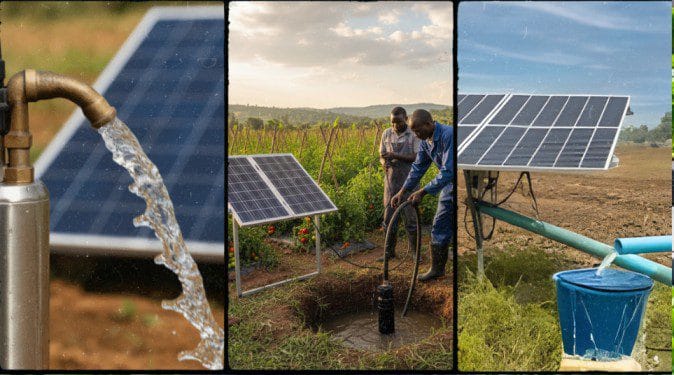
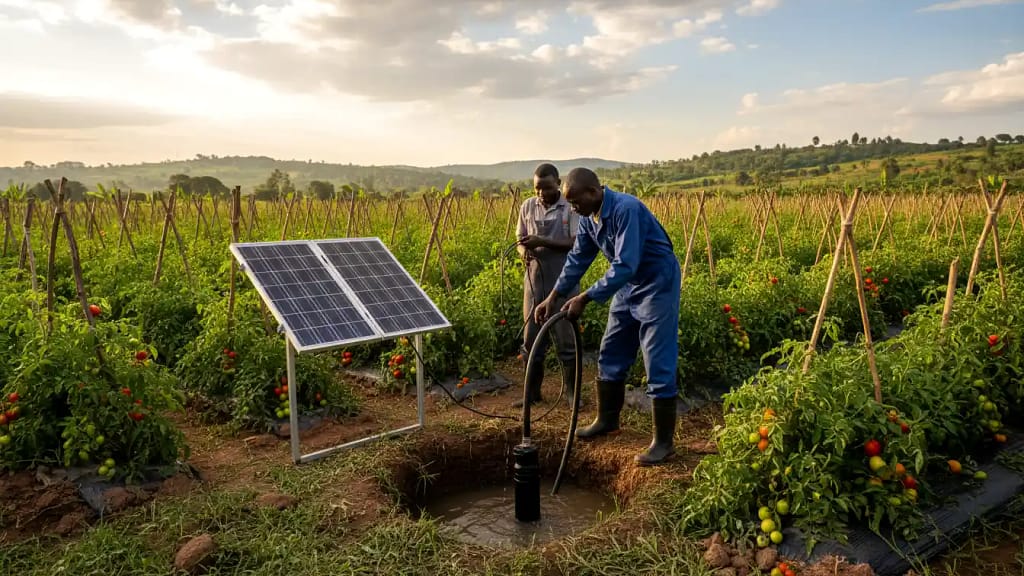
SunCulture is turning the sun into a reliable water source and income boost for thousands of Kenyan farmers. Instead of struggling with expensive diesel pumps or waiting for unreliable rains, smallholders can now use solar powered water pumps on pay as you grow plans to irrigate more land, grow extra seasons and cut fuel costs.
What are the confirmed SunCulture pump prices and payment plans for 2026?
For 2026, the RainMaker2 + ClimateSmart Battery requires a deposit of KES 6,999 with monthly installments of KES 5,149 for 30 months. The larger RainMaker Kubwa starts at a deposit of KES 4,999 with KES 3,809 monthly payments. Cash prices range from KES 54,999 to over KES 160,000 depending on the battery and panel bundle selected.
Investing in solar irrigation is no longer a luxury for Kenyan farmers; it is a survival strategy against erratic rainfall. The 2026 pricing model from SunCulture reflects a significant shift toward “Pay-As-You-Grow” (PAYG) accessibility. This model allows smallholder farmers to bypass the massive upfront cash barrier that previously hindered adoption.
By leveraging carbon credits, SunCulture has effectively subsidized the total cost for the end user. This makes the RainMaker2 series cheaper in real terms than diesel alternatives over a 2-year period. Farmers are essentially trading indefinite fuel costs for finite asset payments.
When you walk into a SunCulture agent shop or contact them via M-Pesa, you will encounter three main product tiers. Understanding these tiers is critical because buying a pump that is too small for your borehole depth will destroy your ROI. The “SunCulture 2000” terminology often used by farmers refers to the legacy capacity of the RainMaker series, which now delivers between 1,200 to 3,000 liters per hour.
Below is the 2026 “Source of Truth” pricing table verified for the Kenyan market:
| Model Variant | Ideal Farm Size | Deposit (KES) | Monthly (PAYG) | Cash Price (Est.) |
|---|---|---|---|---|
| ClimateSmart Direct (No Battery) | 0.5 – 1 Acre | 3,999 | 2,999 (24 mos) | 54,999 |
| RainMaker2 + Battery 2 | 1 – 1.5 Acres | 6,999 | 5,149 (30 mos) | 104,999+ |
| RainMaker Kubwa (High Volume) | 2+ Acres | 4,999 | 3,809 (24 mos) | 64,999+ |
Note: The “Deposit” figures often fluctuate by +/- KES 500 depending on active marketing campaigns or regional agent promos. Always confirm the final cent with the provider before sending money. Be wary of third-party brokers asking for deposits outside the official Paybill numbers.
What are the technical specifications of the 2026 RainMaker series?
The RainMaker2 supports a maximum head of 70 meters and a flow rate of up to 2,800 liters/hour at shallow depths. The RainMaker Kubwa is designed for volume, delivering up to 5,000 liters/hour but with a lower maximum head of 50 meters. Both systems utilize 310W-330W polycrystalline solar panels and IP68 rated submersible pumps.
Read Also: Top 7 Best AI Apps for Kenyan Farmers in 2026: Fight Crop Diseases, Cut Costs and Boost Yields
Understanding Head and Flow
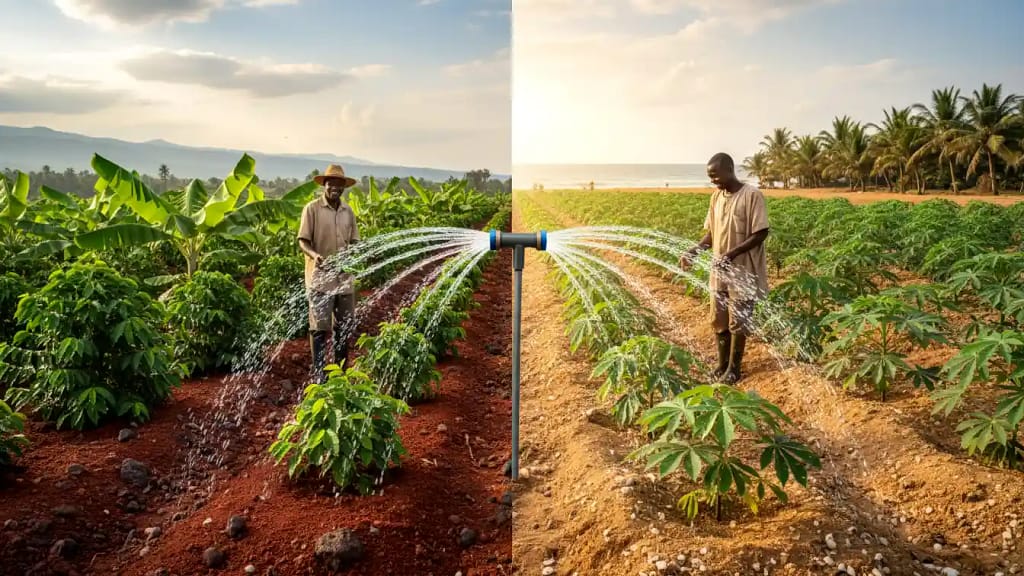
The most confusing aspect for new buyers is the relationship between “Head” (vertical lift) and “Flow” (water volume). As you pump water from deeper within the ground, the volume of water you receive at the surface decreases. The RainMaker2 is engineered as a hybrid solution, offering decent pressure for sprinklers while maintaining volume for drip lines.
If your borehole in Kajiado is 60 meters deep, the RainMaker2 will deliver approximately 600-800 liters per hour. This is sufficient for drip irrigation but may struggle to drive multiple impact sprinklers simultaneously. Conversely, at 10 meters depth, that same pump delivers nearly 3,000 liters per hour, filling a 5,000-liter tank in under two hours.
Battery Capabilities
The ClimateSmart Battery 2 is not just for night pumping. It serves as a centralized power hub for the homestead, capable of powering four LED light bulbs and charging two mobile phones simultaneously. It uses Lithium-NMC chemistry, ensuring a lifespan of roughly 1,500 cycles, which translates to about 4-5 years of daily use.
How do Meru, Uasin Gishu, and Kilifi compare for solar irrigation suitability?
Meru requires high-head pumps like the RainMaker2 due to deep aquifers (100m+) found in the volcanic highlands. Uasin Gishu is ideal for standard pumps with shallower water tables (30-45m) and high solar irradiance on the plateau. Kilifi offers the highest solar power potential but suffers from saline groundwater; farmers must avoid over-pumping to prevent saltwater intrusion.
Module A: Regional Comparative Analysis (2026)
Not every county is equal when it comes to solar irrigation. The physical geography of your land dictates which pump you buy and how fast you break even. We have analyzed three distinct agricultural zones to help you benchmark your own farm.
1. Meru County (Highlands & Mixed Terrain)
Meru presents a “high-risk, high-reward” scenario for solar pumps due to its dramatic topography. The water table here is notoriously deep, often exceeding 100 meters in the borehole belts near Timau and Buuri. A standard surface pump is largely useless in these zones.
Farmers in Meru must invest in the RainMaker2 or specialized Kubwa submersible models capable of high head pressure. While the initial equipment cost is higher, the ROI is protected by the region’s ability to grow high-value export crops like snow peas and french beans. The solar irradiance is moderate, but cloud cover during the Gatanu (misty season) can reduce pumping hours by 20% compared to other regions.
2. Uasin Gishu (The Plateau)
Eldoret and its environs in Uasin Gishu represent the “Goldilocks” zone for solar irrigation. The plateau geology means aquifers are often accessible at 30 to 45 meters, which is the sweet spot for efficiency. This depth allows the standard SunCulture RainMaker series to operate at maximum water volume output without straining the motor.
Read Also: Azolla Farming in Kenya: Cheap Animal Feed and Higher Profits in 2026
Farmers here largely focus on passion fruit, maize (for silage), and vegetables. The consistent sunlight on the plateau ensures the panels operate at near-peak efficiency year-round. An acre of passion fruit under drip irrigation here can generate 3x the revenue of rain-fed maize, making the PAYG monthly payments of KES 5,149 feel negligible against monthly revenues of KES 40,000+.
3. Kilifi County (Coastal Lowlands)
Kilifi has the highest solar potential (irradiance) but the trickiest water chemistry. The water table is shallow, often just 10-20 meters, which sounds perfect for high-volume pumping. However, the risk of salinity is extreme in this coastal strip.
If you pump too aggressively with a powerful Kubwa pump, you risk “up-coning”—drawing saltwater up into your fresh water layer. Kilifi farmers must use sensors (often included in the ClimateSmart battery kits) to monitor usage rigorously. The best crops here are salt-tolerant varieties of chilies and watermelons.
What does a profitable 12-month farming calendar look like for 2026?
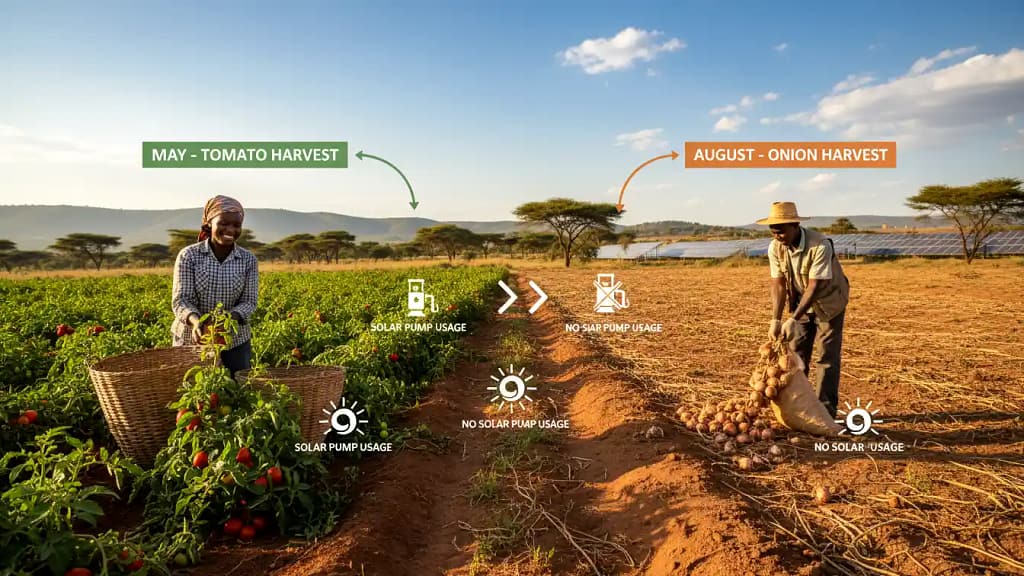
To maximize solar pump profits, plant tomatoes in late January for an April harvest (high prices). Plant onions in May to harvest in August/September during the dry spell. Use October/November for quick-maturing kales or spinach to supply the December festive market. Irrigation allows you to hit market windows when rain-fed crops fail.
Module B: 12-Month Farming Calendar
The biggest mistake beginners make is planting when everyone else is planting. With a solar pump, you are buying the ability to time the market. Here is an optimized calendar for a 1-acre irrigated shamba in 2026.
- January – February (Hot & Dry): This is your “Money Season” for solanaceous crops. While neighbors wait for the long rains, you should be transplanting Tomatoes (Anna F1) or Watermelons. The solar irradiance is at its peak, giving you maximum pumping hours (8-9 hours/day).
- March – April (Long Rains): Rain-fed farmers flood the market with leafy greens, crashing prices. Do NOT plant Sukuma Wiki now. Instead, focus on Onions (Red Creole) which need water but cure better in dry months later.
- May – June (Cooler/Drier): Harvest your tomatoes now as prices spike. The rain-fed crop from other regions often rots or hasn’t matured due to waterlogging. Immediately prep land for Capsicum or Cabbages (Gloria F1).
- July – August (Cold Season): Solar efficiency drops slightly due to cloud cover (especially in Central Kenya). Shift to lower water-demand crops or well-established root vegetables. Harvest your Onions in August when the market is dry and prices are high (often KES 60-80/kg).
- September – October (Short Rains Prep): Plant quick-maturing Spinach or Managu. These will be ready for the December holiday rush when hotels and urban centers demand fresh vegetables.
- November – December (Short Rains): This is your maintenance window. Service your SunCulture pump, clean the panels, and flush your drip lines with mild acid to remove mineral buildup. Harvest your leafy greens for the Christmas market.
Can you break down the deep financials and break-even point for 2026?
A 1-acre tomato farm using a SunCulture pump has a projected revenue of KES 900,000. With total input costs of ~KES 250,000 (including pump payments) and Pay-As-You-Grow installments, the net profit is ~KES 650,000. The break-even point typically occurs in Month 7 or 8 of the first production cycle.
Module C: Deep-Dive Financials (KES)
Let’s move away from estimates and look at the raw 2026 numbers for a 1-acre Tomato Project using the RainMaker2 system. We assume you are paying the monthly installment rather than cash upfront.
The “Zero-to-Profit” Table (1 Acre – Tomatoes)
| Expense Item | Cost (KES) | Notes |
|---|---|---|
| SunCulture Deposit | 6,999 | One-time initial fee. |
| Monthly Installments (x6) | 30,894 | KES 5,149/mo for the first growing season (6 mos). |
| Land Prep & Drip Lines | 40,000 | Ploughing + buying 16mm drip tape (approx 3-4 rolls). |
| Seeds (Hybrid F1) | 15,000 | Varieties like “Anna F1” or “Terminator”. |
| Fertilizer & Manure | 45,000 | DAP, CAN, and 2 lorries of manure. |
| Labor & Crop Protection | 50,000 | Weeding, spraying, harvesting labor. |
| TOTAL INPUTS | 187,893 | Total cash out before first harvest. |
| REVENUE PROJECTIONS | ||
| Conservative Yield | 15 Tons | 15,000 kgs (Low to Mid management). |
| Average Farm Gate Price | KES 40/kg | Price dips to 30, peaks at 70. 40 is safe. |
| GROSS REVENUE | 600,000 | 15,000 kg KES 40. |
| NET PROFIT (Season 1) | 412,107 | Revenue minus Total Inputs. |
Analyst Note: Even with a conservative price of KES 40/kg, the profit margin is over 200%. The biggest cost is usually fuel for diesel pumps (approx KES 30,000 per season). With SunCulture, this cost is zero. Your monthly installment of KES 5,149 is effectively replacing your diesel budget, but unlike diesel, the payments eventually stop, and you own the asset.
Read Also: 10 Most Profitable Farming Ventures in Kenya for 2026
Break-Even Analysis:
Your total sunk cost before seeing a tomato is roughly KES 187,893. If you harvest weekly starting Month 4, you will cover your entire initial investment by the 5th week of harvesting (approx Month 5.5). By the end of the year, you have fully funded the pump’s operations for the next 2.5 years of payments.
How does SunCulture compare to other market options?
SunCulture leads in PAYG financing and “Smart” integration (IoT monitoring). Davis & Shirtliff offers more powerful industrial pumps but typically requires full cash upfront. Futurepump is excellent for portability and manual repairability but lacks the integrated battery home systems found in the RainMaker series.
The Competitive Landscape
In 2026, the Kenyan market is crowded with solar solutions. Davis & Shirtliff remains the gold standard for large-scale, deep-borehole commercial irrigation (10+ acres), but their entry price is prohibitive for smallholders. Their Dayliff systems are robust but lack the accessible financing models that SunCulture has mastered.
Futurepump offers the SF2, a robust surface pump that is incredibly durable and easy to repair with basic tools. However, it is a surface pump, meaning it cannot pull water from deep wells (limited to 7m suction). For farmers with deep wells in Machakos or Meru, submersible options like the RainMaker2 are the only viable solar choice.
How does the supply chain and value addition work for smallholders?
Smart farmers maximize value by grading produce on-farm and using the ClimateSmart Battery to power small value-add tools (like sealers) or lights for night sorting. To bypass brokers, form a cluster with 3-5 neighbors to aggregate volume, allowing you to negotiate transport directly to Nairobi or Mombasa wholesale markets.
Module E: Supply Chain & Value Addition
Owning a pump is step one. Selling the produce is step two. The 2026 supply chain in Kenya is brutal to farmers who sell “raw” to the first broker who shows up with a Probox.
1. On-Farm Aggregation (The Cluster Model)
A single RainMaker2 produces enough water for 1-1.5 acres. Brokers love small farmers because they can dictate the price. However, if you and two neighbors (who also irrigate) combine your harvest, you suddenly have 3-5 tons of tomatoes.
This volume attracts Canter trucks directly from Nairobi’s Marikiti or Wakulima markets. By cutting out the local middleman, you can increase your margin by KES 5-10 per kg. Collective bargaining power is your best defense against predatory pricing.
2. Solar-Powered Value Addition
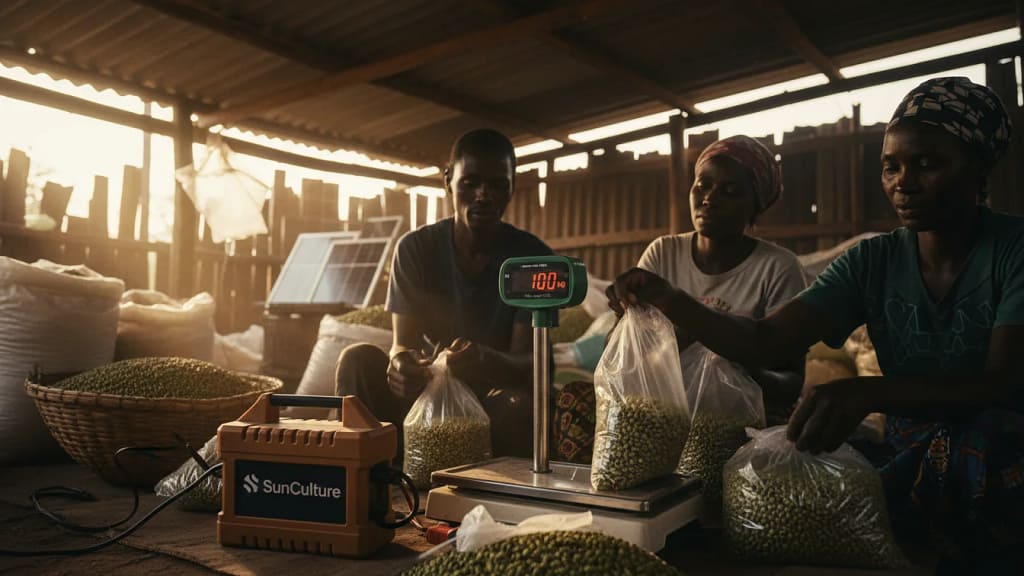
The “ClimateSmart” aspect of the SunCulture system isn’t just for pumping. The battery (ClimateSmart Battery 2) has USB and DC ports. A farmer in Makueni uses the battery to power a small digital weighing scale and a heat sealer.
She packages her green grams (ndengu) in branded 1kg packets instead of selling in 90kg bags. As a result, she sells at KES 150/kg retail instead of KES 80/kg wholesale. The solar system powers the entire packing process at night, turning downtime into production time.
Read Also: Maize Farming in Kenya: High Yield Production Guide, Best Practices and Profit Tips 2026
3. Cold Storage Integration
While the standard battery cannot power a fridge, 2026 has seen the rise of charcoal coolers (evaporative cooling) assisted by solar-powered fans. You can use the SunCulture battery to run a small DC fan that keeps a charcoal cooler wet and aerated. This extends the shelf life of tomatoes by 5-7 days, allowing you to wait for prices to stabilize if the market floods on a Monday.
What is the outlook for solar irrigation in 2026?
The 2026 outlook is defined by independence from fossil fuels. With diesel costs rising, the “SunCulture RainMaker2” offers a verified path to profitability. Government policy via the SoLAR Phase II initiative continues to support the ecosystem through training and water permits, while carbon credits keep upfront costs subsidized.
2026 Outlook and Conclusion
The financial landscape for solar irrigation in Kenya is now mature. With the cost of diesel rising and rainfall becoming more unpredictable, the SunCulture RainMaker2 series offers a verified escape route from poverty. The financials are clear: the monthly PAYG cost is roughly equivalent to buying 30 liters of diesel.
Government policy in 2026, specifically the SoLAR Phase II initiative, is heavily supporting the ecosystem around these pumps (training, water permits), even if they aren’t handing out cash directly. The carbon credit subsidy baked into the price is your “hidden” government grant. It is up to the farmer to seize this opportunity.
Your Action Plan:
1. Test your water: If you are in Kilifi or a dry lowland, check salinity first.
2. Budget the Deposit: Have KES 7,000 ready for the RainMaker2.
3. Form a Cluster: Find two other farmers to share transport logistics.
4. Start Small: Don’t irrigate 5 acres day one. Start with 1 acre of high-value tomatoes or onions to clear your debts in Season 1.
Ready to Secure Your Water?
Don’t wait for the rain. Contact a certified provider today.
- SunCulture Kenya: 0800 721 042 (Toll Free)
- Kenya Seed Company (Seeds): +254 790 005 328
- Simlaw Seeds: +254 722 200 545
- KALRO (Soil Testing): +254 722 206 986
Farmers Also Ask: Troubleshooting & FAQ
What happens if I miss a monthly payment?
SunCulture pumps use IoT technology (remote switching). If you miss a payment, the pump is remotely disabled via the GSM network. It will not pump water until the payment is made via M-Pesa. Once paid, it reactivates almost immediately. It is a “Pay-As-You-Grow” model, similar to KPLC tokens.
Can the RainMaker2 pump water from a river?
Yes, but you must use a filtration system. River water contains silt and debris that can clog the submersible pump impeller. SunCulture kits usually come with a mesh filter, but for muddy rivers, you should install a pre-filter or dig a shallow well 5 meters from the riverbank to filter water naturally through the soil.
Does the government subsidy cover the deposit?
No, currently there is no direct government subsidy that pays the deposit for individual farmers. The “subsidy” is applied to the total manufacturing and import cost via carbon credits, which keeps the price lower than it would be otherwise (approx. 20% cheaper). You must raise the KES 3,999 – 6,999 deposit yourself.
How many acres can the RainMaker Kubwa irrigate?
The RainMaker Kubwa is designed for 2 to 2.5 acres of drip irrigation. If you are using sprinklers, this coverage drops to about 1 acre because sprinklers require higher pressure and waste more water. For maximum acreage, always pair the Kubwa with drip lines.
How long do the batteries last?
The ClimateSmart Battery 2 is a Lithium-Ion unit designed to last 3 to 5 years depending on usage cycles. It comes with a 2-year warranty. To extend its life, keep it in a cool, shaded area and avoid draining it completely to 0% every single night.
Can I use existing solar panels I already own?
Generally, no. SunCulture systems are sold as optimized “plug-and-play” kits. The controller is calibrated to the specific voltage and amperage of their provided panels (usually 310W-330W). Using mismatched panels can void the warranty and damage the pump controller.
Is theft of the pump a major issue?
Theft is a concern, but the pump is difficult to resell. The system is “locked” to your account and requires a code to operate (IoT locked). Without your payments, the stolen pump becomes a useless brick. However, physical security for the solar panels (welding frames) is highly recommended.
What is the difference between RainMaker2 and ClimateSmart Direct?
The RainMaker2 typically includes a battery, allowing you to charge phones, power lights, and potentially pump for short periods when clouds pass. The ClimateSmart Direct is a “direct drive” system with NO battery—it only pumps when the sun is shining. Direct is cheaper but less versatile.
Can I upgrade from a smaller pump to a Kubwa later?
Yes, SunCulture allows for upgrades, but you typically have to close out your current contract or reach a certain equity threshold. You cannot simply “swap” them without financial adjustment. It is better to buy the correct size initially. Contact customer care for specific “trade-in” offers active in 2026.
Who handles repairs if the pump breaks?
SunCulture has a network of technicians across Kenya. The pump has a 3-year warranty. If it fails due to a manufacturing defect, they repair or replace it. If it fails due to negligence (e.g., dropping it in mud without a filter), you pay for repairs. Always keep the customer care number saved.