
- New large farm tractors in Kenya currently cost between KES 1.5 million and KES 5 million depending on the specific brand and horsepower.
- Walking tractors for smallholders range from KES 150,000 to KES 350,000, providing cost-effective ploughing for farms under five acres.
- Used models like the Massey Ferguson 290 average KES 2.5 million, while bank-repossessed machinery can save buyers up to 30 percent.
Table of Contents
Finding the right farm machinery in 2026 can dramatically improve your agricultural productivity and lower long-term labor costs. Whether you manage a commercial wheat farm in Narok or a one-acre greenhouse in Kiambu, understanding current machinery prices and financing options is vital. This guide breaks down the best farm, walking, and small tractors to help you make a grounded, profitable investment.
Why Tractors Are Essential for Kenyan Farmers
Tractors eliminate heavy reliance on expensive manual labor, allowing you to prepare land quickly and plant precisely before seasonal rains stop. This mechanical advantage directly increases crop yields and stabilizes overall farm profitability.
Farming in Kenya has aggressively shifted from manual subsistence to serious commercial agribusiness. Relying purely on manual labor is no longer practical due to rising daily wage costs and unpredictable rainfall patterns. Getting your land prepared quickly means you can plant exactly when the vital rains begin.
Many small-scale farmers lose out on peak yields simply because land preparation takes several weeks by hand. A reliable tractor cuts this preparation time down from weeks to mere hours. It allows you to cover more acreage efficiently and handle tough, compacted soils with absolute ease.
Read Also: Top 10 Best Agrovets in Kenya (2026 Guide): Where to Buy Genuine Inputs in Nairobi, Eldoret & Nakuru
Beyond basic ploughing, these machines offer incredible versatility for modern agribusiness. You can attach trailers to haul harvests to local markets or mount sprayers for large-scale pest control. From what many farmers experience, buying a tractor is the most effective way to transition into profitable, high-yield commercial farming.
Types of Tractors Available in Kenya
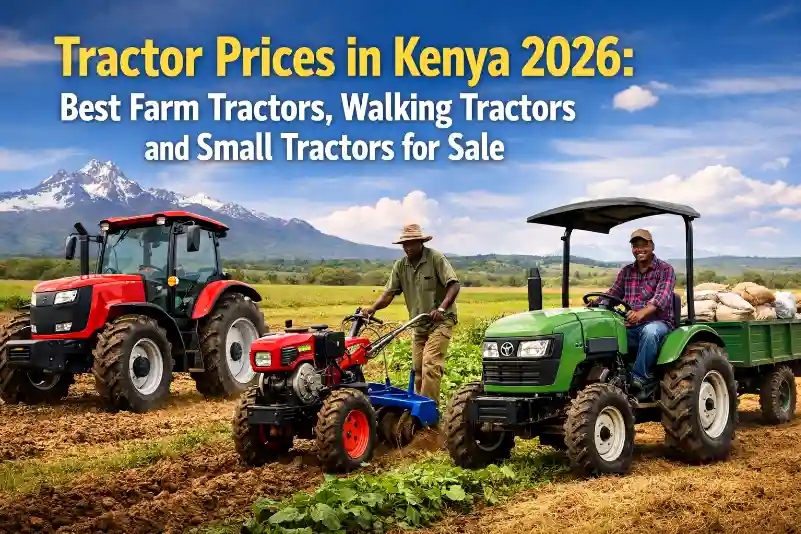
Tractors in the Kenyan market are classified into three main categories: heavy-duty farm tractors for large acreage, walking tractors for smallholders, and small garden tractors for horticulture operations.
Walking onto a dealership lot can be overwhelming if you do not know exactly what your specific shamba needs. Farm machinery is never a one-size-fits-all investment. Choosing the wrong category can lead to wasted fuel, severe soil compaction, or buying a machine that cannot handle your terrain. To make the best financial decision, you must perfectly match the machine’s horsepower to your land size and crop type. The Kenyan agricultural market currently offers three distinct types of tractors suitable for different farming scales.
Farm Tractors
These are heavy-duty machines built specifically for commercial-scale agriculture. They typically range from 50HP to over 150HP and are ideal for farms larger than ten acres. Heavy-duty farm tractors can pull large disc ploughs, heavy planters, and massive harvest trailers without struggling. In regions like Eldoret and Trans Nzoia, these four-wheel giants are strictly necessary for extensive wheat and maize farming. However, their massive size makes them unsuitable for tiny, segmented village plots.
Walking Tractors
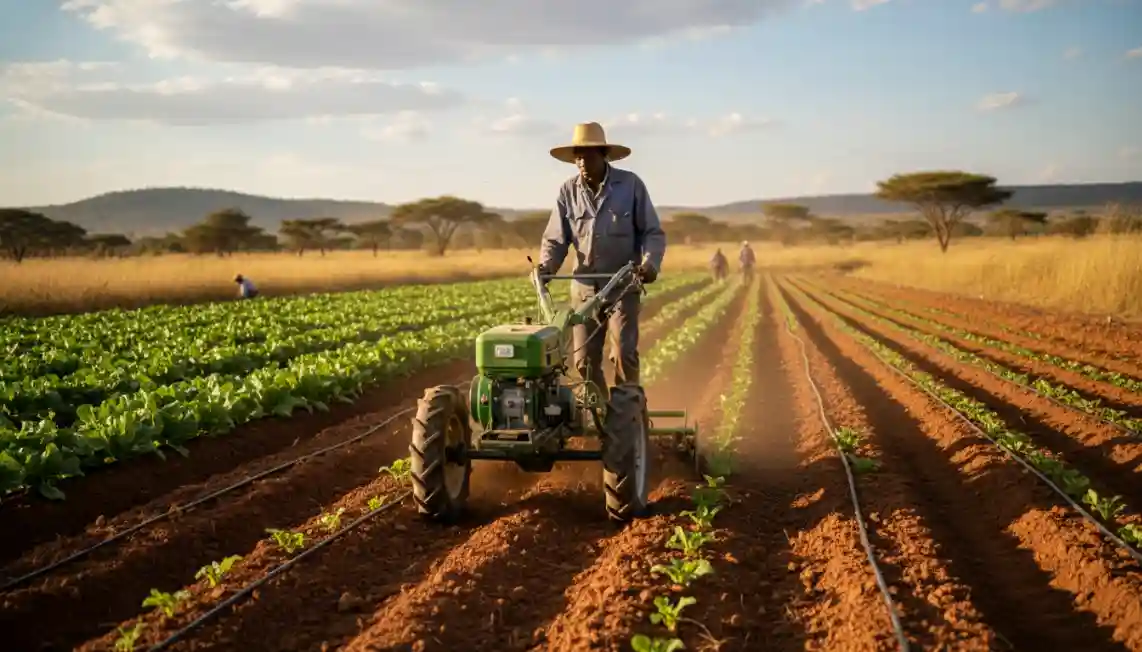
Walking tractors, commonly known as hand tractors, have completely revolutionized small-scale farming across Kenya. These machines are incredibly compact, highly affordable, and perfectly suited for farms under five acres. They typically range between 7HP and 18HP, operated by a farmer simply walking behind the machine. They are excellent for tight farm spaces, horticulture, and navigating securely between established crop rows. Maintenance is remarkably cheap, making them a top favorite for beginners.
Small and Garden Tractors
Small tractors sit perfectly between walking models and full-sized heavy farm tractors. They feature a comfortable seat and steering wheel but have a much smaller footprint and lower horsepower, usually under 40HP. These are perfect for medium-sized horticultural farms, large private estates, and commercial greenhouse operations. They easily maneuver around tight corners while still providing enough power to pull a small backhoe. If you manage a two to five-acre plot, this is often the most efficient choice.
Used vs. New Tractors: Pros, Cons, and Pricing
New tractors offer reliable factory warranties but require millions of shillings in upfront capital. Used tractors provide incredible savings, often priced 40 percent cheaper, but carry the inherent risk of hidden mechanical issues.
Deciding between a brand new or second-hand machine is the biggest financial hurdle most Kenyan farmers face today. New machines straight from authorized dealers provide complete peace of mind and zero mechanical history.
Read Also: How to Get Instant Farm Input Mobile Loans in Kenya 2026: Digital Credit Apps and Bank Options
You get a factory warranty, modern fuel efficiency, and immediate access to genuine spare parts. However, brand new machinery requires a massive capital outlay that most beginners simply cannot afford. A new 75HP machine can easily cost over KES 3.5 million in today’s market.
This steep price is exactly why the used tractors for sale market is booming across the country. Buying used machines can effectively save you up to half the cost of a new unit. Ex-UK models or locally used machines are widely available in agricultural towns like Nakuru and Nairobi. The downside is inheriting previous wear and tear, meaning you must hire a trusted mechanic for inspection before paying a single shilling.
Popular Tractor Brands and Models in Kenya
Top-selling brands in Kenya include Massey Ferguson for rugged simplicity, New Holland for advanced hydraulics, and Kubota for unmatched reliability in compact farming and wet terrain.
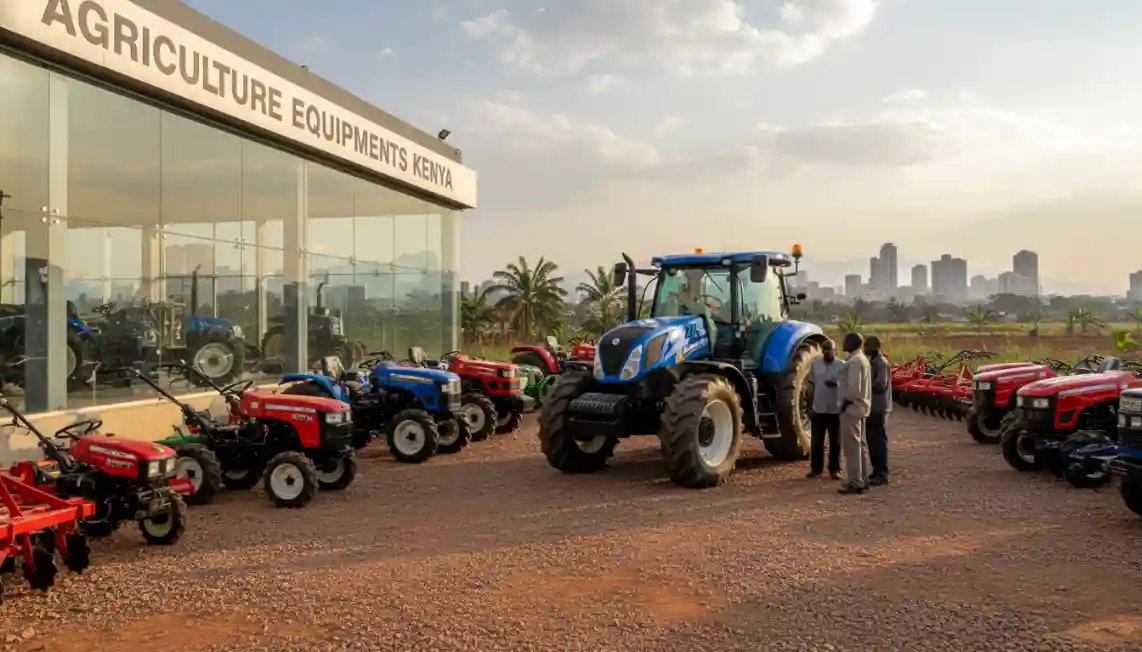
Brand reputation matters heavily in Kenya because it dictates the availability of spare parts and skilled local mechanics. If you buy an obscure brand, a simple breakdown during the crucial planting season could leave your machine grounded. It is highly recommended to stick to models heavily supported by local dealers.
New Holland and Case
New Holland is widely revered for its incredible durability and advanced hydraulic lifting systems. These specific machines dominate the large-scale wheat and maize belts across the Rift Valley. They handle heavy clay soils effortlessly and boast excellent fuel efficiency for their massive size. Case tractors are often sold alongside New Holland and share similar rugged, dependable characteristics. While they feature a premium price tag, they consistently hold their resale value extremely well.
Massey Ferguson
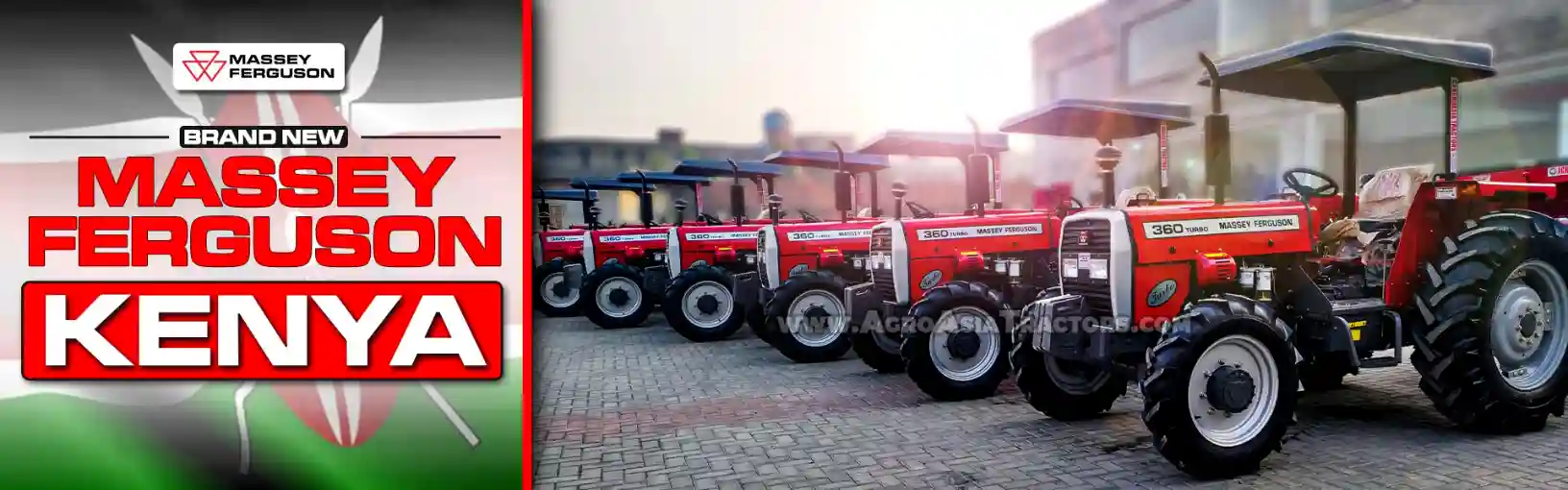
Massey Ferguson remains undoubtedly the most recognized and trusted tractor brand in Kenya. Classic models like the MF 290 and MF 275 are legendary for their mechanical simplicity and ease of repair. Almost every experienced village mechanic knows exactly how to fix a Massey Ferguson. They are robust, purely mechanical, and lack complicated electronics that frequently fail in dusty environments. Finding genuine spare parts for these specific models is incredibly easy in almost any major Kenyan town.
Kubota, RK, and Titan
Kubota dominates the small tractor and specialized rice farming sectors. Their compact units are famous for reliability, particularly in muddy or waterlogged conditions like the Mwea irrigation scheme. They consistently offer excellent power-to-weight ratios.
Read Also: Top Solar Water Pumps Kenya 2026: Best Models for Irrigation, Save 80% on Fuel
Other emerging brands like RK and Titan are gaining serious traction in the walking tractor segment. They offer budget-friendly options imported mostly from Asia, catering heavily to the growing number of smallholder horticulture farmers.
Tractor Implements and Attachments
A tractor is only as useful as its attached implements. Common attachments include disc ploughs for land breaking, rotavators for seedbed preparation, and specialized tools like boom sprayers for crop protection.
A bare tractor cannot perform much meaningful agricultural work on its own. The real farming work is accomplished by the specific tractor implements you attach to the back. When budgeting for your machine, you must allocate sufficient funds for these necessary attachments. For primary tillage, heavy disc ploughs are absolutely essential for breaking hard, compacted Kenyan soils.
Once the land is broken, harrows or rotavators are used to crush large soil clods and create a perfectly smooth seedbed. If you plan to apply pesticides on a large scale, boom sprayers are highly efficient. Many commercial farmers also heavily invest in a tractor with backhoe capabilities for digging trenches or clearing tree stumps. Always ensure the implements you purchase are fully compatible with your tractor’s specific horsepower and hydraulic lifting capacity.
Fertilizer Spreaders and Applications
Proper nutrient application is critical for high yields, making tractor-mounted fertilizer spreaders a highly valuable investment. These attachments broadcast granulated fertilizers evenly across large fields, saving days of manual labor.
KALRO experts consistently recommend matching your spreader’s calibration to your specific soil nutrient requirements. Below is a quick guide comparing common tractor-mounted fertilizer spreaders to help you choose the right equipment. Proper selection depends heavily on your farm size and preferred fertilizer types.
| Spreader Type | Best Suited For | Recommended Fertilizer Types | Average Price (KES) |
| Pendulum Spreader | Medium to large commercial farms | Granular NPK, Urea, CAN | 150,000 to 250,000 |
| Twin-Disc Spreader | Very large estates and wheat farms | All granular blends, heavy applications | 250,000 to 450,000 |
| Drop Spreader (Small Tractor) | Horticulture and small row crops | Powdered or granular basal fertilizers | 80,000 to 150,000 |
Current Tractor Prices in Kenya 2026
In 2026, new large farm tractors range from KES 1.5 million to KES 5 million. Used 4WD models average KES 2.5 million, while compact walking tractors cost between KES 150,000 and KES 350,000.
Understanding current market prices protects you from predatory brokers who frequently inflate machinery costs. In 2026, prices have adjusted slightly due to fluctuating import duties and global shipping costs. Large four-wheel farm tractors represent the absolute highest capital investment for any farmer. A new mid-range tractor around 75HP will set you back between KES 3.5 million and KES 4.5 million.
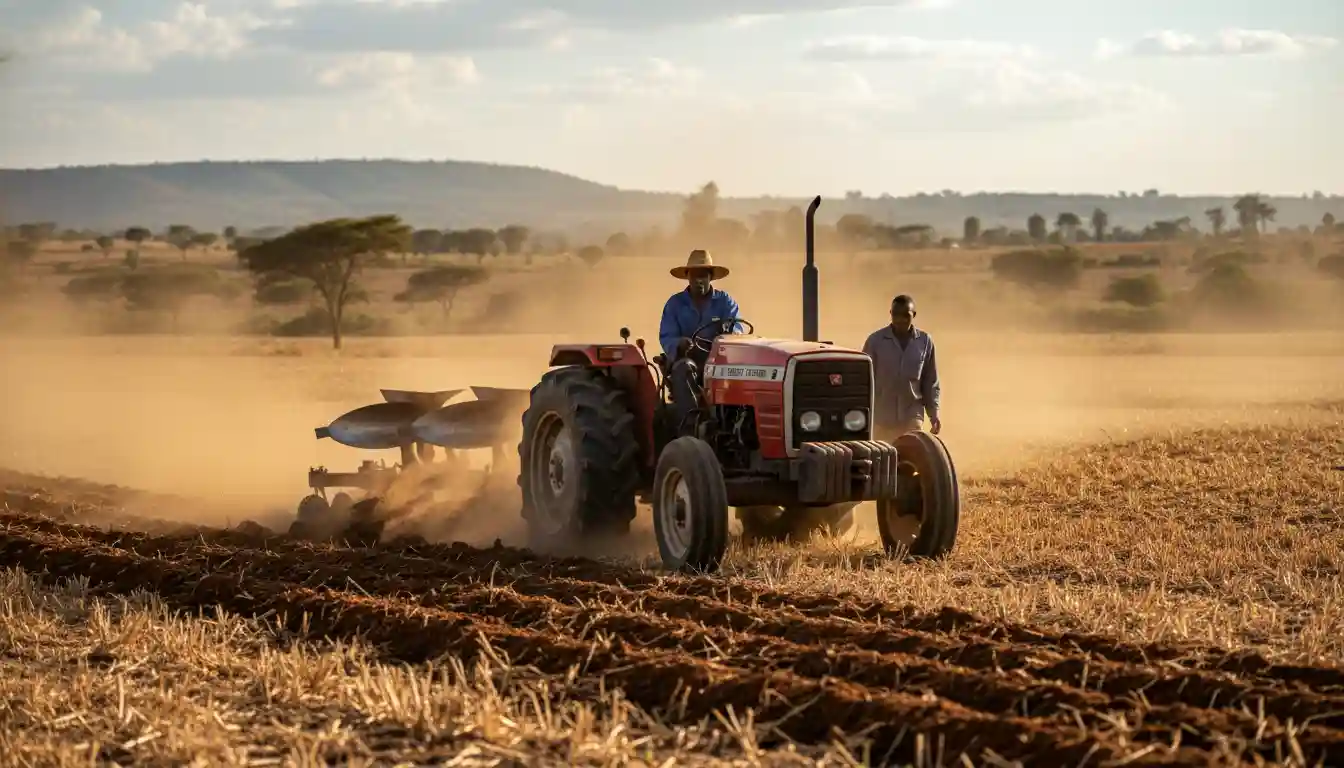
If you opt for the highly popular used market, a reliable model like the Massey Ferguson 290 costs about KES 2.5 million. Older, smaller locally used models can occasionally be found for as low as KES 800,000. For small-scale farmers, walking tractors remain incredibly attractive and financially accessible. Depending on the specific brand and horsepower, these range from KES 150,000 to KES 350,000.
These prices typically include basic attachments like a rotavator, making them a fantastic deal for eager beginners. To help you budget accurately, here is a breakdown of current estimated prices for popular tractor categories in the Kenyan market. Prices may vary slightly depending on the dealer and exact machine condition.
| Tractor Category | Condition | Estimated Price Range (KES) |
| Walking Tractors (7HP to 18HP) | New | 150,000 to 350,000 |
| Small Garden Tractors (Under 40HP) | New / Ex-UK | 800,000 to 1,800,000 |
| Mid-Range Farm Tractors (50HP to 75HP) | Used (Locally or Ex-UK) | 1,500,000 to 3,000,000 |
| Heavy-Duty Tractors (75HP+) | Brand New | 3,500,000 to 5,500,000+ |
Visual Insight Processing Error
A farmer negotiating with a machinery dealer in front of several used red and blue farm tractors in a yard in Eldoret.
Where to Buy Tractors in Kenya
Purchase new machinery strictly from authorized dealers like CMC Motors or CFAO. For used models, visit established machinery yards in Nakuru and Eldoret while strictly avoiding unverified social media brokers.
Knowing exactly where to source your machinery can save you hundreds of thousands of shillings. Authorized dealers are always the safest route for brand new purchases. Companies like FMD East Africa or CMC Motors provide genuine machines, comprehensive warranties, and reliable after-sales support. If you are looking for second-hand deals, Nakuru and Eldoret serve as the primary agricultural hubs.
Read Also: 10 Most Profitable Farming Ventures in Kenya for 2026
The major highways in these towns are lined with reputable yards legally selling ex-UK and locally used tractors. Take your time to physically visit these specific yards and thoroughly test the equipment. Be extremely cautious when browsing online platforms or random social media farming groups.
Never send an M-Pesa deposit to book a tractor before seeing it in person. Always travel with an independent mechanic and carefully verify the logbook details with NTSA before signing transfer papers.
Financing and Payment Options
Farmers can finance machinery through commercial bank asset loans, Sacco credit, or specialized agricultural leasing programs. M-Pesa integration also helps smallholders pay for walking tractors in flexible monthly installments.
Very few farmers have the liquid cash required to buy heavy machinery outright. Fortunately, the Kenyan financial sector currently offers robust asset financing specifically tailored for local agribusiness. Major commercial banks can finance up to 80 percent of the machine’s value, using the tractor itself as collateral.
You will need to provide consistent farm records and healthy bank statements to prove your ability to service the loan. Saccos are another excellent route, often offering lower interest rates and flexible repayment terms aligned with your crop harvest seasons. Asset leasing is also gaining popularity, allowing you to rent the machine long-term without bearing massive depreciation costs.
For smaller purchases like walking tractors, many agricultural supply companies now offer highly flexible payment plans. Some vendors allow you to pay a modest deposit and clear the balance via M-Pesa over several months. Always calculate the total interest carefully to ensure the loan does not consume your farming profits.
Risks & Reality Check: Tractor Ownership
Owning a tractor comes with risks like expensive mechanical breakdowns, loan defaults due to crop failure, and underutilization. Proper maintenance and realistic financial planning are essential to avoid massive losses.
While a tractor boosts productivity, it is crucial to remain realistic about the operational challenges. Mechanical breakdowns are inevitable, and replacing major parts like hydraulic pumps can cost hundreds of thousands of shillings. If your machine breaks down during peak planting season, your entire harvest timeline is severely jeopardized.
Many farmers also face severe financial risks if they rely on loans to purchase their equipment. Consider a farmer in Uasin Gishu who took a bank loan for a new tractor but suffered total crop failure due to drought. Without farm income, servicing a KES 80,000 monthly loan becomes impossible, leading directly to painful asset repossession.
To mitigate these risks, avoid buying a machine that is too large for your actual acreage. A massive 90HP tractor sitting idle on a three-acre farm is a terrible financial liability. Ensure your farm generates enough consistent revenue to cover routine maintenance, expensive diesel, and operator wages.
Conclusion: Choosing the Right Tractor for Your Farm
Your final choice of machinery must align perfectly with your farm size, crop type, and realistic financial budget. Prioritize strong local dealer support to guarantee quick access to spare parts.
The 2026 agricultural landscape in Kenya demands peak efficiency, and mechanized farming is the surest way to achieve it. Whether you are finally upgrading from manual labor or expanding your commercial acreage, purchasing a tractor is a massive milestone.
It requires careful planning and a deep understanding of your unique farm logistics. Do not be swayed simply by a shiny coat of paint or an unnecessarily massive engine. Let your actual land size and realistic budget rigidly dictate your choice. A reliable, affordable walking tractor will serve a two-acre vegetable farmer much better than an expensive, underutilized 80HP machine.
Take your time, meticulously compare used and new options, secure smart financing, and always inspect machinery before you buy. With the right machine and suitable attachments, your farm will see a massive reduction in operational costs. Ultimately, this smart investment paves the way for a significant boost in your seasonal yields.
Farmers Also Ask (FAQ)
What are the current used tractor prices in Kenya?
Prices range from KES 800,000 for older 2WD units to KES 3.5 million for 4WD ex-UK models. Condition and brand dictate the final cost.
Where can I find used tractors for sale in Nakuru, Kenya?
Visit physical machinery yards along the Nakuru-Eldoret highway. Always verify NTSA logbooks and test the equipment before paying any deposit.
How much do New Holland tractors cost in Kenya?
New units cost between KES 3.5 million and KES 5.5 million. Second-hand models generally retail between KES 2.5 million and KES 4 million.
What is the price range for Kubota tractors in Kenya?
These compact tractors cost between KES 1.8 million and KES 3.5 million. They are highly favored for rice farming and muddy terrain.
How much do Jumia tractors sell for in Kenya?
Jumia primarily stocks small walking tractors and hand tillers. Prices for these compact machines range from KES 60,000 to KES 250,000.
Where to find bank-repossessed tractors for sale in Kenya?
Licensed auctioneers like Garam or Phillips Auctioneers handle these sales. Check local daily newspapers or visit auction yards in Nairobi.
How much is a Massey Ferguson tractor in Kenya?
New units average KES 3.5M to KES 5M. The legendary used MF 290 costs around KES 2.5M, while complete 4WD setups fetch up to KES 4.3M.
Where can I buy cheap used tractors for sale in Kenya?
Check local agricultural auction yards or buy directly from retiring farmers. Eldoret and Nakuru remain the best hubs for used farm machinery.
What are the best deals on small tractors and walking tractors in Kenya?
Direct Asian imports and agricultural show deals offer the best value. Walking tractors typically cost KES 150,000 to KES 350,000 with attachments.
How to compare tractor prices and financing options in Kenya?
Get written quotes from authorized dealers and compare them with Sacco loan rates. Ensure the financing terms align with your harvest seasons.