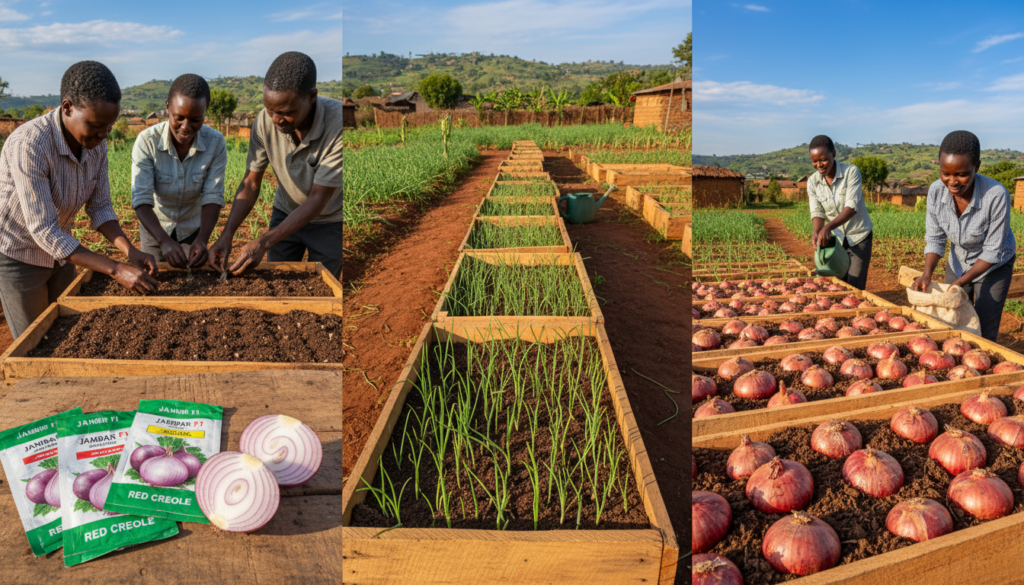
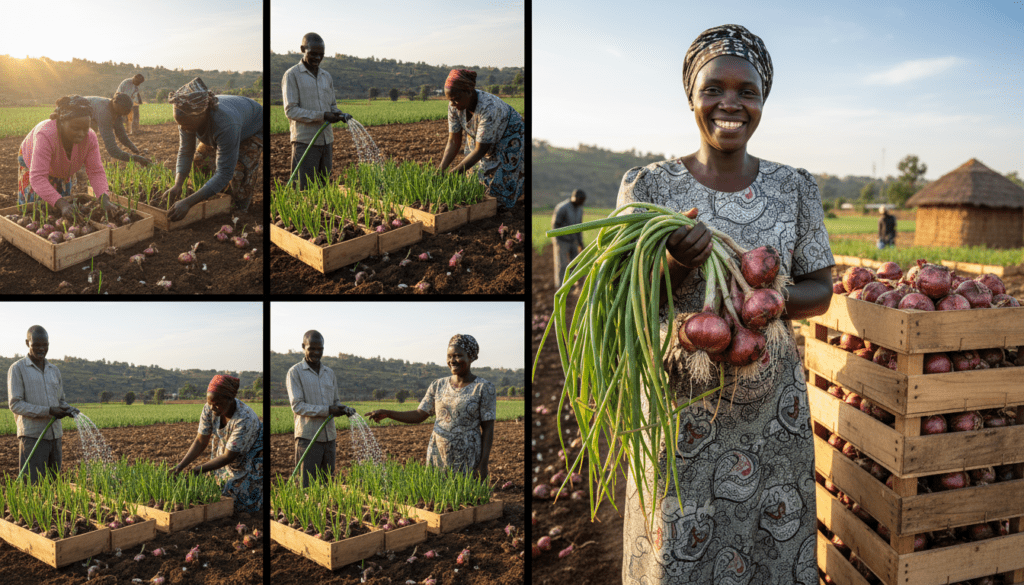
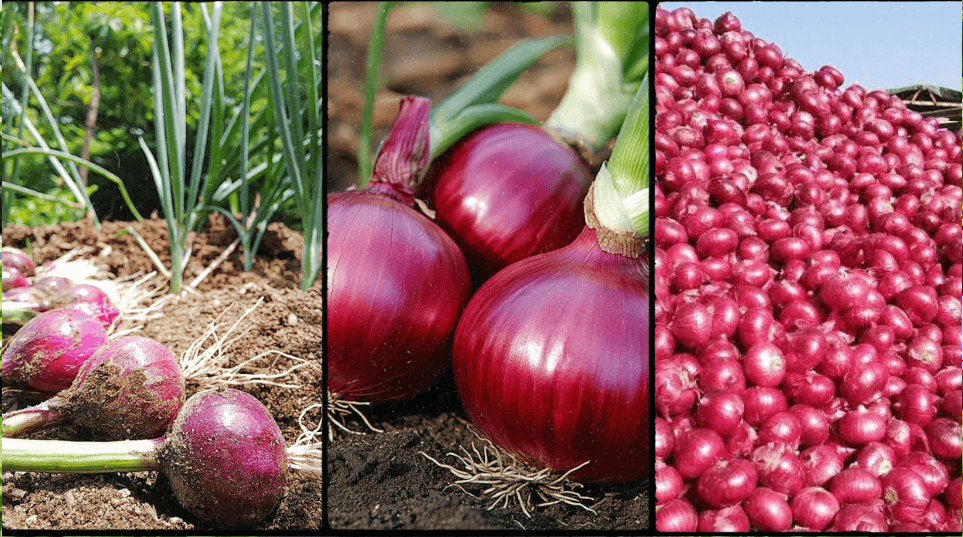
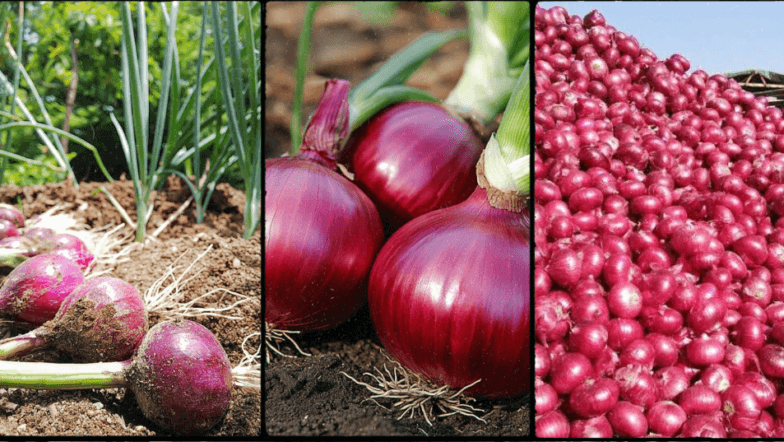
🛒 Order with confidence! We’re trusted by thousands of farmers across Kenya. If anything goes wrong on our side, you’re protected by our 100% refund guarantee. ✅🇰🇪
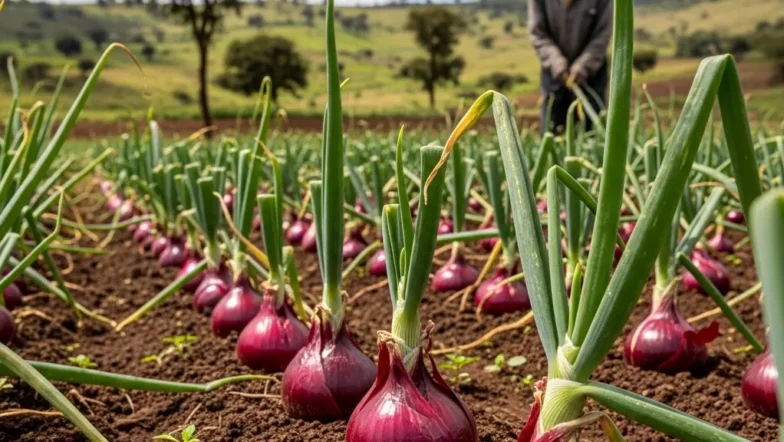
Discover the Top 5 Hybrid Onion Varieties (F1) Dominating the Kenyan Market in 2026. Detailed guide on Neptune, Russet, and Jambar F1, including yield data, where to buy, and profit analysis.
Complete 2026 guide to Bulb Onion Farming in Kenya. Discover the best F1 varieties like Neptune & Jambar, cost analysis, market prices, and farming calendar.
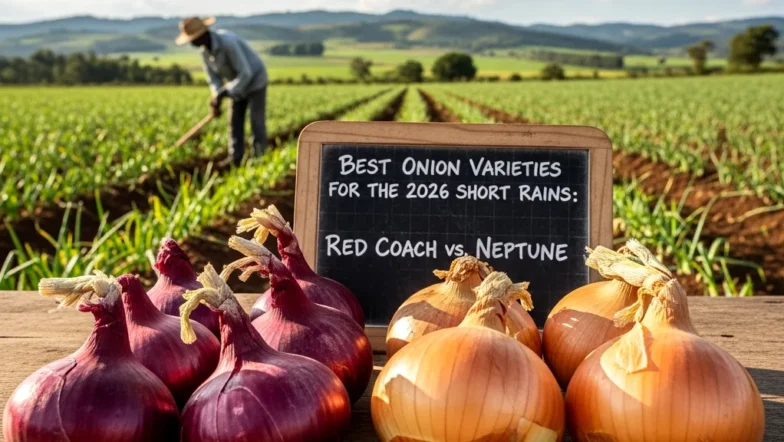
Compare Red Coach F1 vs. Neptune F1 for Kenya’s 2026 Short Rains. Expert guide on yield, costs, profit analysis (KES), and where to buy certified seeds.
The agricultural landscape in Kenya is shifting rapidly from the vast open fields of the Rift Valley to the concrete balconies of Nairobi, Kiambu, and Eldoret. Urban farming is no longer just a hobby for the retired; it is a serious economic survival strategy for families looking to beat the rising cost of living. Growing bulb onions in crates is one of the most efficient, high-value ways to utilize small spaces like balconies, rooftops, and backyards. Unlike leafy greens that spoil quickly, onions have a long shelf life and high market demand, making them a “gold bullion” crop for the urban farmer.
This master guide will take you through every single detail of growing onions in milk or bread crates. We are not just talking about throwing seeds in soil; we are talking about precision agriculture adapted for the Kenyan urban context. You will learn how to mix your soil to replicate the fertile loams of Oloitokitok, how to source the best F1 hybrid seeds from certified Kenyan suppliers, and how to manage pests like Thrips without destroying your ecosystem. Whether you are in a high-rise in Kilimani or a plot in Syokimau, this guide is your roadmap to harvesting premium red onions right outside your door.
CURRENT MARKET ANALYSIS AND PROFITABILITY IN KENYA
Before you buy your first crate, you must understand the financial terrain of onion farming in 2026. As of January 2026, the retail price for dry onions in major markets like Wakulima (Marikiti) and Kongowea ranges between KES 60 and KES 100 per kilogram depending on the quality and origin. Prices recently spiked due to weather conditions affecting local supply, pushing families to seek alternatives to buying from the “mama mboga.” While farm-gate prices can fluctuate down to KES 30 during peak harvests when Tanzanian onions flood the market, urban crate farmers have a distinct advantage. You are not subject to transport costs, broker fees, or post-harvest losses associated with long-distance shipping. Your “farm-gate” is your kitchen door.
The profitability of crate farming lies in density and turnover. A standard plastic milk crate (approx. 60cm by 40cm) can comfortably hold 15 to 20 large bulbs if spaced correctly. If you stack your vertical space or utilize a small 5×5 meter rooftop area, you can manage over 100 crates. With a yield of roughly 2 to 3 kilograms per crate (depending on the variety and care), a 100-crate system could yield 200-300 kgs of onions per cycle. At a conservative market saving of KES 80/kg, that is KES 24,000 worth of produce that you did not have to buy, produced with minimal inputs.
Furthermore, the price of inputs has stabilized but remains high, making homegrown food even more valuable. DAP fertilizer is currently retailing around KES 4,500 to KES 6,400 per 50kg bag depending on the vendor, and certified hybrid seeds like Jambar F1 are premium priced. However, in a crate system, your input usage is fractionally small. You are not wasting fertilizer on weeds or leaching it into deep soil. Every granule of DAP or CAN you apply goes directly to the bulb, making crate farming one of the most cost-efficient methods per square foot of production.
HOW TO GROW BULB ONIONS IN CONTAINERS
CHOOSING THE RIGHT ONION VARIETIES FOR CRATES
Selecting the right seed is the first critical decision you will make. In Kenya, we generally have two categories of onions: Open Pollinated Varieties (OPVs) and F1 Hybrids. For crate farming, where space is expensive and you need guaranteed returns, F1 Hybrids are often the better choice despite the higher seed cost. They offer disease resistance, faster maturity, and uniform bulb sizes, which is crucial when you want every inch of your crate to be productive.
Jambar F1 is currently one of the most popular varieties in Kenya for good reason. It is a high-yielding red onion that produces deep red, globe-shaped bulbs. It is favored for its strong pungency, which is a key preference for Kenyan consumers who use it for frying sukuma wiki and meat stews. Jambar F1 matures in about 90 days after transplanting, which is relatively fast. Its resistance to Pink Root and Fusarium Basal Rot makes it a safer bet for beginners who might struggle with soil-borne diseases in a contained environment.
Red Creole is the classic choice if you prefer open-pollinated seeds. It is widely available at almost every agrovet in Kenya, from Kenya Seed Company stockists to small village shops. Red Creole is famous for its excellent shelf life; you can store these onions for up to six months in a dry, well-ventilated area without them sprouting. However, it takes slightly longer to mature (up to 150 days) and the bulbs tend to be flatter compared to the high-globe shape of hybrids. If you are farming for your own long-term storage, Red Creole is a fantastic, low-cost option.
Neptune F1 and Red Pinoy are other excellent contenders. Red Pinoy is an early maturing variety that is perfect if you are in a rush to get a harvest. It can be ready in as few as 90 days. Neptune F1 is known for its uniformity. When growing in crates, you want onions that grow at the same speed so they don’t overshadow each other. Neptune delivers this consistency, ensuring that when you harvest one crate, almost all the onions are of marketable size.
Seed packets of popular Kenyan onion varieties Jambar F1 and Red Creole displayed next to a fresh red onion.
SOURCING AND PREPARING YOUR CRATES
The foundation of this system is the crate itself. You do not need to buy brand new expensive planters. The black plastic crates used for milk or bread delivery are ideal because they are durable, deep enough for onion roots (which are shallow), and have built-in handles for moving them around. You can find these second-hand in markets like Gikomba in Nairobi, Kibuye in Kisumu, or hardware sections in major towns. Expect to pay between KES 150 and KES 300 per crate depending on its condition and your bargaining skills.
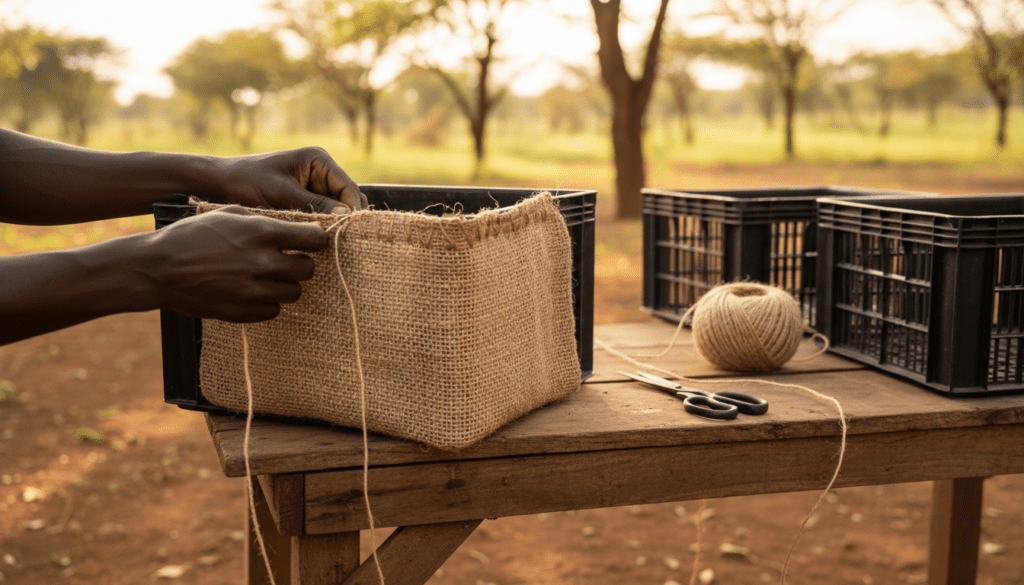
Once you have your crates, you cannot simply fill them with soil. The large holes on the sides and bottom will let all your soil wash away during watering. You need to line the crates. The best material for this is the porous sacks (gunny bags or “magunia”) often used to package potatoes or charcoal. Do not use solid plastic sheeting or garbage bags, as these will trap water and cause root rot. Onions hate “wet feet.” Cut the sacks to fit the inside of the crate, ensuring the bottom and sides are covered.
Secure the sack lining to the crate using binding wire or strong twine. Stitch it through the crate holes so it stays firm when you pour in the heavy soil. Ensure that the lining is not too thick at the bottom; you want excess water to drain out freely. If you are placing the crates on a concrete balcony, place them on bricks or wooden blocks to elevate them slightly. This prevents the bottom from sitting in a puddle of water and allows air to circulate underneath, which air-prunes the roots and prevents fungal diseases.
A person preparing a plastic crate for planting by lining it with a porous sack to hold soil while allowing drainage.
FORMULATING THE PERFECT SOIL MIX
Onions are heavy feeders but they need loose, well-draining soil to expand their bulbs. If the soil is too hard or compact (like pure clay), the bulbs will be small and deformed. If the soil is too sandy, it won’t hold enough water or nutrients. For crate farming in Kenya, we use the “3:2:1 Rule” to create the perfect potting mix. This ratio represents 3 parts Topsoil, 2 parts Manure, and 1 part River Sand.
The topsoil should be sourced from a reliable area, preferably Red Kikuyu Loam or similar fertile soils found in agricultural zones. Avoid soil from construction sites as it often contains cement and chemicals. The manure must be “boma manure” (cow or sheep) that is well-decomposed. Do not use fresh manure; it is high in ammonia and will burn the tender onion roots (a condition farmers call “burning”). The manure should look like dark earth and have no strong smell. This provides the nitrogen and organic matter needed for leafy growth.
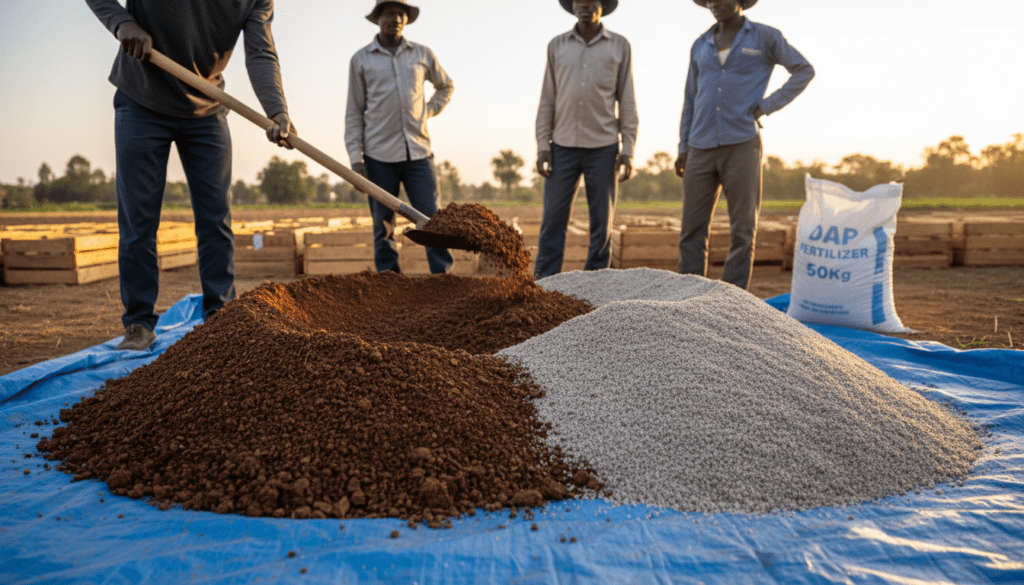
The third component, river sand, is non-negotiable. You can buy a wheelbarrow of sand from local construction suppliers. Sand ensures that the soil mixture remains loose and drains water instantly. Onions grown in crates without sand often suffer from waterlogging. Mix these three components thoroughly on a tarp or a clean concrete floor before filling your crates. At this stage, you should also mix in a handful of DAP fertilizer (about 50g per crate) to provide the phosphorus needed for strong root development immediately after transplanting.
Mixing red topsoil, manure, and river sand on a tarp to create the perfect growing medium for crate onions.
ESTABLISHING AN ONION NURSERY
While you can direct seed onions into the crates, it is highly inefficient for space. Onion seeds are tiny and take about 6-8 weeks to reach transplanting size. If you direct seed, your crates will be occupied by tiny grass-like seedlings for two months, wasting valuable production time. The professional approach is to start seeds in a separate “nursery basin” or a dedicated nursery crate, and then transplant only the strongest seedlings to your main crates.
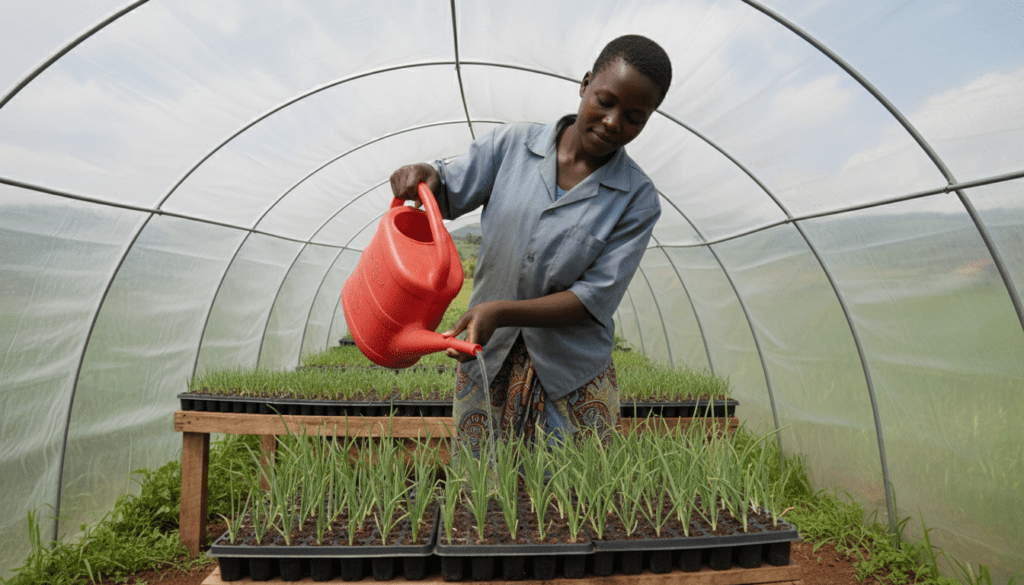
To make a nursery, use a plastic basin or a single crate with the same soil mix described above. Smooth the soil surface until it is perfectly flat. Draw shallow lines (drills) across the soil about 2cm deep and 5cm apart. Sprinkle the seeds thinly along these lines. Do not bury them deep; cover them lightly with a thin layer of soil or fine sand. Water gently using a watering can with a fine rose (head) so you don’t wash the seeds away.
Cover the nursery container with a damp gunny bag or dry grass mulch to retain moisture and keep it dark, which speeds up germination. Check every day. As soon as you see the tiny “loops” of onion seedlings breaking the surface (usually 5-7 days), remove the cover immediately to let them get sunlight. If you leave the cover on too long, the seedlings will become tall, white, and weak (etiolated). Keep the nursery moist but not soaking wet. Weekly foliar feeds with a vegetative booster can help them grow sturdy stems.
An African farmer gently watering young onion seedlings in a nursery tray to ensure they remain moist for healthy growth.
TRANSPLANTING: THE PENCIL THICKNESS RULE
Your seedlings are ready to transplant when they are about the thickness of a pencil (or slightly thinner) and have at least 3 to 4 true leaves. This usually happens 6-8 weeks after sowing. Do not rush this. If you transplant too early, the delicate seedlings may die from shock. Two days before transplanting, reduce watering to “harden off” the seedlings. This toughens them up for the move.
On the day of transplanting, water the nursery heavily so the soil is soft. Gently pull out the seedlings, trying to keep as much root as possible. Expert farmers use a technique called “trimming.” Use a clean pair of scissors to trim the roots to about 2cm long and trim the top leaves by about one-third. Trimming the roots stimulates new root growth, and trimming the tops reduces water loss through transpiration while the roots are re-establishing themselves.
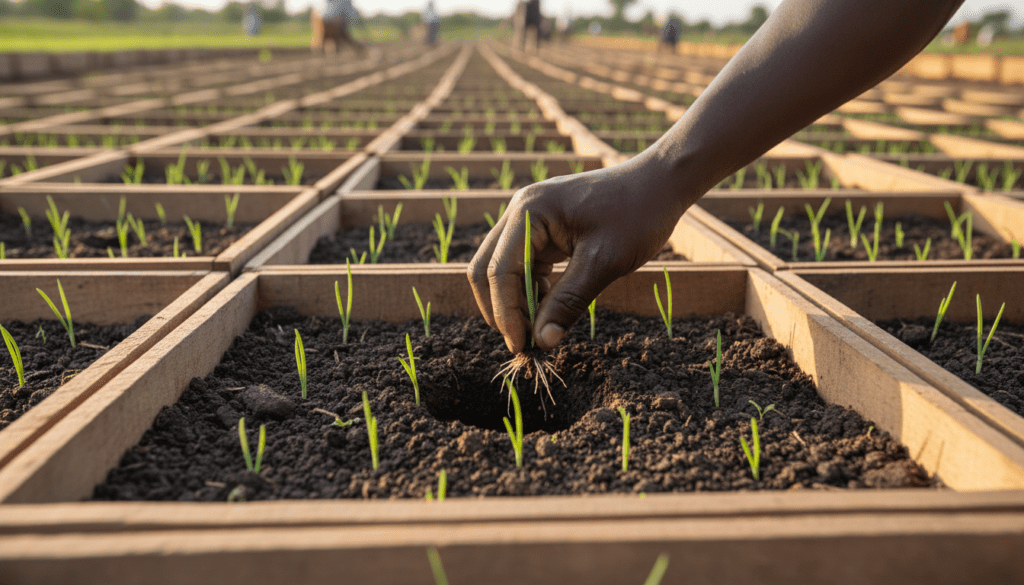
In your main production crates, water the soil well before planting. Use a stick or your finger to poke holes. The spacing is critical: 10cm to 15cm between plants is ideal for crates. In a standard crate, you can arrange them in a grid-4 rows by 5 plants, totaling 20 onions. Do not plant them too deep. The tiny bulb at the base of the stem should be just below the surface, but the point where the leaves fan out must be above the soil. If you bury the neck, the onion will not bulb properly. Firm the soil around the base of each seedling.
Transplanting an onion seedling into a crate
WATERING AND MANAGEMENT FOR CRATES
Container gardening requires different watering discipline than field farming. In a field, roots can go deep to find moisture. In a crate, they are prisoners. If the crate dries out, the plants stop growing immediately. In the hot months of January to March, you may need to water every day or every two days. The rule of thumb is the “finger test.” Poke your finger an inch into the soil. If it feels dry, water. If it is damp, wait.
However, beware of overwatering. Nairobi’s cool season (June-July) brings low evaporation rates. Watering daily during this time will lead to fungal diseases like Downy Mildew. Always water in the morning (between 6 AM and 9 AM). This allows any water splashed on the leaves to dry off during the day. Wet leaves at night are a recipe for disease.
Weeding in crates is easy but necessary. Since you used clean soil and manure, weeds should be minimal. Pull them out by hand as soon as you see them. Weeds in a confined crate compete aggressively for the limited nutrients. You should also aerate the soil occasionally by lightly scratching the surface with a small fork, being careful not to damage the shallow onion bulbs.
FERTILIZER APPLICATION REGIME
Onions are hungry crops. The manure you put in the soil mix is a great start, but for big, market-quality bulbs, you need to supplement. We have already added DAP during planting for root establishment. The next critical stage is the vegetative growth phase, where the plant builds the leaves that will eventually fuel the bulb size.
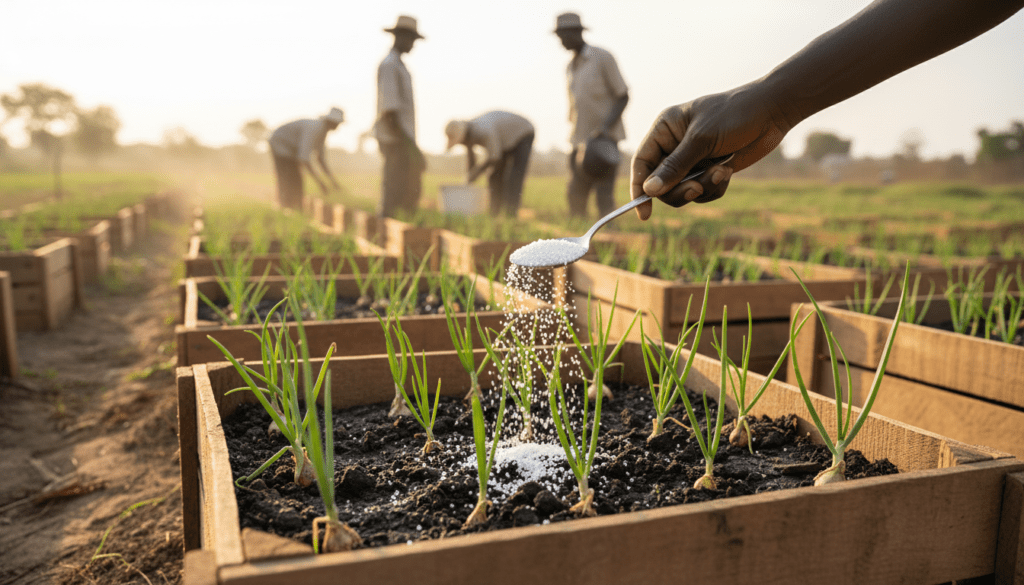
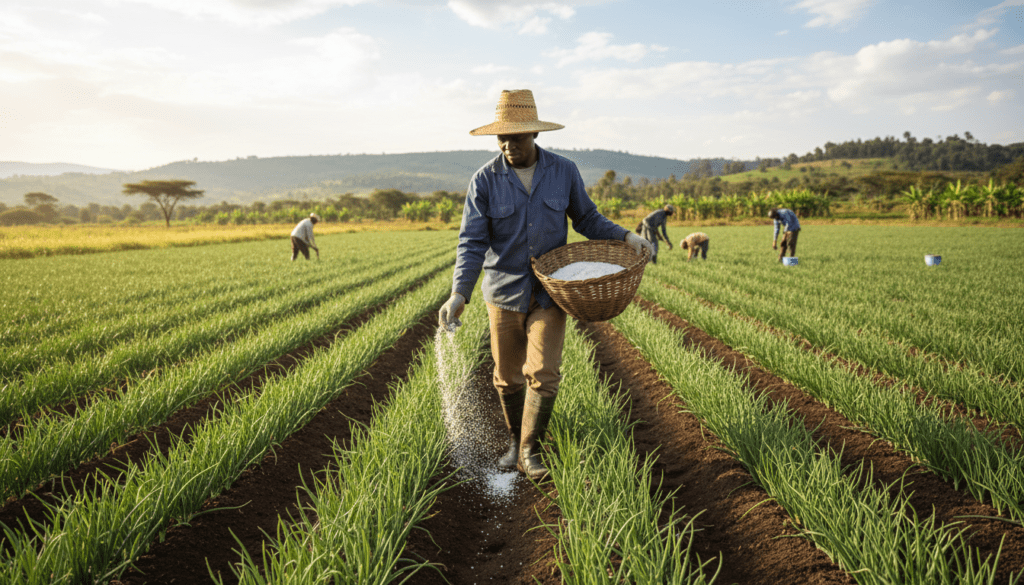
About 3 to 4 weeks after transplanting, apply a nitrogen-rich fertilizer. CAN (Calcium Ammonium Nitrate) is the standard in Kenya. For a single crate, you only need about one tablespoon (10-15 grams). Sprinkle it carefully between the rows, ensuring the granules do not touch the plant stems or leaves, as they will burn the plant. Water immediately after applying to dissolve the fertilizer into the root zone.
The second top dressing should happen about 6-8 weeks after transplanting, just as the bulbing process begins. At this stage, switch to a balanced fertilizer or one higher in potassium, like NPK 17:17:17. Potassium is the element that makes fruit and bulbs swell. Avoid excessive nitrogen at this stage (don’t use Urea), as it will encourage thick necks and leafy growth but delay bulb formation and reduce storage quality.
Applying fertilizer to onions in a crate using a spoon to ensure precise dosage and avoid burning the plants.
PEST AND DISEASE CONTROL
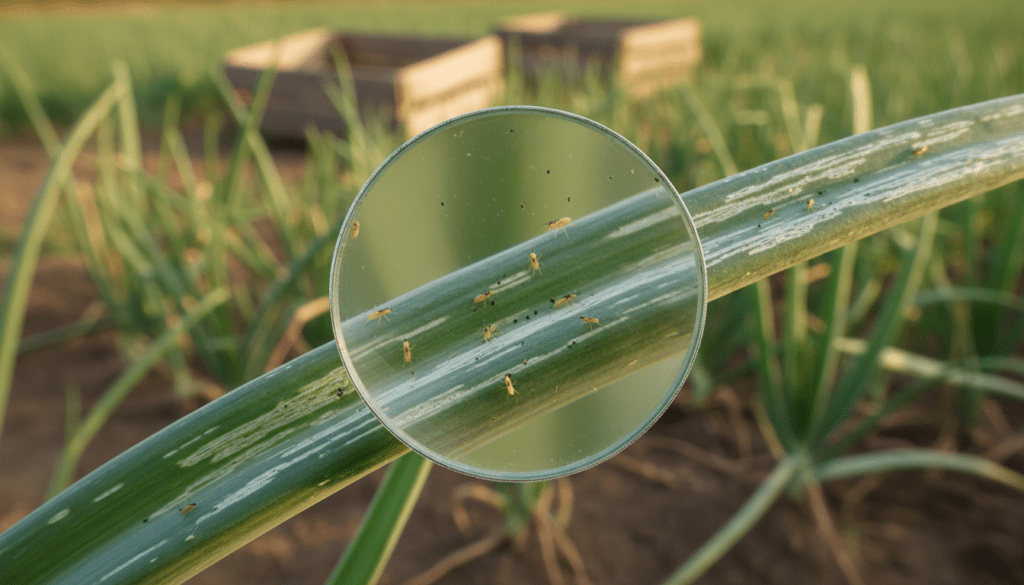
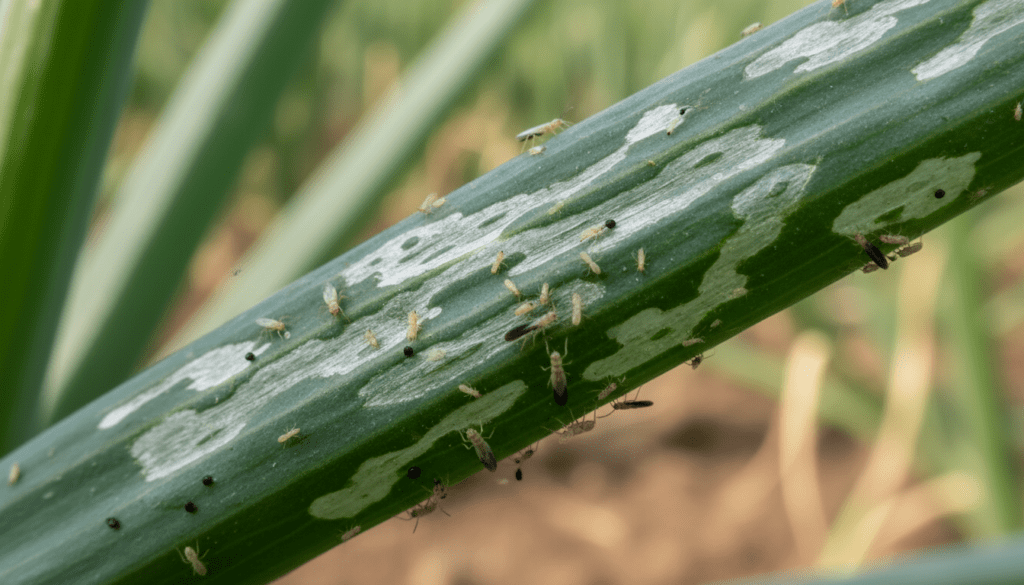
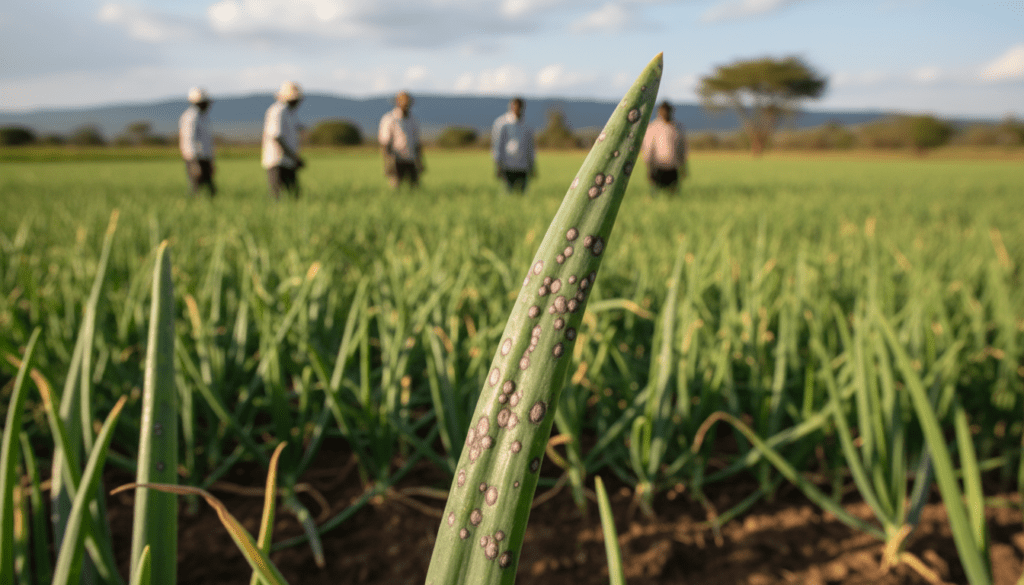
The two biggest enemies of onion farmers in Kenya are Thrips and Downy Mildew. Thrips are tiny, microscopic insects that hide deep in the center of the onion leaves. They suck the sap, causing the leaves to turn silvery or white and dry up. If you see your onion leaves looking like they have silver streaks, you have Thrips. Because crates are often near the house, you might prefer organic or low-toxicity controls. Neem oil is effective if used regularly. For chemical control, products containing Lambda-cyhalothrin (like Duduthrin) or Acetamiprid are common in Kenyan agrovets. Always spray in the evening when bees are not active.
Downy Mildew is a fungal disease that appears as a violet-grey mold on the leaves, usually during cold, wet weather. It causes the leaves to collapse. Prevention is better than cure: ensure your crates are spaced out to allow airflow and never water the leaves in the evening. If infection occurs, fungicides containing Metalaxyl or Mancozeb (like Ridomil Gold) are the industry standard for control.
WARNING: Always observe the Pre-Harvest Interval (PHI) indicated on any pesticide bottle. This is the number of days you must wait after spraying before you can eat the produce. For onions, this is crucial for your family’s safety.
A close-up view of thrips damage on onion leaves, characterized by silvery streaks, alerting farmers to the need for pest control.
SIGNS OF MATURITY AND HARVESTING
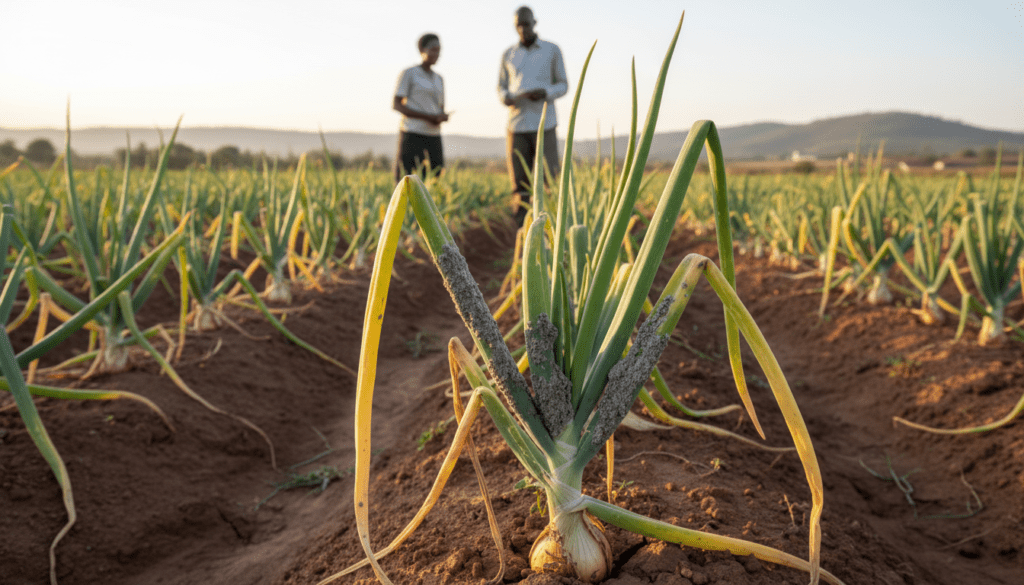
How do you know when your crate onions are ready? They will tell you. As the bulb reaches its maximum size, the “neck” of the onion (the part just above the bulb) becomes soft and weak. The leaves will naturally collapse and fall over. This is called “neck fall.” When about 75% of the onions in your crate have toppled over, it is time to harvest.
Stop watering completely about 1-2 weeks before you intend to harvest. This helps the bulb dry out and creates a papery skin, which is essential for storage. To harvest, simply loosen the soil gently and pull the onions out by the leaves. Do not bang them against each other to remove soil, as this bruises them and causes rot.
Onions in a crate with their tops fallen over, signaling that they are fully mature and ready for harvesting.
You cannot cook the onions immediately after pulling them if you want to store them. They need to “cure.” Curing dries the neck and seals the bulb against bacteria. In a field, farmers leave onions on the ground, but in a crate system, you should move them to a warm, dry, shaded area.
Lay the onions out in a single layer on a wire mesh or a dry sack. Do not pile them up. Keep them there for 2-3 weeks. You will know they are cured when the outer skin is dry and papery, and the neck is completely tight and dry. Only then should you cut off the dried roots and the dried leaves, leaving about an inch of the neck attached. Your onions are now ready for the kitchen or the market.
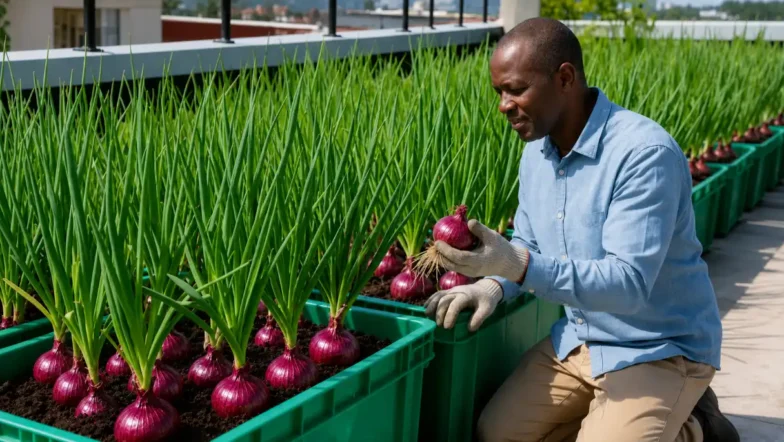
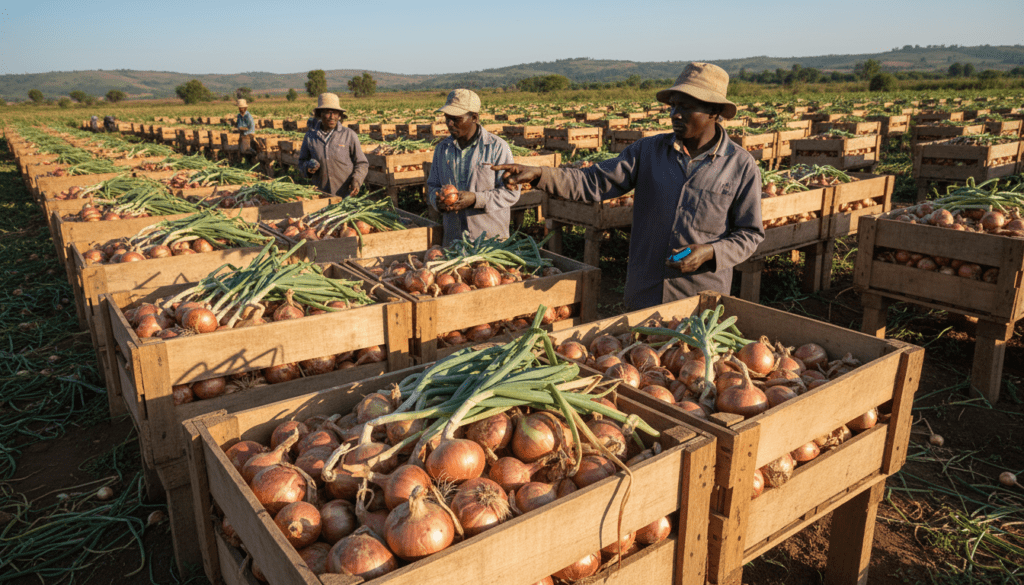
A successful urban farmer displaying a harvest of large red onions grown in crates, showcasing the potential of vertical farming.
In the digital age, you don’t need to travel to Nairobi’s River Road to get certified seeds. Several reputable Kenyan agricultural platforms deliver seeds countrywide.
KENYA SEED COMPANY: The state corporation has robust varieties tailored for local climates. While their website is informative, you can often order via their regional stockists or authorized online distributors. https://www.kenyaseed.co.ke/
AGRIJIBU: A comprehensive online agrovet that stocks seeds from Simlaw, Royal Seed, and Syngenta. They offer delivery services across Kenya. https://www.agrijibu.com/
M-SHAMBA: A digital platform connecting farmers to inputs. They verify their suppliers, ensuring you don’t buy fake seeds. https://m-shamba.com/
ROYAL SEED (KENYA HIGHLAND SEED): Known for their premium F1 varieties like Red Pinoy and Jambar. Their website lists authorized distributors, and some third-party platforms stock their full range. https://www.royalseed.co.ke/
SIMLAW SEEDS: You can find their “Online Shop” link on their official website, offering a wide range of vegetable seeds including Red Creole. https://www.simlaw.co.ke/
EXPERT TIP: When buying online, always check for the KEPHIS certification label on the packet image or description. This seal guarantees that the seeds have been tested for germination and purity.
CONCLUSION
Growing bulb onions in crates is more than just a gardening trend; it is a declaration of food independence for the Kenyan urban dweller. It transforms idle concrete spaces into productive, high-yield mini-farms. By following the precise steps of soil mixing, selecting the right F1 varieties like Jambar, and managing your water and nutrients with care, you can harvest professional-quality onions that rival anything found at Marikiti.
The initial effort of sourcing crates and mixing soil is a one-time investment. Once established, your crate farm becomes a renewable asset, producing cycle after cycle of fresh, pungent, and valuable red onions. Start with five crates today, master the water balance, and soon you will be scaling up to cover your entire roof. The soil is ready, the market is waiting-get planting.
FREQUENTLY ASKED QUESTIONS (FAQ)
Can I use soil from my backyard for the crates?
yes, You must mix it with well-rotted manure and river sand (3:2:1 ratio) to ensure drainage and fertility. If your soil is very sticky (clay), add more manure and sand.
How many onions can I grow in one crate?
In a standard milk/bread crate (approx. 60x40cm), you can comfortably grow 15 to 20 onions.
My onions are producing flowers. Is this good?
No, this is bad. It’s called “bolting.” When an onion flowers, it sends a hard stalk through the center of the bulb, making it tough and inedible.
Why are my onion bulbs small?
Small bulbs are usually caused by three things: planting too deep (burying the bulb), lack of sunlight (onions need full sun), or lack of potassium.
How often should I water the crates?
Perform the finger test daily. In hot weather (Jan-Mar), you might water daily. In cool weather, maybe 2-3 times a week.
Can I grow spring onions (vitunguu vya majani) in the same way?
Yes, absolutely. In fact, spring onions are easier as they don’t need to form a bulb. You can plant them closer together (5cm spacing) in crates. Varieties like “White Lisbon” are excellent for this.
How much profit can I make from one crate?
A single crate yields about 2-3 kgs of onions. At a market price of KES 80/kg, that’s KES 240 per crate. It sounds small, but if you have 50 crates, that’s KES 12,000 per harvest from a “waste” space on your roof.
What is the best season to plant onions in crates?
Since you can control water in crates, you can plant year-round. However, the best market prices are usually found between January and April.
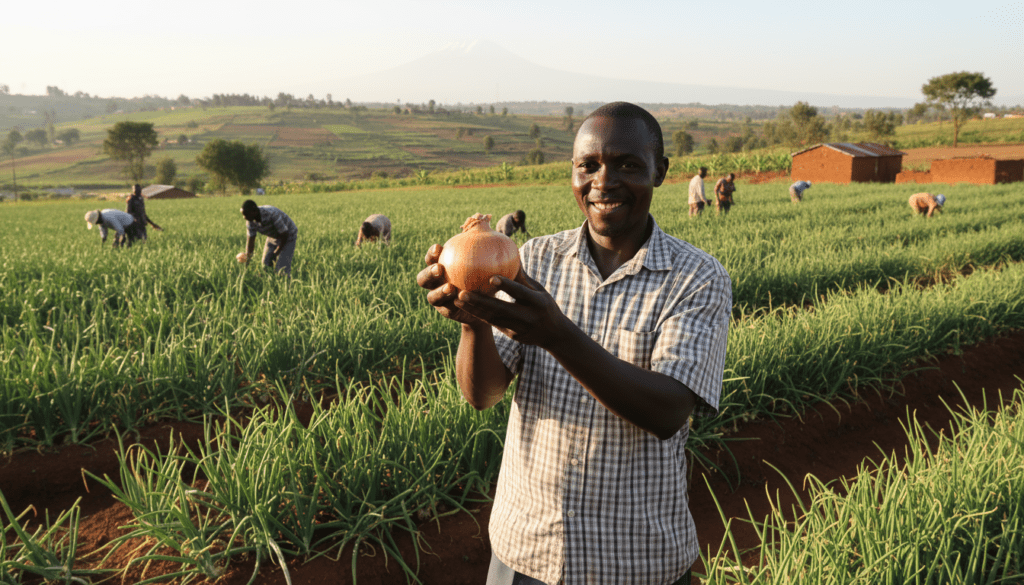
Bulb onion farming is one of the most lucrative agribusiness ventures in Kenya today. The demand for onions in major cities like Nairobi, Mombasa, and Kisumu remains consistently high throughout the year. Despite this demand, Kenya still imports a significant percentage of its onions from neighboring Tanzania to meet local consumption needs. This gap in supply presents a massive opportunity for local farmers to step in and make substantial profits.
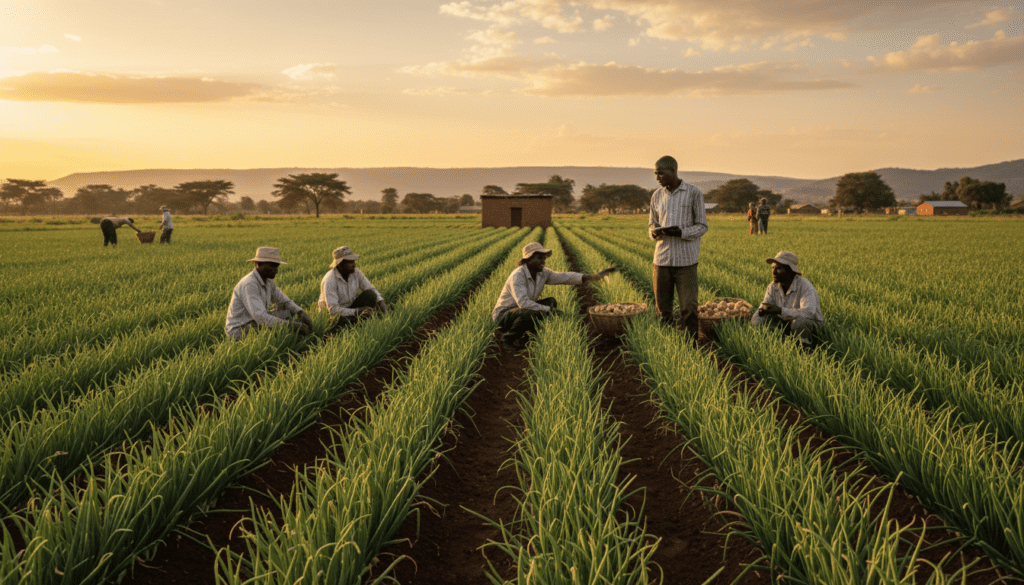
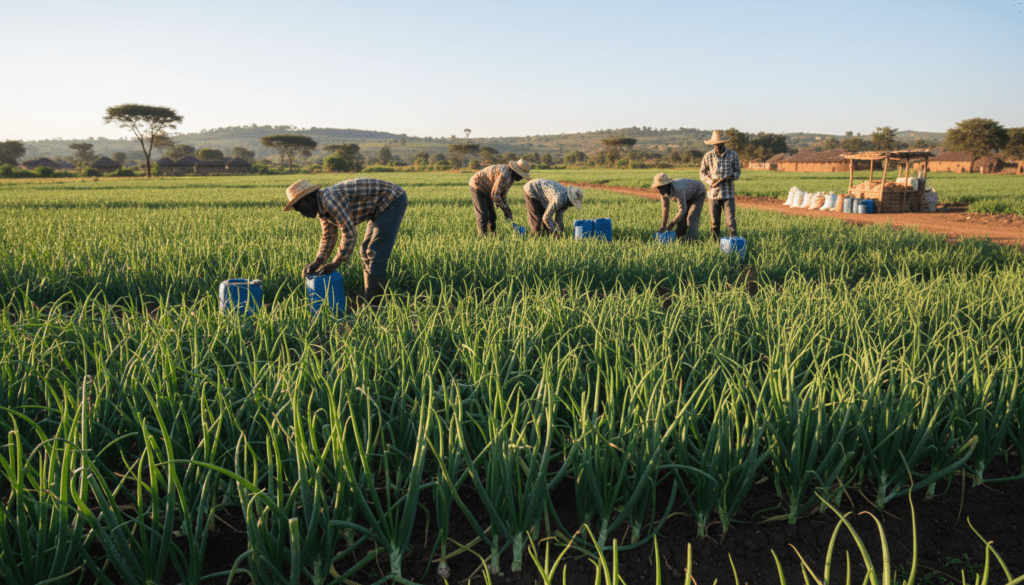
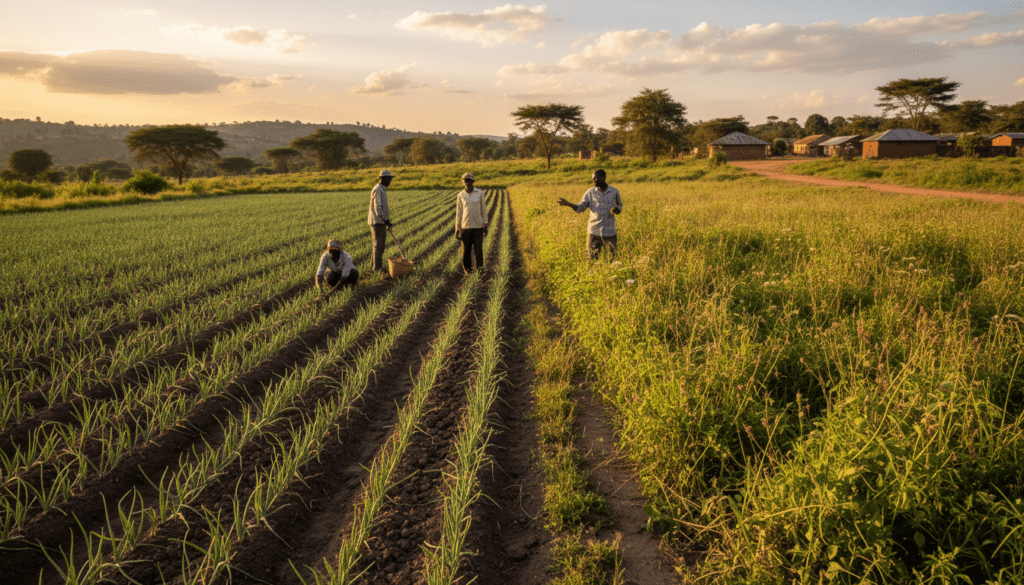
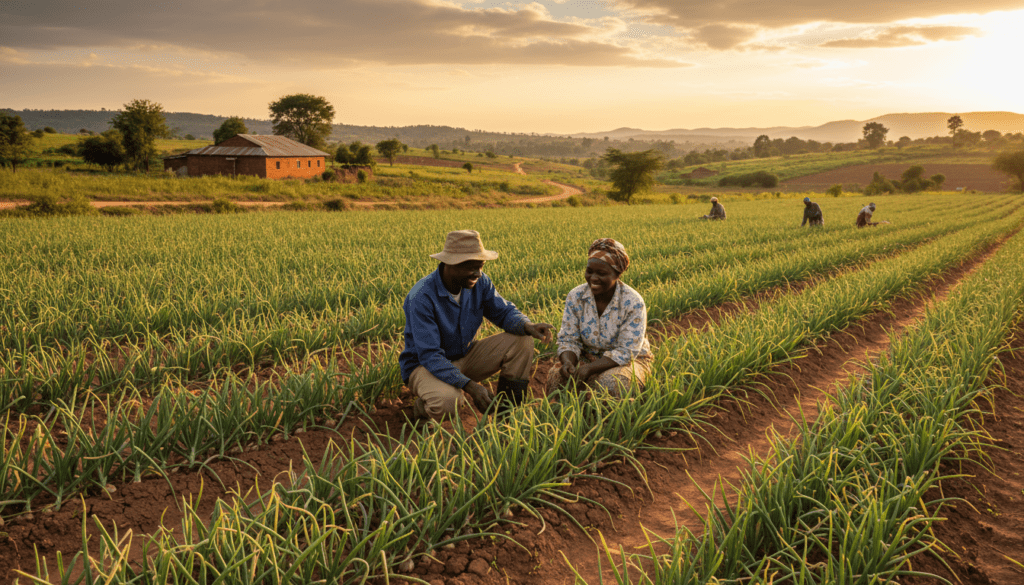
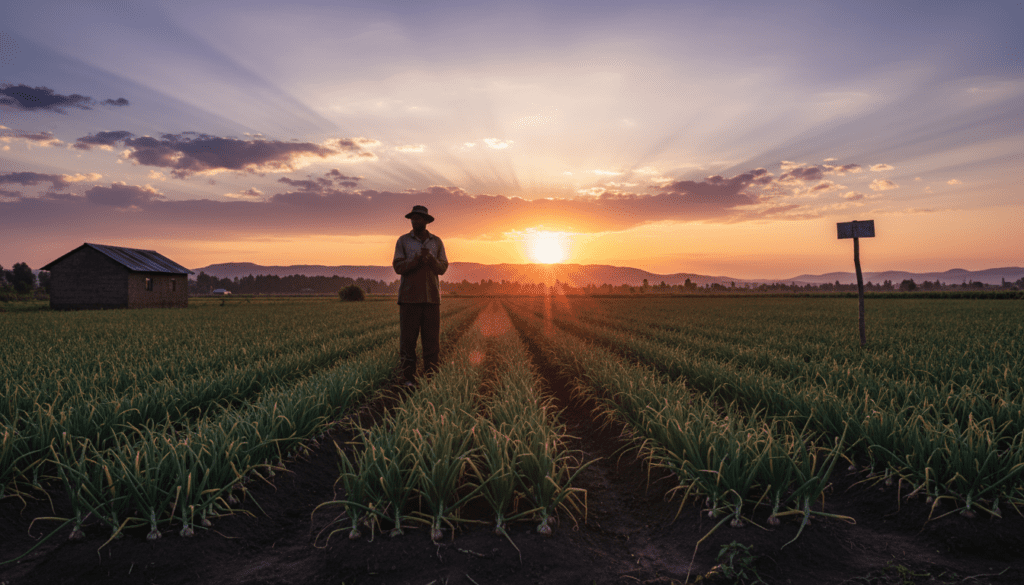
Successful bulb onion farming field in Kenya with a farmer inspecting the crop.
The journey to successful onion farming requires more than just planting seeds in the ground. It demands a clear understanding of ecological requirements, proper variety selection, and strict adherence to crop management practices. Farmers who ignore the technical aspects often face lower yields or poor bulb quality that the market rejects. This guide provides a comprehensive roadmap for beginners looking to start commercial onion farming in 2026.
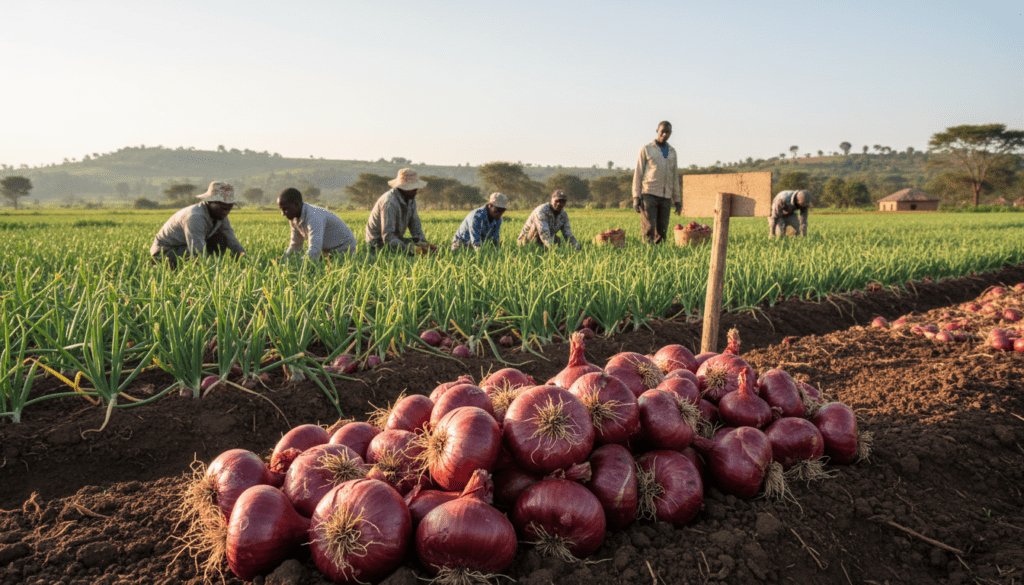
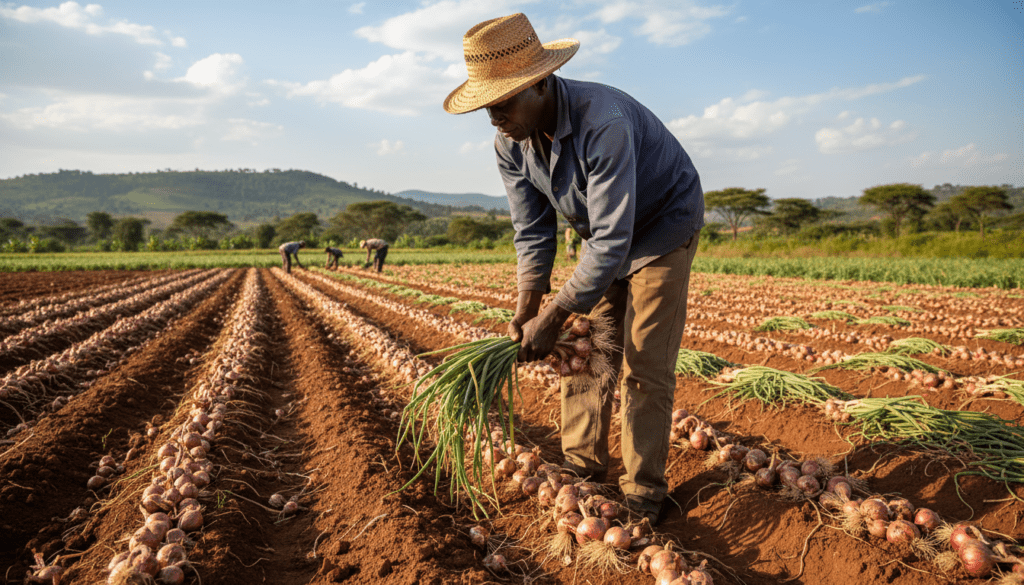
High-quality red bulb onions harvested from a Kenyan farm.
We will cover everything from soil preparation and nursery management to pest control and post-harvest curing. You will also find a detailed financial breakdown of the costs involved per acre and the expected profit margins. By following these expert steps, you can transform a single acre of land into a highly profitable business asset.
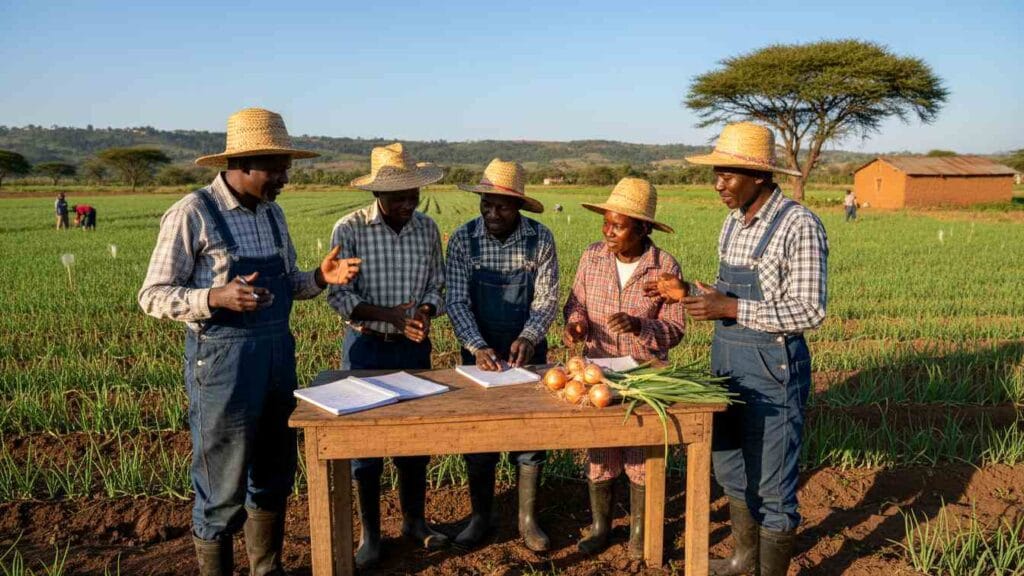
Kenyan farmers planning their onion production season.
Ecological Requirements for Onion Farming in Kenya
Onions are distinct from many other vegetable crops because they react heavily to day length and temperature. In Kenya, we mostly grow short-day varieties that are adapted to our 12-hour daylight cycle. Planting the wrong variety in the wrong climate will result in onions that produce plenty of leaves but fail to form bulbs.
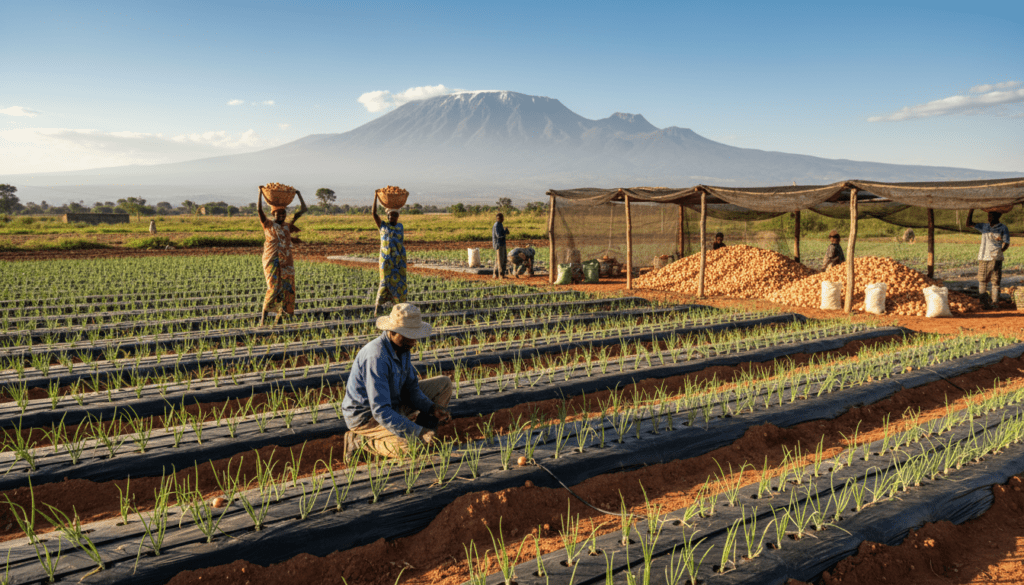
Ideal semi-arid landscape for onion farming in Kenya with irrigation systems.
Altitude and Temperature
Onions perform best in altitudes between 500m and 2,000m above sea level. This covers many agricultural zones in Kenya, including Oloitoktok, Naivasha, Rumuruti, and parts of Meru. The ideal temperature range for bulb formation is between 15 degrees Celsius and 30 degrees Celsius. Hot weather contributes to better curing and lower disease incidence, which is why dry areas with irrigation are preferred over cold, misty highland regions.
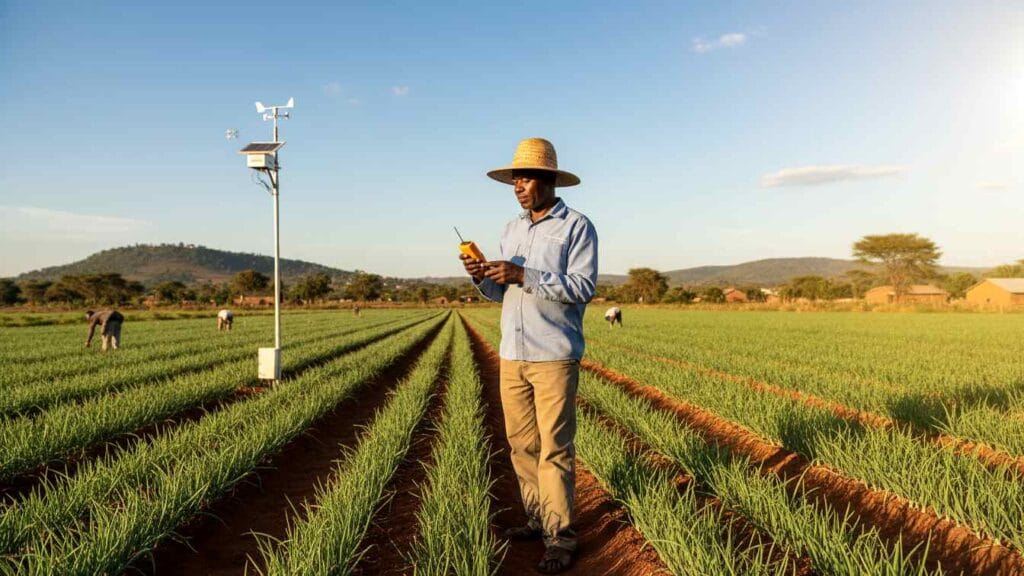
Farmer monitoring temperature conditions for optimal onion growth.
Soil Characteristics
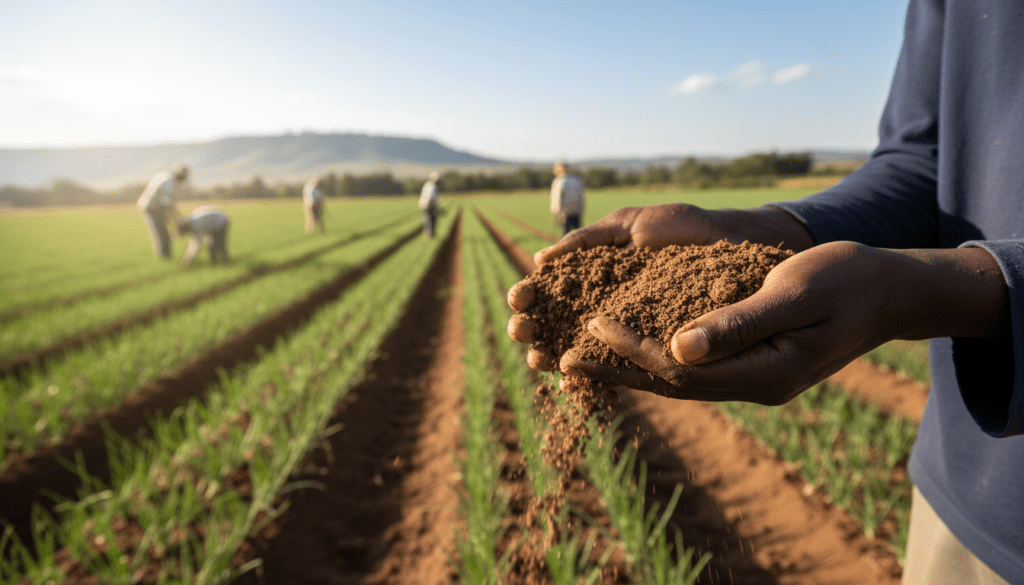
The soil is the foundation of your onion crop. Onions have a shallow root system and require loose, friable soil to expand their bulbs without resistance. Heavy clay soils are discouraged because they restrict bulb expansion and can lead to waterlogging, which causes rot. Sandy loam soils are the gold standard for onion production.
Ideal sandy loam soil texture for growing bulb onions.
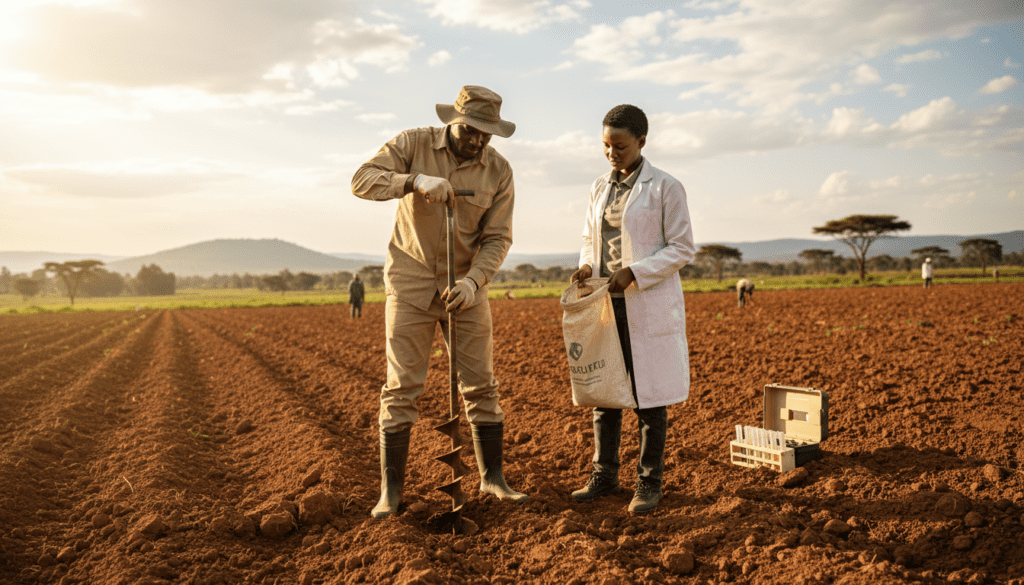
Soil pH is another critical factor that is often overlooked. Onions prefer a pH range of 5.8 to 6.5. If your soil is too acidic (below pH 5.5), nutrients like phosphorous become unavailable to the plant, leading to stunted growth. It is highly recommended to take a soil sample to a KALRO center or a private lab for analysis before ploughing your land.
Soil testing process for onion farming in Kenya.
Best Onion Varieties for the Kenyan Market
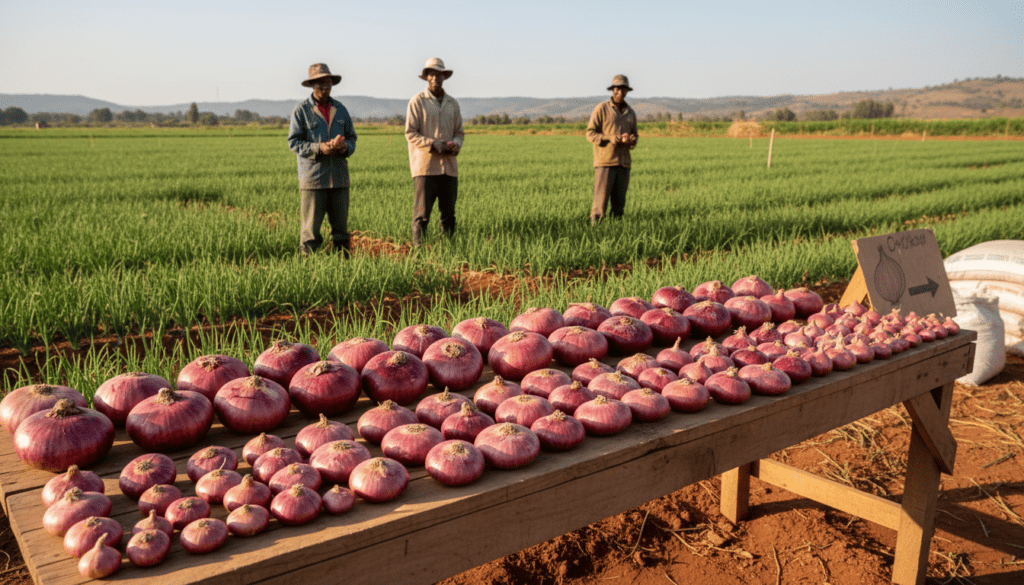
The Kenyan market has a strong preference for Red Onions. While white and yellow onions exist, red onions account for over 90 percent of the market share due to their pungency and longer shelf life. When choosing a variety, you must decide between Open Pollinated Varieties (OPVs) and Hybrid (F1) varieties.
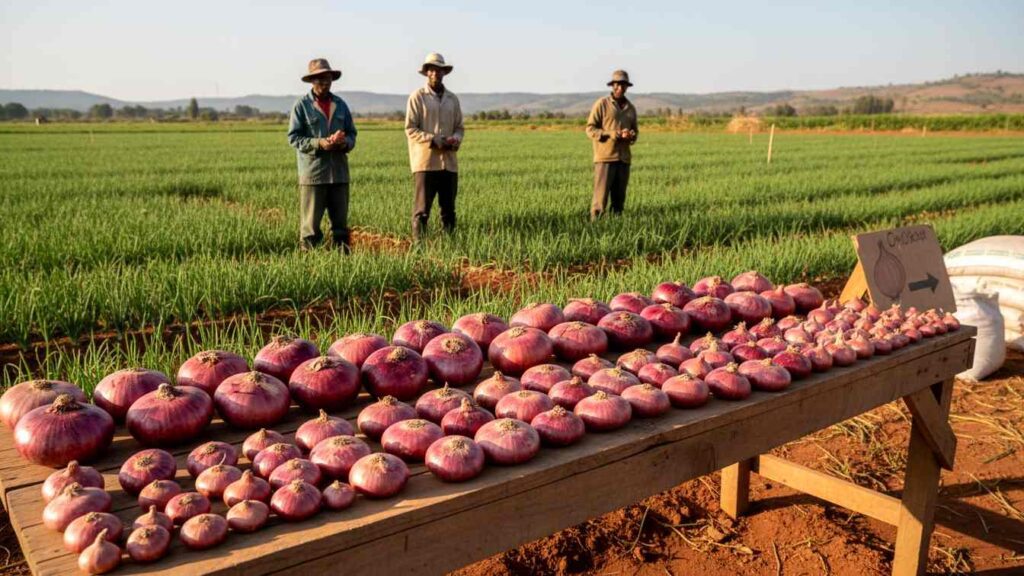
Comparison of different red onion seed varieties available in Kenya.
Jambar F1
Jambar F1 is currently one of the most popular varieties among commercial farmers. It is known for its high yield potential and large bulb size. It has a flat-globe shape and a deep red color that traders love. Jambar F1 matures in about 90 days after transplanting and has excellent storage qualities, allowing farmers to wait for better market prices.
High-yielding Jambar F1 onion variety.
Red Creole
Red Creole is a standard open-pollinated variety that has been farmed in Kenya for decades. It is pungent and has a very long shelf life. However, its yield is generally lower than F1 hybrids, and it takes slightly longer to mature. It is a good starting point for farmers with a limited budget for seeds, as the seed cost is significantly lower than hybrids.
Red Creole onions displayed for sale.
Neptune F1
Neptune F1 is an early maturing hybrid that is gaining traction. It is uniform in shape and highly resistant to pink root disease. This variety is excellent for farmers targeting a specific market window where speed to market is essential. It produces consistent medium-to-large bulbs that pack well in net bags.
Uniform growth of Neptune F1 onion variety in a Kenyan field.
Red Pinoy F1
Red Pinoy is another heavy yielder with a strong deep red color. It is well adapted to East African conditions and shows good tolerance to downy mildew, which is a major challenge in cooler or wetter areas. The bulbs are globe-shaped and have a high market demand in Nairobi.
Packing Red Pinoy onions for the Nairobi market.
Nursery Management: The Foundation of Success
You should never plant onion seeds directly into the main field. They are too small and weak to compete with weeds or survive erratic watering. You must establish a nursery to raise healthy seedlings for the first 6 to 8 weeks. The success of your crop is 50 percent determined by the quality of your seedlings.
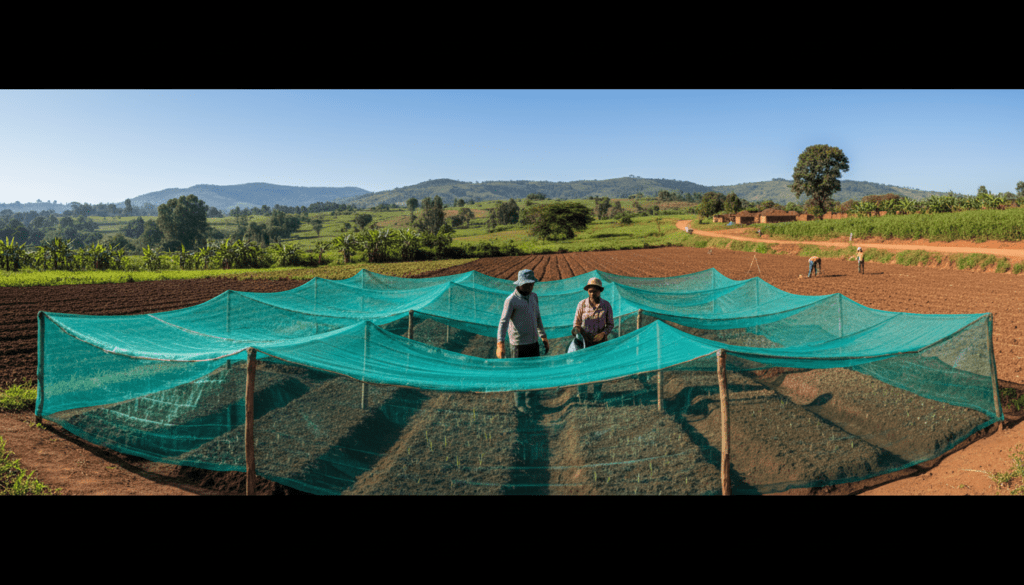
Professional onion nursery setup with shade nets.
Preparing the Nursery Bed
Select a site that has not grown onions or garlic for at least three years to avoid soil-borne diseases. Dig the soil deeply and break all clods until you have a fine tilth. Make raised beds that are 1 meter wide and of any convenient length. Raising the beds prevents waterlogging during heavy rains. Incorporate well-decomposed manure and a phosphate fertilizer like DAP into the topsoil.
Preparing a fine soil tilth for onion seeds.
Sowing the Seeds
Create shallow drills (furrows) running across the bed, spaced 15cm apart. Sowing in rows makes weeding and management much easier than broadcasting seeds. Drop the seeds thinly along the drills and cover lightly with soil. Mulch the bed with dry grass to retain moisture and water immediately.
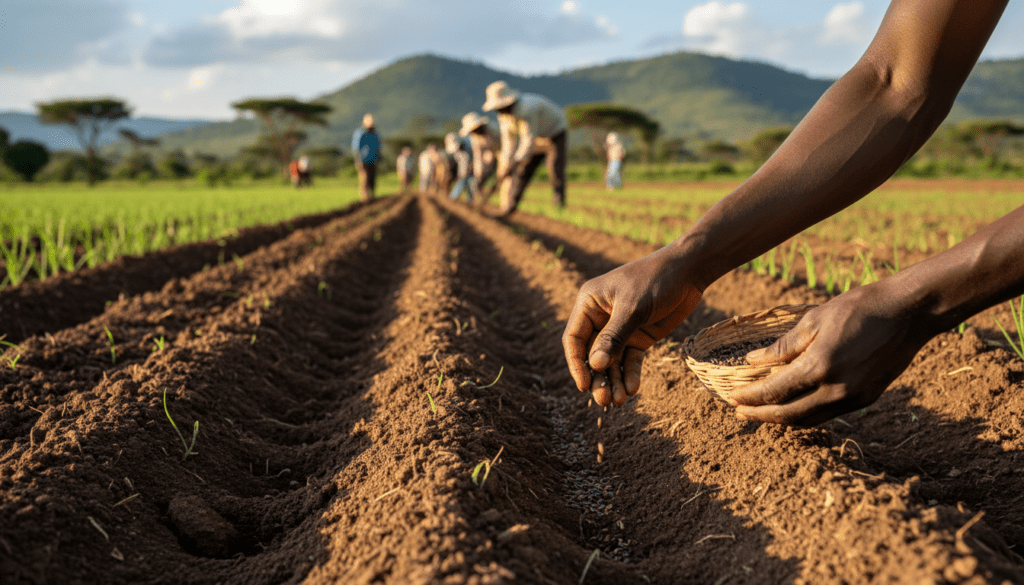
Sowing onion seeds in rows in a nursery bed.
Management and Hardening Off
Water the nursery twice daily until germination, which takes 7 to 10 days. Once the seedlings emerge, remove the dry grass mulch to prevent them from becoming spindly. As the transplanting date approaches (around week 6), reduce the watering frequency. This process, known as hardening off, toughens the seedlings and prepares them for the harsh conditions of the open field.
Healthy onion seedlings growing in a nursery.
Land Preparation and Transplanting
While your seedlings are growing in the nursery, you must prepare the main field. Onions require a very fine seedbed. Plough the land deep and harrow it using a tractor or hand tools to break all large lumps of soil. If the soil is clumpy, the bulbs will be deformed, reducing their market value.
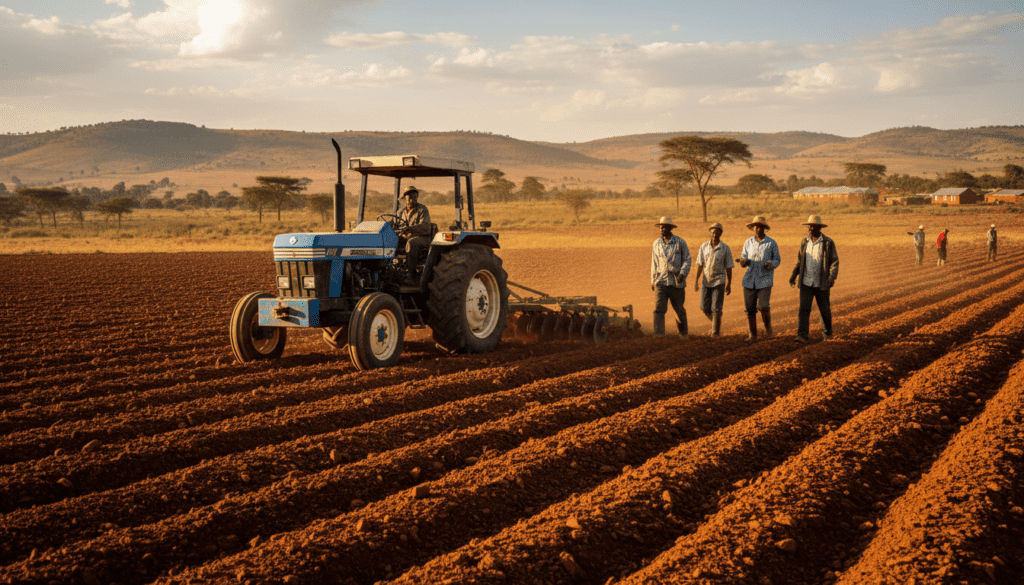
Tractor preparing land for onion farming.
Drip Irrigation Installation
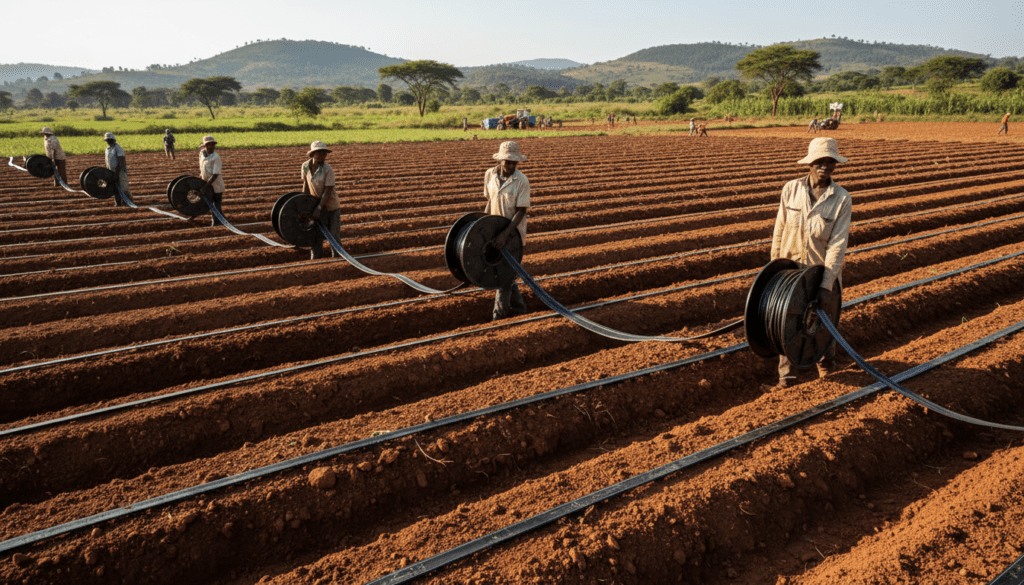
For commercial success, drip irrigation is highly recommended. It saves water, reduces fungal diseases by keeping the leaves dry, and allows for fertigation (applying fertilizer through water). Lay out your drip lines on raised beds. The standard bed width is 1 meter, with 3 drip lines per bed.
Installing drip irrigation for efficient onion farming.
Transplanting Procedure
Transplant when seedlings are pencil-thick, usually 6 to 8 weeks after sowing. Water the nursery heavily before pulling the seedlings to minimize root damage. It is a common practice to trim the roots slightly and cut off 20 percent of the green tops. This reduces transpiration shock and helps the seedling establish faster.
Spacing
Proper spacing is vital for bulb size. If you plant too closely, you will get small onions. If you plant too far apart, you waste land. The recommended spacing is 8cm to 10cm between plants and 20cm to 30cm between rows. This population density targets roughly 250,000 to 300,000 plants per acre.
Correct spacing for onion plants to ensure large bulb size.
Field Management and Fertilizer Program
Feeding your crop correctly is the difference between a 5-ton harvest and a 20-ton harvest. Onions are heavy feeders. You must follow a strict nutrition program that provides Nitrogen, Phosphorous, and Potassium at the right stages.
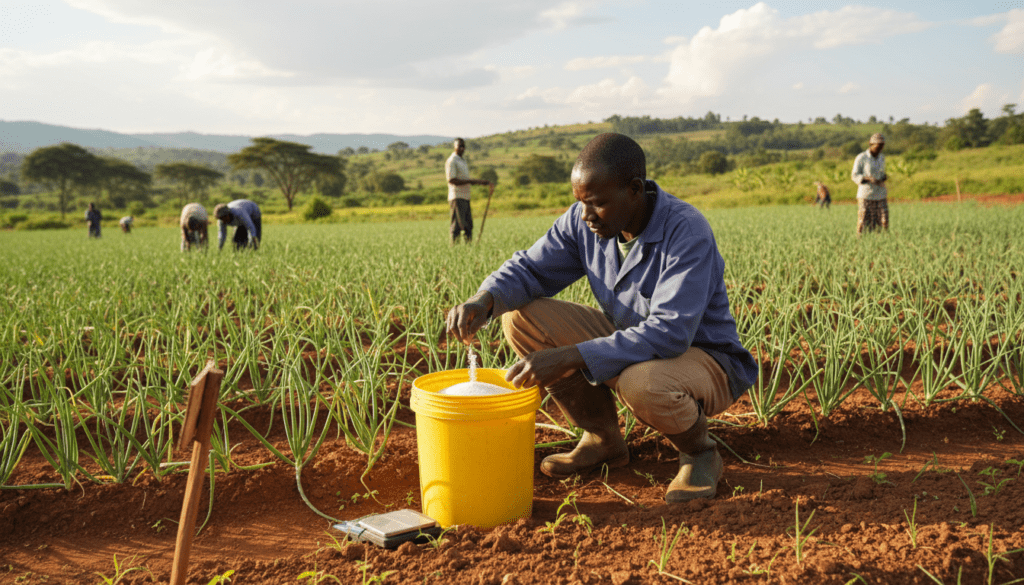
Measuring fertilizer for accurate onion crop nutrition.
Basal Application
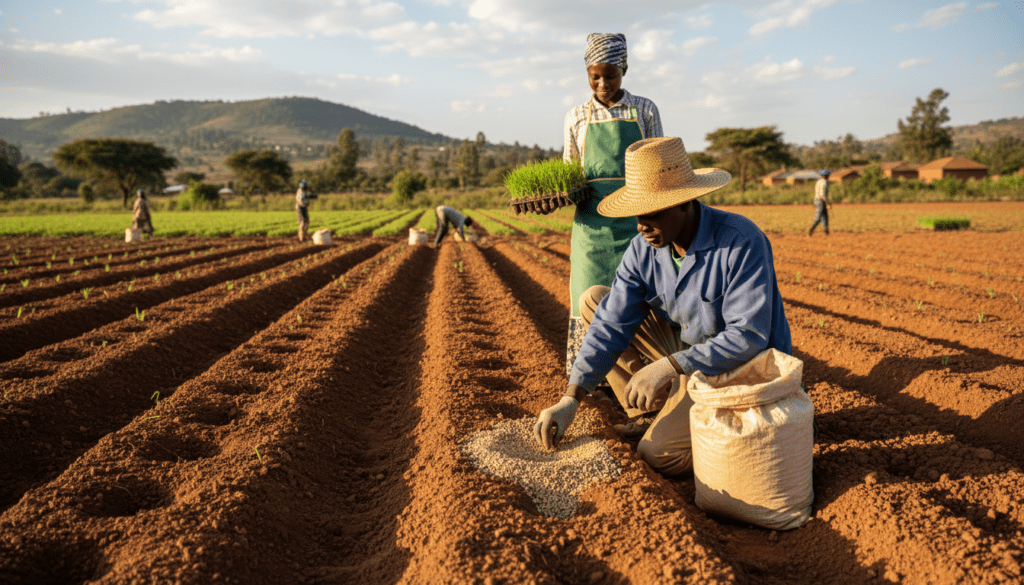
During transplanting, apply DAP (Diammonium Phosphate) or a balanced planting fertilizer. Phosphorous is essential for root development. Without a strong root system, the plant cannot support a large bulb later in the season.
Applying DAP fertilizer during onion transplanting.
Top Dressing
The first top dressing should be done 3 to 4 weeks after transplanting. Use CAN (Calcium Ammonium Nitrate) to boost vegetative growth. You need strong, healthy leaves because each leaf ring corresponds to a layer in the onion bulb.
Top dressing onion plants with nitrogen fertilizer.
The second top dressing is done at the onset of bulbing, usually 6 to 7 weeks after transplanting. Here, you should switch to an NPK fertilizer rich in Potassium, such as NPK 17:17:17 or a specialized onion booster. Potassium is the element responsible for transporting sugars from the leaves to the bulb, increasing its size and weight.
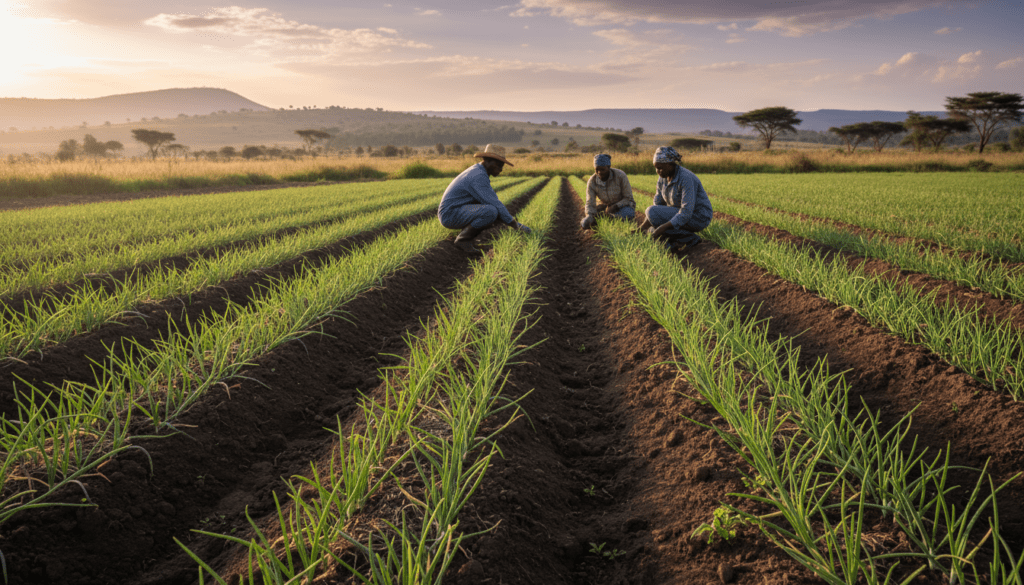
Healthy onion crop at the vegetative stage.
Weed Control
Onions are very poor competitors against weeds due to their upright, slender leaves which do not shade the ground. Weeds will steal nutrients and harbor pests like thrips. You can weed manually or use selective herbicides. Oxyfluorfen (often sold as Goal) is a common pre-emergent herbicide used to control broadleaf weeds in onion fields.
Weed-free onion field for maximum yield.
Pest and Disease Control
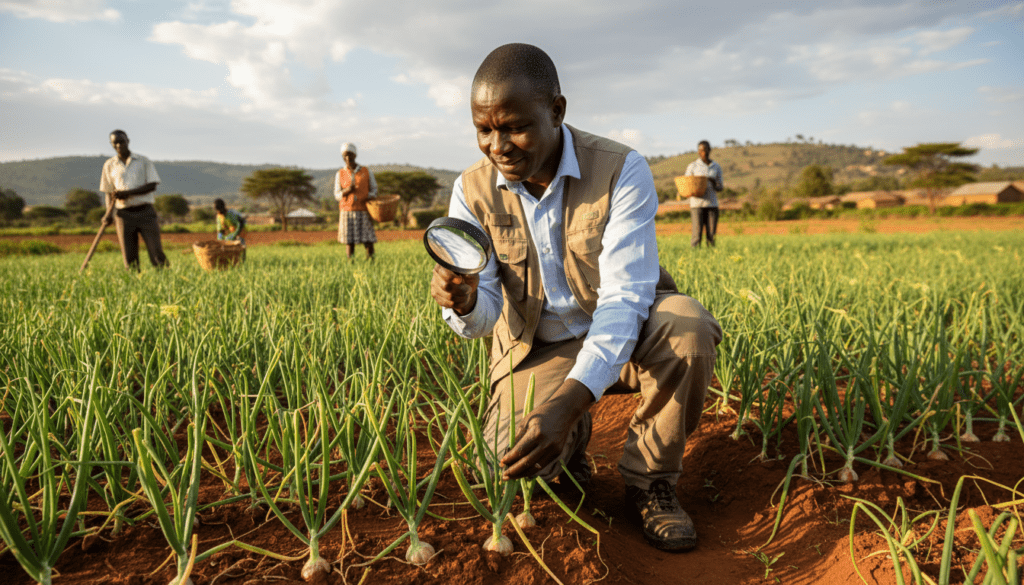
The biggest challenge in Kenyan onion farming is pest and disease management. Scouting your field daily is mandatory. If you wait until you see severe damage, it is often too late to save the crop.
Thrips are tiny insects that hide deep in the leaf axils. They rasp the leaves and suck the sap, causing silvery patches. Severe infestation causes the leaves to dry up and reduces bulb size. To control thrips, use insecticides with active ingredients like Acetamiprid, Imidacloprid, or Spinetoram. Always alternate your chemicals to prevent resistance.
Thrip damage on onion leaves.
Downy Mildew
This is a fungal disease that thrives in cold, wet conditions. It appears as a violet-grey fuzzy growth on the leaves. It can destroy a crop in days. Preventive sprays with Mancozeb are good, but for curative action, use Metalaxyl-based fungicides.
Downy mildew symptoms on onion plants.
Purple Blotch
This fungus causes purple lesions with yellow halos on the leaves. It usually attacks older leaves first. Good field hygiene and crop rotation are the best preventative measures. Azoxystrobin-based fungicides are effective for control.
Purple blotch disease on onion foliage.
Harvesting and Curing
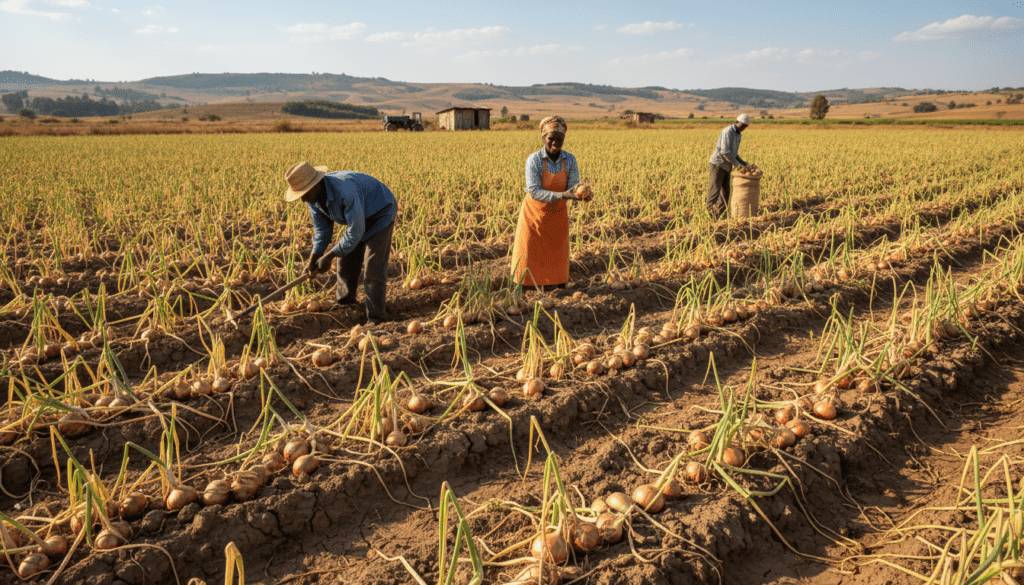
Harvesting is not just about pulling the crop; it is about timing. You should stop watering the onions 2 to 3 weeks before the expected harvest date. This helps the bulbs dry out and prevents rotting during storage.
Onion field ready for harvest with fallen tops.
Signs of Maturity
The crop is ready for harvesting when 75 percent of the tops have fallen over (neck fall) and the leaves have started to yellow. Do not wait for all the leaves to dry completely, as the bulbs might start regrowing roots if there is moisture in the soil.
Harvesting mature onions in a Kenyan farm.
Curing (Drying)
Curing is the process of drying the outer skin and the neck of the onion to seal it against bacteria. You can cure onions in the field if the weather is hot and dry by arranging them in windrows, covering the bulbs with the leaves of the next row to prevent sunscald. Alternatively, move them to a well-ventilated shed. Proper curing takes 1 to 2 weeks and is crucial for long shelf life.
Curing onions in the field to improve shelf life.
Cost of Production Per Acre (2026 Estimates)
Farming is a business, and you must know your numbers. Below is a detailed cost breakdown for one acre of bulb onions in Kenya. Note that these are estimates and costs can vary based on location and labour availability.
Item
Description
Cost (KES)
:—
:—
:—
Land Preparation
Ploughing, Harrowing, Bed making
15,000
Seeds
High quality F1 Hybrid seeds (e.g., 1kg)
25,000
Nursery Management
Labour, trays, media
5,000
Drip Irrigation Kit
Depreciation cost (one season share)
10,000
Transplanting Labour
Casuals for planting
6,000
Fertilizers
DAP, CAN, NPK, Foliar feeds
25,000
Crop Protection
Fungicides, Insecticides, Herbicides
20,000
Weeding Labour
Manual weeding (2-3 times)
10,000
Watering/Fuel
Pump fuel or water bill
15,000
Harvesting/Curing
Labour and bags
15,000
Miscellaneous
Transport, unexpected costs
10,000
**TOTAL**
**156,000**
Financial planning for onion farming costs in Kenya.
Profitability Analysis
The profit potential for onions is what attracts many investors. Let us look at conservative and optimistic scenarios.
Yield Expectations
A well-managed acre of hybrid onions can yield between 15 to 20 tons (15,000kg to 20,000kg). Average management usually yields around 10 to 12 tons.
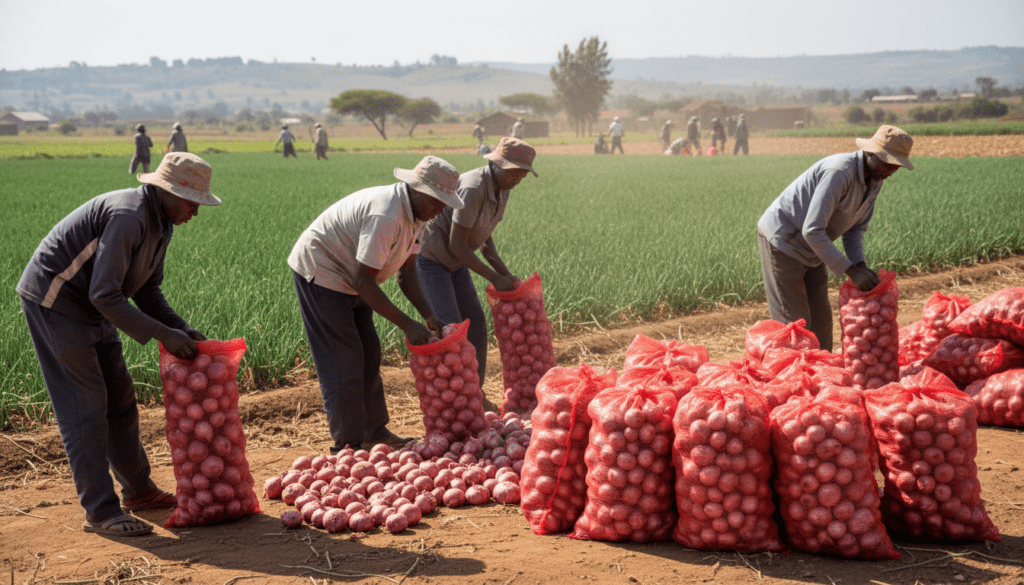
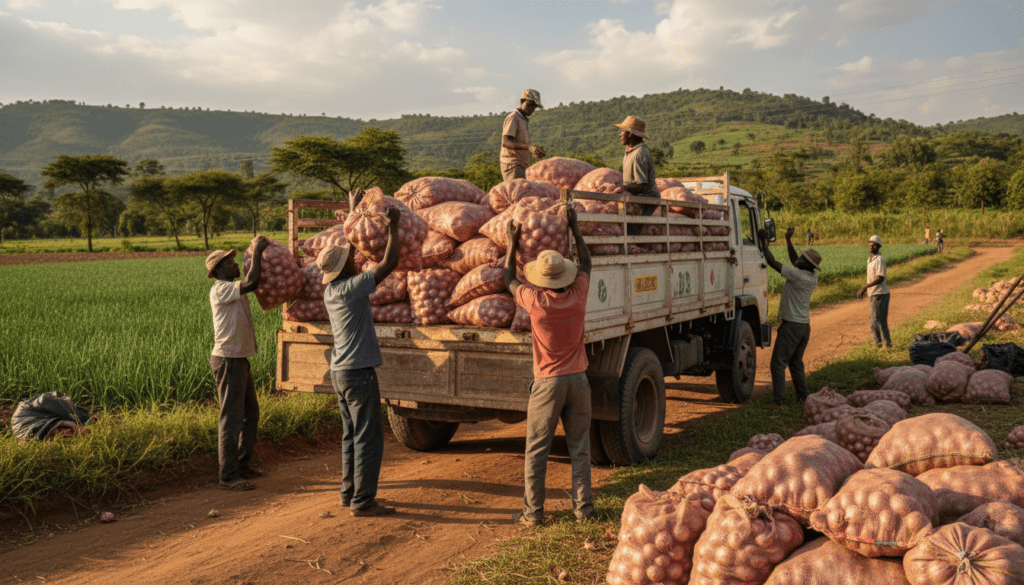
Loading harvested onions for transport to the market.
Market Prices
Market prices in Kenya fluctuate based on supply, usually ranging from KES 30 per kg (glut season) to KES 80+ per kg (scarcity). A safe average price for calculation is KES 45 per kg.
The Calculation
Target Yield: 16,000 kgAverage Farm Gate Price: KES 45 per kgGross Revenue: 16,000 x 45 = KES 720,000Total Cost of Production: KES 156,000Net Profit: 720,000 – 156,000 = KES 564,000
Even with a lower price of KES 35 and a lower yield of 12,000 kg, the revenue would be KES 420,000, leaving a net profit of over KES 260,000 in just 4 months. This represents a return on investment of over 100 percent.
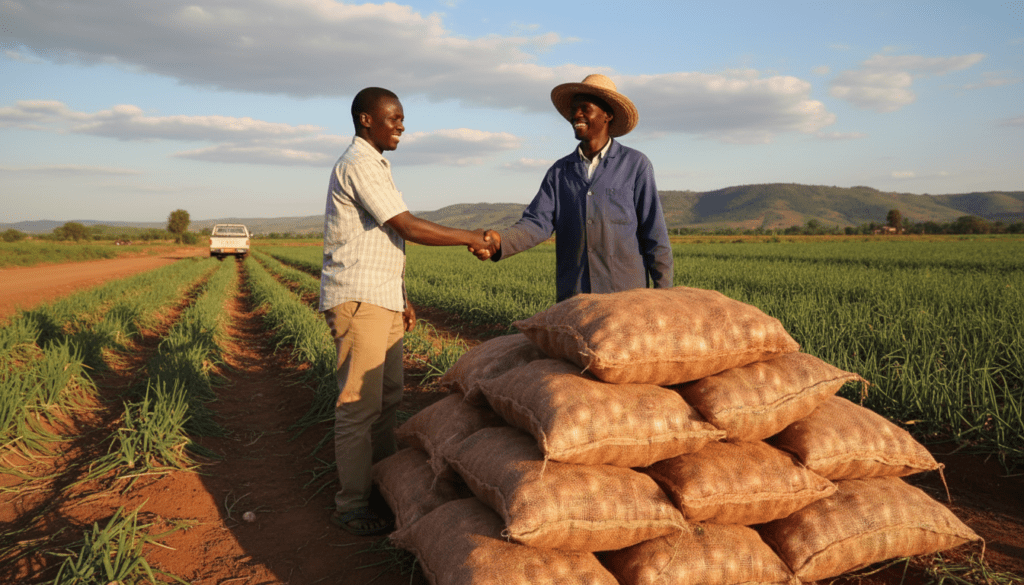
Successful onion sale transaction.
Market Challenges and Tips for Success
While the numbers look good, the market has pitfalls. The biggest challenge is the influx of onions from Tanzania, which often lowers prices in Kenyan markets. To beat this, you must time your planting.
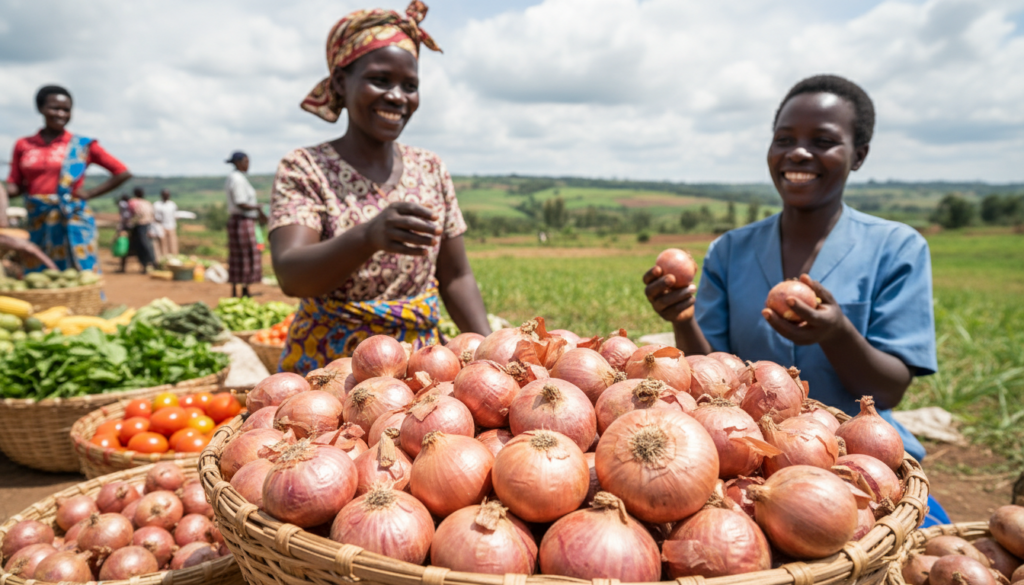
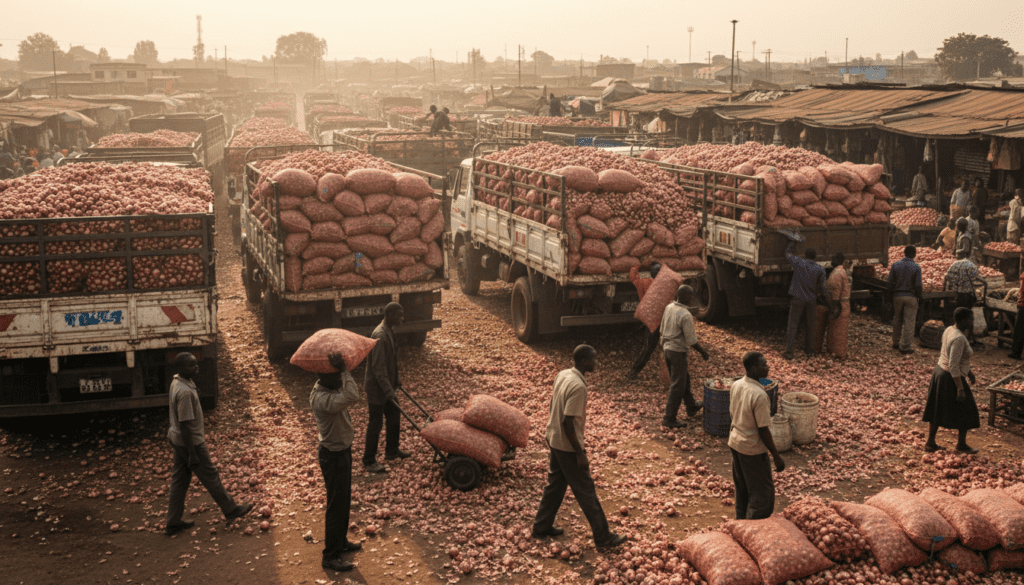
Onion trading at a busy Kenyan market.
Timing is Everything
The best prices are usually found from January to March and May to June. Work backwards from these months to determine your planting date. For example, to harvest in February, you need to transplant in November.
Dealing with Middlemen
Brokers are a reality in the Kenyan supply chain. To get better leverage, try to sell directly to institutions, schools, or supermarkets. Alternatively, form a group with neighboring farmers to aggregate your produce. A buyer is more likely to give a better price for a 10-ton truckload than for a few bags.
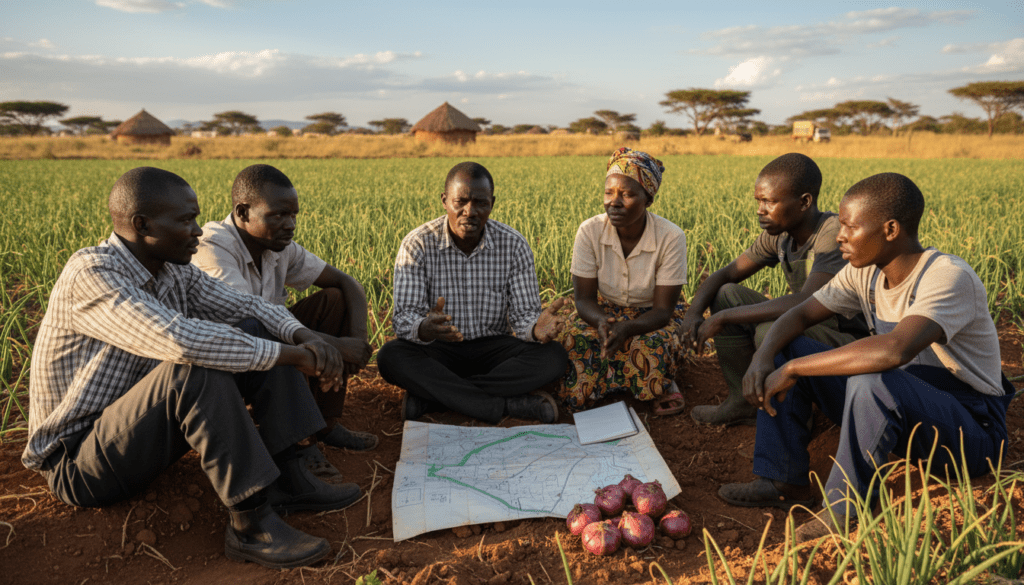
Farmers cooperating to sell onions in bulk.
Cure Properly
Farmers often rush to sell immediately after harvest because they need cash. If you cure your onions well, you can store them for 2 to 3 months in a well-ventilated store. This allows you to wait for the market glut to clear and prices to rise.
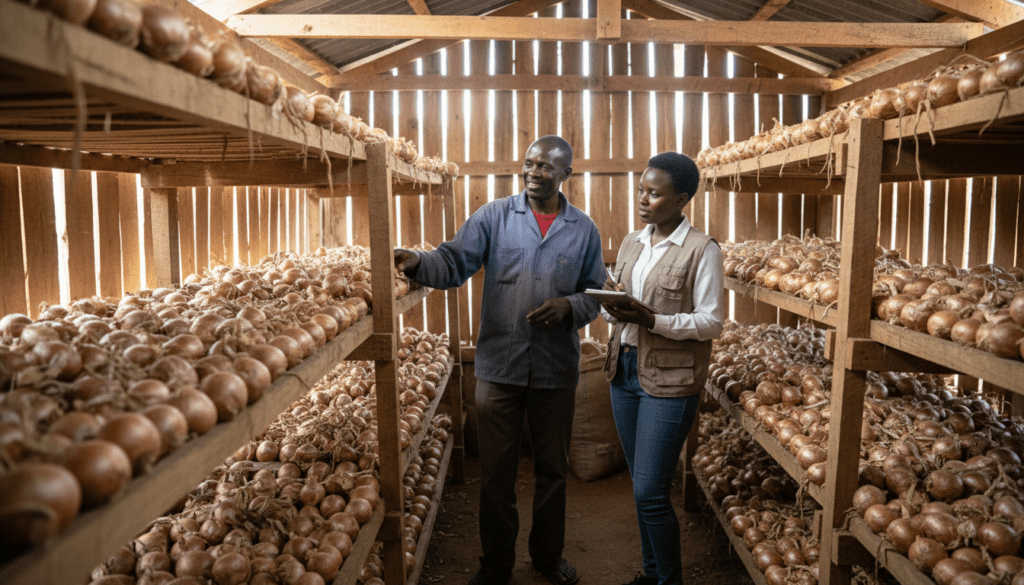
Proper storage facility for onions.
Conclusion: Start Your Onion Business Today
Onion farming in Kenya is a serious business that can pay off well if you do it the right way. It is not about guessing. It is about following a proven plan. Success comes from using good seeds, giving the plants the right food (fertilizer) and water, and watching for pests every single day so you can stop them before they cause big damage.
If you are a beginner, do not try to do too much at once. Start with a small piece of land so you can learn how the onions grow and how to handle the work. Once you see how the crop performs, you can slowly add more land.
Remember these three keys to making money:
Watch the Market: Check when onions are in short supply in your area and plan your planting so you can harvest during those times when prices are high.
Cut Waste: Keep your costs low by using drip irrigation to save water and by catching pests early so you do not waste money on expensive chemicals later.
Quality First: A well-dried onion (curing) lasts longer and fetches a higher price than one that is poorly handled. Take your time during the drying stage to seal the skin.
Onion farming is a journey. It takes hard work and patience, but the rewards are real. Start with what you have, stay consistent, and keep learning from every harvest. Your path to a successful farming business starts with the very first seed you plant today.
Frequently Asked Questions about Bulb Onion Farming in Kenya (2026)
1. Is bulb onion farming in Kenya profitable in 2026? Yes. With good management, one acre of hybrid bulb onions can generate several hundred thousand shillings in profit in a 4–5 month cycle, even after paying for seeds, fertilizers, labour and irrigation.
2. How much capital do I need to start 1 acre of bulb onions? For 2026, a realistic starting budget for one acre is about KES 150,000–170,000, depending on land preparation costs, seed type, labour rates and whether you already have a drip irrigation kit.
3. What is the best bulb onion variety for Kenyan markets? Popular high‑yielding red bulb varieties include Jambar F1, Neptune F1 and Red Pinoy F1, while Red Creole is a cheaper open‑pollinated option for farmers with a smaller seed budget.
4. How long do bulb onions take to mature in Kenya? Most hybrid bulb onions take about 3–4 months after transplanting to reach maturity, so from sowing in the nursery to final harvest you should plan for roughly 4–5 months.
5. What spacing should I use for bulb onions per acre? A common commercial spacing is 8–10 cm between plants and 20–30 cm between rows, giving roughly 250,000–300,000 plants per acre for good bulb size and high yield.
6. Do I need drip irrigation for bulb onion farming? You can grow onions under rain‑fed conditions, but drip irrigation is highly recommended because it saves water, reduces fungal diseases and allows you to apply fertilizers more efficiently.
7. Which areas in Kenya are best for bulb onion farming? Warm, well‑drained areas between about 500 m and 2,000 m above sea level such as parts of Kajiado, Naivasha, Machakos, Laikipia, Meru and other semi‑arid zones with access to irrigation perform very well.
8. What are the most common onion pests and diseases? Thrips are the number one insect pest, while major diseases include downy mildew and purple blotch, all of which require regular scouting and a planned spray program or integrated pest management.
9. When is the best time to plant onions for good prices? Many farmers target planting so that they harvest in the drier months like January–March or May–June, when market supply is lower and prices per kilogram are usually higher.
10. Where can I sell my bulb onions in Kenya? You can sell through major wholesale markets such as Wakulima (Marikiti) in Nairobi and Kongowea in Mombasa, local town markets, brokers, or directly to supermarkets, schools, hotels and institutions for better prices.
Conclusion
Bulb onion farming in Kenya is a serious business that rewards diligence and patience. It is not a get-rich-quick scheme, but a science that requires investment in good seeds, proper nutrition, and water management. By following the guidelines in this article, managing your costs, and keeping an eye on the market trends, you can successfully navigate the challenges and reap the sweet rewards of onion farming. Start small, learn the ropes, and scale up as you gain confidence.
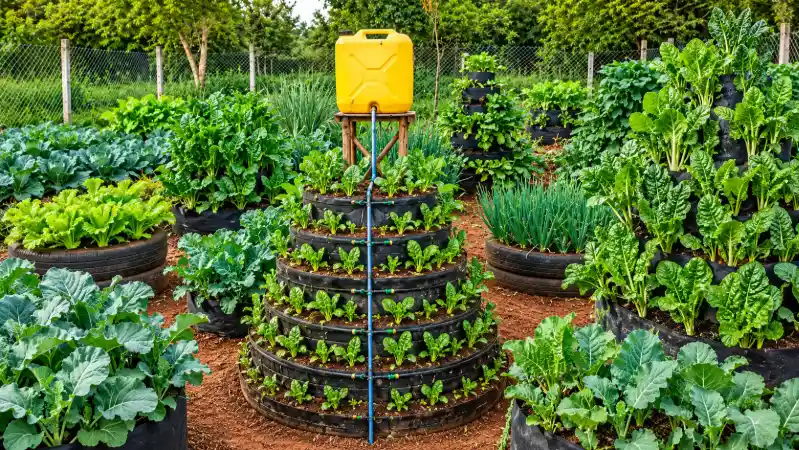
Discover the 20 best vegetables to grow in a kitchen garden in Kenya and learn how to grow them organically using the right soil mix, compost, grow bags, raised beds, vertical gardens, proper watering, and natural pest control. This complete guide is designed for Kenyan homes, small backyards, balconies, and urban spaces.
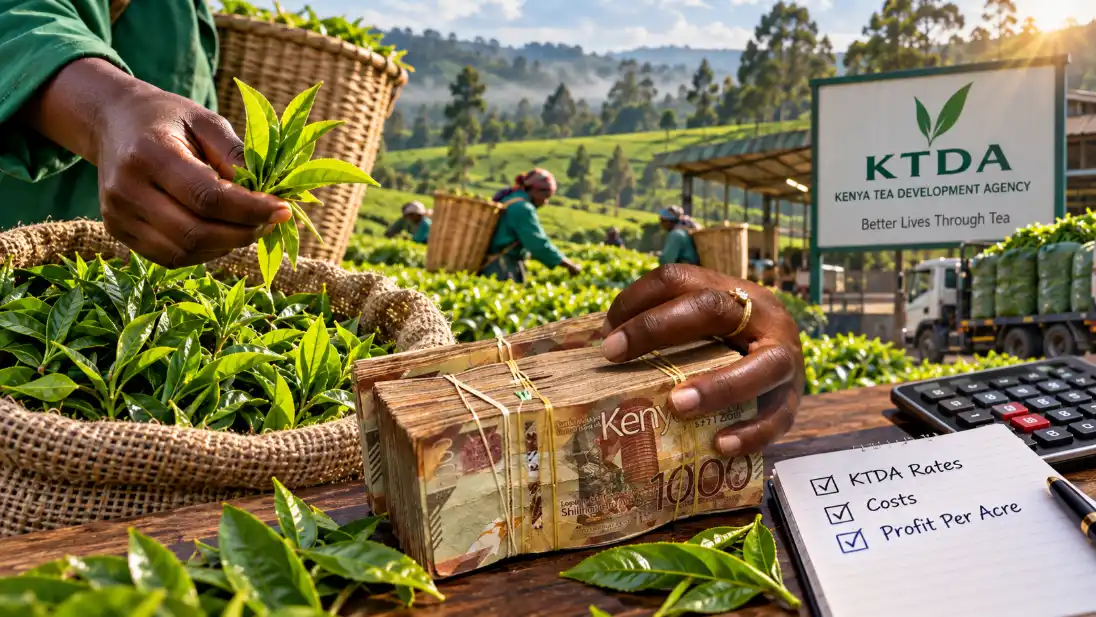
Learn how tea farming in Kenya works in 2026, including KTDA rates, startup and production costs, expected yields, profit per acre, best tea-growing areas, and practical tips for smallholder farmers.
To provide the best experiences, we use technologies like cookies to store and/or access device information. Consenting to these technologies will allow us to process data such as browsing behavior or unique IDs on this site. Not consenting or withdrawing consent, may adversely affect certain features and functions.
Functional
Always active
The technical storage or access is strictly necessary for the legitimate purpose of enabling the use of a specific service explicitly requested by the subscriber or user, or for the sole purpose of carrying out the transmission of a communication over an electronic communications network.
Preferences
The technical storage or access is necessary for the legitimate purpose of storing preferences that are not requested by the subscriber or user.
Statistics
The technical storage or access that is used exclusively for statistical purposes.The technical storage or access that is used exclusively for anonymous statistical purposes. Without a subpoena, voluntary compliance on the part of your Internet Service Provider, or additional records from a third party, information stored or retrieved for this purpose alone cannot usually be used to identify you.
Marketing
The technical storage or access is required to create user profiles to send advertising, or to track the user on a website or across several websites for similar marketing purposes.


 stephen kilemi
February 20, 2026
stephen kilemi
February 20, 2026