
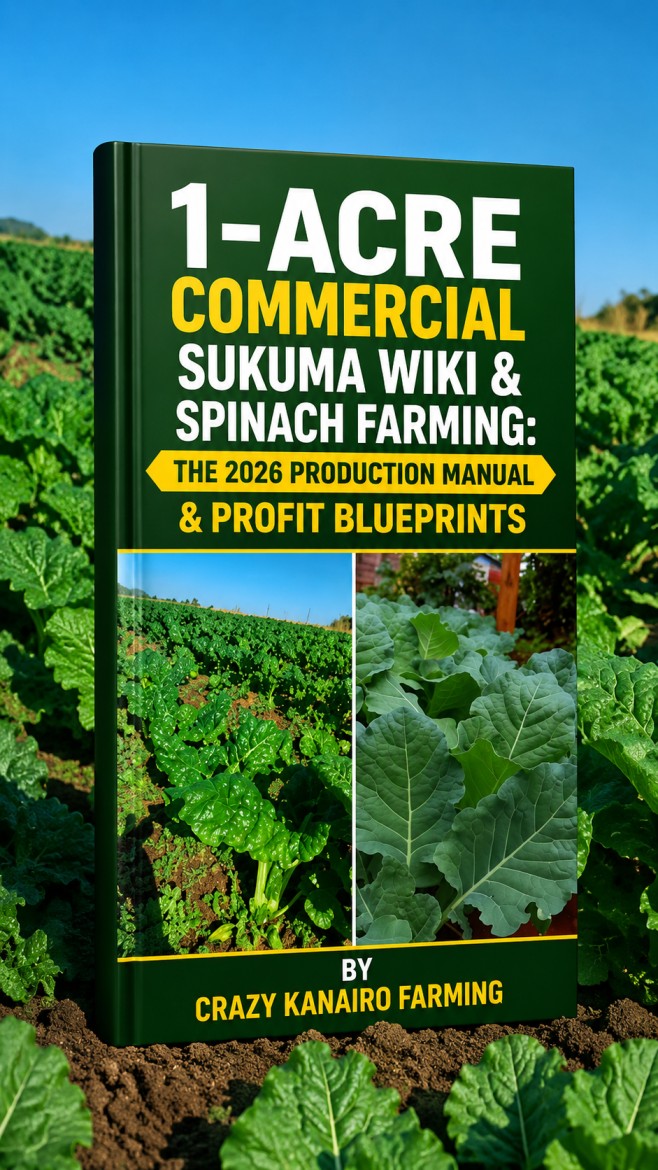
Most vegetable farmers in Kenya are not in business. They are in survival mode.
They plant when rain comes. They sell when brokers show up. They accept whatever price the market gives them. Then they call it farming.
That system is why most 1-acre farms never scale, never stabilize income, and never produce predictable profit.
This guide breaks that cycle completely.
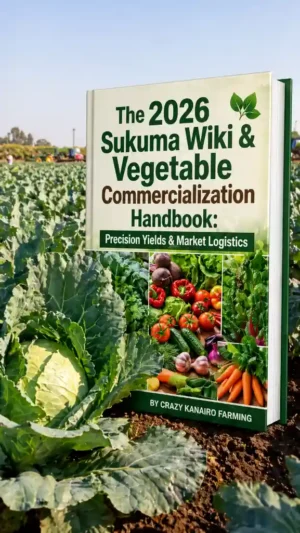
1-Acre Commercial Sukuma Wiki & Spinach Farming (2026 Edition) is not a theory document. It is a commercial production system.
It shows you how to convert a single acre of land into a structured agricultural operation that behaves like a factory, not a gamble.
With proper execution, a 1-acre setup can realistically generate between KES 600,000 and KES 1,200,000 annually by targeting dry-season scarcity, controlling input efficiency, and selling strategically instead of passively.
But here is the truth most farmers ignore:
Profit is not made in the field. Profit is made in the system behind the field.
Inside this guide, you will learn:
You will understand why most Sukuma Wiki farmers stay broke even when they have fertile land and rain.
You will see how commercial farmers structure irrigation, spacing, and staggered planting so they harvest every week instead of waiting for one uncertain season.
You will learn how to build a predictable supply chain that removes brokers who typically take 30% to 50% of your farm revenue.
You will understand the real economics of a 1-acre farm, including break-even pricing, cost control, labor structure, and market timing.
You will learn how professionals time production to hit price peaks when Sukuma Wiki rises from as low as KES 800 per bag to over KES 3,500 during scarcity windows.
You will also get a full breakdown of:
- Solar drip irrigation system setup for year-round production
- Soil preparation and nutrient correction for high yield crops
- Hybrid seed selection for fast turnover and disease resistance
- Nursery systems that guarantee survival rates above 95%
- Fertilizer programs that actually match commercial output targets
- Pest control systems that prevent total crop collapse
- Harvest handling systems that protect weight and market value
- Direct sales channels that bypass traditional market exploitation
This is the hard truth most farmers avoid:
If you are still farming without irrigation, without a planting schedule, without market contracts, and without cost tracking, you are not running a business.
You are taking chances with food production.
And in 2026, chances are expensive.
Who this guide is for:
This is for farmers who are tired of inconsistent income and want structure.
For landowners who want to turn 1 acre into a predictable cash-generating unit.
For agripreneurs who understand that farming today is data, timing, and systems, not guesswork.
Who this is NOT for:
If you are looking for quick money without work structure, this will not help you.
If you are not willing to track costs, manage labor, and follow a system, you will waste this information.
Bottom line:
This guide does not promise magic yields.
It shows you how commercial vegetable farming actually works when done like a business.
The difference between a struggling farmer and a profitable one is not land size.
It is system design.
If you are ready to stop guessing and start operating like a commercial producer, this manual is your starting point.
Discover more from Crazy Kanairo Farming
Subscribe to get the latest posts sent to your email.





There are no reviews yet.