
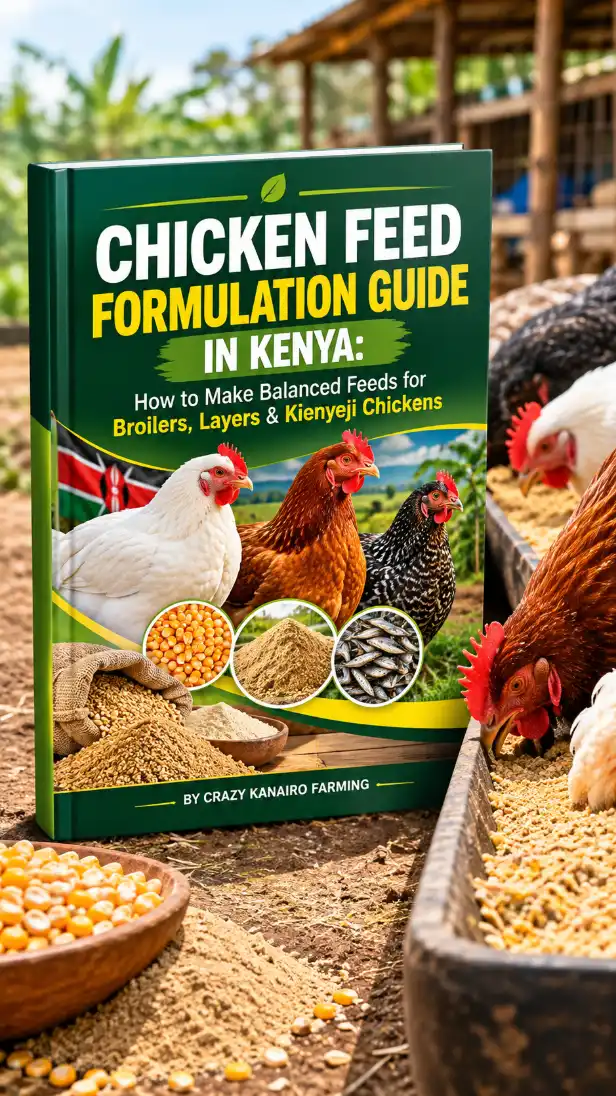
Chicken Feed Formulation Guide in Kenya
Feed can make or destroy your poultry business.
You can buy the best chicks, build an expensive poultry house and vaccinate correctly, but if the birds are eating badly formulated feed, your results will still disappoint you.
That is the reality many poultry farmers do not want to hear.
Slow-growing broilers, undersized Kienyeji chickens, poor egg production, weak eggshells and high feed consumption are not always caused by disease. Sometimes the problem is sitting inside the feeder.
And simply mixing maize, omena, bran and sunflower cake together does not automatically create balanced chicken feed.
This guide was created to help Kenyan poultry farmers understand the actual principles behind poultry feed formulation.
Stop Guessing With Buckets
One of the biggest mistakes farmers make is measuring ingredients using buckets, tins, basins or estimates.
That is not feed formulation.
Different ingredients have different densities. A bucket of maize does not weigh the same as a bucket of wheat bran, soybean meal or fish meal.
When a formula requires a specific quantity, you need to weigh it accurately using a digital scale.
Small errors become serious when you are mixing 50 kg, 100 kg, 500 kg or one tonne of feed.
Too little protein can slow growth.
Too much calcium in young birds can create nutritional problems.
Too little calcium in laying hens can contribute to weak eggshells.
Incorrect premix quantities can leave birds deficient in essential vitamins and minerals.
This guide teaches you how to stop guessing and start measuring.
Understand What Your Chickens Actually Need
Chickens do not need maize because it is maize.
They need the energy maize provides.
They do not need soybean meal simply because every feed manufacturer uses it.
They need its protein and amino acids.
A properly formulated poultry ration must balance important nutrients including:
- Energy
- Crude protein
- Lysine
- Methionine
- Calcium
- Phosphorus
- Vitamins
- Trace minerals
- Fibre
- Clean water
The guide explains what these nutrients do and why the requirements change depending on whether you are feeding broilers, layers or improved Kienyeji chickens.
Practical 100 KG Poultry Feed Formulations
You are not buying a guide full of theory with no practical application.
It includes example 100 kg formulations for major poultry feeding stages, including:
Broilers
- Broiler starter
- Broiler finisher
Layers
- Chick and grower feeding guidance
- Growers mash
- Layers mash
Improved Kienyeji
- Kienyeji starter
- Kienyeji grower
- Kienyeji layer feed
Ingredients covered include maize, maize germ, wheat pollard, wheat bran, soybean meal, sunflower cake, omena, limestone, DCP, salt, toxin binders and vitamin-mineral premixes.
Learn the Pearson Square Method
Do not depend on somebody else’s formula forever.
The guide teaches you the Pearson Square method, one of the simplest ways to understand how low-protein and high-protein ingredient groups can be combined to reach a target crude protein level.
A practical example shows how an energy group containing approximately 12% crude protein can be balanced with a protein group containing approximately 50% crude protein to target a 20% crude protein ration.
Once you understand the calculation, feed formulation starts becoming something you can reason through instead of blindly copying numbers from WhatsApp groups.
Learn How to Mix Feed Correctly
Having the right ingredients is only half the job.
Poor mixing can ruin a good formulation.
If vitamins, minerals and other micro-ingredients are concentrated in one section of your feed, some birds may receive too much while others receive almost nothing.
The guide explains:
- Accurate weighing
- Proper grain particle size
- Pre-mixing micro-ingredients
- Manual feed mixing
- Uniform distribution
- Safe bagging
- Correct feed storage
- Moisture management
- FIFO stock management
If you are going to make your own feed, do it properly.
Otherwise, buying a professionally manufactured feed may be cheaper than losing birds because of careless formulation.
Aflatoxin Can Destroy Your Results
Cheap maize is not cheap if it damages your flock.
The guide explains why damp, mouldy or poorly stored grains are dangerous and why ingredient quality matters just as much as the formulation itself.
You will learn practical ways of reducing aflatoxin risk, including checking grains before purchasing, keeping feed dry, using raised pallets, managing stock correctly and using appropriate toxin binders.
A mathematically perfect feed made using rotten ingredients is still bad feed.
Troubleshoot Poor Poultry Performance
Your chickens cannot tell you what is wrong, but their performance gives you clues.
The guide covers common problems including:
- Slow broiler growth
- Poor muscle development
- Falling egg production
- Small eggs
- Thin eggshells
- Soft-shelled eggs
- Wet droppings
- Excessive feed wastage
- Uneven feed particle sizes
You will learn possible feed-related causes and practical areas to investigate before randomly changing medications or blaming your chicken breed.
Understand Feed Ingredient Costs
Feed is one of the biggest expenses in poultry farming.
Making your own feed can reduce costs when ingredients are sourced well and the formulation is done correctly.
But homemade feed is not automatically cheaper.
If you buy expensive ingredients, waste materials, formulate incorrectly or lose birds because of poor nutrition, you have saved nothing.
The goal is not simply to make cheap feed.
The goal is to produce cost-effective feed that still meets the nutritional requirements of your flock.
Bonus: Learn How to Use AI for Feed Formulation
The guide also contains a bonus prompt showing you how to use AI tools such as ChatGPT to assist with feed calculations.
You provide information such as:
- Chicken type
- Age or feeding stage
- Feed quantity required
- Available ingredients
- Protein values
- Energy values
- Ingredient prices
- Premix inclusion rate
- Calcium and phosphorus targets
- Lysine and methionine requirements
The prompt then instructs the AI to calculate quantities, estimated nutrient levels, cost per kilogram and total batch cost while identifying missing nutritional data instead of pretending the feed is balanced.
Who Is This Guide For?
This guide is suitable for:
🐔 Broiler farmers
🥚 Layer farmers
🌾 Improved Kienyeji farmers
🏡 Small-scale poultry farmers
🏭 Farmers planning to mix feed commercially
📚 Agribusiness students and trainers
💰 Farmers trying to understand and control feed costs
You do not need to be an animal nutritionist to understand the guide.
But you do need to be willing to measure accurately, follow calculations and stop relying on guesswork.
Important
Feed formulation is serious.
Nutritional values of agricultural ingredients can vary according to variety, supplier, processing method, storage and quality.
Where possible, ingredient nutrient values should be confirmed using reliable feed analysis data, and commercial-scale formulations should be reviewed by a qualified poultry nutrition professional.
This guide gives you the knowledge and practical framework to understand what you are doing instead of blindly copying feed recipes from social media.
If you are serious about poultry farming, understand your feed.
Get the Chicken Feed Formulation Guide in Kenya today and learn how to formulate smarter feeds for broilers, layers and improved Kienyeji chickens.
Published by Crazy Kanairo Farming
Discover more from Crazy Kanairo Farming
Subscribe to get the latest posts sent to your email.




There are no reviews yet.