
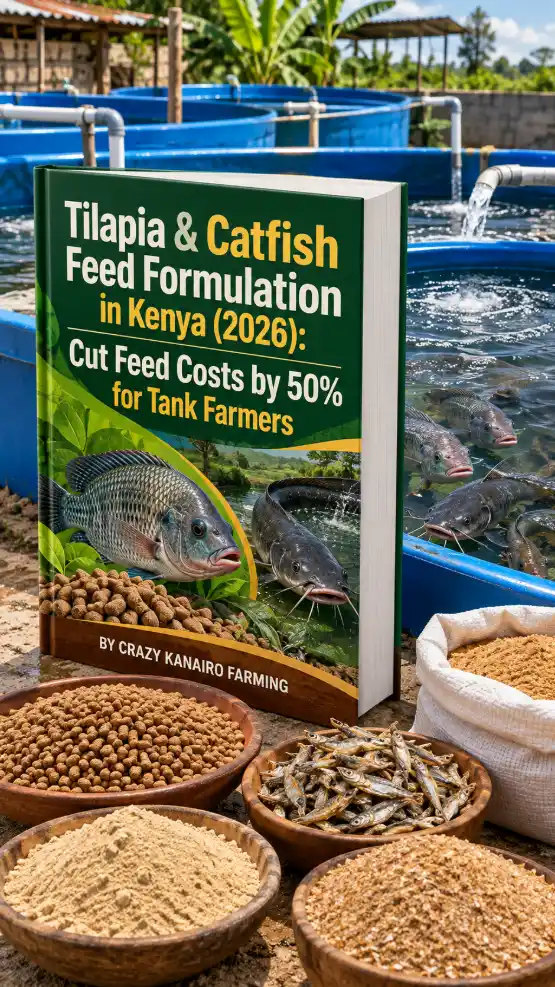
Tilapia & Catfish Feed Formulation in Kenya (2026)
Understand what goes into your fish feed and where your money goes.
Buying another bag of fish feed is easy. Knowing whether that feed gives your farm good value takes more work.
If you rear tilapia or catfish in tanks, you need to understand the relationship between feed price, nutritional quality, feeding quantity, fish growth, and water quality. A cheaper feed can become expensive if your fish need more of it to gain weight.
The Tilapia & Catfish Feed Formulation in Kenya (2026) guide from Crazy Kanairo Farming brings these topics together in one practical digital resource.
It explains local ingredients, formulation mathematics, feed preparation, feeding calculations, and cost tracking so you can ask better questions, compare your options, and make more informed decisions.
🌱 Why This Guide Is Useful
Many farmers focus on the price of a feed bag without calculating the cost of producing a kilogram of fish.
Others mix ingredients because they are available or affordable, without checking their contribution to the finished feed. Feeding quantities may also stay the same even as fish grow.
This guide helps you understand those gaps.
You will learn how to examine ingredient costs, calculate feed quantities, prepare pellets, and track performance. These skills give you a clearer picture of what your feeding programme is costing and where improvements may be possible.
📘 What You Will Learn Inside
1. Understand Fish Feed Economics
Learn why the cheapest feed per kilogram may not deliver the lowest production cost.
The guide explains:
- The relationship between feed price and fish growth.
- How poor feed performance can reduce apparent savings.
- Why longer production cycles create additional expenses.
- How to compare feeding options using cost calculations.
The benefit: You can evaluate feed using its effect on your farm’s results, rather than its purchase price alone.
2. Understand Tilapia and Catfish Feeding Needs
Tilapia and catfish have different nutritional needs, and those needs change as the fish grow.
The guide introduces:
- Protein requirements at different growth stages.
- The roles of fats, fibre, and minerals.
- Differences between fingerling and grower diets.
- Why ingredient choices should reflect the species and stage you are feeding.
The benefit: You gain a foundation for assessing whether a proposed feed suits your fish.
3. Explore Locally Available Ingredients
Get an introduction to ingredients commonly considered for fish feed production in Kenya:
- Omena fishmeal
- Toasted soybean meal
- Sunflower seed cake
- Dried black soldier fly larvae meal
- Wheat pollard
- Maize bran
- Mineral and vitamin supplements
- Cassava starch binders
The guide discusses their roles, indicative protein values, and quality concerns.
The benefit: You can approach ingredient purchases with a better understanding of what each material contributes.
4. Find Starting Points for Ingredient Sourcing
The guide includes Kenyan markets, milling outlets, businesses, and online platforms to investigate when sourcing raw materials.
It also discusses bulk purchasing, transport costs, and buying closer to the source.
The benefit: You have a starting point for comparing suppliers and obtaining local quotations.
Confirm current availability, specifications, prices, and suitability directly with each supplier before purchasing.
5. Follow Feed Formulation Mathematics
Understand the Pearson Square method through a worked example showing how two ingredient groups can be combined to reach a target crude protein level.
The guide walks through:
- Choosing a protein target.
- Calculating ingredient proportions.
- Converting proportions into batch weights.
- Working out ingredient costs.
- Calculating the cost per kilogram.
The benefit: You can follow the arithmetic behind a feed mix instead of relying on unexplained percentages.
Protein calculations are one part of formulation. A complete diet also requires attention to digestibility, amino acids, energy, minerals, and ingredient quality.
6. Understand the Feed Production Process
The guide explains the steps involved in preparing farm-made pellets:
- Grinding ingredients.
- Weighing the required quantities.
- Mixing dry materials.
- Adding water and binders.
- Pelletizing.
- Drying.
- Storing finished feed.
It also discusses pellet sizes, dough consistency, and handling practices.
The benefit: You can understand the equipment and preparation involved before deciding whether making feed is practical for your farm.
7. Calculate Daily Feeding Quantities
Learn how to estimate tank biomass using fish numbers and sampled average weight.
Worked examples show how biomass connects to a daily feeding allowance and how that allowance can be divided across feeding sessions.
The benefit: You have a method for reviewing feeding quantities as your fish grow, instead of feeding by guesswork.
8. Track Feed Conversion Ratio
The guide explains Feed Conversion Ratio (FCR) and why it matters when comparing commercial and farm-made feeds.
Learn how feed consumption and weight gain help you assess performance.
The benefit: You can judge whether a lower feed price translates into a lower feeding cost per kilogram of fish produced.
9. Understand Feeding and Water Quality Risks
Feed management affects more than growth. Uneaten feed and unstable pellets can add waste to your tanks.
The guide covers:
- Sinking pellets and feeding observation.
- Uneaten feed accumulation.
- Aeration and water quality monitoring.
- Ingredient contamination and storage concerns.
- Small-batch testing before larger production runs.
The benefit: You can plan feed changes with greater awareness of their effect on your tank system.
🎁 Additional Resources Included
30 Practical Feed Production and Cost-Control Tips
A reference section covering ingredient purchasing, processing, storage, feeding practices, and cost tracking.
Frequently Asked Questions
Answers to common questions about local ingredients, feed preparation, feeding quantities, and production costs.
Customizable AI Calculation Prompt
A reusable prompt for entering your fish species, growth stage, ingredient protein values, and local prices into an AI assistant.
Use it to explore batch calculations and compare ingredient combinations.
Treat AI outputs as draft calculations requiring review before use.
👨🏽🌾 Who Is This Guide For?
This guide is useful for:
- Beginner fish farmers learning how feeding affects production costs.
- Tilapia and catfish tank farmers reviewing their feeding programmes.
- Farmers considering on-farm feed preparation who want to understand the process first.
- Farmer groups exploring shared ingredient purchasing.
- Agribusiness learners looking for a Kenya-focused introduction to feed formulation and costing.
It is particularly relevant to farmers using plastic tanks, concrete tanks, and raised canvas systems.
💡 Why Buy This Guide?
The value is in bringing the main feeding decisions together.
Instead of working through scattered tips, you get a structured resource connecting ingredients, calculations, processing, feeding quantities, and performance tracking.
You can return to it when comparing raw-material quotations, planning a batch, reviewing feeding allowances, or checking your feed expenditure.
Better information helps you make better purchasing and management decisions.
📥 Get Your Digital Guide
Purchase the Tilapia & Catfish Feed Formulation in Kenya (2026) guide and build your understanding of practical fish feeding and cost control.
After your purchase is completed, access your downloadable guide through the My Account section:
👉 https://crazykanairofarming.com/my-account/
Need help accessing your guide or clarification while reading?
📞 Call or WhatsApp: 0751042669
Published by Crazy Kanairo Farming
🌐 https://crazykanairofarming.com/
This is a digital educational guide. Savings and growth results vary with ingredient quality, local prices, processing methods, water conditions, and farm management. Review any proposed formulation with a qualified aquaculture nutrition professional before large-scale use.
Discover more from Crazy Kanairo Farming
Subscribe to get the latest posts sent to your email.

There are no reviews yet.