

- Prices for a modern automatic 128-egg incubator in Kenya currently range between KSh 20,000 and KSh 28,000 depending on the dealer.
- Dual-power models that connect to both 240V AC and 12V DC batteries are strictly necessary for Kenyan farmers due to frequent power interruptions.
- Maintaining a strict temperature of 37.5 degrees Celsius and stopping the egg-turning mechanism on day 18 are the biggest secrets to a successful hatch.
Table of Contents
Hatching your own chicks is one of the fastest ways to reduce operational costs on a Kenyan poultry farm. Buying day-old chicks from commercial hatcheries often eats into your profit margins before you even buy a single bag of chick mash. A reliable machine allows you to take control of your poultry production cycle and scale up on your own terms.
Why Most Farmers in Kenya Fail With Egg Incubators
Most Kenyan farmers fail with incubators because they buy cheap plastic models that lose heat rapidly during cold nights. Frequent power cuts without a proper battery backup system also lead to massive embryo deaths inside the shell. Poor humidity management during the final three days of hatching is another major cause of failure.
The cost of fertilized eggs in Kenya is a major investment for any beginner farmer. When you load a machine with 100 pure Kienyeji eggs at KSh 20 each, you are risking KSh 2,000 on a single hatch cycle. From what many farmers experience, losing a whole batch due to minor machine errors is financially devastating.
The main causes of failure revolve around KPLC power cuts and poor climate control inside the machine. When electricity disappears for several hours in cold areas like Limuru, cheap incubators cannot retain internal heat. Embryos quickly chill and die if the internal temperature drops below 35 degrees Celsius for an extended period.
Many beginners also fall victim to buying low-quality incubators from untrusted online vendors. These machines often have faulty thermostats that give entirely false temperature readings to the user. In this guide, we provide real Kenya prices in KSh and highlight the best models found in local verified agrovets.
Best Egg Incubators in Kenya (Comparison 2026)
Detailed Review: Top Performing Incubators in Kenya (2026)
1. Janoel Mini Series (24 Eggs)
This is the “training wheels” of incubators. It is small, lightweight, and fits on a kitchen counter.
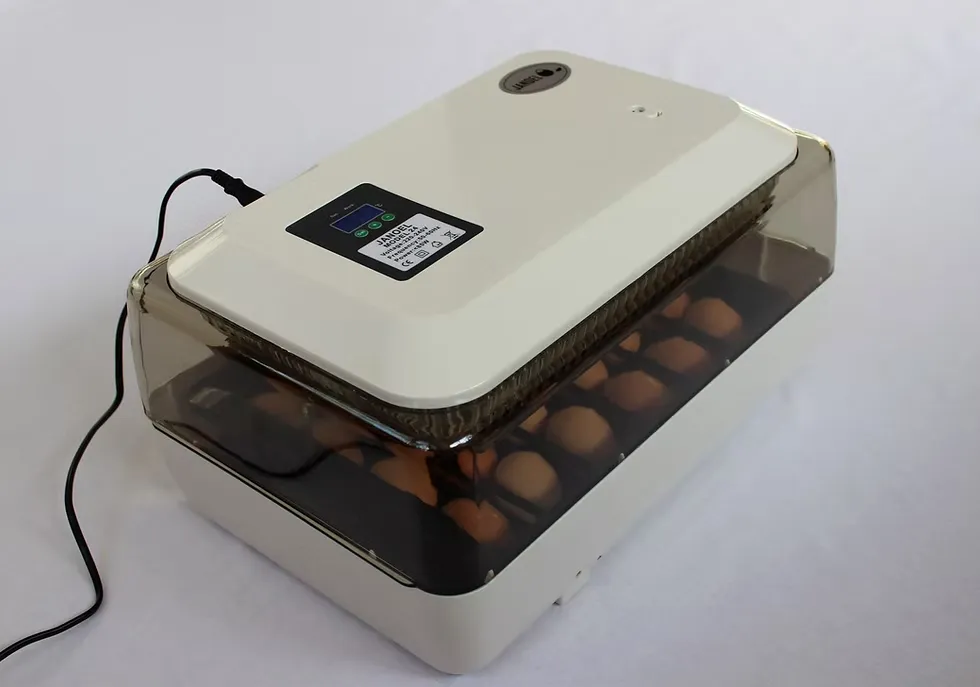
- The Build: High-grade transparent plastic so you can see the hatch without opening the lid.
- Power: Most 2026 versions are AC/DC, meaning you can run it off a small $12\text{V}$ battery during those annoying two-hour blackouts.
- Best For: Hobbyists or those hatching expensive ornamental birds where you only have a few eggs at a time.
- Price Range: KSh 8,500 – 12,000.
2. Ecochicks Starter (64 Eggs)
Probably the most common “first machine” for Kenyan poultry entrepreneurs.
- The Build: Usually a tabletop “drawer” style or roller system.
- The Advantage: It strikes the perfect balance between price and capacity. It’s small enough to be portable but large enough to produce a meaningful batch of chicks for sale.
- Caveat: It has thin walls. In cold regions like Limuru, you must use the provided styrofoam jacket or the temperature will fluctuate wildly at 3:00 AM.
- Price Range: KSh 14,000 – 16,000.
3. Cimuka Standard (104 Eggs)
Cimuka is a premium brand known for high hatch rates, but it often comes with a “European” catch.
- The Build: High-quality, specialized plastic that is very easy to disinfect.
- The Weakness: Many of the standard models are AC Only. If you buy this without a UPS or an inverter, a KPLC outage will ruin your hatch. It’s built for stability, not for “rough” power grids.
- Price Range: KSh 30,000 – 35,000.
4. Hitech Dual (128 Eggs)
This is the “Workhorse” of the 100-egg category.
- The Build: Often features a dual-layer shell for better heat retention.
- Why Farmers Love It: It is strictly AC/DC. It comes with the battery clips in the box. It’s designed specifically for markets where power is unreliable.
- Automation: Fully automatic rollers that handle different egg sizes (Kienyeji to Duck) without changing trays.
- Price Range: KSh 24,000 – 28,000.
5. Skywave Advanced (192 Eggs)
Skywave has gained a massive footprint in Nairobi agrovets because of its “Smart” features.
- The Tech: It features a more advanced control board that handles humidity more precisely than the cheaper 64-egg models.
- Reliability: Excellent airflow. It uses multiple small fans rather than one big one to ensure no “cold spots” exist in the corners.
- Price Range: KSh 29,000 – 35,000.
6. Zamchick Cabinet (300 Eggs)
This is where you move from “tabletop” to “Cabinet.”
- The Build: This is a mini-fridge style unit with insulated sandwich panels.
- The Advantage: Insulation. Even if the power goes out and you don’t have a battery, a cabinet unit can hold its internal heat for much longer than a plastic machine. It’s a “Set and Forget” machine for serious side-hustlers.
- Price Range: KSh 45,000 – 55,000.
7. Neochicks Pro (528 Eggs)
A dominant name in the Kenyan commercial space.
- Power: Fully Solar Compatible. It’s built to be the heart of a small commercial hatchery.
- Structure: Heavy-duty metal frame. It includes a dedicated “hatcher” section at the bottom, so you can keep setting new eggs every week while others are hatching.
- Price Range: KSh 65,000 – 80,000.
8. Industrial Hatcher (1056 Eggs)
The “Big Boy” for those supplying entire villages or counties with day-old chicks.
- The Build: Purely industrial. It uses a high-volume XM-18 controller, which is the gold standard for commercial hatching.
- The Reality: You need a dedicated, well-ventilated room for this. It generates its own heat and humidity on a large scale. At this level, you aren’t just a farmer; you are a factory.
- Price Range: KSh 85,000 – 100,000.
9. Eco-Kuku Smart Series (64–352 Eggs)
Eco-Kuku has become a household name in Kenya because they offer more than just a machine; they offer a “survival kit” for the local farmer.
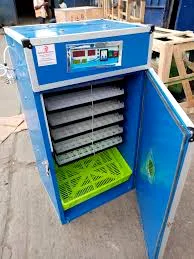
- The Build: Extremely robust AC/DC circuitry. Unlike generic brands where the DC clips feel like an afterthought, Eco-Kuku machines are built to run on solar batteries for days if necessary.
- The Unique Edge: They often include a “Fridge Guard” or voltage stabilizer built into the power cable. In Kenya, power surges are just as deadly as power cuts. This built-in protection saves your control board from blowing up when the lights come back on.
- Service: Because they have a strong local presence, you can get free training and “hatching consultations” in their Nairobi or regional offices.
- Price Range: KSh 14,000 – 55,000.
10. Industrial “Setter & Hatcher” Combos (1056–2112+ Eggs)
These are the heavyweights found in professional hatcheries in Naivasha and Thika. At this level, the machine is usually divided into two distinct sections.
- The Build: High-capacity metal cabinets with “Double Function” technology. This means the machine can act as both a setter (where eggs turn) and a hatcher (where eggs lay flat to hatch) at the same time.
- The Advantage: This allows for Staggered Hatching. You can put in 300 eggs every Monday. By the third week, you are hatching 300 chicks every single Monday like clockwork. This is how you build a consistent weekly income.
- Backup Power: These require a significant solar inverter system ($1\text{kW}$ or higher) or a standby generator. They are for serious investors who are running a chick-supply business.
- Price Range: KSh 85,000 – 175,000+.
Final Recommendation for 2026
- The “Survivor” Pick: If you are in a remote area with zero electricity, get the Eco-Kuku 64 or 128. It’s the most reliable for pure solar use.
- The “Profit” Pick: If you have some capital and want to sell chicks to your neighbors, go for the Hitech Dual 192. It’s the sweet spot for ROI (Return on Investment).
- The “Empire” Pick: If you want to dominate the county’s chick market, don’t play with plastic. Buy the Industrial 1056. It’s a tank that will make you money for the next decade.
Which one should you choose?
- If you are on a budget in a cold area: Get the Hitech Dual 128. The insulation and AC/DC capability are worth the extra coins.
- If you want to start a business: Skip the plastic ones and go straight to the Zamchick 300 or Neochicks 528. The durability means you won’t be buying a new machine every year.
To help you make a fast and informed decision, we have analyzed the top-performing models currently dominating the Kenyan market. The table below compares capacity, power options, and average retail prices to guide your startup budget.
| Model Name | Capacity (Eggs) | Power Type | Automation Level | Best For | Price Range (KSh) |
|---|---|---|---|---|---|
| Janoel Mini Series | 24 | AC / DC | Auto Turn | Beginner | 8,500 – 12,000 |
| Ecochicks Starter | 64 | AC / DC | Auto Turn | Beginner | 14,000 – 16,000 |
| Cimuka Standard | 104 | AC Only | Auto Turn | Medium | 30,000 – 35,000 |
| Hitech Dual | 128 | AC / DC | Auto Turn | Medium | 24,000 – 28,000 |
| Skywave Advanced | 192 | AC / DC | Auto Turn | Medium | 29,000 – 35,000 |
| Zamchick Cabinet | 300 | AC / DC | Fully Auto | Commercial | 45,000 – 55,000 |
| Neochicks Pro | 528 | AC / Solar | Fully Auto | Commercial | 65,000 – 80,000 |
| Industrial Hatcher | 1056 | AC / Solar | Fully Auto | Commercial | 85,000 – 100,000 |
“Cheap is Expensive.” Saving KSh 3,000 on a generic machine only to lose KSh 10,000 worth of eggs in the first month is a mistake you don’t want to make. Stick to verified dealers who offer at least a 6-month warranty.
Best Small Egg Incubators in Kenya (24 to 64 Eggs)
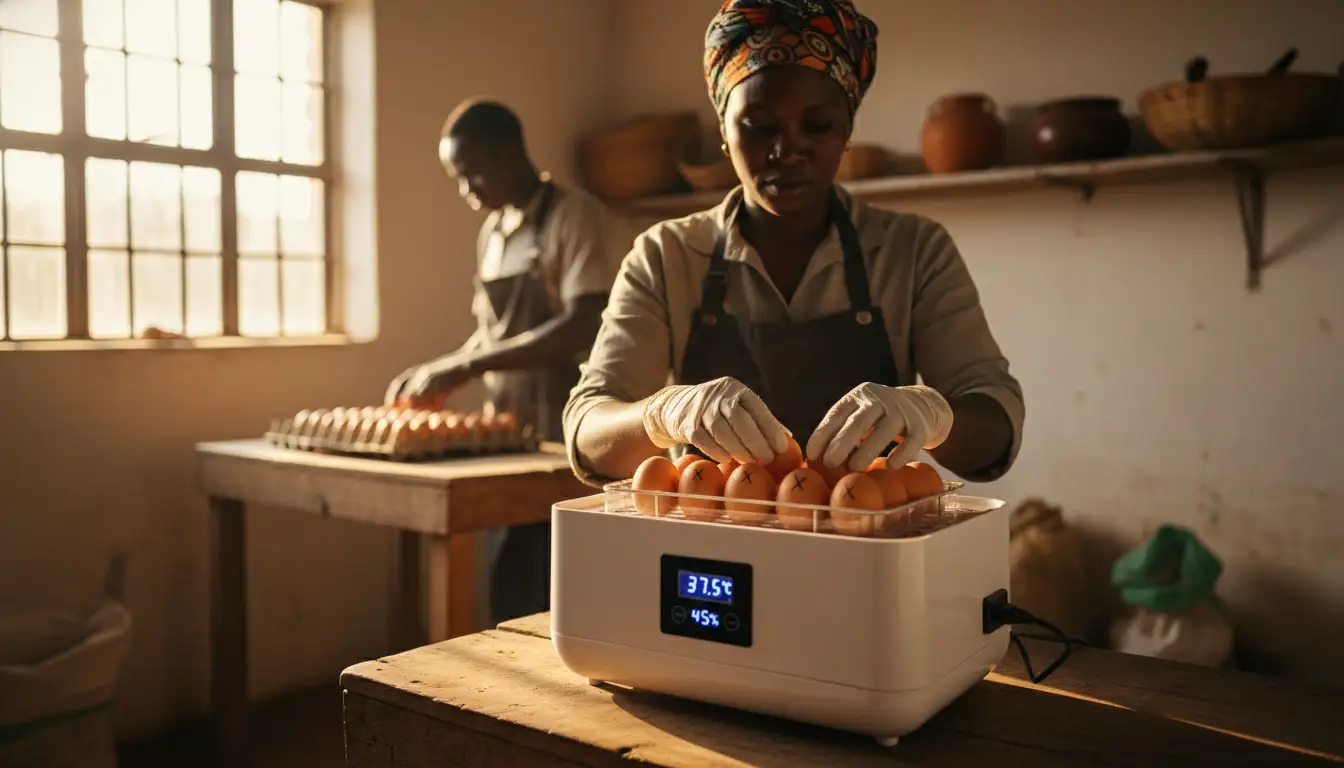
Small egg incubators holding 24 to 64 eggs are ideal for hobbyists and beginner farmers learning the trade. The most reliable options include the Janoel 24 type incubators and cheap digital models easily found online. They are highly affordable but require stable room temperatures to function well in cold counties.
Beginner farmers usually start with smaller machines to learn the basics of hatching without risking massive capital. The Janoel 24 type incubators are highly popular in Kenya because they feature simple digital displays and automatic egg rollers. You can easily set the target temperature and let the smart machine handle the rest of the work.
The main advantage of these cheap digital incubators is their low entry cost and simple operation. A small poultry farmer in Machakos can easily run a 64-egg unit from a basic home solar setup. These machines take up very little space and serve as the perfect training ground for anyone transitioning into commercial poultry farming.
However, what equipment guides rarely tell you is that these small units are often unstable in cold areas like Nyandarua. The low-quality plastic casings offer almost zero insulation against freezing night temperatures. It is highly advisable to wrap these plastic machines in thick blankets or styrofoam boxes during cold seasons to prevent heat loss.
Best Medium Egg Incubators in Kenya (100 to 300 Eggs)
Medium egg incubators holding 100 to 300 eggs are the sweet spot for side-income poultry farmers in Kenya. Cabinet models and Cimuka or Hitech-type machines offer superior temperature stability and higher hatch rates. These models are widely available in Nairobi agrovets and cost between KSh 25,000 and KSh 55,000.
Once you move past the beginner stage, medium-sized cabinet incubators become the most practical choice for a growing shamba. These units are extremely common in Nairobi agrovets along River Road and in industrial farming hubs. They usually feature multiple rolling trays and stronger ventilation fans to ensure perfectly even heat distribution.
The biggest upgrade you receive with these medium units is superior temperature stability. Unlike the cheap plastic models, medium incubators often feature double-walled insulation or thicker PVC protective boarding. This vital insulation locks in the heat and prevents the machine from overworking itself during sudden cold spells.
These specific machines are highly suitable for side-income poultry farmers aiming to hatch chicks for local community sale. A farmer in Kisumu using a 192-egg machine can comfortably hatch over 150 chicks every single month. Selling these day-old chicks can easily generate enough revenue to recover the cost of the machine within three short months.
Best Large Commercial Incubators in Kenya (300 to 1000+ Eggs)
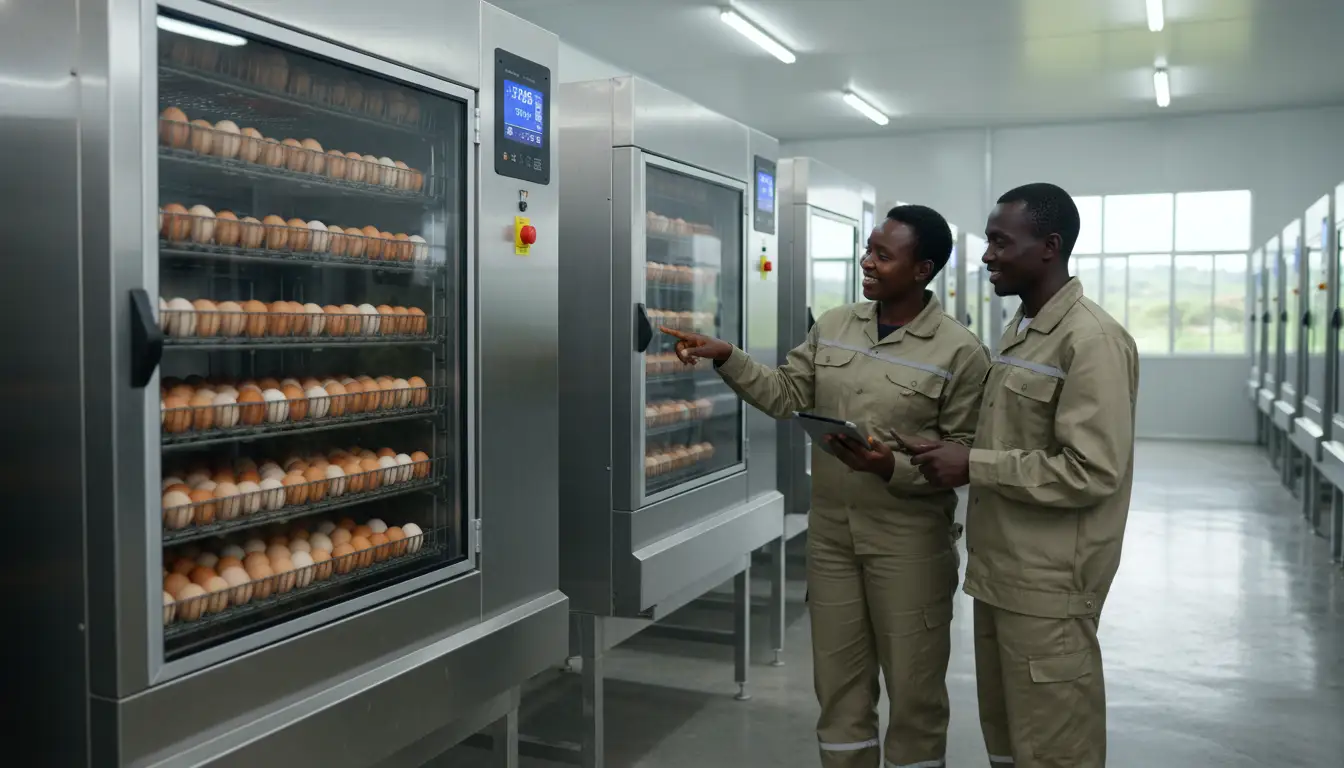
Large commercial incubators holding 300 to over 1000 eggs are strictly built for high-volume hatcheries. These metal cabinet incubators feature industrial hatchers, powerful airflow systems, and precise humidity controls. They deliver a massive return on investment and can easily last up to 10 years with proper routine maintenance.
For serious agribusiness investors, large commercial incubators form the absolute foundation of a profitable chick-selling enterprise. These massive metal cabinet incubators look like large refrigerators and can securely hold up to 2000 eggs at once. They are structurally reinforced to handle continuous hatching cycles without suffering from unexpected mechanical failures.
Read Also: Kienyeji Chicken Vaccination Schedule: A Month-by-Month Guide for 2026
The proven durability of these commercial units is unmatched in the Kenyan agricultural market today. A well-maintained metal incubator can comfortably give you a 5 to 10 years lifespan with minimal repairs. The heating elements and automated motors used in these units are strictly industrial grade and designed for heavy duty performance.
Superior airflow and humidity control systems are what make these large machines highly effective for investors. They utilize advanced ultrasonic humidifiers and multiple exhaust fans to create the perfect microclimate for thousands of growing embryos. In major agricultural zones like Eldoret, commercial hatcheries rely entirely on these robust systems to consistently achieve hatch rates above 90 percent.
Best Egg Incubators for Power Outages in Kenya
The best egg incubators for Kenyan farmers are AC/DC dual-power models that seamlessly switch to battery power during outages. Connecting a 12V system or integrating an inverter and solar setup prevents massive embryo losses. Investing in backup power is always cheaper than losing a full batch of expensive fertilized eggs.
Power instability remains the absolute biggest threat to poultry farmers across Kenya today. KPLC power cuts can last anywhere from two hours to two full days depending on your specific county grid. If an incubator loses power for more than four hours, the developing chicks inside the eggs will likely suffocate and die.
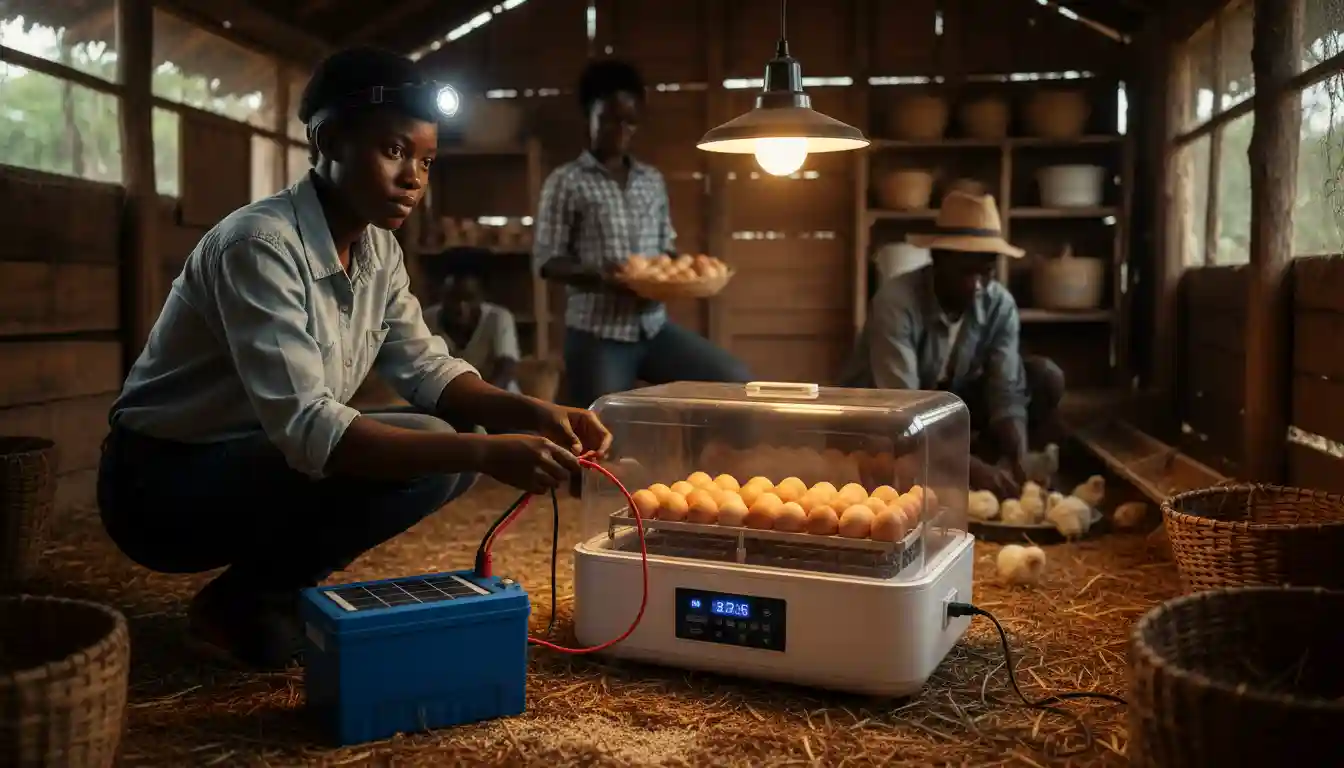
Battery backup compatibility using standard 12V systems has revolutionized local hatching success rates completely. Modern dual-power machines come with simple crocodile clips that connect directly to a heavy-duty car or solar battery. When the main power drops, the machine automatically draws power from the battery without ever dropping the critical internal temperature.
You must carefully weigh the cost of a failed hatch versus a reliable backup investment. Losing 300 pure Kienyeji eggs costs you KSh 6,000 in raw materials alone, plus three weeks of entirely wasted time. Buying a reliable 100AH solar battery and a small inverter will cost you roughly KSh 15,000 but will protect your business for years.
How to Choose the Right Egg Incubator in Kenya
To choose the right egg incubator in Kenya, prioritize models with automatic egg turning and reliable tray humidity systems. Verify that spare parts are easily available in local agrovets before buying imported brands. Always match the incubator capacity to your actual farm size to avoid wasting electricity on empty rolling trays.
Walking into a busy agrovet in Nairobi can be overwhelming due to the sheer number of incubator brands displayed. Your first major decision should be choosing between auto versus manual egg turning mechanisms. Automatic turners save you the daily stress of opening the machine three times a day to manually roll the eggs.
Next, carefully inspect the specific humidity system type installed inside the machine. Some basic models use a simple water tray system at the bottom, while advanced ones utilize automatic water pumping systems. The Nairobi agrovet reality is that generic Chinese replacement parts are incredibly easy to find, but rare European models might leave you permanently stranded.
Never ignore warranty authenticity when handing over your hard-earned cash to machinery dealers. Ensure the vendor stamps a formal receipt and offers at least a solid six-month guarantee on the electronic control board. Finally, balance your capacity versus farm size realistically to avoid heating massive empty machines with expensive electricity.
How to Get 85 to 90 Percent Hatch Rate in Kenya
Achieving an 85 to 90 percent hatch rate in Kenya requires maintaining a strict internal temperature of exactly 37.5 degrees Celsius. Manage humidity in stages by keeping it moderate early on, then increasing it heavily for the final lockdown. Stop turning the eggs on day 18 and strictly avoid opening the incubator during the actual hatching phase.
The ultimate secret to high hatching success lies in absolute temperature precision from day one. Your incubator must remain locked at exactly 37.5 degrees Celsius throughout the entire 21-day incubation period. Experts from agricultural bodies like KALRO Naivasha warn that even a small fluctuation can cause chicks to hatch prematurely with severe physical deformities.
Humidity stages play a critical and often misunderstood role in how easily the chick breaks out of the protective shell. From Day 1 to Day 18, maintain moderate humidity around 50 to 55 percent to allow the egg to lose the correct moisture volume. On Day 18, initiate the high humidity lockdown by safely raising the moisture levels to 70 percent.
Read Also: Top 10 Deadly Chicken Diseases in Poultry Farming 2026: How to Protect Your Kienyeji Chicken (Guide)
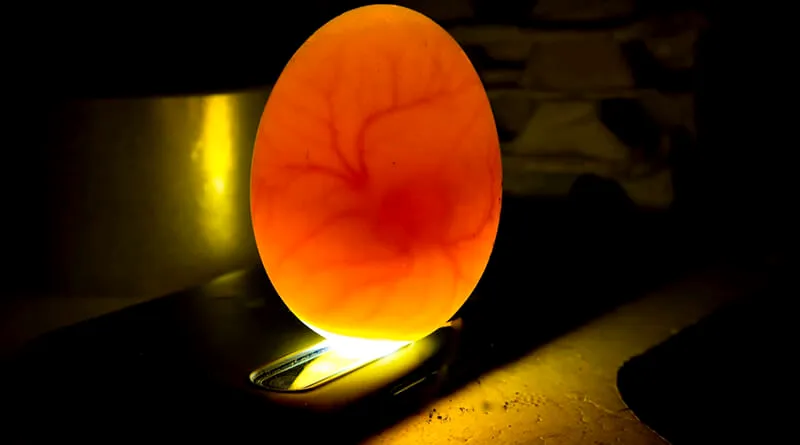
Proper management during the incubation cycle distinctly separates successful farmers from frustrated ones. Practice candling on Day 7 and Day 14 to actively identify and remove unfertilized or dead eggs before they rot and explode. Most importantly, you must strictly stop turning eggs on Day 18 to allow the chicks to perfectly align themselves for hatching.
Why Your Eggs Are Not Hatching in an Incubator
Eggs fail to hatch mainly due to wrong temperature settings and dangerously unstable humidity during the 21-day cycle. Placing dirty eggs with blocked pores inside the machine easily suffocates the developing embryos. Opening the incubator door repeatedly during the final hatching phase also causes fragile chicks to die trapped inside the shell.
Nothing is more frustrating than waiting 21 long days only to find fully unhatched eggs inside your machine. A wrong temperature setting is the leading culprit for complete hatching failures in modern Kenyan farms. If the thermostat falsely reads 37.5 degrees but the actual temperature is 35 degrees, the embryos will develop too slowly and eventually die.
External factors and poor hygiene habits heavily impact the ultimate survival of your sensitive embryos. Many beginners make the fatal mistake of setting dirty eggs covered in dry chicken manure. The manure blocks the microscopic breathing pores on the eggshell, effectively suffocating the chick while introducing deadly bacteria into the warm environment.
Human error during the critical final days frequently destroys many otherwise healthy hatches. Opening the incubator during the hatch to physically help a struggling chick out is a massive biological mistake. Every time you open the door, all the vital humidity escapes, causing the egg membranes of the unhatched eggs to dry out like cement.
Egg Incubator Prices in Kenya (2026 Guide)
Understanding current market prices helps you completely avoid being overcharged by middlemen in the busy agricultural sector. Below is a breakdown of what you should expect to pay for various incubator capacities.
- 24 to 64 eggs: KSh 8,500 to KSh 16,000
- 100 to 300 eggs: KSh 30,000 to KSh 55,000
- 500+ eggs: KSh 75,000 and above
Below is a quick financial breakdown for a medium 128-egg operation to help you understand the true profit potential. The table estimates a realistic 85 percent hatch rate and standard local market prices for day-old Kienyeji chicks.
| Cost / Revenue Item | Estimated Amount (KSh) |
|---|---|
| Cost of 128 Fertilized Eggs (@ KSh 20) | 2,560 |
| Estimated Electricity/Battery Cost (21 Days) | 800 |
| Total Production Cost per Cycle | 3,360 |
| Chicks Hatched (85% Success Rate) | 108 chicks |
| Gross Revenue (Selling chicks @ KSh 100 each) | 10,800 |
| Estimated Net Profit per 21-Day Cycle | 7,440 |
Where to Buy Egg Incubators in Kenya
Finding reliable incubator dealers requires careful sourcing to avoid ending up with counterfeit or faulty machines. Many successful farmers recommend buying directly from established agricultural machinery shops located along Luthuli Avenue or near major KALRO offices. Shopping physically allows you to inspect the build quality rather than relying solely on heavily edited online photos.

Always insist on testing the machine’s electronic control board and verifying the warranty paperwork before leaving the shop. Reputable vendors will happily plug the machine in and demonstrate the automatic turning features for you. If you are buying online, stick strictly to verified Jumia Mall vendors with hundreds of positive local reviews.
Read Also: Azolla vs. BSF vs. Hydroponic Fodder: Which is the Cheapest Feed in Kenya? (2026 Edition)
Spare parts procurement is another critical reason to buy from established local dealers rather than importing directly. Heating tubes and turning motors eventually wear out after two or three years of continuous heavy use. Buying a popular brand ensures you can walk into any agrovet in Nairobi and find cheap replacement parts instantly.
Where to Buy Egg Incubators in Kenya: Verified Dealers (2026)
Finding a reliable incubator dealer in Kenya requires careful sourcing to avoid counterfeit machines or “fly-by-night” vendors who disappear after the sale. Many successful farmers recommend buying directly from established shops with physical showrooms where you can test the machine before paying.
1. Neochicks Poultry Ltd
Neochicks is one of the most recognized brands for both small-scale and industrial incubators in Kenya. They are famous for their robust after-sales support and training for beginners.
- Location: 7th Floor, Rehema House, Standard Street, Nairobi CBD.
- Phone: 0707787884
- Website: neochickspoultry.com
- Email: [email protected]
2. Eco-chicks Kenya Ltd
A leader in solar-compatible and AC/DC hybrid incubators. They are the best choice if you are looking for machines specifically designed for areas with frequent power cuts.
- Location: Anniversary Towers, University Way, Nairobi.
- Phone: +254 727 087 285 / +254 713 148 245
- Website: ecochicks.co.ke
- Email: [email protected]
3. Skywave Appliances
While they sell various electronics, Skywave has become a major hub for automatic egg incubators due to their competitive pricing and central location.
- Location: Luthuli Avenue, Nairobi.
- Phone: 0721 411 104
- Website: skywave.co.ke
4. Eco-Kuku Kenya
Known for high-efficiency “Smart” incubators, they provide extensive manuals and setup guides tailored for the Kenyan environment.
- Location: Kunda Business Center, Ngara Road, Nairobi.
- Phone: +254 710 905696
- Website: ecokuku.co.ke
- Email: [email protected]
5. Jumia Kenya (Online Purchase)
If you are far from Nairobi, Jumia is a safe bet, provided you buy from “Jumia Mall” or “Top Rated” sellers.
- Safety Tip: Look for vendors like “Generic” (for budget units) or “Eco-chicks” who have official stores on the platform.
- Link: jumia.co.ke
The “Agrovet Reality” and Spare Parts
Buying from the dealers listed above is critical because of spare parts. Heating tubes, $12\text{V}$ turning motors, and XM-18 controllers eventually wear out after two or three years of heavy use.
If you buy a “no-name” machine from a random street vendor, you will struggle to find a replacement fan or sensor. However, with the brands mentioned, you can walk into almost any major agrovet in Nairobi or Thika and find cheap replacement parts instantly.
Final Physical Inspection Checklist
Before leaving the shop with your machine:
- The Power Test: Ask the vendor to plug it in. Check if the fan spins smoothly and if the heating element starts warming up within 60 seconds.
- The Turning Test: Use the manual turn button on the controller to ensure the rollers or trays actually move.
- The Warranty: Ensure they stamp your receipt with a formal warranty (usually 6–12 months). A verbal “trust me” is not a warranty.
Risks & Reality Check: The Hard Truths of Hatching
Running a successful hatchery is not just about plugging in a smart machine and waiting for guaranteed profits. Market and batch failures are very real risks if you cannot sell your day-old chicks immediately after they hatch. Unsold chicks will consume expensive starter mash rapidly, wiping out your projected profit margins within days.
Estimated ranges for financial returns vary heavily based on your individual feed management and local chick demand. You might experience a flawless 90 percent hatch rate, but if a sudden disease outbreak hits your county, buyers will vanish. Secure your local market network of fellow farmers before you start incubating large batches of eggs.
Furthermore, machine depreciation is a silent cost that many new farmers completely forget to calculate. A plastic incubator running continuously will eventually crack or suffer from degraded insulation properties. You must actively save a small portion of your profits to repair or replace the machine when its lifespan ends.
Final Recommendation: Best Egg Incubator in Kenya (2026)
For beginners, the Janoel 64-egg dual-power model is the best affordable and reliable choice. Medium farmers should actively invest in the 128-egg or 192-egg Hitech automatic incubators for consistent side income generation. Commercial farms should strictly purchase 1000-egg industrial metal cabinets from reputable local dealers to ensure long-term durability.
Making the final purchasing decision ultimately comes down to your realistic budget and available farm infrastructure. The best for beginners is undoubtedly the 64-egg dual-power automatic incubator currently dominating the market. It is affordable, fits easily in a small room, and handles power cuts beautifully when connected to a standard battery.
The best for medium farmers is the 128-egg or 192-egg automatic cabinet model built with proper insulation. These specific units provide the perfect balance between daily electricity consumption and profitable output volume. You can comfortably hatch enough chicks to sustain a profitable side hustle while still working a full-time job.
The best for commercial farms are the heavy-duty 1056-egg or larger metal industrial hatchers. Do not waste money buying multiple small plastic machines if your ultimate goal is commercial dominance in your county. Invest heavily in a single high-quality industrial unit and pair it with a strong solar inverter system for maximum security.
Frequently Asked Questions About Egg Incubators in Kenya (2026)
What is the price of a chicken egg incubator in Kenya in 2026?
Prices range from KSh 8,500 for small 24-egg models up to KSh 150,000 for large 2112-egg commercial units found in major Nairobi agrovets.
How much is a 20 egg incubator in Kenya?
A 20-egg mini incubator typically costs between KSh 3,500 and KSh 6,500 depending on its automation features and brand quality.
What is the price of a 20 egg incubator in Kenya on Jumia?
On Jumia Kenya, a basic 20-egg manual or semi-automatic incubator currently retails for KSh 3,500 to KSh 5,500 plus standard delivery fees.
What is the best 20 egg incubator in Kenya for beginners?
The Janoel mini automatic series is considered best for beginners due to simple digital temperature controls and low power consumption.
Where can I buy a used chicken egg incubator in Kenya?
You can purchase used incubators safely on local classifieds like Jiji, Facebook Marketplace, or through verified poultry farming WhatsApp groups.
What is the price of a used 20 egg incubator in Kenya?
A fully functional second-hand 20-egg incubator usually sells for KSh 2,000 to KSh 3,500 based on its physical condition and location.
How much is a 30 egg incubator in Kenya?
Standard 30-egg incubators cost about KSh 6,000 locally. Premium imported brands built for advanced breeders can reach up to KSh 35,000.
What is the price of a 30 egg incubator in Kenya on Jumia?
Reliable digital 30-egg models listed on Jumia typically cost between KSh 6,000 and KSh 8,500 depending on the specific vendor discounts.
What is the price of a 100 egg incubator in Kenya?
Most 100-egg models, specifically the 104 or 128 capacity dual-power machines, retail for KSh 20,000 to KSh 30,000 across Kenyan stores.
What is the price of a 500 egg incubator in Kenya?
A fully automatic 500-egg commercial incubator ranges from KSh 65,000 to KSh 80,000 when purchased from certified agricultural suppliers.