

- Kenya faces a severe domestic rice deficit of over one million metric tonnes in 2026.
- Government fertilizer subsidies successfully cap essential input prices at KES 2,500 per bag.
- Net profits for well-managed irrigated commercial farms can comfortably reach KES 140,000 per acre.
Table of Contents
Rice cultivation in 2026 is a high-risk, high-reward venture that punishes the unprepared. While the national supply deficit creates a massive market opening, it is not an easy “goldmine.” It is a capital-intensive business that requires navigating complex water rights and high labor costs. For the serious agribusiness investor, the profit potential is real, but success depends on precision, not luck.
This widening gap presents an undisputed goldmine for farmers who treat cultivation as a modern agribusiness. From what many farmers experience daily, shifting from traditional maize to irrigated rice drastically multiplies profit margins. Success requires absolute dedication to precision farming and strict water management.
Why Rice Farming in Kenya Is Booming in 2026
The rapid boom is driven by a massive national supply deficit and supportive government fertilizer subsidies. Farmers are shifting to this crop to capitalize on superior profit margins per acre.
Kenya currently consumes nearly 1.5 million metric tonnes of rice annually. However, local farmers produce roughly 260,000 metric tonnes. This severe supply gap means locally produced grain has a ready market waiting to pay premium prices.
Read Also: Top 10 Best Maize Seeds in Kenya 2026: Prices, Yields & Highest Profit Varieties
Consumption trends have drastically shifted away from traditional maize meal toward fast-cooking grains. Urban households prefer meals that require less power and time to prepare. In 2026, per capita consumption is projected to hit twenty-nine kilograms annually.
Farmers are aggressively shifting away from other cereals because the financial math makes absolute sense. While maize suffers from fluctuating state prices, premium varieties like Pishori maintain stable farm-gate values. The digital KIAMIS e-voucher system has also slashed input costs significantly.
Best Areas for Rice Farming in Kenya
Mwea remains the premier hub due to its optimal black cotton soils and reliable canal irrigation. Ahero, Bunyala, and West Kano are also top-performing regions with suitable tropical climates.
Mwea in Kirinyaga County is the undisputed capital of this crop in the country. This region alone accounts for roughly sixty-five percent of all locally produced volume. Mwea farmers exclusively dominate the lucrative aromatic market due to unique climatic conditions.
Ahero and West Kano in Kisumu County are rapidly catching up as major production zones. The Lake Victoria basin provides an excellent tropical climate with the high temperatures necessary for vegetative growth. The heavy clay soils here prevent water seepage and reduce overall irrigation costs.
Bunyala in Busia County is another exceptional zone that capitalizes on water from the River Nzoia. The warm and humid climate creates an ideal environment for high-yielding varieties like Komboka. Successful cultivation demands flat topography, heavy loamy soils, and a guaranteed permanent water source.
Best Rice Varieties in Kenya (Pishori vs Basmati vs Others)
Best Rice Varieties in Kenya: Choosing Your Weapon
The choice of seed is where your profit is either secured or lost. In 2026, the market is split between the “Aroma Kings” and the “Yield Beasts.” If you chase aroma with a yield mindset, you will go broke. If you chase yield in a premium market, you will have a warehouse full of grain no one wants to buy at a high price.
1. Mwea Pishori (The Queen of Aroma)
Pishori is the only choice for farmers targeting the high-end Nairobi middle-class market. Its scent is its branding.
- The Reality: It is a high-maintenance variety. It has a weak stem and is prone to “lodging” (falling over) if you over-fertilize with nitrogen.
- The Trade-off: You sacrifice volume for price. While you only get 15 to 20 bags, you can sell them for nearly double the price of hybrid varieties.
2. Komboka (The Yield Beast)
Komboka is the 2026 champion for commercial farmers who care about tonnage. Developed by KALRO, it is designed to survive the erratic water rationing common in Mwea and Ahero.
- The Reality: It lacks the signature Pishori scent. If you try to sell this as “premium aromatic,” savvy buyers will call your bluff.
- The Advantage: It hits 40 bags per acre consistently. It is semi-dwarf, meaning it won’t fall over in the wind, and it matures 20 days faster than traditional Basmati.
3. Basmati 370 (The Export Standard)
This is for the investor looking beyond Kenyan borders. It is the gold standard for elongation.
- The Reality: It is highly susceptible to Rice Blast disease. If you aren’t prepared to spend heavily on fungicides, don’t plant it.
- The Advantage: It has a more predictable growth cycle and is widely accepted by international millers.
Read Also: Kenya Seed Company Price List 2026 (Maize, Grass & Crop Seeds Prices in Kenya)
4. Nerica Varieties (The Upland Option)
Nerica is for the “dry-land” farmer. If you don’t have access to an irrigation canal, this is your only viable path.
- The Reality: The yields are the lowest in the group. Without flooded paddies, weed management becomes a nightmare that requires 3x the labor.
- The Advantage: It allows you to farm in regions like Kwale or parts of Western Kenya where traditional paddies are impossible.
2026 Rice Variety Comparison & Risk Matrix
| Variety | Yield (Bags/Acre) | Market Niche | Critical Failure Point |
| Mwea Pishori | 15 – 20 | Premium Local | Lodging & low yield |
| Komboka | 35 – 45 | Mass Market | Lack of aroma/lower price |
| Basmati 370 | 20 – 25 | Export/Premium | High disease susceptibility |
| Nerica 4 | 15 – 25 | Upland (Rain-fed) | Extreme weed competition |
Other Rice Varieties
The Kenya Agricultural and Livestock Research Organization (KALRO) has revolutionized the sector by introducing highly resilient alternatives. Komboka is now planted widely because it requires less water and yields heavily. Nerica varieties are also gaining traction in rain-fed upland areas.
These new types are early-maturing and engineered to survive erratic weather patterns. The following table provides a quick comparison of the top varieties currently dominating the market.
| Variety | Yield Potential (Bags/Acre) | Maturity Period | Best Feature |
|---|---|---|---|
| Mwea Pishori | 15 to 20 | 120 to 140 Days | Premium market price and strong aroma. |
| Komboka | 35 to 40 | 110 to 120 Days | High yield and strong drought tolerance. |
| Basmati 370 | 20 to 25 | 120 to 135 Days | Excellent export potential. |
| Nerica 4 | 15 to 25 | 90 to 100 Days | Thrives in upland rain-fed systems. |
Where to Buy Rice Seeds and Inputs in Kenya (2026 Directory)
Do not waste time with local “agro-vets” that cannot produce a KEPHIS certification for their specific batch of rice seeds. In 2026, the following hubs are the only verified sources for foundation and certified seeds:
1. Official Seed Research Centers (Best for Certified Seeds)
- KALRO Mwea (Rice Research Center): Located in Kimbimbi/Wang’uru, Kirinyaga County.
- Contacts: +254 202 028 217 / +254 722 206 986
- Email: [email protected]
- Website: kalro.org/rice
- KALRO Kibos (Kisumu): Located along Kibos Road, Kisumu. This is the primary hub for Lake Victoria basin varieties like Komboka.
- Mwea Rice Growers Multipurpose Co-operative (MRGM): Located in Wang’uru Town.
- Website: mrgm.co.ke
- Contacts: +254 741 249 003
2. Regulatory & Scheme Management (For Water & Compliance)
- National Irrigation Authority (NIA) – Mwea Office: Visit the MIAD Centre (Mwea Irrigation Agricultural Development) in Wang’uru.
- Contacts: 020 203 3987
- Website: irrigation.go.ke
- NIA West Kano/Ahero Offices: Located in Kisumu, off the Kisumu-Nairobi Highway.
- Contacts: +254 711 061 700
- KEPHIS Headquarters: Located at Ololua Ridge, Karen, Nairobi. Visit them to verify seed merchants or report fake inputs.
- Contacts: +254 709 891 000
- Website: kephis.go.ke
3. Equipment & Specialized Inputs (Weeders & Moisture Meters)
- Brazafric Enterprises Ltd (Nairobi): Best for professional moisture meters and milling equipment.
- Website: brazafric.com
- Location: 11th Floor, Western Heights, Karuna Rd, Westlands.
- Scales Technology (Nairobi/Regional): Specialized in moisture analyzers.
- Website: scales-technology.co.ke
- Contacts: +254 743 233 223
Don’t just call; travel to Wang’uru or Kibos on a Tuesday or Wednesday morning if you want to actually see the seed stock
Step-by-Step Rice Farming Process in Kenya
The process begins with thorough land ploughing, followed by raising certified seeds in a well-managed nursery. Seedlings are transplanted after three weeks, maintained with strict water flooding, fertilized efficiently, and protected from pests.
Land Preparation
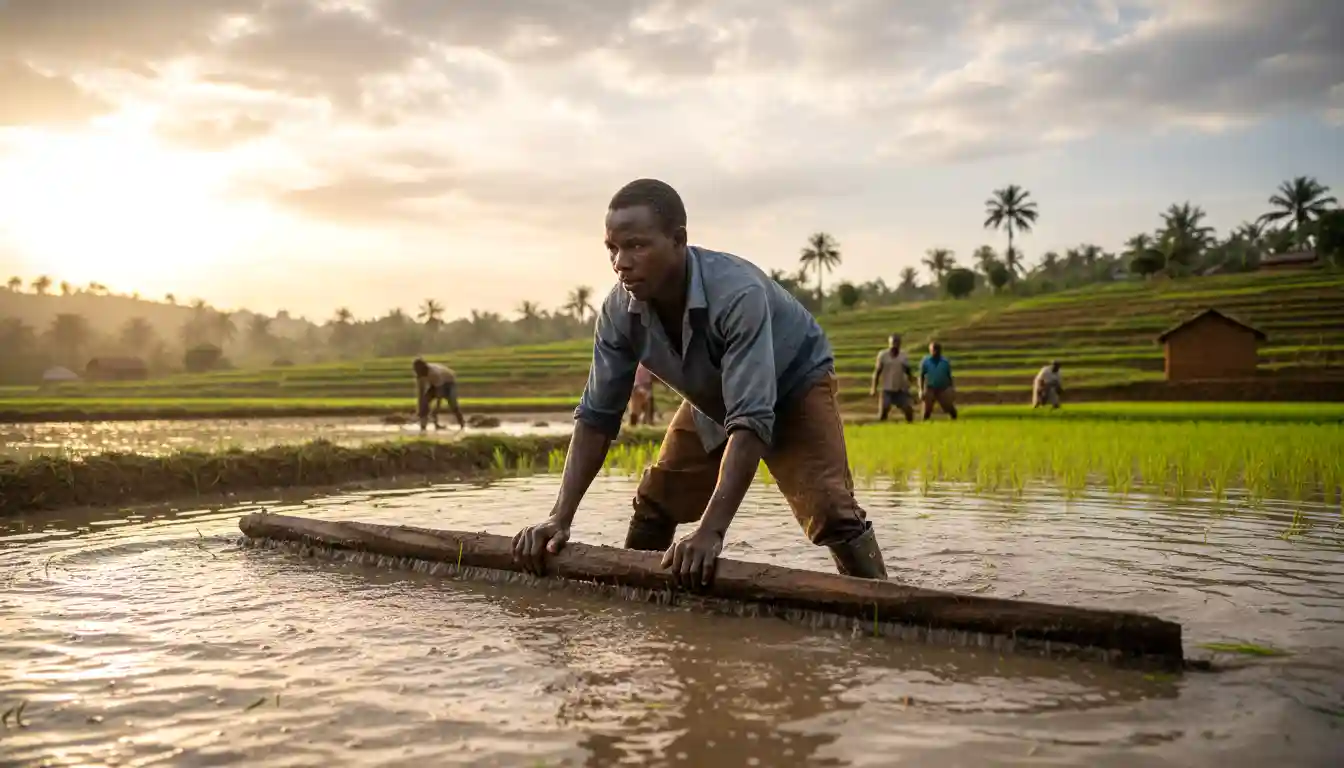
Primary ploughing using a tractor breaks the hard soil pan and buries previous crop residues. This should happen a month before the irrigation cycle begins to allow organic matter to decompose. Next comes leveling and puddling, which involves churning the flooded soil into a uniform mud.
Proper leveling ensures an even distribution of water across the entire block. This step is vital for weed control and uniform crop maturity. Poorly leveled fields lead to dry patches where weeds thrive aggressively.
Nursery Establishment
Successful germination requires high-quality seeds soaked in clean water for twenty-four hours. They are then incubated in a warm place for another two days to pre-germinate. A standard acre requires roughly twenty kilograms of certified seed.
The nursery bed should be raised, well-manured, and situated near a reliable water source. Pre-germinated seeds are broadcast evenly over the wet mud. Seedlings must be kept continuously moist but not deeply submerged during their first two weeks.
Transplanting
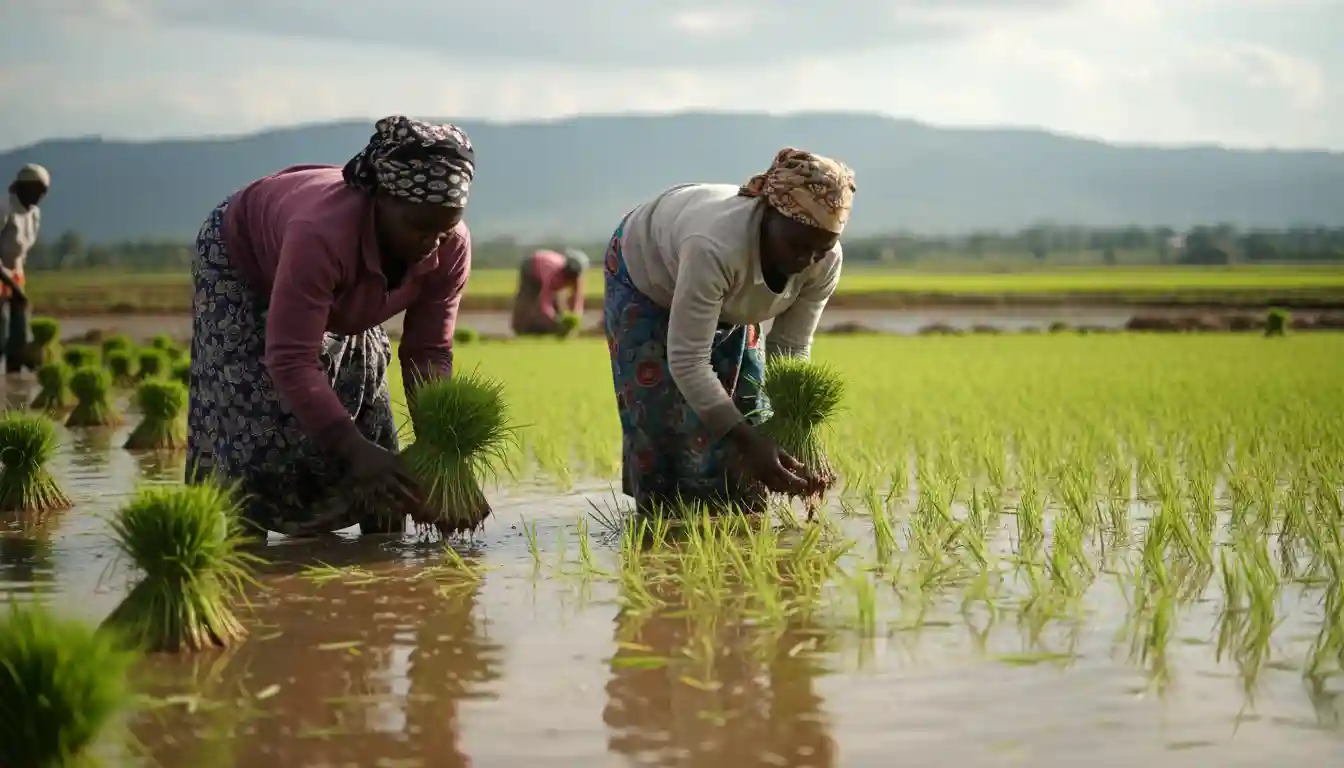
Moving seedlings must happen exactly when they are three weeks old. Delaying this process stunts the plant’s tillering ability and drastically reduces your final yield. Seedlings should be uprooted gently to avoid severe root damage.
Proper spacing is non-negotiable for maximizing sunlight capture and nutrient uptake. The recommended spacing is twenty centimeters between rows and plants. Random planting severely limits yields and makes mechanical weeding utterly impossible.
Irrigation Management
The field must be kept flooded with about five centimeters of water immediately after transplanting. This shallow flooding suppresses early weed germination effectively. As the crop enters the tillering stage, the water depth should be gradually increased.
The field must be drained completely during top-dressing to prevent chemicals from washing away. Two weeks before the final harvest, all water must be drained from the paddies. This forces the grain to harden and dries the soil for harvesting machinery.
Fertilizer Application
These plants are heavy feeders and require a strict nutritional regime to hit peak yields. The table below outlines the recommended fertilizer schedule for maximum productivity.
| Growth Stage | Fertilizer Type | Rate Per Acre | Application Goal |
|---|---|---|---|
| Basal (Planting) | DAP | 100 kg | Strong root establishment. |
| Early Tillering | Urea or CAN | 50 kg | Boost maximum tiller formation. |
| Panicle Initiation | Urea | 50 kg | Increase final grain size. |
Weed & Pest Control
Weeds compete aggressively for nutrients, capable of reducing yields by over forty percent if left unchecked. A pre-emergence herbicide should be applied three days after transplanting. Manual or mechanical rotary weeding should follow at day twenty to aerate the soil.
The most devastating pests locally are the Apple Snail, stem borers, and grain-eating birds. Snails slice through young seedlings overnight, requiring immediate application of recommended molluscicides. Bird control requires hiring dedicated labor to chase flocks away during the ripening stages.
Top 10 Rice Pests & Diseases: The Silent Profit Killers
If you ignore disease management, you aren’t farming, you’re gambling. In the Kenyan rice sector, a single outbreak can pivot your “profitable season” into a total write off. Pathogens don’t care about your investment; they only care about host availability and poor management.
1. Rice Blast (Magnaporthe oryzae)
This is the most devastating rice disease in Kenya, especially for Pishori growers. It attacks leaves (leaf blast), nodes, and the neck of the panicle (neck blast).
- Symptoms: Eye-shaped spots with gray centers and brown borders. Neck blast causes the panicle to snap, leading to empty “white heads.”
- The Risk: Can wipe out 100% of your yield in a week if weather is cool and humid.
- Management: Avoid excessive nitrogen. Plant resistant varieties like Komboka.
2. Rice Yellow Mottle Virus (RYMV)
Specific to Africa and a massive threat in Western Kenya (Ahero/Bunyala). It is spread by beetles and mechanical contact.
- Symptoms: Yellowish-green mottling/striping on leaves and severe stunting of the plant.
- The Risk: Early infection stops grain formation entirely.
- Management: Rogue (uproot) infected plants immediately. Sync planting dates with neighbors to avoid “green bridge” transmission.
3. Brown Spot (Cochliobolus miyabeanus)
Usually a sign of poor soil management or “hungry” rice. It targets stressed plants.
- Symptoms: Small, circular, dark brown lesions that look like sesame seeds on the leaves.
- The Risk: Reduces grain quality and weight; can kill up to 50% of seedlings in a nursery.
- Management: Fix your soil. Ensure adequate Potassium (K) and proper water leveling.
4. Bacterial Leaf Blight (BLB)
Caused by Xanthomonas oryzae. It thrives in windy, rainy conditions where leaves get wounded.
- Symptoms: Water-soaked streaks that turn yellow or white, starting from the leaf tips.
- The Risk: Causes “Kresek” (systemic wilting), killing the entire plant in the vegetative stage.
- Management: Use certified seeds. Do not clip seedling tips during transplanting—you are just creating entry wounds for bacteria.
5. Sheath Blight (Rhizoctonia solani)
A fungal disease that “climbs” the plant from the water line.
- Symptoms: Large, oval, greenish-gray lesions with purple borders on the leaf sheaths near the water level.
- The Risk: Dries out the leaves and causes lodging (falling over), making mechanical harvesting impossible.
- Management: Avoid high planting density (20x20cm is the rule). Drain the field periodically to reduce humidity.
6. False Smut (Ustilaginoidea virens)
Often called the “disease of wealth” because it appears in high-yielding fields, but it’s actually a grain destroyer.
- Symptoms: Individual grains turn into large, velvety orange or yellowish-green balls of spores.
- The Risk: Contaminates the entire harvest; millers will reject discolored grain.
- Management: Use certified seeds. Avoid late-season nitrogen applications.
7. Bacterial Leaf Streak
Similar to BLB but produces narrow, translucent streaks between the leaf veins.
- Symptoms: Linear streaks that “ooze” yellow bacterial beads during high humidity.
- The Risk: Rapid leaf browning and reduced photosynthesis, leading to shriveled grains.
- Management: Clean cultivation and field sanitation.
8. Sheath Rot (Sarocladium oryzae)
This fungus attacks the sheath that encloses the young panicle.
- Symptoms: Oblong brown lesions on the uppermost leaf sheath. The panicle often fails to emerge or emerges partially with rotted grains.
- The Risk: Direct loss of panicles; it often hitches a ride on Stem Borer injuries.
- Management: Control Stem Borers and avoid wounding the plants.
9. Leaf Scald
A fungal disease that loves wet, flooded conditions.
- Symptoms: Zonate (banded) lesions starting from the leaf tip that look like “scalded” or burnt tissue.
- The Risk: Lowers grain filling ratio and reduces milling quality.
- Management: Balance your NPK fertilizers; do not over-rely on Urea alone.
10. Rodents (Rats and Mice)
Rodents are among the most destructive yet often ignored pests in rice farming. Unlike insects that attack early, rats and mice strike closer to harvest when farmers expect profits, causing serious losses.
They feed on ripening grains, cut down panicles, and can destroy a large portion of a field in a short time if not controlled. In severe infestations, yield losses can reach 10–30% of the expected harvest, especially in poorly managed or unattended farms.
Rodents thrive in rice fields because flooded paddies provide both food and shelter along bunds and drainage areas. They are most active at night, making early detection difficult for farmers who do not monitor their fields regularly.
Control Measures
- Clear field bunds and surrounding vegetation to remove hiding places
- Use traps along field edges during the grain-filling stage
- Encourage natural predators like owls where possible
- Maintain clean farm surroundings and avoid leaving spilled grain
- Community-wide control is more effective than individual efforts
Rodent control is most critical during the last 3–4 weeks before harvest. At this stage, even small populations can wipe out a farmer’s expected profit in a few nights if left unmanaged.
Proper rodent management is not optional. It is a profit protection strategy every serious rice farmer must take seriously.
The Bottom Line on Disease
If you see symptoms, you are already losing money. Prevention is the only profitable strategy.
- Seed Source: Never use “neighbors’ seeds.” They are usually carrying Smut or RYMV.
- Nitrogen Discipline: Over-applying Urea makes the plant “soft” and attractive to fungi.
- Water Control: Proper drainage at the right stages breaks the life cycle of many fungal pathogens.
Read Also: Beyond Maize: 7 Drought-Resistant “Smart Crops” to Plant This Season
Are you willing to invest in certified seed treatment, or are you going to risk a 30% yield loss by using untreated grain?
Cost of Rice Farming in Kenya (Per Acre Breakdown)
The total cost ranges between KES 90,000 and KES 110,000 per acre. This covers leasing, mechanized preparation, certified seeds, subsidized fertilizers, intensive labor, pest control, and harvesting.
You must treat your farm like a strict financial ledger to run a profitable operation. The biggest hidden trap for beginners is underestimating the intense labor costs required for daily maintenance. Leasing an acre of prepared paddy land with water access costs roughly KES 20,000 per season.
Land preparation using a tractor for puddling will cost you around KES 12,000. Certified seeds cost KES 3,500, while nursery establishment and transplanting labor drain another KES 12,000. Your fertilizer budget is strictly capped at KES 10,000 thanks to government subsidies.
Agrochemicals for weed and pest control will average KES 8,000. You must also budget heavily for crop maintenance, specifically weeding and bird control, which easily costs KES 15,000. Finally, harvesting logistics will require an additional KES 15,000, bringing the total working capital to KES 95,500.
Why You Will Likely Lose Money in Your First Season
Most first-time rice investors fail because they treat the paddy like a passive investment. If your plot is at the tail end of a canal in Mwea or Ahero, you are at the mercy of water cartels and upstream neighbors.
If you don’t have a KES 50,000 emergency buffer per acre, a single invasion of Apple Snails or a sudden drought will wipe out your capital before you even see a panicle. Do not expect “comfortable” profits if you cannot be on the ground to manage the daily drama of canal maintenance and bird scaring.
Rice Yield Per Acre in Kenya
An average farmer harvests between 15 and 20 bags per acre. High-performance commercial farmers using certified varieties and strict spacing can comfortably achieve yields of 35 to 45 bags.
The gap between an average harvest and a high-performance one comes down strictly to agronomic discipline. The national average remains low because many farmers use recycled, uncertified seeds. They also ignore exact plant spacing and apply nutrients late.
High-performance farmers adopt superior varieties that are genetically wired to produce heavy panicles. By combining these seeds with timely top-dressing, they consistently hit higher target weights. This dramatically increases their revenue without significantly doubling their initial input costs.
Yields are also heavily influenced by the quality of land leveling and weed management. An uneven field means unequal water distribution, causing parts of the crop to dry out. Timely bird control is a massive factor that dictates the final volume.
Case Study: The Cost of Cutting Corners In the 2025 season, John Ochieng in the West Kano scheme attempted to save costs by using recycled seeds from his neighbor. While his neighbors used certified Komboka and harvested 35 bags per acre, John’s crop was hit by rice blast disease early.
He managed only 11 bags of low-quality grain that brokers refused to buy at premium rates. Contrast this with Mary Njeri in Mwea, who followed the strict KIAMIS fertilizer schedule. Despite a water shortage, her discipline in leveling her field perfectly ensured her yield stayed at 32 bags, netting her over KES 130,000 after all expenses.
Rice Farming Profit Per Acre in Kenya (Real Numbers)
A well-managed acre yielding 30 bags generates KES 240,000 in gross revenue. After deducting KES 100,000 in production costs, a farmer earns a net profit of KES 140,000 per season.
Let us look at a realistic one-acre breakdown using a highly demanded aromatic variety. Assume a conservative yield of thirty bags resulting from excellent crop management. Farm-gate prices for pure paddy sit confidently at KES 8,000 per bag.
Selling thirty bags at KES 8,000 generates a gross revenue of KES 240,000. Your total production cost, from land lease to final harvest, hovers around KES 100,000. When you subtract these strict costs, you are left with a clean net profit of KES 140,000.
If you choose to bypass brokers and mill the grain yourself, the profits multiply aggressively. Milled premium grades retail for up to KES 160 per kilo. Selling directly to urban consumers significantly boosts your final take-home cash.
Rice Farming Calendar in Kenya (Planting to Harvest Timeline)
The typical calendar begins with land preparation in July and nursery sowing in August. Transplanting occurs in September, followed by vegetative growth, with the final harvest in late December or January.
Cultivation requires strict adherence to a timeline, particularly in regions depending on specific rainfall patterns. Month one is entirely dedicated to primary land preparation and repairing water canals. Broken canals will bleed your water supply and destroy your profit margins.
Month two involves flooding the field, intense soil puddling, and establishing the seed nursery. By month three, seedlings are ready for exact line-based transplanting into the main field. Month four is the critical vegetative stage, demanding nitrogen top-dressing and aggressive weed control.
Read Also: 15 Most Profitable Agribusiness Ideas in Kenya to Start in 2026
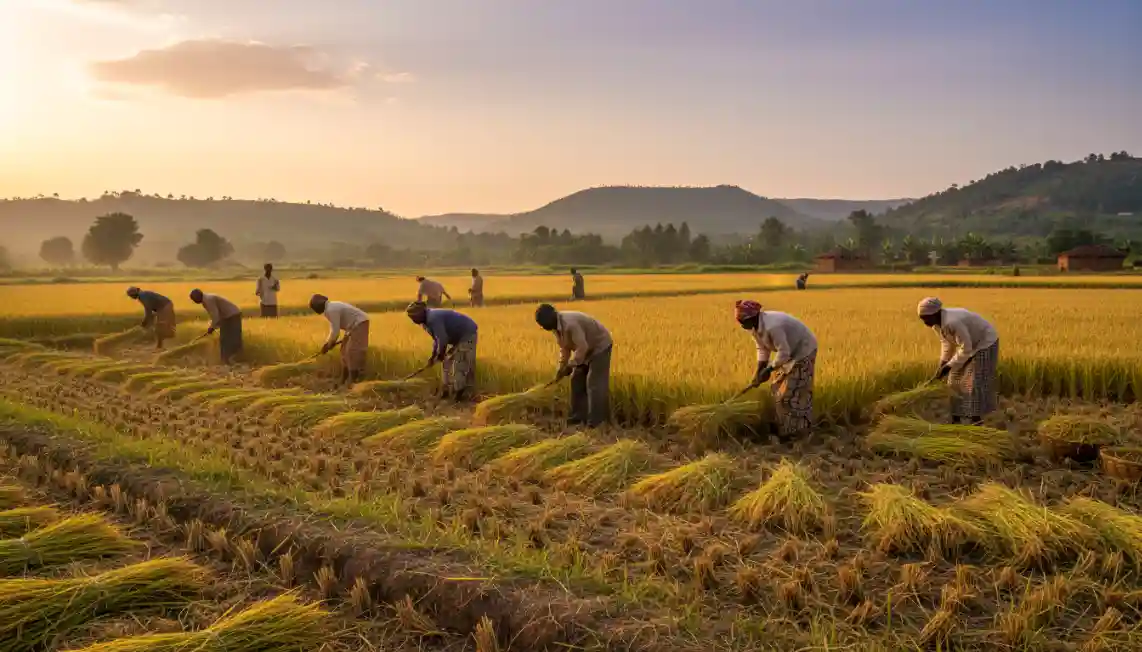
Months five and six encompass panicle initiation, flowering, and grain filling. This is when bird control becomes a full-time, mandatory expense. By late month six, the golden crop is harvested, threshed, and dried to a strict fourteen percent moisture content.
Risks & Reality Check: Common Challenges in Rice Farming in Kenya
The biggest threats are severe water shortages from prolonged droughts, devastating pest invasions, high input costs, and market manipulation by brokers during local harvest periods.
Water insecurity is the ultimate dream killer in this specific agribusiness. Erratic rainfall frequently leaves major irrigation dams depleted, forcing strict rationing systems. If your farm sits at the tail end of a canal system, you face a high risk of complete crop failure.
Pest and disease management is a relentless, expensive daily battle. The recent invasion of the Apple Snail has caused massive panic by devouring young transplanted seedlings. Furthermore, fungal diseases can wipe out entire blocks if farmers plant susceptible recycled seeds.
Market fluctuations are also incredibly brutal for unorganized independent growers. Brokers often manipulate farm-gate prices right at the harvest peak when farmers are desperate for quick cash. Sudden duty-free import windows can also temporarily flood the market with cheap overseas alternatives.
How to Maximize Rice Farming Profits in Kenya
Maximize profits by strictly using certified KALRO seeds and avoiding recycled grains. Implement precise row spacing, optimize fertilizer application timing, and invest in personal value addition like custom milling.
The easiest way to bleed money is to buy cheap, uncertified seeds from an unreliable source. Always source certified foundation varieties directly from approved agricultural agents. These seeds guarantee high germination rates, aggressive tillering, and built-in resistance to common viral diseases.
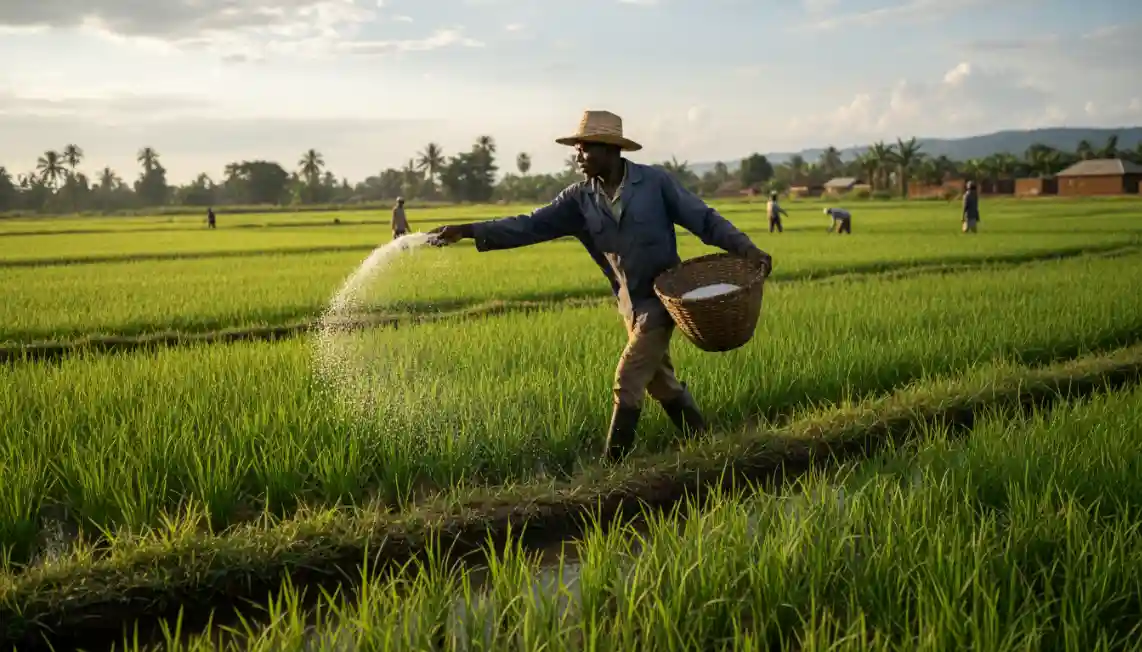
Agronomic discipline is your absolute best defense against low harvest weights. Ensure laborers use measuring ropes during transplanting to maintain a strict spacing grid. This allows maximum sunlight penetration and lets you use mechanical weeders to cut manual labor costs.
Never sell your harvest raw from the field if you want to build real generational wealth. Value addition is where the true money is made in this industry. Transport your paddy to local cooperative millers, dry it perfectly, and package it in branded bags.
Rice Market in Kenya (Prices & Selling Tips)
Farm-gate prices fluctuate between KES 70 and KES 200 per kilo depending on the variety. Secure the best prices by selling directly to major cooperative millers or distributing to urban wholesalers.
The local market is highly lucrative but requires smart navigation to avoid exploitation by middlemen. Brokers often patrol farms during the harvest season with ready cash, offering low-ball prices. You must plan your harvest finances carefully so you are not forced into a panic sale.
Selling through established channels like regional multipurpose cooperative societies offers much better price protection. The government also occasionally steps in to buy local harvests at premium rates. This stabilizes the market and protects active farmers from sudden import shocks.
Aromatic varieties will always dictate their own terms on the open trading floors. Urban consumers strictly demand genuine aroma and are deeply suspicious of adulterated broker supplies. If you consistently supply pure grain to high-end estates, you will create a highly profitable demand loop.
Conclusion: Is Rice Farming in Kenya Worth It in 2026?
Rice farming in Kenya is no longer a subsistence activity. It has become a serious commercial agribusiness driven by rising demand, urban population growth, and a persistent national rice deficit. For farmers with access to reliable water and disciplined management practices, the numbers are clear: rice can deliver strong and consistent returns per acre.
However, profitability is not automatic. The difference between loss and high returns comes down to execution. Farmers who use certified seeds, follow proper spacing, manage water correctly, and apply fertilizers on time consistently outperform those who rely on guesswork or recycled methods. In contrast, poor planning, weak pest control, and ignoring irrigation discipline can quickly erase profits.
The reality is simple. Rice farming rewards precision, capital investment, and patience. It is not a shortcut to quick money, but a structured system that pays well when done correctly. Regions like Mwea, Ahero, and Bunyala continue to prove that with the right conditions, farmers can earn substantial income per acre each season.
If you approach rice farming as a business rather than a trial-and-error activity, 2026 presents a strong opportunity. The market is available, demand is growing, and the gap between local production and consumption remains wide. Those who treat it professionally will continue to benefit the most.
Call to Action
Ready to start profitable rice farming in Kenya? Don’t guess your way through it.
Get certified seeds, follow the right farming methods, and plan your costs properly to avoid losses and maximize your profit per acre.
👉 Start today by choosing a reliable rice growing area and using proven techniques like those used in Mwea farmers.
👉 Share this guide with other farmers and stay updated with more practical agribusiness insights.
FAQs About Rice Farming in Kenya
How profitable is rice farming in Kenya per acre in 2026?
Rice farming can earn KES 100,000–140,000 profit per acre per season with good management and strong market prices.
What is the current price of a 25kg bag of rice in Kenya today?
A 25kg bag of rice in Kenya costs roughly KES 3,000–6,000 depending on variety, quality, and location.
How many months does rice take to mature in Kenya?
Rice takes about 3 to 5 months (90–150 days) to mature depending on the variety and farming conditions.
Which fertilizer is best for rice farming in Kenya?
DAP is best for planting, while CAN or Urea is used for top dressing to boost growth and grain formation.
How many times can rice be harvested per year in Kenya?
Rice can be harvested 1–2 times per year depending on irrigation and climate conditions.
Which is the best month to plant and harvest rice in Kenya?
Best planting months are Jan–Mar or Aug–Oct; harvesting happens about 4 months later
How much does it cost to start rice farming per acre in Kenya?
Starting rice farming costs about KES 90,000–110,000 per acre including land prep, seeds, labor, and inputs.
How many bags of rice can one acre produce in Kenya?
One acre produces 15–25 bags on average, but good farming can reach 30–45 bags.
Which are the main rice growing areas in Kenya?
Top areas include Mwea, Ahero, West Kano, Bunyala, and Tana River due to irrigation and suitable soils.
Is rice farming in Kenya profitable for small-scale farmers?
Yes, small-scale farmers can profit if they have water access, use certified seeds, and manage costs well.