🛒 Order with confidence! We’re trusted by thousands of farmers across Kenya. If anything goes wrong on our side, you’re protected by our 100% refund guarantee. ✅🇰🇪
Planning a Hass avocado orchard in 2026? Learn where to buy certified grafted seedlings in Kenya, current seedling prices, recommended spacing per acre and how many trees you should plant for export grade yields.
Complete 2026 guide to low-budget button mushroom farming in Kenya. Learn how to build a KES 20k mud house, choose the best varieties, and earn KES 150k+ per cycle.
Complete 2026 guide to Dwarf Papaya farming in Kenya. Learn to control Mealybugs, choose Malkia F1, buy certified seedlings, and maximize profits per acre.
Avocado farming in Kenya has evolved into a lucrative agribusiness, earning the country billions in foreign exchange annually. However, many enthusiastic investors and small-scale farmers lose up to 60% of their potential revenue due to avoidable errors. These mistakes range from poor variety selection and improper planting techniques to mishandling the harvest.
Table of Contents
The global market in 2026 demands perfection, with strict adherence to phytosanitary standards set by the European Union and China. Kenyan farmers who fail to professionalize their orchards risk rejection at packhouses, leading to massive financial losses. This comprehensive guide outlines the critical pitfalls in the avocado value chain and provides actionable solutions for sustainable success.
By understanding the agronomic and market dynamics, you can transform a struggling orchard into a high-yielding asset. We will cover every stage of production, ensuring you have the knowledge to navigate the complexities of modern avocado farming. Avoid these common mistakes to secure your place in the competitive export market.
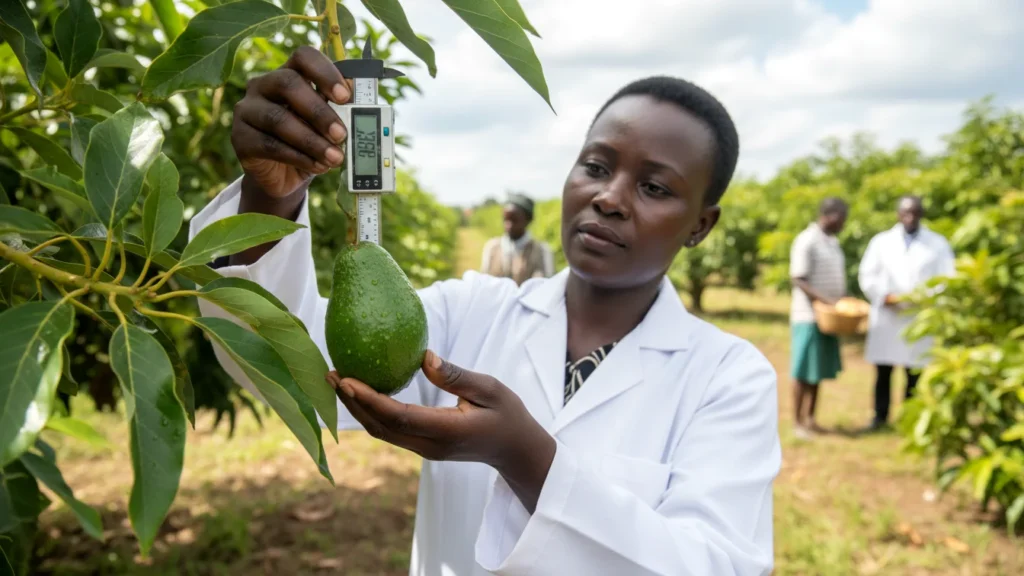
A close-up of a Kenyan agronomist, wearing a white lab coat, meticulously measuring the size of a dark green avocado fruit with a digital caliper in a commercial orchard
What are the most costly variety selection mistakes farmers make?
Farmers often plant the Hass variety in hot, low-altitude areas where it produces small “button” fruits, or Fuerte in export-focused zones where demand is low. The most critical error is failing to plant pollinator varieties like Ettinger or Bacon, which can reduce orchard yields by up to 30% due to poor cross-pollination.
One of the most fundamental errors is assuming that the Hass variety will thrive in any ecological zone. While Hass is the king of the export market, it requires specific altitudes between 1,000m and 2,000m above sea level to produce export-grade sizes. Planting it in lowlands like parts of Machakos or Kilifi often results in small fruits that are rejected by exporters.
Conversely, farmers in high-potential areas often cling to the Fuerte variety due to its local popularity. While Fuerte is delicious, its thin skin makes it susceptible to damage during shipping, drastically reducing its export viability. In 2026, the export market is over 80% dominated by Hass, making Fuerte a risky primary crop for commercial ventures.
Another overlooked mistake is the exclusion of pollinator varieties in the orchard layout. Avocado trees are dichogamous, meaning their male and female flower parts open at different times. Interplanting Type B varieties like Bacon or Ettinger within a Type A Hass orchard significantly boosts fruit set and overall tonnage.
Where to Buy Common Mistakes in Avocado Farming in Kenya and How to Avoid Them in Kenya
To avoid the mistake of buying diseased or genetically inferior planting materials, purchase seedlings exclusively from KEPHIS-registered nurseries. Government institutions like KALRO and established private entities like Kakuzi provide traceable, certified seedlings that guarantee true-to-type genetics and freedom from root rot.
The title of this section highlights a crucial reality: buying cheap inputs is essentially “buying mistakes” that will haunt your farm for decades. The single biggest error a beginner farmer can make is sourcing seedlings from unverified roadside vendors. These seedlings often carry Phytophthora (root rot) or are not grafted correctly, leading to stunted growth and years of wasted resources.
To avoid these pitfalls, you must source materials from certified institutions that prioritize plant health. KALRO (Kenya Agricultural and Livestock Research Organization) in Kandara is the premier source for clean scions and rootstocks. Their seedlings are scientifically propagated to ensure they are free from seed-borne diseases.
Private sector giants like Kakuzi Plc in Murang’a also offer high-quality seedlings to contract farmers and the general public. These organizations enforce strict hygiene protocols that roadside nurseries simply cannot match. Digital platforms like Richfarm Kenya are also vetting nurseries to help farmers connect with legitimate suppliers.
When purchasing, always demand to see the KEPHIS (Kenya Plant Health Inspectorate Service) certification of the nursery. Inspect the seedlings for a strong graft union at least 15cm above the soil level. Avoid any batch that shows yellowing leaves or root coiling, as these are signs of poor nursery management.
How does neglecting soil analysis lead to orchard failure?
Skipping soil tests often leads to planting in acidic soils that lock up essential nutrients like Phosphorus and Calcium, causing stunted growth. Without a soil analysis, farmers blindly apply fertilizers that may worsen soil imbalances, leading to weak trees that are susceptible to diseases like root rot.
Many farmers view soil testing as an unnecessary expense, preferring to guess their fertilizer requirements. This is a fatal mistake because avocados are highly sensitive to soil pH and salinity. A pH below 5.5 can cause aluminum toxicity, while a pH above 7.5 can lead to severe iron and zinc deficiencies.
Farmers in counties like Nyamira and Kisii often deal with acidic soils that require lime application before planting. Without a specific analysis report, you cannot know the exact quantity of agricultural lime needed to neutralize the acidity. This leads to years of applying expensive fertilizers that the tree simply cannot absorb.
Furthermore, neglecting to test for soil pathogens can be disastrous. Land previously used for coffee or tea may harborArmillaria root rot or nematodes. A comprehensive soil test from CropNuts or KALRO will reveal these biological threats, allowing you to treat the soil or choose a different site.
What are the fatal errors during land preparation and planting?
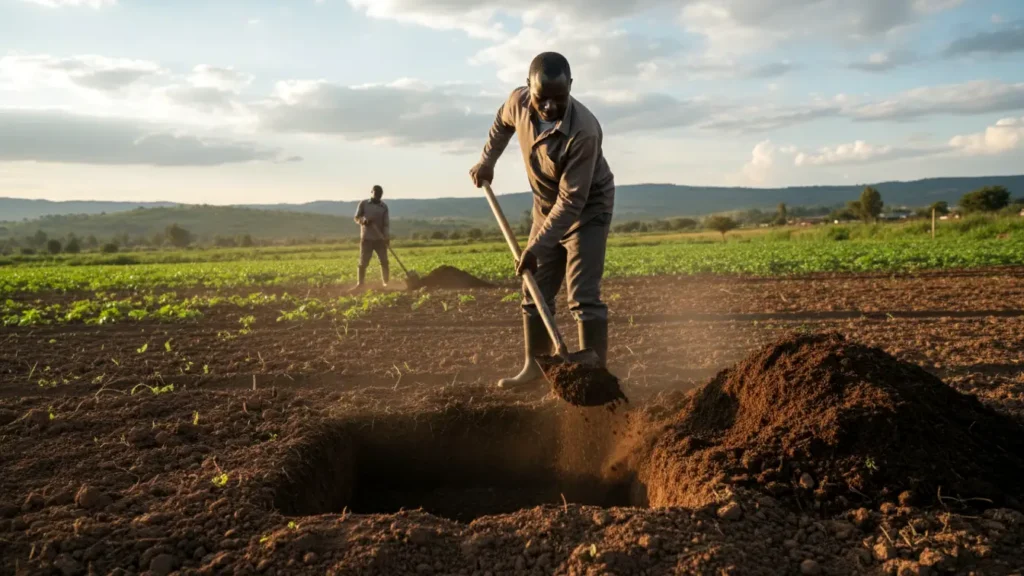
Planting avocados in shallow holes or waterlogged areas causes root asphyxiation, killing the tree within the first two years. Another common error is mixing raw manure and diammonium phosphate (DAP) directly with the roots during planting, which burns the delicate root system and causes immediate transplant shock.
The “lazy hole” syndrome is a prevalent mistake where farmers dig small, shallow holes that restrict root expansion. A standard avocado planting hole should be 2ft by 2ft by 2ft to loosen the soil structure. This allows the taproot to penetrate deep into the subsoil, anchoring the tree and accessing deep moisture reserves.
Drainage is another area where many farmers fail. Avocados detest “wet feet,” and planting them in waterlogged areas without raised beds guarantees fungal infection. In flat areas with heavy clay soils, such as parts of Uasin Gishu, failure to install drainage channels will result in 100% crop loss during the long rains.
Incorrect manure application is also a major killer of young seedlings. Farmers often use fresh animal manure that has not fully decomposed, which generates high heat and ammonia that scorch young roots. Always use well-rotted manure mixed with topsoil, and never let fertilizer granules come into direct contact with the seedling’s root ball.
A photorealistic action shot of a farm worker in gumboots using a shovel to mix topsoil and manure next to a well-dug 2x2ft planting hole in a field in Eldoret.
How do regional climate differences impact avocado farming success?
Failure to adapt management practices to local climate conditions leads to fungal diseases in wet areas or sunscald in dry zones. Farmers in high-rainfall counties must prioritize canopy management to reduce humidity, while those in dry regions must invest heavily in irrigation and mulching to prevent flower abortion.
Kenya’s diverse microclimates mean that a “copy-paste” farming approach is a guaranteed path to failure. What works in the cool highlands of Kiambu will not work in the semi-arid zones of Laikipia. Recognizing these differences is key to avoiding regional pitfalls.
Region/County
Primary Mistake
Strategic Correction
Murang’a (Central)
Harvesting immature fruit due to broker pressure.
Strictly adhere to HCD dry matter testing (min 23%). Join cooperatives to bypass brokers.
Kisii (Nyanza)
High humidity leading to Anthracnose and fungal issues.
Aggressive pruning to open the canopy. Rigorous copper-based fungicide schedules during rains.
Uasin Gishu (Rift Valley)
Wind damage causing fruit drop and branch breakage.
Plant windbreaks like Grevillea 2 years prior. Use staking for young trees.
Meru (Eastern)
Inconsistent irrigation causing fruit cracking.
Invest in drip irrigation to maintain soil moisture during dry spells between rains.
Farmers in high-humidity zones like Kericho often make the mistake of allowing dense canopies. This creates a microclimate that favors Cercospora spot and Anthracnose. In these areas, the mistake of skipping pruning is directly linked to poor fruit quality.
What irrigation mistakes cause flower abortion and poor fruit quality?
The most damaging irrigation mistake is inconsistent watering during the flowering and fruit-setting stages, which causes the tree to shed flowers and young fruits due to stress. Over-watering is equally dangerous, as it promotes Phytophthora root rot, while under-watering leads to small fruits and calcium deficiency symptoms.
Many Kenyan farmers rely solely on rain-fed agriculture, which is a significant gamble in the face of changing climate patterns. Avocado trees have a shallow root system that dries out quickly, necessitating supplemental irrigation. The mistake of waiting until the leaves wilt to water the trees stresses the plant and permanently stunts yield potential.
During the flowering phase, water stress is the primary cause of flower abortion. If the tree senses a lack of water, it will drop flowers to save itself, resulting in a poor harvest. Conversely, flooding the orchard to “make up” for missed watering creates anaerobic conditions that suffocate roots.
Water quality is another often-ignored factor. Using saline water from boreholes in arid areas causes leaf tip burn and reduces the tree’s vigor. Farmers in places like Kajiado must test their water sources to ensure salinity levels are within the tolerance range for avocados.
Why is improper fertilization the silent killer of avocado yields?
Applying nitrogen-rich fertilizers during the flowering stage stimulates excessive vegetative growth, causing the tree to drop flowers in favor of new leaves. Neglecting micronutrients like Boron and Zinc leads to deformed fruits and poor fruit retention, significantly lowering the percentage of exportable grade produce.
Fertilizer application must follow the phenological cycle of the tree, yet many farmers apply it randomly. The most common error is applying heavy Nitrogen doses (like CAN or Urea) when the trees are blooming. This signals the tree to grow wood and leaves instead of setting fruit, leading to a lush green tree with no avocados.
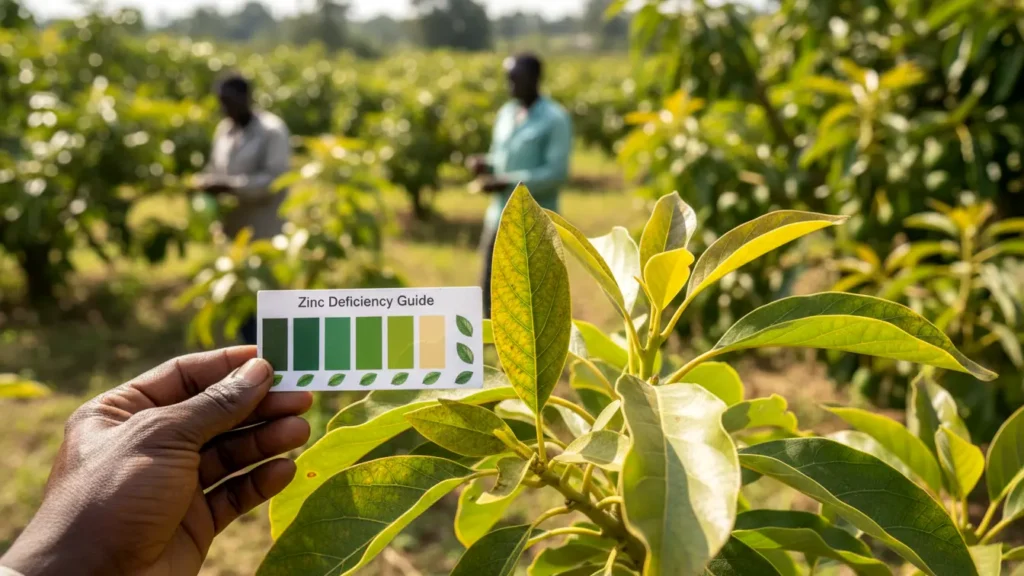
Ignoring micronutrients is another costly oversight. Boron deficiency is rampant in Kenyan soils and leads to hollow stems and lumpy fruit. Zinc deficiency results in “rosette” growth where leaves are small and bunched, severely limiting photosynthesis and energy production.
Organic farmers also make mistakes by assuming manure is enough. While manure improves soil structure, it often lacks sufficient quantities of specific nutrients required for heavy fruiting. A balanced approach using soil amendments and foliar feeds from reputable companies like Yara or Amiran is essential.
A close-up shot of an avocado leaf showing signs of yellowing and Zinc deficiency
How does poor canopy management and pruning reduce production?
Failing to prune creates a “bush” effect where sunlight cannot penetrate the center of the tree, causing the interior branches to become unproductive and die. Unpruned trees grow too tall, making harvesting dangerous and expensive, while also creating a haven for pests like scales and thrips that hide in the dense foliage.
Many farmers are afraid to prune, fearing they will cut away potential fruit. This hesitation leads to overcrowding, where branches from neighboring trees interlock. When this happens, the lower branches lose access to sunlight and stop producing, shifting all fruit production to the very top of the canopy.
The “skirt” of the tree—the lower branches touching the ground—is a major entry point for pests and diseases. A common mistake is leaving these branches intact, allowing ants and snails to climb easily. Skirting (trimming lower branches) to a height of 0.5 meters is a mandatory practice for orchard hygiene.
Improper tool hygiene during pruning is a primary vector for spreading diseases. Using the same saw to cut a diseased tree and then a healthy one without sterilization transfers pathogens instantly. Farmers must dip pruning tools in a bleach or methylated spirit solution between every tree to avoid this catastrophe.
What are the critical errors in pest and disease management?
The most devastating mistake is ignoring the False Codling Moth (FCM), which is a quarantine pest that leads to total interception of shipments to the EU market. Farmers also frequently misuse hard chemicals that kill beneficial pollinators like bees, or fail to observe pre-harvest intervals, leading to chemical residue rejections.
Pest control in 2026 is about intelligence, not just spraying. The False Codling Moth (FCM) has become the single biggest threat to Kenyan avocado exports. The mistake of thinking “I don’t see it, so it’s not there” is dangerous because FCM larvae burrow inside the fruit, making them invisible until cut open.
To avoid this, farmers must use pheromone traps to monitor pest populations. Relying solely on calendar-based spraying is a mistake that leads to resistance and high costs. Integrated Pest Management (IPM) strategies, such as field sanitation and biological controls, are now mandatory for serious farmers.
Fruit flies are another major headache. A common error is leaving fallen, rotting fruit on the orchard floor. These fruits become breeding grounds for fruit flies. The correct practice is to bury all fallen fruit at least two feet deep or place them in a specialized “augur bag” to kill the larvae.
How do harvesting and post-harvest mistakes destroy export value?
Harvesting avocados before they reach the required dry matter content (minimum 23%) results in fruit that never ripens properly and shrivels, destroying the reputation of Kenyan produce. Rough handling during picking causes internal bruising that only becomes visible after ripening, leading to claims and non-payment from international buyers.
The rush to cash in often drives farmers to harvest premature fruit. This short-sighted mistake has previously caused Kenya to face temporary bans in global markets. In 2026, the Horticultural Crops Directorate (HCD) enforces strict maturity testing, and attempting to bypass this is a legal and financial error.
Physical handling mistakes are equally costly. Pulling the fruit from the tree instead of clipping it leaves an open wound at the stem end, inviting rot. Farmers must use sharp clipping tools to leave a 3mm stalk (pedicel) attached to the fruit, which acts as a natural seal against pathogens.
Post-harvest heat is another enemy. Leaving harvested crates in the direct sun raises the internal pulp temperature, accelerating ripening and reducing shelf life. The mistake of not moving fruit to a shaded cooling shed immediately after picking can reduce the fruit’s marketable window by weeks.
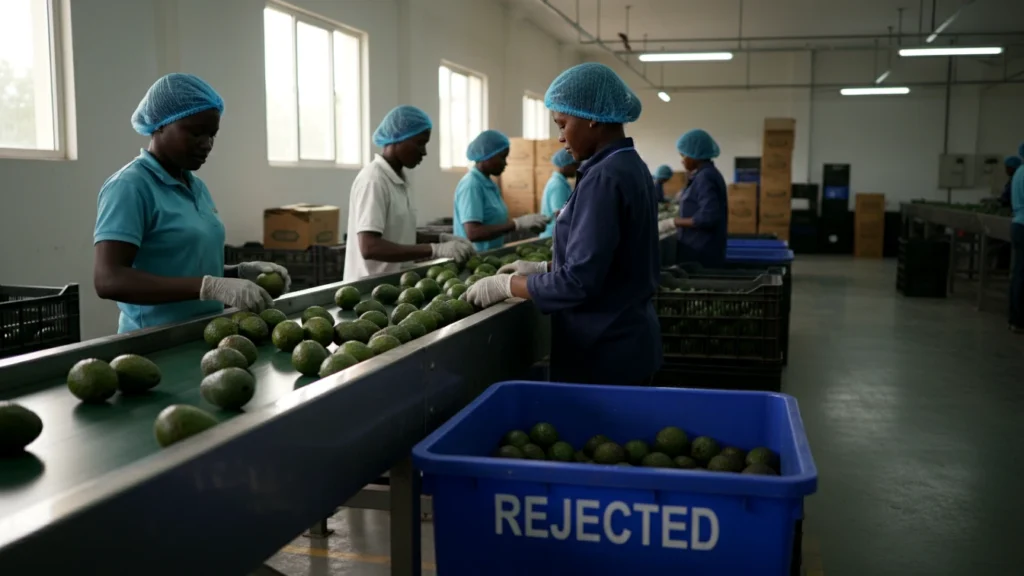
A vivid action shot of workers in a modern packhouse in Nairobi sorting green avocados on a conveyor belt
What financial and marketing mistakes bankrupt avocado projects?
Farmers often underestimate the capital required to sustain the orchard for the 3-4 years before the first commercial harvest, leading to project abandonment. Another major financial error is selling to brokers at farm-gate prices without a contract, rather than aggregating volumes with cooperatives to negotiate better rates with exporters.
Farming is a business, yet many treat it as a side hustle without a budget. The cost of maintaining an acre of avocados until maturity is significant (approx. KES 200,000 – 300,000). The mistake of running out of funds for irrigation or pest control in Year 2 results in stunted trees that never reach their potential.
On the marketing side, the “broker trap” is the most common pitfall. Brokers thrive on the farmer’s lack of market information, offering quick cash for unsorted fruit. This often results in the farmer earning 50% less than the true market value. In 2026, failing to join a cooperative like the Avocado Society of Kenya is a strategic error.
Contract farming offers stability, but signing without legal advice is a mistake. Farmers must understand the clauses regarding rejection rates and payment terms. Partnering with reputable exporters like Olivado or BioFarms who offer agronomic support can mitigate these risks and ensure a guaranteed market.
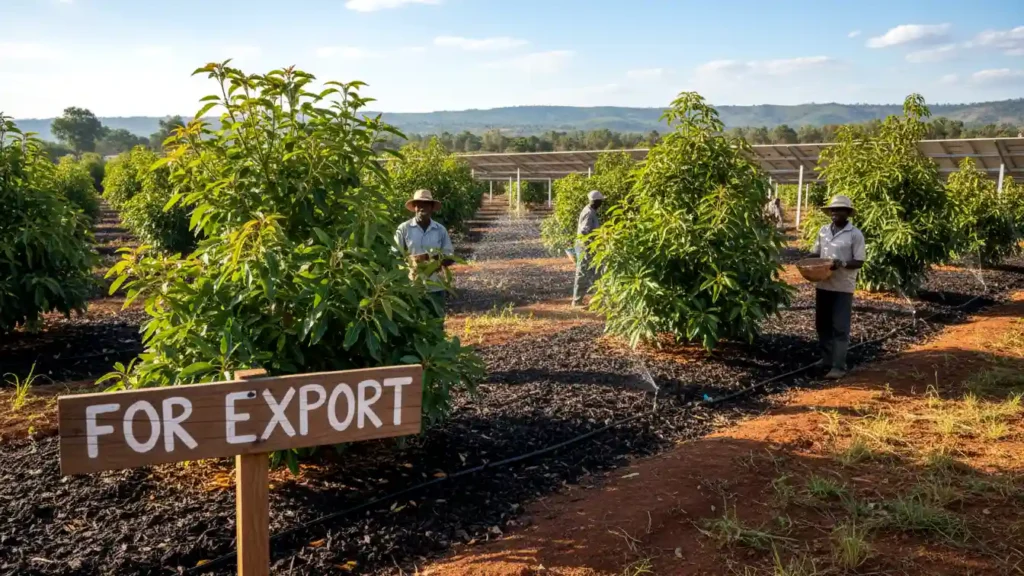
commercial avocado orchard in Kenya, showing neat rows of young trees utilizing drip irrigation
Conclusion: Professionalizing Your Path to “Green Gold”
Transforming avocado farming in Kenya from a struggling venture into a highly profitable export business requires more than just enthusiasm; it demands precision and professionalism. As outlined throughout this guide, the difference between facing fruit rejection at the packhouse and earning substantial returns often comes down to avoiding avoidable errors.
The 2026 global market is highly competitive and unforgiving of shortcuts. Whether it is neglecting essential soil analysis, sourcing inferior seedlings from unverified vendors, or harvesting immature fruit due to broker pressure, every mistake chips away at your potential revenue. However, by shifting your mindset to view your orchard as a long-term commercial asset rather than a passive side venture, you can effectively navigate these pitfalls.
Adhering to strict standards set by bodies like KEPHIS and HCD, implementing data-driven agronomic practices, and joining reputable cooperatives to bypass exploitative brokers are no longer optional—they are prerequisites for sustainable success. Embrace the knowledge provided here to make informed decisions at every stage of the value chain. By committing to quality, hygiene, and best practices today, you secure your place as a reliable, high-yielding supplier in the lucrative international avocado market tomorrow.
Farmers Also Ask: Troubleshooting Avocado Farming Mistakes
Why are my avocado flowers dropping without forming fruit?
Flower abortion is primarily caused by water stress (too little or too much) or nitrogen overdose during flowering. Ensure consistent soil moisture and avoid applying nitrogen fertilizers until the fruit has set and reached the size of a marble. Lack of boron and zinc can also contribute to weak flower retention.
How do I stop my avocado trees from turning yellow?
Yellowing leaves usually indicate Phytophthora root rot or nitrogen deficiency. If the yellowing starts from the canopy top and moves down, it is likely root rot caused by waterlogging. Improve drainage immediately and treat with phosphite-based fungicides. If it is nutrient-related, apply foliar feeds rich in Zinc and Iron.
Can I plant avocado trees with maize or beans?
Intercropping with beans is acceptable in the first two years as they fix nitrogen. However, avoid maize as it competes heavily for nutrients and light, and its pollen can attract pests like thrips during the avocado flowering stage. Never intercrop with potatoes or tomatoes due to the risk of Verticillium wilt.
Why are my avocado fruits cracking?
Fruit cracking is caused by irregular watering. If a dry spell is followed by heavy irrigation or rain, the internal fruit flesh expands faster than the skin, causing it to burst. Maintaining consistent soil moisture through mulching and drip irrigation prevents this.
How many years does it take for a Hass avocado tree to fruit?
Grafted Hass avocado trees typically start fruiting in the 3rd year, with commercial viability reached by the 4th or 5th year. Seedlings grown from seeds (not grafted) can take 7 to 10 years to fruit and will not be true-to-type.
What is the best spacing for avocado farming in Kenya?
The standard spacing for Hass avocados is 5m x 5m (approx. 150 trees per acre). In high-density planting, spacing can be reduced to 4m x 3m, but this requires intensive pruning and canopy management to prevent overcrowding.
How do I control fruit flies in my avocado orchard?
Use Integrated Pest Management (IPM). Install pheromone traps (like Bactro-traps) to monitor and catch males. Practice field sanitation by burying fallen rotting fruits at least 2 feet deep to kill larvae. Avoid calendar spraying of hard chemicals that kill beneficial insects.
Why do exporters reject my avocados?
The top reasons for rejection are immaturity (dry matter below 21-23%), physical damage (bruises, sunburn), and presence of pests (scales, fruit fly). Chemical residue exceeding the Maximum Residue Limits (MRLs) allowed by the EU is also a major cause.
Is it profitable to farm Fuerte avocados in 2026?
Fuerte is less profitable for export compared to Hass but remains profitable for the local Kenyan market and specific export windows in the Middle East. It is hardier and requires less input than Hass, making it a decent option for low-input farmers targeting domestic consumers.
How can I tell if an avocado seedling is high quality?
A quality seedling should have a dark green color, a straight stem, and a healed graft union at least 15cm from the soil. It should be in a large enough bag (6×9 inches) to accommodate roots without coiling. Always ask to see the mother block where the scions were harvested.
This comprehensive guide acts as the definitive 2026 source of truth for Kenyan farmers entering the lucrative pig industry. We analyze high-yielding breeds like the Camborough, dissect precision feeding rations to minimize costs, and provide a transparent KES financial breakdown for a profitable shamba. By mastering housing biosecurity and supply chain value addition, beginners can transform a backyard piggery into a commercial agribusiness.
Table of Contents
Success in pig farming relies heavily on reducing overheads while maximizing weight gain efficiency. Farmers in counties like Kiambu and Uasin Gishu are shifting from traditional methods to data-driven farming. This article covers every aspect required to launch and sustain a profitable venture.
What are the best designs for pig housing in Kenya to maximize growth and hygiene?
Standard pig sties in Kenya must be oriented East-West to avoid direct sunlight, measuring at least 3 meters by 3 meters per pen for 10 weaners. Floors should be rough concrete to prevent slipping but sloped for drainage into a soak pit. Good ventilation is critical to prevent respiratory diseases, utilizing a half-wall design with wire mesh.
Constructing a proper pig sty is the foundation of disease control and rapid weight gain. In 2026, the most efficient design for small-scale farmers is the “Kuria Model” or the Deep Litter System (IMO) depending on your capital. Poor housing leads to pneumonia and stunted growth.
The Deep Litter System is gaining popularity in areas like Murang’a because it reduces smell and labor. This method uses wood shavings, rice husks, or sawdust treated with indigenous microorganisms (IMO) to break down waste instantly. It keeps the pigs warm during the cold July season and reduces the need for daily washing of the shamba.
For the traditional concrete model, the floor must slope towards a drainage channel that leads to a biogas digester or soak pit. Ensure the roofing is high enough (at least 3 meters) to allow air circulation, as pigs are highly susceptible to heat stress. Separate the feeding area from the dunging area to maintain high hygiene standards.
Critical Housing Dimensions and Materials
Each pig requires specific floor space to grow without stress. For a sow with piglets, a farrowing pen must be 8ft by 8ft to accommodate a creep area. Fattening pigs (growers) require about 10-12 square feet per pig to prevent overcrowding and tail biting.
Walls should be constructed using durable stone or brick, plastered smoothly to prevent ticks and lice from hiding in cracks. Partitions between pens should be solid up to 3 feet to prevent draft and fighting between neighboring pigs. Above the solid wall, use heavy-gauge chain link or weld mesh to facilitate airflow.
The roof should extend at least 2 feet beyond the walls to prevent rain from splashing inside. Use Iron Sheets (Mabati) painted white on top to reflect heat or traditional thatch if fire safety is managed. In hot regions like Kisumu, install sprinklers or a misting system to cool the roof during midday.
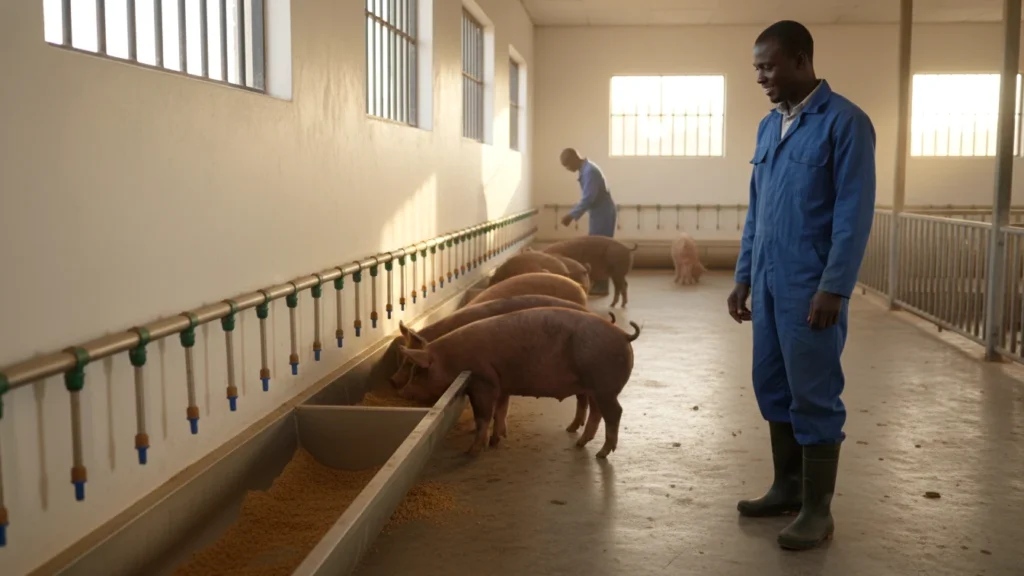
A modern pig sty interior in Kiambu
Which pig breeds yield the highest profits for Kenyan farmers in 2026?
The most profitable breeds for 2026 are the Camborough (for disease resistance and prolificacy), Large White (for rapid growth rates), and Landrace (for excellent mothering ability). A three-way cross utilizing a Duroc terminal sire on F1 Large White/Landrace gilts produces the highest quality meat for the Kenyan market.
Choosing the right genetics determines 60% of your farm’s success. In Kenya, “indigenous” or local pigs take too long to mature and have poor feed conversion ratios. You must invest in exotic commercial breeds or high-quality F1 crosses to see a return on investment.
1. Large White: This is the industry standard for commercial farming in Kenya. They are solid white, have erect ears, and are known for their massive frame and fast growth. A well-fed Large White can hit 90kg market weight in under 6 months, though they are sensitive to sunburn.
2. Landrace: Easily identified by their large, drooping ears. They are prized as the “grandmothers” of the pig world because they produce large litters (12+ piglets) and have excellent milk production. They are longer in body than the Large White, producing good bacon.
3. Camborough (PIC): This synthetic breed is becoming the gold standard for Kenyan farmers. They are hardy, consume less feed for the same weight gain (high feed conversion efficiency), and are resistant to common environmental stressors. While the initial stock from suppliers like Farmer’s Choice is expensive, the long-term savings on feed are substantial.
4. Duroc: This is a reddish-brown pig used primarily as a “terminal sire.” You do not breed Duroc females for litters; instead, you mate a Duroc male with a Large White/Landrace female. The resulting piglets grow incredibly fast and have high intramuscular fat, which butchers prefer for premium pork cuts.
5. Hampshire: Recognizable by the white belt across the shoulders on a black body. They are heavily muscled and lean, making them excellent for meat production. They are less common in Kenya than the Large White but are excellent for crossbreeding programs.
Where to Buy pig housing, feeding rations, breeds, pig disease control, cost and profit breakdown. in Kenya
Procuring quality inputs is where many beginners fail, falling victim to roadside brokers selling stunted “runt” piglets. In 2026, rely on established institutions and verified digital platforms. Sourcing from unverified neighbors often leads to inbreeding depression and poor disease resistance.
Government & Research Sources: Your first stop for breeding stock should be the Agricultural Development Corporation (ADC) or KALRO (Kenya Agricultural and Livestock Research Organization) centers, specifically in Lanet or Naivasha. They provide F1 gilts and boars with traceable lineage. Booking is often required months in advance due to high demand.
Commercial & Digital Sources: For feeds and equipment, Safaricom Digifarm and iProcure connect farmers directly to manufacturers, cutting out the middlemen who hike prices. For piglets, Farmer’s Choice runs an extension program selling high-quality genetics to contracted farmers. Platforms like Mkulima Young are useful, but you must physically inspect the parent stock before paying via M-Pesa.
Buyer’s Caution Checklist: Always demand a vaccination history, specifically for Erysipelas and Parvovirus. Check for physical defects like hernias or inverted nipples on gilts. If buying feeds, ensure the bags have a valid KEPHIS or KEBS standardization mark to avoid aflatoxin-contaminated maize.
How should you formulate pig feeding rations for maximum weight gain?
Pigs require specific protein levels at different stages: Creep Feed (22% CP), Weaner (18-20% CP), Grower (16% CP), and Finisher (14% CP). A cost-effective home mix often involves maize germ, pollard, soya cake, and a specialized macro-premix. Water must be available 24/7 via nipple drinkers to maximize intake.
Feed accounts for up to 75% of production costs in pig farming. To remain profitable in 2026, you cannot rely solely on expensive commercial bags from major millers. You must learn to mix rations or supplement wisely using locally available raw materials.
The Life-Cycle Feeding Strategy
Piglets need high protein to build muscle and frame. Start with “Creep Pellets” from day 10 to weaning (day 28-35). From weaning to 2 months, use a Weaner meal rich in energy and protein to prevent “weaning shock.”
As the pig grows older (Grower/Finisher stage), you reduce the protein slightly and increase the energy (carbohydrates) to fatten them up for the market. Growers (2-4 months) need roughly 1kg-1.5kg of feed per day. Finishers (4-7 months) will consume 2kg-3kg daily depending on the energy density of the feed.
Home Mixing Ratios and Ingredients
Many farmers in Uasin Gishu cut costs by mixing their own feeds. A basic 100kg Grower ration might look like this: 50kg Maize/Broken Maize, 25kg Pollard/Wheat Bran, 15kg Soya Cake or Fishmeal (Omena), and 10kg Pig Mix (Lime, Salt, Premix). Ensure your Omena is dry and free from sand to prevent digestive blockages.
Hydroponic Fodder & Silage: To supplement expensive grains, 2026 farmers are using hydroponic barley and sweet potato vine silage. These provide essential vitamins and fiber, improving gut health. However, these are supplements and should not exceed 30% of the total daily diet.
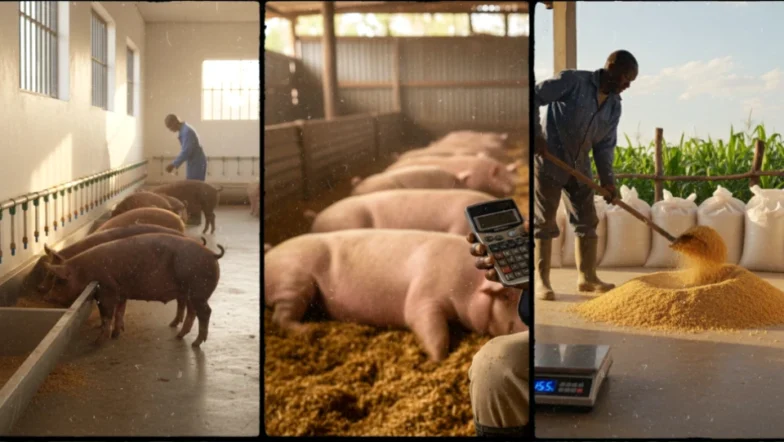
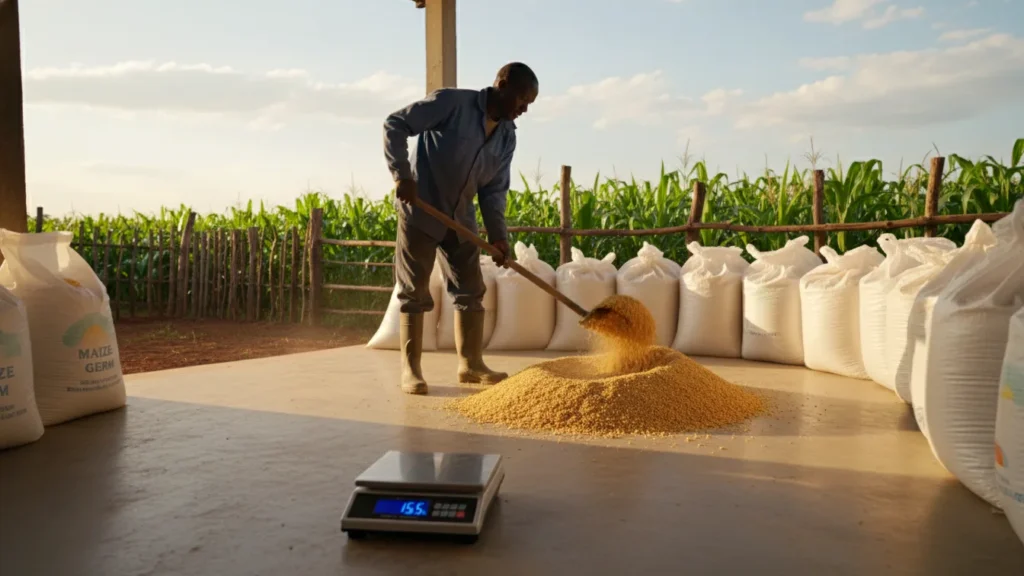
A Kenyan farmer mixing pig feed rations using a shovel on a clean concrete floor
What is the most effective protocol for pig disease control and vaccination?
Strict biosecurity is the only defense against African Swine Fever (ASF), which has no cure or vaccine. Essential vaccinations include Erysipelas and Parvovirus for breeding stock. Regular deworming with Ivermectin every 3 months and controlling external parasites like mites using acaricides is mandatory for herd health.
Disease can wipe out a pig farm in days. The most feared killer in Kenya is African Swine Fever (ASF). Since there is no vaccine, your farm must be a fortress against unauthorized entry.
Biosecurity Measures
Fencing is non-negotiable to keep out stray dogs, wild pigs, and unauthorized visitors. Install a footbath with disinfectant (like glutaraldehyde or Virkon) at the entrance of the piggery. Do not feed swill (kitchen scraps) from hotels unless it has been thoroughly boiled for at least 30 minutes, as raw pork scraps can carry ASF virus.
Vaccination and Health Schedule
While ASF has no jab, you must vaccinate against other killers to protect your investment. 1. Week 3-4: Iron injection to prevent anemia, as piglets born on concrete lack access to soil nutrients. 2. Weaning: Deworming with broad-spectrum dewormers. 3. Gilts/Sows: Parvovirus and Leptospirosis vaccines before breeding to prevent stillbirths. 4. Routine: Erysipelas vaccination every 6 months to prevent “Diamond Skin Disease.”
Observe your pigs daily for signs of illness. Symptoms like lethargy, shivering, loss of appetite, or purple discoloration of the ears require immediate veterinary attention. Isolation pens must be available to quarantine sick animals away from the healthy herd.
Which Kenyan counties offer the best environment for commercial pig farming?
Kiambu offers the best market access due to proximity to Nairobi and slaughterhouses. Uasin Gishu provides the lowest production costs due to abundant maize and wheat for feed. Nakuru offers a balanced advantage with a central location for logistics and a moderate climate suitable for exotic breeds.
1. Kiambu County (The Market Hub): Kiambu is the heart of pig farming in Kenya due to the presence of Farmer’s Choice in Kahawa West. Land is expensive here, so farmers utilize intensive zero-grazing units on small plots (40x80ft). The advantage is low transport costs to the market, but the challenge is the high cost of buying feeds from retailers.
2. Uasin Gishu (The Grain Basket): Farmers in Eldoret and surrounding areas have a massive competitive advantage: cheap feed. Being the maize and wheat capital, farmers can source raw materials directly from harvesters at rock-bottom prices. The profit margins per pig in Uasin Gishu are typically 15-20% higher than in Kiambu, though transport to Nairobi markets cuts into this slightly.
3. Nakuru County (The Logistics Center): Nakuru is strategically placed to supply Western Kenya, Nairobi, and the Central region. The climate is mild, reducing heat stress on pigs. Availability of by-products from local industries (like milling plants) makes feed formulation easier and cheaper.
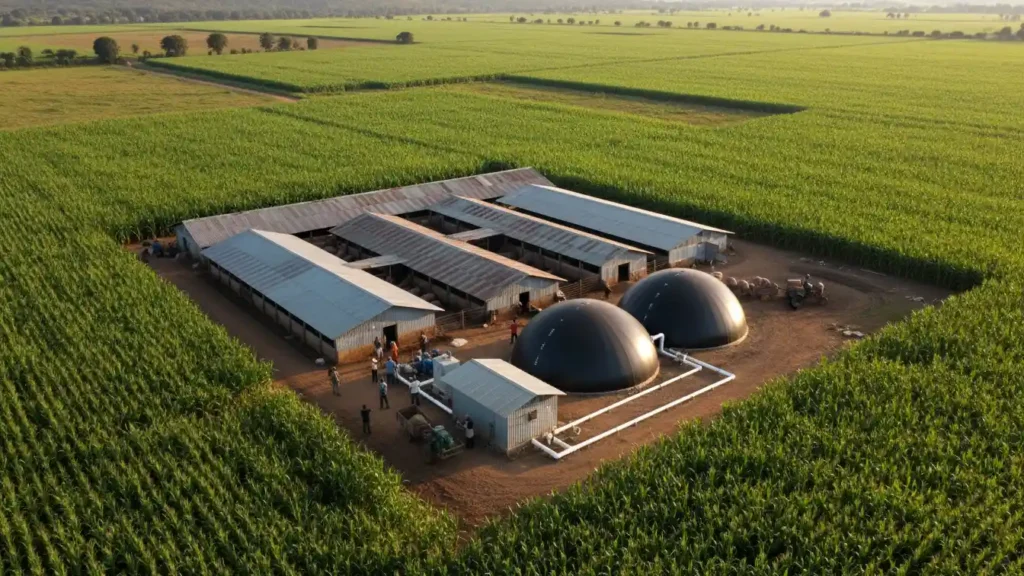
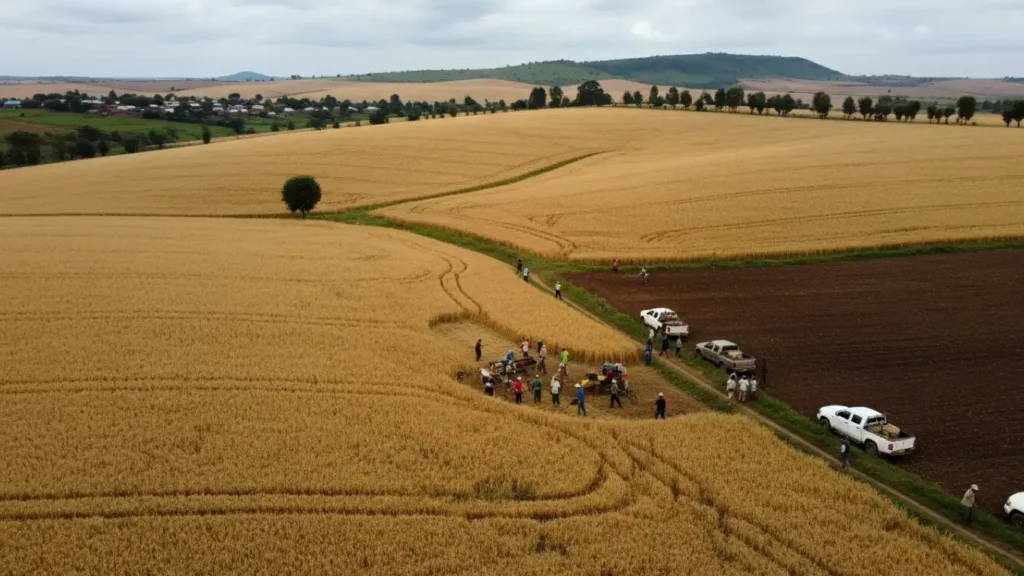
An aerial drone view of a commercial pig farm in Uasin Gishu
How should a beginner plan their pig farming calendar for the first year?
Months 1-2 focus on sty construction and biosecurity setup. Month 3 is for sourcing weaners and quarantining them. Months 4-8 are strictly for feeding and growth management. Months 9-10 involve finishing and marketing, while Months 11-12 focus on deep cleaning and restocking or farrowing if breeding.
Quarter 1: Infrastructure & Sourcing (Jan – Mar)
January is typically dry and perfect for construction activities. Build your sty and cure the concrete floors thoroughly to prevent cracking. In February, source your feeds and secure a reliable water connection. By March, bring in your weaners (approx. 2 months old) and isolate them for observation.
Quarter 2: The Growth Phase (Apr – Jun)
The long rains arrive during this period. Ensure your roof doesn’t leak and bedding remains dry to prevent pneumonia. Pigs are on Grower Mash during this stage. This is a cash-intensive period with no income, so ensure your financial reserves are ready.
Quarter 3: Finishing & Health Check (Jul – Sep)
July is cold, requiring extra bedding or heating for younger pigs. Switch to Finisher Mash to bulk up the pigs for the final push. If you are keeping gilts for breeding, serve them (inseminate) in month 8 when they reach roughly 110kg and are on their 2nd or 3rd heat.
Quarter 4: Harvest & Review (Oct – Dec)
Your first batch is ready for slaughter (porkers) at 6-7 months. December offers the highest pork demand due to Christmas festivities. Sell your stock, sanitize the pens thoroughly, and review your financial books to adjust feed ratios for the next year.
What are the realistic costs and profit margins for pig farming in 2026?
Raising a pig to market weight (90kg) costs approximately KES 14,000 – 16,000 in feeds and vet care. Selling at KES 280-320 per kg carcass weight generates revenue of KES 20,000 – 23,000. This leaves a net profit of roughly KES 4,000 – 7,000 per pig, taking about 6-7 months to realize.
Profitability in 2026 depends entirely on the Feed Conversion Ratio (FCR). If your pigs eat too much but grow too slowly, you will lose money. The following breakdown assumes a commercial approach with 10 pigs.
Expense Category
Details
Cost (KES)
Stocking (Weaners)
10 Quality Weaners @ 5,000 each
50,000
Feeding (Total)
~300kg feed per pig to reach 90kg @ 45/kg
135,000
Veterinary/Meds
Vaccines, Dewormers, Iron, Vitamins
5,000
Labor & Water
Part-time attendant / Utility bills
15,000
Transportation
Moving pigs to slaughter/market
5,000
Total Cost
Cost of production for 10 pigs
210,000
Revenue
10 pigs x 70kg (Carcass Weight) x 300 KES/kg
210,000
PROFIT SCENARIO
Standard Break Even
0 (Break-even)
Analyst Note: The table above shows a break-even scenario if you rely 100% on expensive commercial feeds and sell at standard broker prices. To make the KES 70,000 profit often cited by experts, you MUST reduce feed costs to KES 30-35/kg by home mixing. Additionally, selling value-added products (sausages/pork joints) rather than whole carcasses increases revenue significantly.
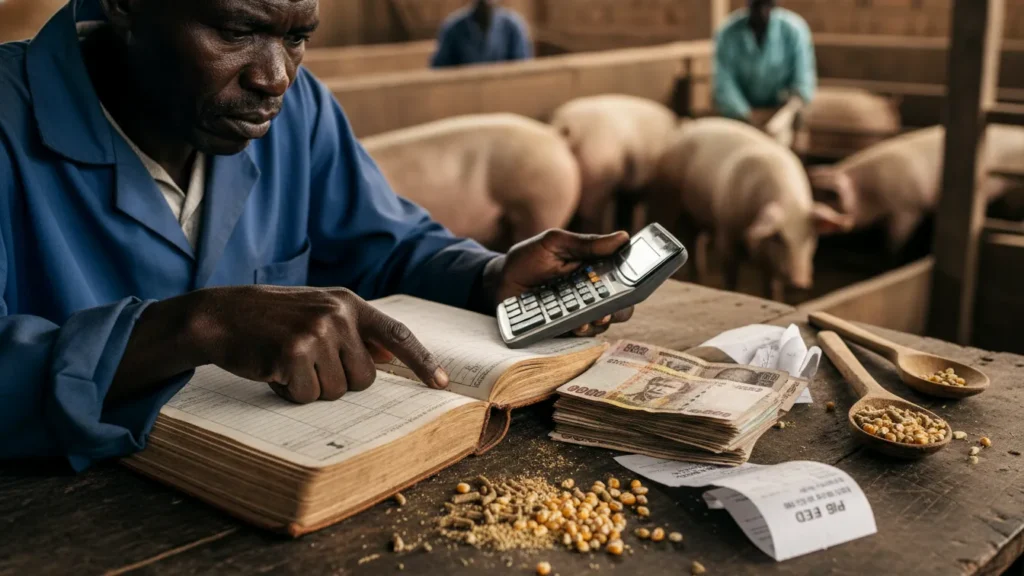
A detailed close-up of a Kenyan farmer holding a ledger book and a calculator
How can farmers add value to maximize revenue per pig?
Value addition involves processing raw pork into sausages, bacon, smokies, or selling specific cuts (chops, ribs) directly to consumers. Opening a local “Pork Joint” or butchery allows farmers to bypass brokers, often doubling the profit margin per animal compared to selling live weight.
Selling a live pig to a broker is the least profitable exit strategy. The broker makes the money, not the farmer. In 2026, the smart money is in the “Farm-to-Fork” model where you control the retail price.
The “Vibanda” & Butchery Model
Opening a small roast pork eatery (vibanda) in a high-traffic area allows you to sell 1kg of cooked pork for KES 600-800. Compare this to the KES 300 per kg you receive for raw carcass weight. Even after factoring in charcoal and labor, the margin doubles per pig processed.
Processing Licenses and Regulations
If you want to produce sausages or smokies, you need certification from the Kenya Bureau of Standards (KEBS) and a food handling certificate. While the paperwork is tedious, processed pork has a longer shelf life. Start small with unbranded fresh sausages for local neighbors before scaling to supermarkets.
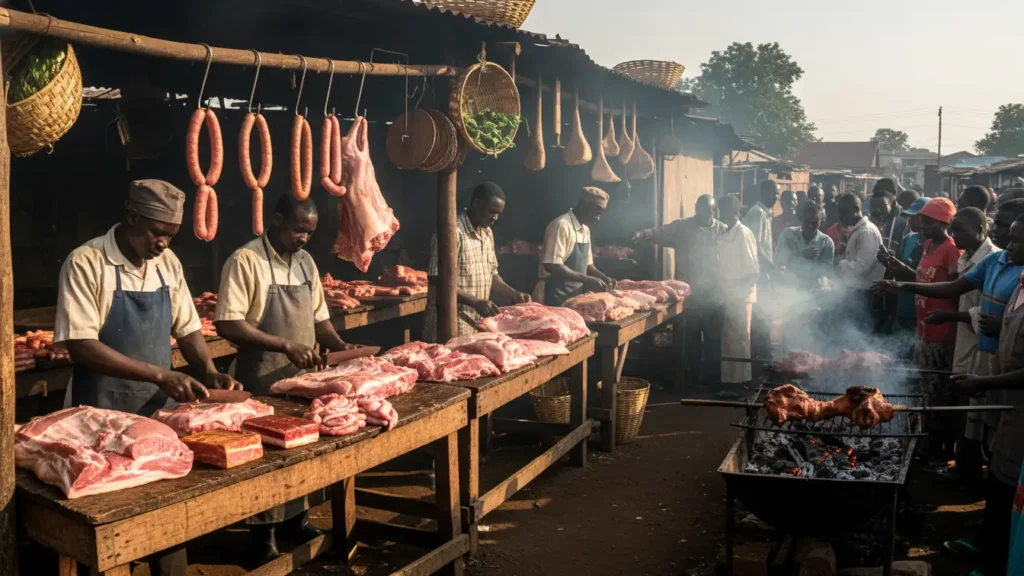
A bustling local butchery in Nairobi displaying fresh pork cuts
2026 Outlook: The Future of Pig Farming in Kenya
As we move through 2026, the Kenyan pig industry is consolidating. The days of “trial and error” farming are over. Success now belongs to farmers who use data to manage feed costs and maintain strict biosecurity against ASF.
We are seeing a massive shift towards insect-based protein (Black Soldier Fly larvae) to replace expensive Omena and Soya. Farmers adopting this technology are seeing feed costs drop by 30%. Furthermore, the demand for pork in urban centers like Nairobi, Kisumu, and Mombasa is at an all-time high due to the rising price of beef.
Don’t guess with your investment. Start with proper genetics and a solid feed plan. Visit your local KALRO center this week to book your F1 foundation stock and join a local cooperative for bulk feed purchasing.
Farmers Also Ask (FAQ)
How long does it take for a pig to reach market weight?
With good management and quality breeds like Large White or Camborough, a pig should reach 90-100kg (market weight) in 6 to 7 months. Indigenous breeds may take over 10 months to reach this weight. Consistent feeding is key to meeting this timeline.
What is the best way to prevent piglets from being crushed by the sow?
Install “farrowing crates” or guard rails in the pen. These rails are fixed about 20cm from the wall and 20cm from the floor. They give piglets a safe escape space when the mother lies down.
Can I feed my pigs entirely on kitchen waste?
No, kitchen waste alone lacks the balanced protein and minerals needed for growth. It causes slow growth and produces fatty, low-quality meat. It can also transmit diseases like ASF if not boiled strictly.
How much water does a pig need per day?
A growing pig needs 5-10 liters of water daily. A lactating sow (breastfeeding) can drink up to 20-30 liters. Lack of water immediately stops growth and milk production.
What is the ratio of boars to sows?
For natural mating, one healthy boar can service about 20 sows. If you have fewer than 5 sows, it is cheaper to pay for Artificial Insemination (AI) services. This avoids the high cost of feeding a boar year-round.
How do I know if my pig has worms?
Signs include coughing, rough hair coat, slow growth, pot-belly, and scouring (diarrhea). Even without signs, deworm every 3 months as a preventative measure. Consult a vet for the correct dosage.
Is Artificial Insemination (AI) better than keeping a boar?
For small farmers, yes. AI grants access to superior genetics from top-quality boars without the cost of feeding one. It also prevents the spread of sexually transmitted diseases.
Why are my pigs eating their own piglets (Cannibalism)?
This is usually caused by stress, lack of water, or mineral deficiency (salt or protein). Ensure the sow is not thirsty and her ration has enough salt. Isolate aggressive sows immediately to protect the litter.
What is “Castration” and when should it be done?
Castration is the removal of testicles in male piglets not intended for breeding. It prevents “boar taint” (bad smell in meat). It should be done between day 3 and day 7 to minimize stress.
How much land do I need for 50 pigs?
For 50 pigs, you need roughly a 40x60ft or 50x100ft plot. This accommodates the pens, a feed store, and a waste management system. You do not need acres of grazing land for commercial pig farming.
Securing an instant agricultural input loan in 2026 is faster than ever thanks to AI-driven credit scoring from providers like DigiFarm,Apollo Agriculture, and KCB Mobigrow. Farmers can now access unsecured financing for seeds and fertilizer within minutes by dialing USSD codes or using mobile apps. Eligibility hinges on an active M-Pesa history and verifiable farming activities. This guide breaks down the eligibility criteria, application steps, and repayment models to help you secure capital for the upcoming season.
Table of Contents
The Kenyan agricultural landscape has undergone a digital revolution. Gone are the days of rigorous paperwork at physical bank branches. Today, your smartphone is your bank, and your farm’s location data is your collateral.
For smallholder farmers, this shift means immediate access to high-quality inputs. By leveraging data from satellite imagery and mobile money transactions, lenders can now assess risk remotely. This guide serves as your comprehensive handbook to navigating this new financial ecosystem.
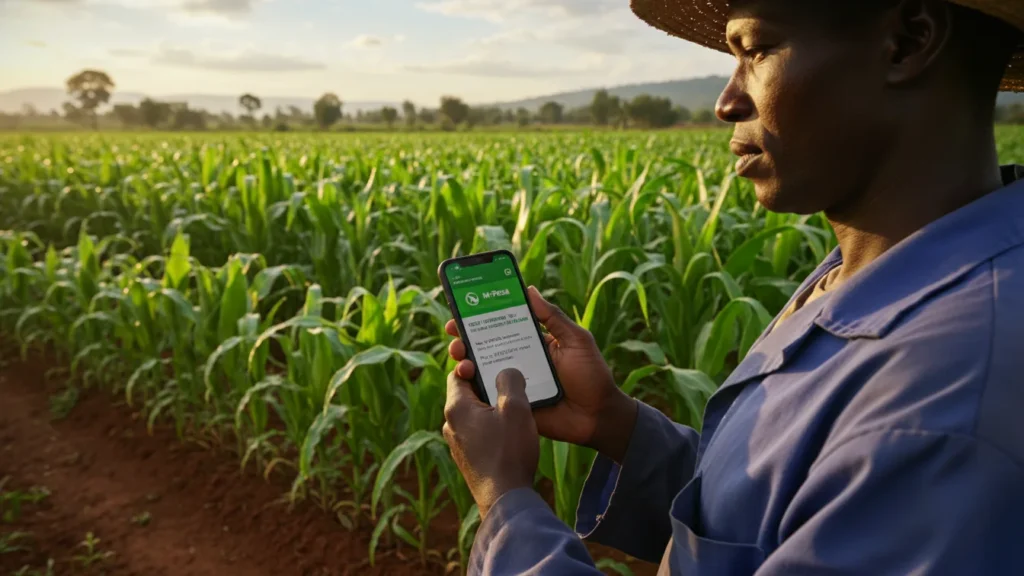
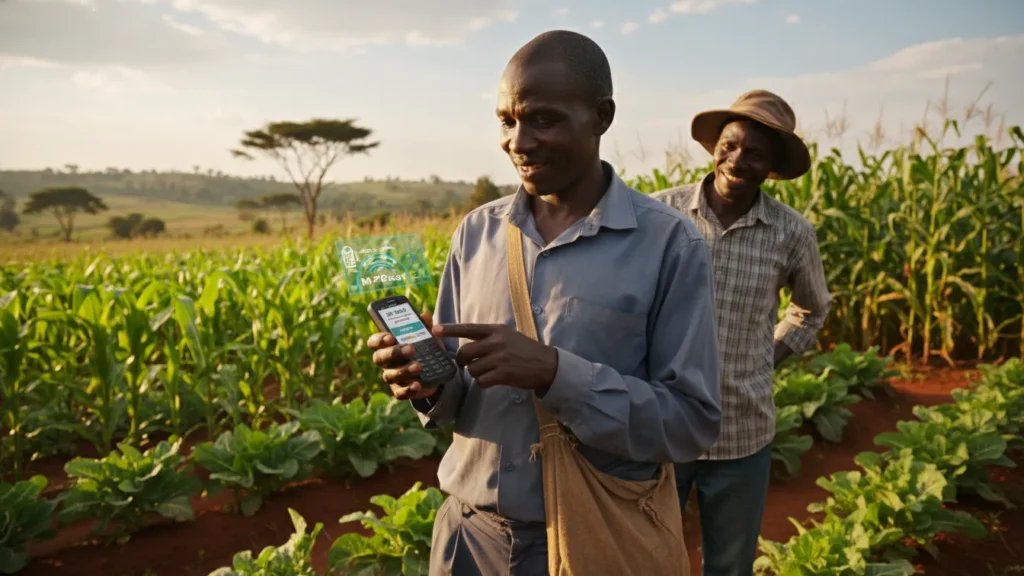
A close-up shot of a Kenyan farmer in Uasin Gishu holding a smartphone displaying an M-Pesa loan confirmation message
Which Mobile Loan Providers Are Dominating the Kenyan Market in 2026?
In 2026, the market leaders for instant ag-loans are Safaricom DigiFarm,Apollo Agriculture, and KCB Mobigrow. These platforms have integrated directly with the government’s e-voucher subsidy program, allowing farmers to pay just 60% of input costs upfront. Specialized insurtech players like Pula now bundle weather-index insurance automatically with these loans to protect against drought risks.
The “Big Three” providers have carved out distinct niches in the market. Understanding their specific strengths will help you choose the right partner for your farm. Safaricom DigiFarm is the mass-market leader, accessible via simple USSD codes.
By dialing 944#, farmers can register and access credit limits based on their M-Pesa usage and farm size. In 2026, their partnership withiProcure ensures that the loan isn’t cash, but a digital voucher. This voucher is redeemable for physical inputs at local agrovets, ensuring the funds are used for farming.
Apollo Agriculture targets farmers looking for a comprehensive service package. They provide a bundle that includes high-quality seeds from companies like Kenya Seedor SeedCo, fertilizer, and crop insurance. Their repayment model is strictly tied to the harvest season, which aligns perfectly with maize and potato cash flows.
KCB Mobigrow offers a more banking-centric approach but with digital speed. They are particularly strong in the dairy sector and larger-scale grain farming. Their loans often come with higher limits, suitable for farmers managing more than five acres.
How Do Regional Differences Affect Loan Eligibility and Input Costs?
Loan limits and input packages vary significantly by county due to ecological zones and crop risks. High-potential zones like Uasin Gishu attract higher credit limits for maize, while semi-arid regions focus on drought-resistant crops. Lenders use satellite data to customize these offers, meaning a farmer in Meru gets a different loan structure than one in Kilifi.
Module A: Regional Comparative Analysis
To understand where you stand, we must compare the credit environment across three distinct agricultural hubs: Meru, Uasin Gishu, and Kilifi. Lenders in 2026 use location-based risk profiling to determine your offer.
Feature
Meru County (Highlands)
Uasin Gishu (Breadbasket)
Kilifi County (Coastal)
Primary Crops Funded
Potatoes, Bananas, Coffee
Maize, Wheat, Dairy
Cashew, Coconut, Cassava
Avg. Loan Limit (Beginner)
KES 15,000 – 25,000
KES 20,000 – 40,000
KES 8,000 – 15,000
Key Risk Factor
Price volatility (Potato gluts)
Pest attacks (Fall Armyworm)
Drought & Heat Stress
Input Package Focus
Certified Potato Seeds (Shangi), Fungicides
Hybrid Maize Seeds (600 series), DAP Fertilizer
Drought-tolerant seeds, Irrigation kits
Digital Adoption Rate
High (75% smartphone use)
Very High (85% smartphone use)
Growing (55% smartphone use)
Meru County is currently benefiting from the “National Potato Strategy.” This initiative has pushed lenders to offer specific financing for certified potato seeds to combat low yields. If you are in Meru, look for loan products that specifically mention “Viazi Soko” partnerships.
Uasin Gishu remains the stronghold of maize farming in Kenya. Here, Apollo Agriculture and KCB Mobigrow compete aggressively for market share. They often offer higher loan limits per acre because the harvest data in this region is historically predictable.
Kilifi County presents a unique “Green Revolution” opportunity for coastal farmers. While traditionally underserved, 2026 has seen a surge in financing for irrigation kits along the Sabaki River. Lenders here are cautious with rain-fed crops but willing to finance value-chain crops like coconuts if linked to processors like Kentaste.
A split-screen comparison showing a lush potato farm in Meru with a farmer checking plants
When Is the Best Time to Apply to Align with the Farming Calendar?
Timing your application is critical; applying too early means interest accrues before planting, while applying too late risks missing the rains. In 2026, most digital lenders open their application windows 4-6 weeks before the onset of the Long Rains (March) and Short Rains (October).
Module B: 12-Month Farming Calendar (2026)
Successful loan repayment depends entirely on syncing your borrowing with your harvest income. This calendar assumes a standard maize/bean rotation for Uasin Gishu and Meru, though it is adaptable for other regions.
January:Planning & Soil Testing. Contact CropNuts or DigiFarm for soil testing. Apply for “Long Rains” input loans now. Lenders process approvals this month.
February:Input Acquisition. Loan disbursed as e-vouchers. Collect seeds and fertilizer from approved stockists like Simlaw Seeds or local agrovets. Land preparation begins.
March:Planting (Long Rains). Onset of rains. Planting must happen immediately. First installment of loan repayment (if on a monthly schedule) or insurance premium activation.
April:Weeding & Top Dressing. Apply CAN fertilizer. Some loans offer a second disbursement tranche specifically for top-dressing inputs.
May:Pest Control. Monitor for Fall Armyworm. Use emergency credit lines if unexpected pesticide costs arise.
June:Crop Maintenance. Heavy rains usually cease. Crops are maturing.
July:Harvest Preparation. Begin scouting for buyers. DigiFarm market linkages open up.
August:Harvesting (Green Maize/Beans). Early harvest for cash flow. Repay a small portion of the loan if possible to reduce interest.
September:Main Harvest & Drying. Main crop harvest. Dry maize to 13.5% moisture content.
October:Loan Repayment & Short Rains Planting.CRITICAL: Full loan repayment is often due to unlock “Short Rains” credit. Apply for second season funding.
November:Short Rains Management. Planting of short-cycle crops (beans, vegetables).
December:Market Review. Analyze profit. Plan for the next year.
“Farmers who miss the January application window often have to resort to predatory lenders. Digital platforms have strict cut-off dates to manage their own risk.”
Is the Cost of Credit Worth the Potential Return on Investment?
Yes, but only if you achieve optimal yields. With interest rates averaging 1.5% to 3% per month (approx. 18-36% APR), the cost of digital credit is high compared to traditional banks but accessible without collateral. The break-even point for a maize farmer in 2026 is approximately 11.5 bags per acre.
Let’s look at the numbers for a 1-acre Maize Farm in 2026 using a digital loan package. We assume the farmer is using the government subsidy e-voucher for fertilizer alongside the loan.
Assumption: You borrow KES 25,000 for inputs (Seeds, Fertilizer, Insurance). Loan Term: 6 Months. Interest Rate: 12% total (flat rate for the season).
Expense Category
Item Details
Cost (KES)
Land Preparation
Ploughing & Harrowing (Tractor)
8,000
Seeds
2 Packets (10kg) Hybrid Maize (e.g., 614/6213)
5,000
Fertilizer (Planting)
1 Bag DAP (Subsidized price via e-voucher)
2,500
Fertilizer (Top Dressing)
1 Bag CAN (Subsidized price via e-voucher)
2,500
Labor (Weeding/Harvest)
Manual labor (2 cycles)
12,000
Pest Control
Pesticides (Armyworm/Stalk borer)
3,000
Post-Harvest
Bags, Dusting, Transport
4,000
Loan Interest
12% on KES 25,000 input loan
3,000
TOTAL COST
Production Cost per Acre
40,000
Revenue Scenarios (2026 Market Prices)
Scenario A (Poor Yield): 15 bags @ KES 3,500/bag = KES 52,500. Profit: KES 12,500. This barely covers household needs and is not sustainable.
Scenario B (Average Yield): 25 bags @ KES 3,500/bag = KES 87,500. Profit: KES 47,500. This is a good ROI that allows for reinvestment and school fees.
Scenario C (High Yield): 35 bags @ KES 3,500/bag = KES 122,500. Profit: KES 82,500. This level of success typically requires strict adherence to agronomy advice.
The Break-Even Point: To cover the KES 40,000 production cost, you need to harvest at least 11.5 bags per acre. However, to make the risk worthwhile, targeting 20+ bags is essential. The loan is a tool to reach Scenario B or C by enabling access to certified seeds.
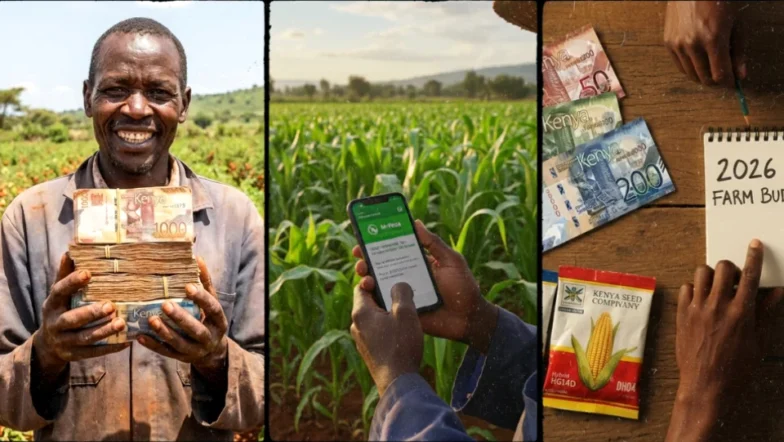
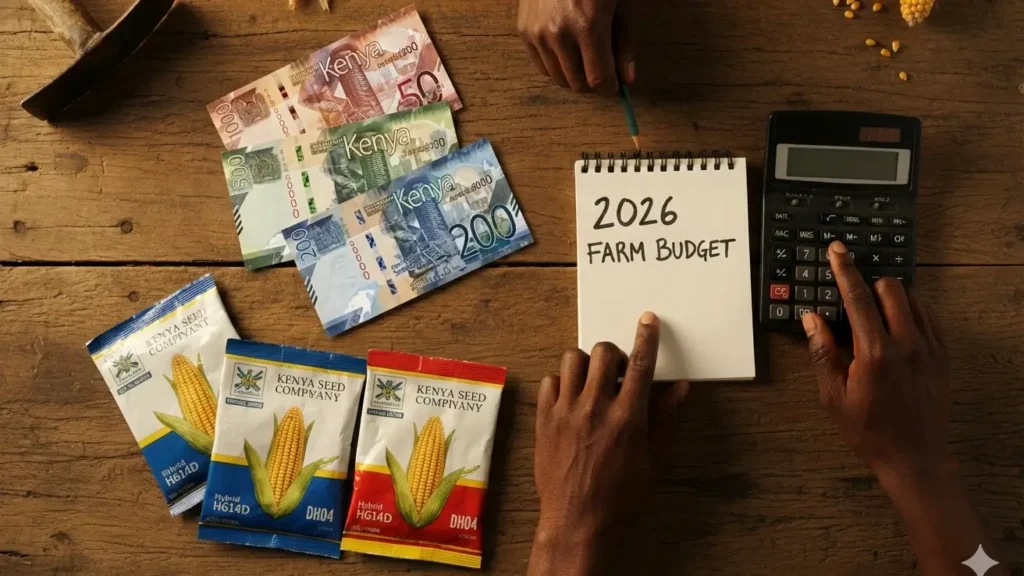
A flat-lay photograph on a wooden table showing Kenyan currency (1000 shilling notes)
How Do Insurance Bundles Protect Your Loan?
Bundled insurance is the safety net that makes digital borrowing safer for smallholders. Providers like Apollo Agriculture partner with Pula to offer “Area Yield Index Insurance.” This means if average yields in your specific ward drop due to drought or pests, a payout is triggered automatically to cover part of your loan.
Module D: Risk Mitigation Mechanisms
Farming in Kenya is fraught with climate risks. In the past, a bad season meant a farmer would default and be auctioned. In 2026, the integration of insurtech has changed this narrative.
1. Area Yield Index Insurance: This is the most common form of coverage bundled with mobile loans. It does not require an agent to visit your specific farm to assess damage. Instead, if the average yield in your “Agro-Ecological Zone” falls below a certain threshold (e.g., 70% of historical average), every farmer in that zone with a loan gets a payout.
2. Hybrid Weather Index Insurance: This utilizes satellite data to monitor rainfall and vegetation health. If your area in Kitui or Makueni experiences a verified drought during the critical flowering stage of maize, the insurance kicks in. This data-driven approach removes human bias and speeds up claim settlements.
3. Credit Life Insurance: Almost all digital loans now include a small premium for credit life insurance. This covers the loan balance in the unfortunate event of the borrower’s death or permanent disability. It ensures that the debt does not pass on to the family, protecting the farm’s assets.
How Does the Supply Chain Support Value Addition?
Digital loans in 2026 often come with “market linkage” contracts. This means the lender connects you to a buyer (off-taker) who pays a premium for quality. Value addition here doesn’t just mean processing; it includes proper drying, grading, and packaging, which are often funded as part of the credit package.
Module E: Supply Chain & Value Addition
The days of selling raw produce to brokers at the farm gate for a pittance are fading. Modern credit facilities are increasingly “bundled” with supply chain solutions to ensure farmers can repay their loans.
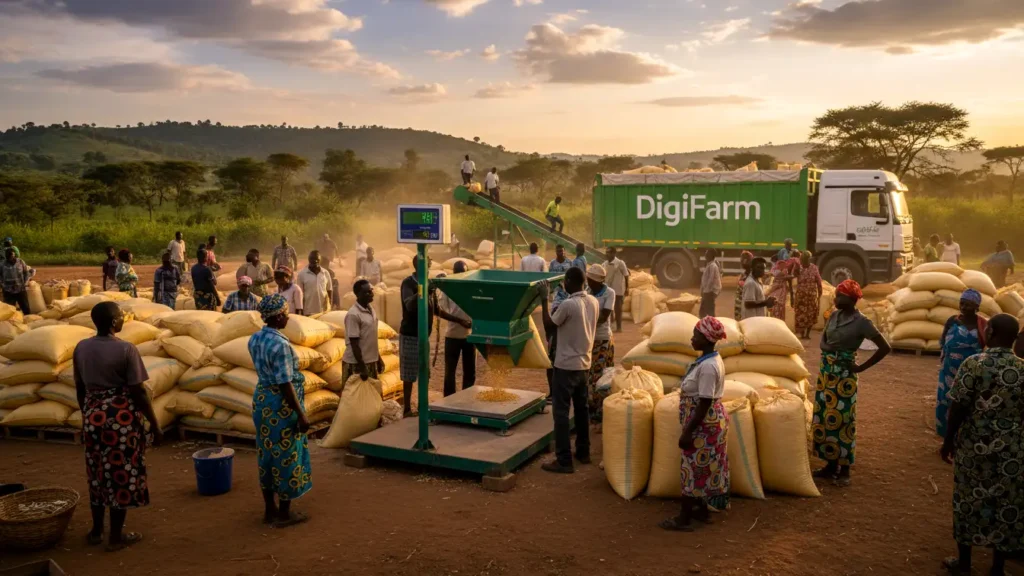
1. Aggregation Centers: Providers like DigiFarm have established collection centers where produce is weighed digitally and receipts are issued via SMS. This transparency eliminates the “broken scale” tricks used by middlemen. Your loan repayment is often deducted automatically from this sale, building your credit score for the next season.
2. Value Addition Financing: In Kilifi, loans are now available for small-scale solar dryers for mangoes and coconuts. By drying the fruit, farmers can sell chips during the off-season when prices are higher. Kentaste works with farmers to ensure coconuts are harvested at the right maturity for oil processing.
3. Subsidized Transport: Some input loans now include a logistics component. Instead of struggling to transport 10 bags of fertilizer on a motorbike (boda boda), the aggregate order for a village is delivered by truck to a local depot. This reduces transport costs per farmer by up to 40%.
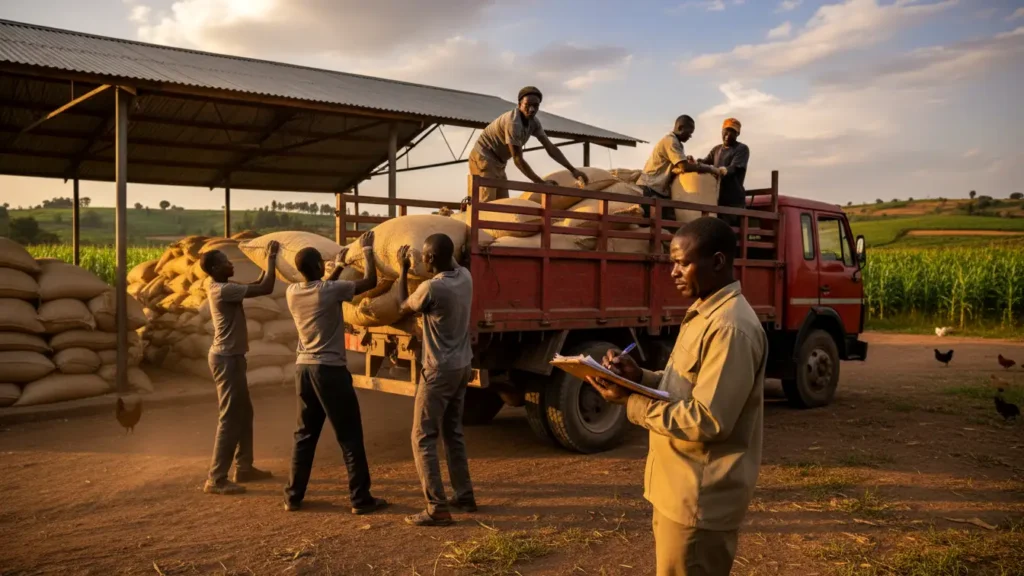
A bustling collection center in Kenya where farmers are delivering sacks of maize to a digital weighing station
2026 Outlook: What Is the Future of Ag-Financing?
The future of agricultural financing lies in “Climate-Smart Lending.” Lenders are beginning to offer lower interest rates to farmers who adopt regenerative practices like cover cropping and zero-tillage. Additionally, blockchain technology is being piloted to create immutable records of a farmer’s harvest history, further reducing the need for physical collateral.
As we look through 2026 and beyond, the trend is undeniable: Data is the new collateral. The “shamba” you cultivate is being mapped by satellites, and your M-Pesa history tells a story of your reliability. This digital footprint is becoming more valuable than a title deed.
We are seeing a move towards specific climate incentives. Loans are becoming cheaper for farmers who adopt conservation agriculture because data shows these methods reduce risk. Furthermore, the integration of government subsidies directly into digital wallets means the era of queuing for fertilizer at NCPB depots is effectively over.
For the youth entering agriculture, this digitization lowers the barrier to entry. You no longer need to inherit land with a title deed to get started; you just need to lease land, have a smartphone, and demonstrate your farming activity digitally.
Ready to Scale Your Farm?
“Don’t wait for the rains to start looking for capital. Download the apps, register your farm, and check your credit limit today.”
Action Step: Dial 944# (DigiFarm) or download the Apollo Agriculture app now to start your eligibility check.
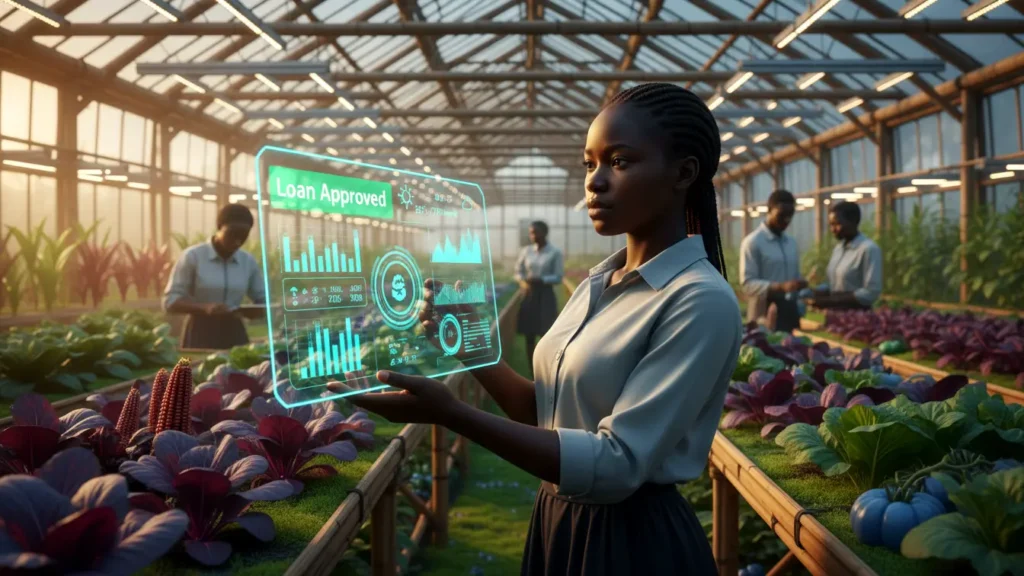
young Kenyan female farmer using a tablet in a greenhouse
Farmers Also Ask: 10-Question Deep-Dive Troubleshooting FAQ
Can I get a loan if I don’t have a title deed?
Yes. Most digital ag-loans in 2026 are unsecured. They rely on your credit score (CRB status), M-Pesa transaction history, and sometimes a “group guarantee” model where you and your neighbors co-guarantee each other. They do not require a title deed as collateral.
What happens if my crop fails due to drought?
This is where bundled insurance helps. If you took a loan that includes Pula or other weather-index insurance, and the satellite data confirms a drought in your area, the insurance payout is used to offset your loan balance. Always confirm if your loan package includes insurance before signing.
Can I use the loan to pay for labor?
Usually, no. Most digital loans are “input financing,” meaning you receive vouchers for seeds and fertilizer, not cash. However, some advanced tier loans (after you have successfully repaid 2-3 cycles) may offer a small cash component (10-20%) specifically for labor or harvesting costs.
How do I check my credit limit on DigiFarm?
Dial 944# on your Safaricom line. Select the “Loans” option. The system will automatically calculate your limit based on your historical data. If it says “0,” you may need to use other Safaricom services more frequently or register your farm details first to build a profile.
What are the interest rates for Apollo Agriculture in 2026?
Apollo Agriculture typically charges a flat fee per season rather than a monthly compound interest. In 2026, this fee ranges from 10% to 15% of the input value, depending on the crop and region. This fee is added to the total loan amount due at harvest.
Are there loans for livestock farming?
Yes, but they are different from crop loans. KCB Mobigrow and Equity Bank offer products for dairy farmers (for feeds and vet services), often linked to milk delivery payments. If you deliver milk to a cooperative, check if they have a check-off loan arrangement.
How does the e-voucher subsidy work with these loans?
The government e-voucher covers roughly 40% of the fertilizer cost. When you apply for a digital loan, the lender will finance the remaining 60% that you would normally pay in cash. This significantly lowers the total amount you need to borrow.
Can I pay back the loan early?
Yes, and it is highly recommended. Repaying early often qualifies you for a higher limit in the next season. Some lenders may also offer a small discount on the interest or fees for early repayment, though this varies by provider.
What do I do if I am blacklisted by CRB?
If you are negative listed on the CRB, you will likely be blocked from instant digital loans. You must clear your outstanding default with the previous lender and obtain a clearance certificate. Some “Group Lending” models might still accept you if your group members agree to vouch for you.
Who supplies the seeds and fertilizer?
Lenders partner with reputable suppliers to avoid fake inputs. Common partners include Kenya Seed Company, Simlaw Seeds, Yara, and MEA Fertilizers. You will be directed to a specific local agrovet that is an authorized agent to pick up these genuine products.
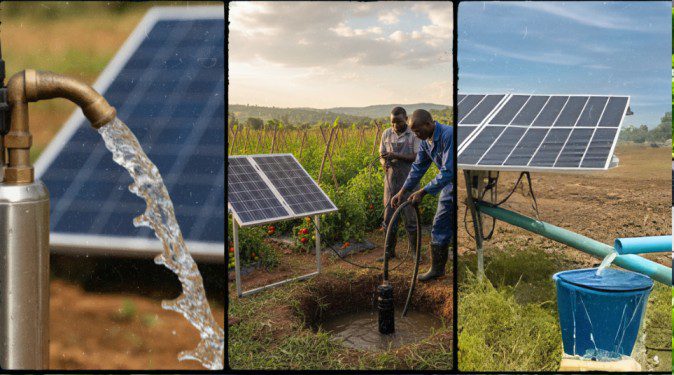
SunCulture is turning the sun into a reliable water source and income boost for thousands of Kenyan farmers. Instead of struggling with expensive diesel pumps or waiting for unreliable rains, smallholders can now use solar powered water pumps on pay as you grow plans to irrigate more land, grow extra seasons and cut fuel costs.
The Kenyan agricultural sector has undergone a massive transformation over the last five years. Gone are the days when farming was a retirement plan or a last resort. In 2026, you are entering an era of precision agriculture and high-value export markets. The farmers making millions today are not just working hard; they are working with data.
As a beginner, you face significant challenges: fluctuating weather patterns, expensive inputs like DAP and CAN fertilizer, and volatile market prices. However, the opportunities currently outweigh the risks if you choose the right venture. The demand for organic food in Nairobi and the opening of new export corridors to China and the Middle East for fresh produce have created a goldmine for those ready to professionalize their operations.
This guide is not theoretical. It is built on current market rates in Kenya Shillings (KES), recognized varieties from the Kenya Agricultural and Livestock Research Organization (KALRO), and proven agronomic practices. To succeed, you must treat your farm as a business. You need to calculate your cost of production per unit, understand your break-even point, and secure a market before you plant a single seed.
Below are the 10 most profitable farming ventures you can start this year, ranked by their potential for high Returns on Investment (ROI) and scalability.
1. Hass Avocado Farming: The Export Green Gold
Despite the market maturing,Hass Avocadoremains the undisputed king of high-value tree crops in Kenya. In 2026, the focus has shifted from merely planting trees to producing export-quality fruit that meets strict phytosanitary standards. China and Europe are hungry for Kenyan avocados, but they demand quality.
Why It Is Profitable
Once your trees reach maturity (year 3 to 4), the maintenance costs drop significantly while yields increase. A single mature tree can produce 500 to 1,000 fruits per year. With export prices averaging KES 10 to KES 20 per fruit depending on the season and size, the math is compelling.
Operational Costs and ROI
Initial Setup (Per Acre): You will need approximately 150 seedlings at a spacing of 5m by 5m. Certified seedlings from KALRO or certified nurseries cost about KES 350 each. Total establishment cost, including hole preparation, manure, and labor, is roughly KES 100,000.
Returns: By year 4, one acre can generate between KES 500,000 and KES 1,000,000 annually. The trees remain productive for over 20 years, making this a generational investment.
Key Success Factors
You must invest in irrigation. Relying on rain is a recipe for small, unmarketable fruit. You also need to adhere to strict pest management to avoid fruit flies and False Codling Moth, which are quarantine pests that can get your export license revoked.
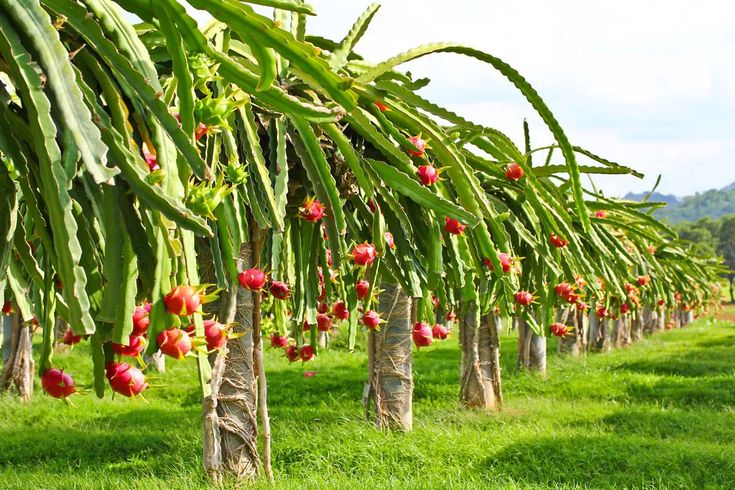
2. Dragon Fruit Farming: The New High-Value Frontier
Dragon Fruit Farming
Dragon fruit is where Hass Avocado was ten years ago. It is currently the most expensive fruit per kilogram in the local market. Because it is a cactus, it is incredibly resilient to drought, making it perfect for semi-arid areas like Ukambani, Isinya, and parts of Naivasha.
Market Dynamics
In 2026, the local supply is still lower than demand. Supermarkets and high-end grocers in Nairobi sell Dragon Fruit for between KES 800 and KES 1,200 per kilogram. Even at a wholesale farm-gate price of KES 500 per kg, the margins are astronomical.
Varieties and Planting
You should focus on the sweet varieties: Red flesh (Costa Rican) and Yellow skin varieties. You will need concrete posts and old motorcycle tires for support, as the plant is a climber. An acre takes about 1,000 posts with 2 vines per post.
Financial Breakdown
Startup Cost: High. Posts, irrigation, and cuttings can cost up to KES 500,000 per acre. Revenue: A mature acre can produce 10 tonnes. At a conservative KES 400 per kg, that is KES 4 million in gross revenue. It is labor-intensive during pollination and harvesting but offers the highest ROI per square meter.
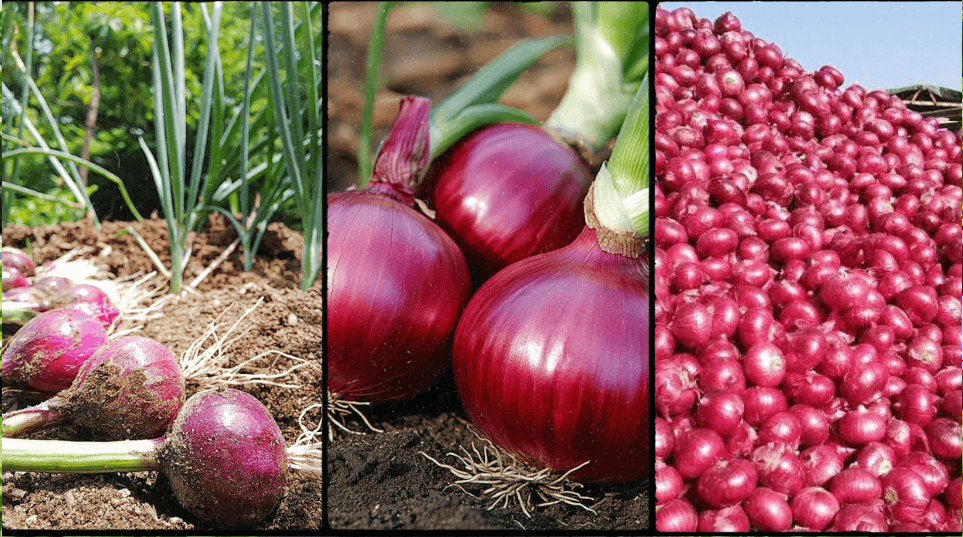
3. Bulb Onion Farming: The Cash Flow King
For beginner farmers who cannot wait three years for a tree crop to mature, bulb onions are the solution. The consumption of onions in Kenya is constant; every meal starts with an onion. However, timing is everything.
To make money with onions, you must harvest when the market is dry. Avoid harvesting in July/August when the Tanzanian onions flood the market. Plan your planting so that you harvest in January/February or May/June.
Preferred Varieties
Neptune F1, Red Creak F1, and Jambar F1 are the leaders. They have a deep red color and a long shelf life, which brokers love. These hybrid seeds are expensive but resistant to Downy Mildew and Pink Root diseases.
ROI Analysis
Cost of Production: KES 120,000 to KES 150,000 per acre (inputs, labor, irrigation). Yield: A well-managed acre yields 15 to 20 tonnes. Profit: At a market price of KES 50 per kg, 15 tonnes yields KES 750,000. Net profit can exceed KES 500,000 in just 4 months.
4. Watermelon Farming: High Risk, High Reward
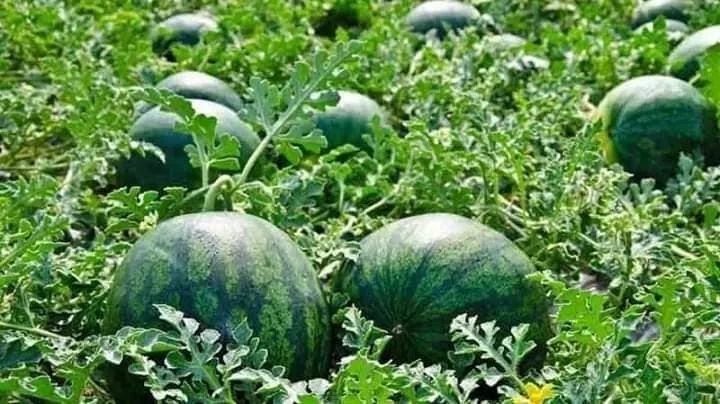
Watermelon growing in a farm
Watermelon is often called the “lottery” of farming. It matures in 75-90 days and can turn a pauper into a millionaire, or vice versa if the crop fails. In 2026, the demand remains huge, especially in urban centers during hot seasons.
Best Varieties for 2026
Stick to Sukari F1 and Zebra F1. These varieties are known for their sweetness and transport hardiness. Brokers will often refuse to buy varieties that crack easily during transport.
Ecological Requirements
Watermelons need heat. Areas like Mwea, Pekerra, and coastal regions are ideal. You must have a steady supply of water for irrigation, but you must stop watering two weeks before harvest to increase sugar content (Brix level).
Financials
Investment: KES 80,000 to KES 100,000 per acre. Returns: Yields can hit 30-40 tonnes per acre. At KES 20 per kg farm-gate price, revenue is KES 600,000 to KES 800,000 per season.
5. Improved Kienyeji Chicken: The Accessible Entry Point
If you have limited land, poultry is your best bet. The market has shifted away from broilers due to high feed costs and low margins. The consumer preference in 2026 is heavily skewed towards “Kienyeji” (indigenous) meat and yellow-yolk eggs.
The “Improved” Advantage
KALRO Improved Kienyeji, Kuroiler, and Rainbow Rooster breeds grow faster than traditional indigenous chickens but maintain the disease resistance and meat quality consumers pay a premium for. They can scavenge for food, reducing your feed bill significantly.
Revenue Streams
You can earn from three sources: selling fertilized eggs for incubation, selling day-old chicks, or selling meat/eggs. Meat: A bird matures in 4-5 months and sells for KES 800-1,000. Eggs: A tray of Kienyeji eggs sells for KES 600-750, compared to KES 350 for exotic layers.
Cost Control
The biggest cost is feed. You must learn to formulate your own feed using local ingredients like maize germ, soya, and omena. Buying commercial feed exclusively will eat up your profits.
6. Passion Fruit Farming: Continuous Weekly Income
Passion fruit is unique because once harvest begins (around month 6-7), it continues weekly for up to 3 years. This provides excellent cash flow for paying bills and funding other farm operations.
Varieties
Purple Passion: Higher demand in fresh market and export. Requires cooler climates (Meru, Uasin Gishu, Nyeri). Yellow Passion: More disease resistant, larger, used mostly for juice processing. Does well in warmer areas.
Management
You must trellis the vines properly. The biggest threat is Woodiness Virus and Fusarium Wilt. You should source grafted seedlings where the scion is purple passion and the rootstock is yellow passion to combine sweetness with disease resistance.
Profitability
One acre can host 600-800 plants. A well-tended vine produces 15-20kg per year. That is roughly 10-15 tonnes per acre. At KES 70 per kg, you are looking at over KES 700,000 annually with weekly payouts.
7. Greenhouse Tomato Farming: Precision for Profit
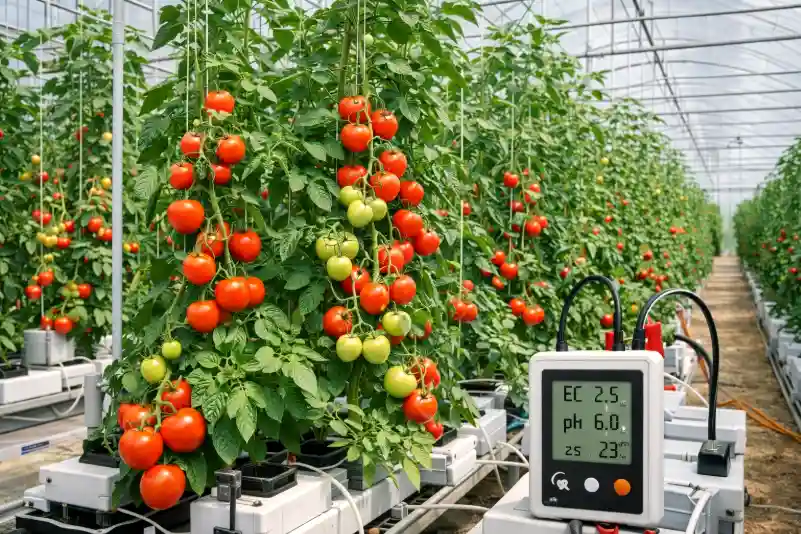
Precision tomato farming in a modern greenhouse using digital monitoring for nutrient and pH levels.
Open field tomato farming is risky due to blight and erratic rain. Greenhouse farming solves this but requires high initial capital. In 2026, the standard is the 8m by 30m greenhouse.
You control the environment. This means you can time your harvest to coincide with high market prices (April and December). You also extend the harvesting period to 6-8 months, compared to 1 month for open field.
Varieties
Indeterminate varieties like Anna F1 and Tylka F1 continue growing upwards and producing fruit as long as they are fed. They require trellising strings.
The Math
A standard greenhouse houses 1,000 plants. Each plant can yield 10-15kg over its life. That is 10 to 15 tonnes from a small space. At an average of KES 60/kg, revenue is KES 600,000 to KES 900,000 per season. However, construction costs are KES 300,000+, so ROI is realized from the second season onwards.
8. Dairy Goat Farming: Small Space, Premium Product
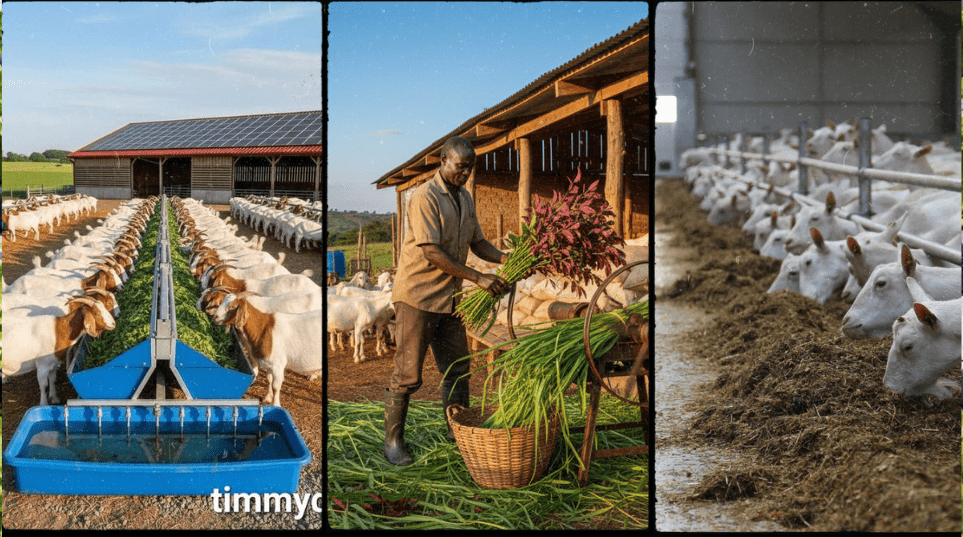
Images of Dairy goats feeding
With land sizes shrinking, dairy cows are becoming difficult to manage for smallholders. Dairy goats are the perfect alternative. Goat milk is a niche superfood, prescribed for people with lactose intolerance and immune issues.
Breeds
Alpine and Toggenburg are the best milkers in Kenyan conditions. A good doe gives 2-4 liters of milk per day.
Goat milk retails for KES 200 per liter, compared to KES 40-50 for cow milk. Feeding: Goats consume much less than cows and eat a wider variety of fodder, including shrubs. Breeding: Goats twin often. Selling weaned kids (young goats) is a massive secondary income stream. A purebred kid sells for KES 10,000 to KES 15,000.
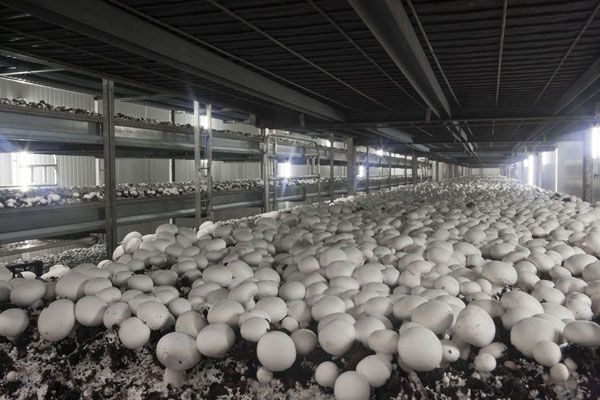
9. Mushroom Farming: The Urban Farming Champion
Mushroom Farming
You do not need a single acre of land for this. You can grow mushrooms in a garage, a mud house, or a specialized structure. It is the ultimate vertical farming venture.
Types to Grow
Oyster Mushrooms: Easiest for beginners. They grow on wheat straw, bean trash, or sugarcane bagasse. Harvest starts in 4 weeks. Button Mushrooms: High demand but require complex compost and casing soil. Technically demanding.
ROI
A 10ft by 10ft room can hold 400 bags. Each bag produces 2kg of mushrooms over its cycle. Total 800kg. Wholesale price is KES 400/kg. Revenue: KES 320,000. Costs are low (spawn and substrate), usually around KES 50,000.
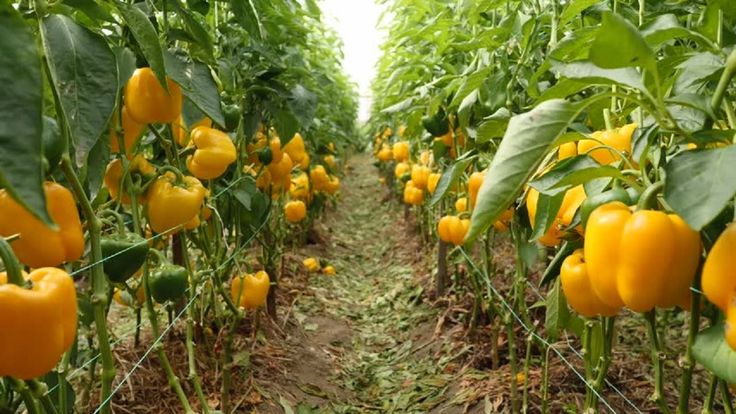
10. Colored Capsicum Farming: The Salad Luxury
Colored Capsicum Farming
Walk into any supermarket and look at the price of Yellow and Red Capsicums. They are sold per piece or per weight at premium rates. Unlike green capsicums, the colored varieties are almost exclusively grown in greenhouses to protect them from pests and sunscald.
Demand
The hospitality industry (hotels, burger joints, pizza places) and the growing middle class drive demand. The price is stable, rarely dropping below KES 100 per kg.
Similar to tomatoes, indeterminate varieties yield for months. A well-managed greenhouse crop yields 5-8kg per plant. With 1,000 plants, that is 5-8 tonnes. At KES 120/kg average, the returns are solid.
Step-by-Step: How to Analyze ROI Before Planting
Most farmers fail because they plant first and calculate later. Follow this strict process to ensure profitability.
Phase 1: Market Research
Visit the wholesale markets (Marikiti, Wakulima) at 4:00 AM. Observe what is moving fast and what is rotting. Talk to the brokers. Ask them what will be in demand in 3 months.
Phase 2: Soil Testing
Never skip this. Take soil samples to KALRO or CropNuts. It costs roughly KES 2,500. It will save you thousands in wasted fertilizer. If your soil pH is acidic, your expensive DAP fertilizer will be locked up and unavailable to the plants.
Phase 3: Budgeting
Create a budget that includes a 20% contingency fund. Factor in labor, water pumping costs, and post-harvest transport. If the paper math doesn’t show at least a 40% profit margin, do not plant.
Comparative ROI Analysis Table (2026 Estimates)
The table below provides a quick comparison to help you choose the right venture for your capital and timeline.
Venture
Time to First Harvest
Est. Startup Cost (1 Acre/Unit)
Est. Net Profit (Per Season/Year)
Risk Level
Hass Avocado
3 Years
KES 100,000
KES 500,000+ (Year 5)
Low
Bulb Onions
3-4 Months
KES 150,000
KES 400,000
Medium
Watermelon
3 Months
KES 100,000
KES 600,000
High
Dragon Fruit
12-18 Months
KES 500,000
KES 2,000,000+
Medium
Mushrooms (Small scale)
2 Months
KES 50,000
KES 150,000+
Medium
Dairy Goats (5 Does)
Immediate (if lactating)
KES 100,000
KES 300,000 (Yearly)
Low
Conclusion: Take Action Today
The 2026 farming season is full of promise, but it rewards only the prepared. You now have the data, the costs, and the varieties. Do not let “analysis paralysis” stop you. Start small if you must, but start with high standards.
Your Next Step: Choose oneventure from this list that matches your climate and budget. Call a soil testing service tomorrow. Your journey to agricultural wealth begins with that single phone call. Plant with precision, harvest with pride.
People Also Ask (FAQ)
Which farming is most profitable in Kenya for beginners?
For absolute beginners, Bulb Onions or Improved Kienyeji Chicken are the safest bets. Onions have a clear market and are non-perishable for a few weeks, allowing you to find a buyer. Chickens require low capital and can be scaled up as you gain experience.
How much money do I need to start farming in Kenya?
You can start with as little as KES 20,000 for a small sack-farming vegetable project or indigenous chicken setup. However, for a commercial one-acre venture like watermelons or onions, you need a minimum operating capital of KES 100,000 to KES 150,000 to cover inputs and labor.
What is the most expensive crop to grow in Kenya?
Greenhouse crops (Tomatoes/Capsicum) and Dragon Fruit have the highest startup costs. A standard greenhouse costs over KES 300,000 to construct properly, and Dragon Fruit requires expensive posts and irrigation infrastructure. However, they also offer the highest returns per square meter.
Is farming tax-free in Kenya?
Generally, raw agricultural produce sold by farmers is exempt from VAT. However, if you process your goods (e.g., making yoghurt from milk or packing juices), you may become liable for taxes.
Where can I buy certified seeds in Kenya?
You shou purchase seeds from KALRO centers or certified stockists like Kenya Seed Company, Simlaw Seeds, or Amiran Kenya. Avoid buying seeds from open-air markets as they may be fake or have low germination rates, leading to total crop failure.
Agricultural insurance in Kenya has evolved into a critical safety net for farmers, protecting against climate shocks, pests, and market volatility. In 2026, modern digital platforms and government subsidies have made coverage more accessible, with premiums averaging 3.5% to 6% of the production cost. This guide outlines the best providers, cost structures, and regional strategies to secure your shamba against unforeseen losses.
Table of Contents
The agricultural sector contributes significantly to Kenya’s economy, yet it remains highly vulnerable to unpredictable weather patterns. Recent data indicates that climate variability affects over 70% of agricultural output in the region. Coverage is no longer a luxury but a necessary input for sustainable farming.
Technological advancements have streamlined the coverage process, allowing for faster onboarding and claims settlement. Farmers can now access policies via USSD codes or mobile apps, bypassing traditional paperwork. This shift has democratized access, bringing financial security to even the smallest landholders.
What Are the Best Crop and Livestock Insurance Policies for 2026?
The most effective policies for 2026 are Area Yield Index Coverage (AYII) for crops andIndex-Based Livestock Coverage (IBLI) for pastoralists. Top-performing “varieties” of coverage include Multi-Peril Crop Coverage (MPCI) for large-scale farmers and hybrid seed-embedded micro-coverage for smallholders. These policies leverage satellite data and automated weather stations to trigger faster M-Pesa payouts without lengthy field assessments.
Selecting the right coverage “variety” or policy type is as crucial as choosing the right seed. For 2026, the market has shifted away from traditional indemnity-based models toward technology-driven index solutions. Understanding these options ensures you get value for your money.
1. Area Yield Index Insurance (AYII)
AYII is currently the gold standard for small-scale maize, wheat, and sorghum farmers in Kenya. Instead of visiting every individual farm to assess damage, insurers measure the average yield of a specific “unit area” (usually a ward or village). If the area’s average yield drops below a historical benchmark due to drought or pests, all insured farmers in that zone receive a payout.
This model significantly reduces premium costs because it eliminates expensive administrative overheads like individual farm inspections. APA Coverage and CIC Group are leaders in this space, often partnering with county governments to subsidize premiums. It is particularly effective for staple crops grown by many farmers in the same region.
Farmers in high-potential areas like Trans-Nzoia and Bungoma have seen great success with this model. It aligns payouts with the general performance of the season, ensuring fairness. However, it does not cover localized risks like hail damage on a specific farm.
Agricultural officer using a tablet to explain insurance policy terms to a group of maize farmers
2. Index-Based Livestock Insurance (IBLI)
For pastoralists in arid regions, IBLI uses satellite imagery to monitor forage availability (greenness of vegetation). When forage becomes scarce due to drought, the policy triggers a payout to help farmers buy feed and keep their animals alive. This is critical for keeping livestock healthy before they succumb to starvation.
The International Livestock Research Institute (ILRI) pioneered this technology, which is now sold by commercial insurers. It is designed to be proactive rather than reactive. Payouts are often released before animals die, allowing herders to purchase fodder or water trucking services.
3. Multi-Peril Crop Insurance (MPCI)
This is a comprehensive cover designed primarily for medium to large-scale commercial farmers. It covers losses from a wide range of risks including fire, lightning, storm, hail, and flooding. Unlike index coverage, MPCI requires an individual assessment of the farm before and after the loss.
UAP Old Mutual is a key provider of this tailored coverage. It is more expensive than index coverage due to the administrative cost of visits. However, it offers the most accurate compensation for specific losses suffered by an individual enterprise.
A rapidly growing trend in 2026 is insurance embedded directly into the cost of inputs. When you buy a bag of certified seeds from companies like Kenya Seed Company or Syngenta, a small insurance premium is included. You register the bag via USSD code, and if the season fails, you are compensated with replacement inputs.
Expert Tip: “Never ignore the waiting period clauses. For livestock policies, coverage usually starts 15-30 days after the premium is paid. Ensure your animals are tagged and verified early to avoid claim rejections.” — Senior Underwriter, Nairobi.
Expert Tip: “Never ignore the waiting period clauses. For livestock policies, coverage usually starts 15-30 days after the premium is paid. Ensure your animals are tagged and verified early to avoid claim rejections.” — Senior Underwriter, Nairobi.
Where to Get Crop & Livestock Insurance Kenya (2026): Costs & Top Providers in Kenya?
You can purchase agricultural insurance through established underwriters like CIC Group, APA Insurance, and Kenya Orient, or via aggregators like Digifarm and Pula Advisors. In 2026, many farmers buy coverage directly through banking apps (KCB, Equity) or via USSD menus linked to seed purchases. Always verify the agent’s license with the Insurance Regulatory Authority (IRA) before transacting.
The procurement landscape for agricultural insurance has digitized, moving from physical offices to mobile-first platforms. Here is where you should source your coverage in 2026.
Top Digital & Physical Providers
CIC Group (Agri-Business) remains the market leader offering the widest range of livestock and crop policies. They have strong networks in cooperatives and offer specialized products for dairy and horticulture. Their “Co-op Insurance” model is highly trusted among SACCO members.
APA Insurance is excellent for Area Yield Index Insurance and specialized horticulture covers (greenhouses). They have partnered deeply with the government on subsidy programs. Their digital claims process is rated highly for speed and transparency.
UAP-Old Mutualis known for Multi-Peril Crop Insurance suitable for medium-to-large scale commercial farming. They provide strong technical support and agronomy advice alongside their policies. Their products often appeal to farmers with bank loans requiring comprehensive collateral protection.
ACRE Africa operates as a specialized intermediary that designs micro-insurance products sold through input dealers and aggregators. They connect insurers with smallholder farmers who were previously uninsurable. Their scratch-card insurance models attached to seed bags are revolutionary.
Digifarm (Safaricom) offers bundled insurance products directly on your phone. You can pay premiums using M-Pesa and receive claims directly to your mobile wallet. This platform integrates credit, inputs, and insurance into a single digital ecosystem.
A farmer transacting on a mobile phone to pay for crop insurance premiums via M-Pesa
Buyer’s Caution: Verification List
Before paying any premium, perform these checks to avoid fraud. First, text the insurer’s name to the Insurance Regulatory Authority (IRA) verification number to confirm they are licensed for agricultural products. This simple step can save you from fake agents.
Second, demand a “Key Facts Statement” (KFS). This is a simplified 1-page summary of what is covered and what is excluded. Do not rely solely on verbal promises made by sales agents.
Third, ensure you receive an official digital receipt immediately. Do not pay cash to individual agents without an official receipt book. Mobile money payments to official paybills are safer as they create a digital paper trail.
How Do Insurance Costs Compare Across Different Kenyan Counties?
Insurance costs vary significantly by region based on climate risk profiles. Turkana (High Risk) premiums can reach 8-10% for livestock due to frequent drought. Uasin Gishu (Medium Risk) crop premiums average 4-6% for maize. Kiambu (Low Risk) dairy and horticulture premiums are generally lower, around 3.5-4.5%, due to better infrastructure and lower weather volatility.
Geography is the primary driver of insurance premiums in Kenya. Underwriters analyze historical weather data and claim frequency to set rates for each county. Understanding your region’s risk profile helps in budgeting.
1. Turkana & Marsabit (Arid/Pastoralist Focus)
Turkana faces severe drought risks, making it a high-premium zone for livestock insurance. However, the Kenya Livestock Insurance Program (KLIP) often subsidizes these costs significantly. Farmers here rely heavily on IBLI to protect camels and goats from starvation.
Without subsidies, commercial rates are steep, reflecting the high probability of payout. The government often steps in to cover up to 50% of the premium for vulnerable households. This makes coverage affordable for the poorest herders.
2. Uasin Gishu & Trans-Nzoia (The Grain Basket)
As major maize and wheat producers, these counties have a mature insurance market. Premiums are moderate because the weather is relatively predictable, though changing rain patterns are increasing rates slightly. Most farmers here use Multi-Peril Crop Insurance (MPCI) tied to bank loans for fertilizer and machinery.
The high density of farmers allows insurers to pool risk effectively. This keeps premiums competitive compared to other regions. Aggregators often negotiate bulk rates for cooperatives in these areas.
Aerial drone view of vast wheat fields ready for harvest under a cloudy sky
Kiambu features high-value intensive farming. Insurance here focuses on “Named Peril” policies for greenhouses (covering windstorm and hail) and high-yield dairy cows (covering death and theft). Because risks like theft or fire are more manageable than regional drought, premiums are competitive relative to the high value of the assets insured.
Dairy farmers in this region often access insurance through their milk processors. Premiums are sometimes deducted directly from milk payments. This arrangement simplifies the payment process and ensures continuous coverage.
4. Nakuru & Narok (Mixed Farming)
These counties have diverse agricultural activities ranging from wheat to potatoes. The risk profile is mixed, with some areas prone to flash floods while others face dry spells. Insurance products here are often customized to specific zones within the county.
Potato farmers in Nyandarua and Nakuru are increasingly adopting seed potato insurance. This covers the high cost of certified seeds against rot or germination failure. Premiums are generally around 4-5% of the input cost.
When Should You Apply for Coverage During the Farming Calendar?
Timing is non-negotiable; you must purchase crop insurance before planting or at the onset of rains. For the Long Rains (March-May), finalize policies by late February. For the Short Rains (October-December), secure coverage by late September. Livestock insurance typically has open windows but requires a 15-30 day waiting period before coverage becomes active to prevent “adverse selection.”
Insurance operates on strict deadlines to prevent fraud. Attempting to insure a crop after germination or an animal that is already sick will result in immediate rejection. Planning your insurance purchase is as important as planning your fertilizer application.
12-Month Insurance Activity Calendar
January – February: This is the primary purchase window for the Long Rains. Finalize your budgets and pay premiums now. If you are a dairy farmer, this is a good time to tag new calves and update your policy.
March: This is the deadline for planting declarations. You must submit returns to insurers stating the acreage planted and seed variety used. Rains typically begin, marking the start of the risk period.
April – May: This is the monitoring phase. Keep detailed records of rainfall and farm activities. Notify insurers immediately if you notice flooding or early pest infestation.
June – July: Mid-season assessments occur during these months. For MPCI, adjusters may visit to inspect crop health. For Index insurance, satellite data is aggregated to check for drought triggers.
August – September: Harvest declarations are due for the Long Rains. If your yield is below the guaranteed threshold, file your claims now. This is also the time to prepare for Short Rains coverage.
October: The purchase window for Short Rains opens. Pay premiums for the second season promptly. Late payments are rarely accepted once the rains have started.
November – December: Claim settlements are processed for the Long Rains. You should receive payouts during this period. Use this time to review your annual performance and adjust coverage for the next year.
A farmer marking dates on a wall calendar while holding insurance documents
What Are the Financial Costs and Returns of Agricultural Insurance?
For a standard acre of maize, premiums cost between KES 1,500 and KES 2,500 per season depending on coverage depth. The break-even point is reached if you suffer a significant loss once every 5-7 years. While it adds to upfront costs, insurance unlocks cheaper credit from banks, often lowering loan interest rates by 1-2%, which offsets the premium expense.
Farmers often view insurance as a “dead cost,” but in 2026, it is a financial tool that safeguards working capital. It transforms agriculture from a gamble into a calculated business investment. Let’s break down the numbers for a typical 5-acre commercial maize farm.
Analysis: By spending KES 4,800 on premiums, the farmer avoids a catastrophic KES 120,000 loss. Furthermore, banks often mandate insurance for agribusiness loans. If you have a valid policy, banks view you as a lower risk, potentially reducing your interest rate.
This interest saving alone can sometimes pay for the insurance premium. For example, a 2% reduction on a KES 120,000 loan saves KES 2,400. This covers half the cost of the premium immediately.
Break-Even Context
You do not need a payout every year for insurance to be profitable. If one catastrophic drought wipes out your shamba every ten years, the payout from that single event usually exceeds the total premiums paid over that decade. It ensures you stay in business for the next season.
How Does Insurance Impact the Agricultural Supply Chain and Value Addition?
Insurance de-risks the entire supply chain, encouraging aggregators and processors to contract smallholder farmers. When farmers are insured, input suppliers are more willing to offer seeds and fertilizer on credit. For value addition, processors like Brookside or Unga Ltd prefer sourcing from insured cooperatives because supply consistency is guaranteed even during adverse weather years.
Insurance is the grease that keeps the agricultural supply chain moving. In 2026, value chain integration is tighter than ever. Large buyers are increasingly demanding that their suppliers have risk mitigation measures in place.
De-Risking Input Credit
Agrovets and input suppliers are often reluctant to lend to farmers due to fear of crop failure. Insurance bridges this gap effectively. Companies like Apollo Agriculture bundle insurance with fertilizer and seed loans.
If the crop fails, the insurance pays off the loan directly to the supplier. This protects the farmer’s credit score from default. It also ensures the supplier maintains a healthy balance sheet.
Contract Farming Stability
Exporters of french beans or avocados require consistent volumes to meet international orders. They are increasingly mandating that their contracted farmers hold valid insurance. This ensures that if a specific region is hit by hail, the financial blow doesn’t cause the farmer to abandon agriculture.
This stability allows farmers to recover and plant again quickly for the next cycle. It builds long-term trust between the buyer and the farmer. Without insurance, one bad season can end a contracting relationship.
A truck being loaded with bags of maize at a cooperative depot while a manager checks a clipboard
How to File a Successful Insurance Claim in 2026
Filing a claim can be stressful, but following the right procedure ensures a smooth settlement. The process has become more digital, but specific steps must be followed. Understanding these steps before a loss occurs is vital.
Step 1: Immediate Notification
Notify your insurer immediately upon noticing damage. Most policies require notification within 24 to 48 hours of the event. You can often do this via a mobile app, USSD code, or a toll-free call.
Step 2: Documentation and Evidence
Take clear photos of the damaged crops or dead livestock. For livestock, preserve the ear tags as proof of identity. Do not dispose of the carcass or harvest the damaged crop until the insurer gives the go-ahead.
Step 3: The Assessment
For index insurance, this step is automated via satellite or weather station data. For indemnity insurance, an adjuster will visit your farm. Be present during the visit to answer questions and sign the assessment form.
Step 4: Settlement
Once the claim is approved, payment is processed. In 2026, most smallholder claims are settled via M-Pesa. Larger commercial claims are paid via bank transfer.
What Is the 2026 Outlook for Kenyan Agricultural Coverage?
The outlook for 2026 is robust, driven by climate urgency and digital adoption. We expect to see a surge in “parametric” products where payouts are triggered automatically by sensors, removing human bias and delay. The integration of AI in yield estimation will make premiums more accurate and affordable for individual smallholders.
Government involvement will likely deepen through expanded subsidy programs. The goal is to reach universal coverage for vulnerable pastoralists. Additionally, blockchain technology may soon be used to make policy contracts smart and self-executing.
Call to Action: Do not wait for the clouds to gather before thinking about protection. Start small. For the upcoming season, allocate 5% of your input budget to a simple Area Yield Index cover. Contact CIC Agribusiness or visit your local Digifarm agent today to get a quote. Your farm is a business—protect it like one.
Farmers Also Ask (FAQ)
1. What usually is not covered by crop insurance?
Standard policies exclude losses caused by negligence (e.g., poor weeding), theft of crops in the field, and post-harvest losses (e.g., rot in storage). Malicious damage and war are also standard exclusions. Always read the “Exclusions” section of your policy.
2. Can I insure my small one-acre farm?
Yes. Modern “micro-insurance” products are designed specifically for smallholders. You can buy coverage for as little as half an acre, often bundled with seed purchases. Aggregators pool many small farmers together to make this viable for insurers.
3. How long does it take to get paid after a loss?
It depends on the policy. Index-based insurance (weather/satellite) usually pays out within 14-21 days after the season data is finalized. Traditional indemnity insurance requiring field visits can take 30-60 days to process after the claim is filed.
4. Does livestock insurance cover theft?
Standard Index-Based Livestock Insurance (IBLI) only covers death due to drought (lack of forage). However, “comprehensive” livestock policies available for high-value dairy cows (zero-grazing) often cover theft, accident, and disease, but they cost more
5. Is government-subsidized insurance available?
Yes. The Kenya Agricultural Livestock and Research Organization (KALRO) and the Ministry of Agriculture operate the Kenya Agricultural Insurance Program (KAIP) and KLIP. These programs can subsidize up to 50% of the premium for vulnerable farmers in specific counties.
6. What happens if I replant after a crop failure?
If you suffer early germination failure and replant, some policies offer a “replanting benefit” (usually 15-25% of the sum insured) to cover the cost of new seeds. You must notify the insurer immediately before replanting to qualify.
7. Can I insure crops against monkey or elephant damage?
Generally, no. Damage by wild animals is usually considered a “wildlife conflict” issue handled by the Kenya Wildlife Service (KWS). However, some specialized Multi-Peril policies may include it if explicitly stated, but it is rare for standard policies.
8. How do I prove the value of my dairy cow for insurance?
You will need a valuation report from a veterinary officer. The vet assesses the cow’s breed, age, production history, and health to assign a market value. This value becomes the “Sum Insured” upon which premiums are calculated.
9. Can I pay premiums in installments?
Most agricultural policies require upfront payment before the risk period begins (before planting or grazing season). However, digital platforms and SACCOs may offer financing where they pay the insurer upfront and you repay the SACCO in installments.
10. What is a “franchise” or “deductible” in crop insurance?
This is the portion of the loss you bear yourself. For example, if your policy has a 10% deductible, the insurer will not pay for losses less than 10%. They only pay for severe losses that exceed this threshold to avoid handling tiny administrative claims.
To provide the best experiences, we use technologies like cookies to store and/or access device information. Consenting to these technologies will allow us to process data such as browsing behavior or unique IDs on this site. Not consenting or withdrawing consent, may adversely affect certain features and functions.
Functional
Always active
The technical storage or access is strictly necessary for the legitimate purpose of enabling the use of a specific service explicitly requested by the subscriber or user, or for the sole purpose of carrying out the transmission of a communication over an electronic communications network.
Preferences
The technical storage or access is necessary for the legitimate purpose of storing preferences that are not requested by the subscriber or user.
Statistics
The technical storage or access that is used exclusively for statistical purposes.The technical storage or access that is used exclusively for anonymous statistical purposes. Without a subpoena, voluntary compliance on the part of your Internet Service Provider, or additional records from a third party, information stored or retrieved for this purpose alone cannot usually be used to identify you.
Marketing
The technical storage or access is required to create user profiles to send advertising, or to track the user on a website or across several websites for similar marketing purposes.

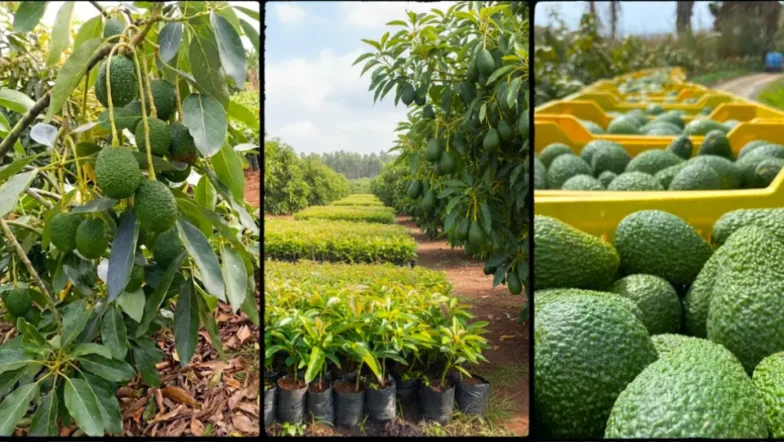
 stephen kilemi
February 2, 2026
stephen kilemi
February 2, 2026