
- Official KALRO certified Irish potato seed in 2026 ranges between KSh 3,000 and KSh 3,700 per 50kg bag depending on generation class (C1 vs C2) and tuber size.
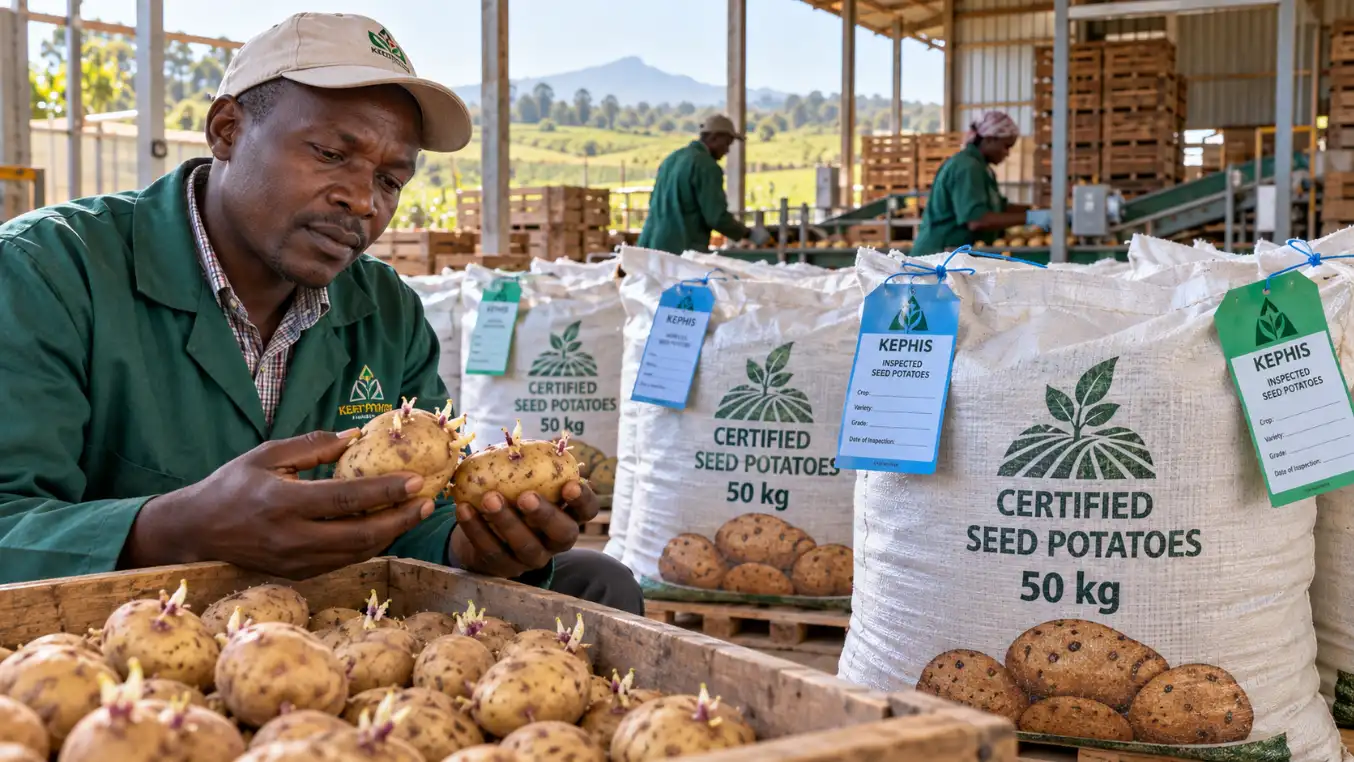
- KEPHIS regulatory standards mandate that all official certified seed potato bags must be packaged in 50kg units, fully sealed with official tamper-evident green labels.
- Certified seed can be purchased directly from KALRO Tigoni, ADC Molo, licensed NPCK Viazi Soko outlets, or verified private producers like Kisima Farm and FreshCrop.
Table of Contents
Sourcing high-quality, disease-free seed potatoes is the foundational step toward achieving profitable yields in Kenya’s potato production zones. Kenya Agricultural and Livestock Research Organization (KALRO) plays a central role in breeding, multiplying, and maintaining nuclear stock for high-performing potato varieties. This comprehensive 2026 guide breaks down verified KALRO potato seed prices, seed generations, variety performance metrics, per-acre input budgets, and official purchase locations across Kenya.
Read Also: Top 10 Best Maize Seeds in Kenya 2026: Prices, Yields & Highest Profit Varieties
Seed prices, seasonal availability, and variety stocks fluctuate depending on seed multiplication cycles, localized rainfall patterns, and national demand. Farmers are advised to confirm current inventory and direct payment details with official KALRO distribution outlets or licensed KEPHIS stockists prior to making financial commitments.
KALRO Irish Potato Seed Price List 2026
KALRO certified Irish potato seeds in 2026 cost between KSh 3,000 and KSh 3,700 per 50kg bag for C1 and C2 generations across major facilities like KALRO Tigoni and accredited seed merchants. Per kilogram pricing on digital platforms ranges from KSh 60 to KSh 75 depending on seed grade size.
Potato seed costs are influenced by multiplication generation, seed size classification, and distribution logistics. Official certified seed from research institutions is strictly measured and sold by standardized weight to guarantee purity, germination capacity, and freedom from bacterial wilt and potato cyst nematodes.
KALRO Potato Seed Prices by Bag Size and Seed Class
The table below provides indicative 2026 market prices for certified potato seed classes produced at KALRO centers and verified public multiplication units across Kenya.
| Seed Class / Generation | Bag Size (Standard) | Price Range (KES) | Per Kilogram Equivalent | Primary Intended Use |
|---|---|---|---|---|
| C1 (Certified Generation 1) | 50 kg bag | KSh 3,200 – KSh 3,500 | KSh 64 – KSh 70 | Commercial crop & on-farm seed multiplication |
| C2 (Certified Generation 2) | 50 kg bag | KSh 3,000 – KSh 3,200 | KSh 60 – KSh 64 | Direct commercial table/processing ware production |
| Basic / Pre-Basic Seed | 50 kg bag | KSh 4,000 – KSh 4,500 | KSh 80 – KSh 90 | Licensed specialized seed multipliers only |
How Much Is a 50kg Bag of KALRO Potato Seed?
A standard 50kg bag of KALRO certified potato seed costs KSh 3,000 for Class 2 (C2) seed and up to KSh 3,700 for Class 1 (C1) seed at primary multiplication hubs like KALRO Tigoni in Kiambu County. When purchasing through accredited regional stockists in Eldoret, Nakuru, or Meru, transport adjustments may add KSh 100 to KSh 200 per bag.
Pricing differences reflect seed generation rather than variety name. A 50kg bag of certified Shangi C1 seed commands the same baseline price as a 50kg bag of certified Unica C1 seed at official KALRO gates, provided seed size grades remain equal.
How Much Is a 90kg Bag of KALRO Potato Seed?
Strict regulatory directives issued by the Kenya Plant Health Inspectorate Service (KEPHIS) and National Potato Council of Kenya (NPCK) mandate that certified seed potatoes must not be sold in 90kg bags. Official certified seed is strictly graded, packed, and sealed in 50kg bags to protect seed tubers from compaction damage, bruising, and poor ventilation during handling.
If an unverified vendor offers potato seed sold in informal 90kg extended bags (extended bags weighing up to 110kg), that material represents uncertified commercial ware potatoes sold as farm-saved seed. Farmers purchasing informal 90kg units face high risks of introducing bacterial wilt (Ralstonia solanacearum) and viral infections into their soil.
What Determines the Price of KALRO Potato Seed?
KALRO potato seed prices are determined by seed multiplication generation, size grading standards, variety breeding rights, seasonal production costs, and transport distance from primary multiplication centers in Tigoni, Molo, and Naivasha to target farming regions.
Read Also: Kenya Seed Company Price List 2026 (Maize, Grass & Crop Seeds Prices in Kenya)
Seed potato valuation relies on rigorous technical parameters. Understanding these parameters enables growers to evaluate seed quality accurately and allocate capital effectively during purchasing seasons.
Seed Generation
Seed generation measures how many multiplication cycles the seed tuber has undergone since emerging from tissue culture micro-plants in sterile laboratory conditions:
- Pre-Basic Seed: Initial high-purity seed tubers grown from tissue culture in screenhouses. High production costs make this seed expensive and limited to seed specialists.
- Basic Seed: First open-field multiplication from pre-basic stock. Used to establish C1 seed crops under strict isolation.
- C1 Seed (Certified 1): Produced from basic seed. Possesses high viral resistance and vigor. Ideal for commercial growers wishing to produce both ware crop and certified C2 seed.
- C2 Seed (Certified 2): Produced from C1 seed. Offers high yields for table or processing potatoes, but should not be multiplied further to avoid disease accumulation.
Seed Size
Certified potato seeds are graded mechanically into distinct size categories prior to packaging:
- Size 1 (30mm – 45mm): Medium small seed tubers. Higher stem counts per kilogram, allowing lower total seeding weight per acre (approx. 800 kg to 900 kg per acre).
- Size 2 (45mm – 60mm): Large seed tubers. Higher energy reserves per tuber, favoring rapid early establishment in drier conditions, requiring higher seeding weight (approx. 1,000 kg to 1,200 kg per acre).
Variety and Market Demand
Breeding rights, maintenance costs, and market demand influence availability. Rapidly sprouting varieties like Shangi experience high turn-over rates, while specialized processing varieties like Dutch Ruba or Markies involve specific maintenance regimes that affect production planning.
Availability and Season
Seed availability spikes prior to the primary rainy seasons (March to May long rains and October to December short rains). High seasonal demand frequently leads to localized seed shortages, temporarily increasing acquisition costs for farmers who fail to book early.
KALRO Certified Irish Potato Varieties Available in Kenya
KALRO Tigoni and accredited public multiplication centers maintain several certified varieties including Shangi, Tigoni, Unica, Sherekea, Kenya Karibu, Arka, and Kenya Mavuno, each tailored for distinct climatic zones and target markets.
Choosing the correct variety requires balancing maturity duration, disease tolerance, processing quality, and buyer preference in target marketing hubs.
Shangi Potato Seed
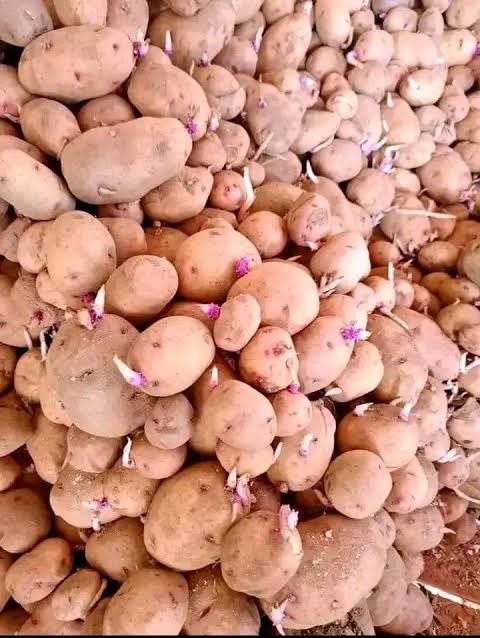
- Maturity: Early maturing (2.5 to 3 months).
- Yield Potential: 12 to 16 tonnes per acre under recommended agronomic practices.
- Key Traits: Short dormancy (sprouts quickly), exceptional cooking quality, high consumer preference in urban wholesale markets.
- Considerations: Highly susceptible to late blight if unmanaged; requires strict fungicide spray schedules in wet seasons. Short shelf life requires immediate post-harvest marketing.
Tigoni Potato Seed
- Maturity: Medium maturing (3 to 3.5 months).
- Yield Potential: 14 to 18 tonnes per acre.
- Key Traits: White skin with light yellow flesh, excellent mashing and boiling characteristics, moderate late blight tolerance.
- Considerations: Moderate dormancy period allowing flexible storage periods compared to Shangi.
Unica Potato Seed
- Maturity: Early to medium maturing (3 months).
- Yield Potential: 16 to 22 tonnes per acre.
- Key Traits: Red skin, high heat and drought tolerance, robust resistance to potato virus Y and late blight. Excellent for processing French fries (chips) and fresh market sales.
- Considerations: Performs exceptionally well in mid-altitude and drier zones including Laikipia, Kajiado, and Machakos under irrigation.
Kenya Karibu Potato Seed
- Maturity: Medium late maturing (3.5 to 4 months).
- Yield Potential: 14 to 18 tonnes per acre.
- Key Traits: Red tubers, thick skin, long dormancy, high resistance to late blight infection. Excellent choice for high-altitude zones prone to persistent rainfall.
- Considerations: Takes longer to mature; requires patient market timing.
Arka Potato Seed
- Maturity: Medium maturing (3 to 3.5 months).
- Yield Potential: 12 to 15 tonnes per acre.
- Key Traits: High dry matter content, suited for crisping and processing, fair field tolerance to viral complexes.
- Considerations: Demands targeted soil nutrient management to maintain uniformity.
Sherekea Potato Seed
- Maturity: Medium to late maturing (3.5 to 4 months).
- Yield Potential: 18 to 25 tonnes per acre.
- Key Traits: Round tubers with deep eyes and red skin, exceptionally high resistance to late blight, long shelf-life in storage.
- Considerations: Requires wider plant spacing to avoid producing oversized, non-uniform tubers.
Kenya Mavuno Potato Seed
- Maturity: Medium maturing (3.5 months).
- Yield Potential: 15 to 20 tonnes per acre.
- Key Traits: Broad adaptability across highland and mid-altitude zones, good table cooking traits, reliable late blight tolerance.
- Considerations: Requires consistent earthing-up to prevent tuber greening.
KALRO Potato Seed vs Other Certified Seed Potato Suppliers in Kenya
KALRO is Kenya’s primary public agricultural research institute, but certified seed is also produced by accredited institutions such as ADC Molo, Kisima Farm, FreshCrop, Agrico Potato Services Africa, and Egerton University under KEPHIS supervision.
Understanding the supplier ecosystem ensures growers source quality certified seed even when public research stations experience stock outages.
| Seed Producer | Primary Location | Main Varieties Handled | Key Advantage |
|---|---|---|---|
| KALRO Tigoni | Limuru, Kiambu | Shangi, Tigoni, Unica, Sherekea, Karibu | Primary breeding source, public affordable pricing |
| ADC Molo | Molo, Nakuru | Shangi, Dutch Robijn, Unica, Tigoni | Large scale production capacity, cold storage facility |
| Kisima Farm | Timau, Meru | Unica, Shangi, Asante, Panamera | High-altitude clean seed, advanced aeroponics, low disease pressure |
| Agrico Africa | Nakuru / Ol Kalou | Markies, Destiny, Arizona, Manitou | Specialized imported Dutch processing varieties for factory contracts |
| FreshCrop Ltd | Nakuru / Nyandarua | Shangi, Unica, Markies | Large scale multiplication, mechanization options |
Where to Buy KALRO Certified Potato Seed in Kenya
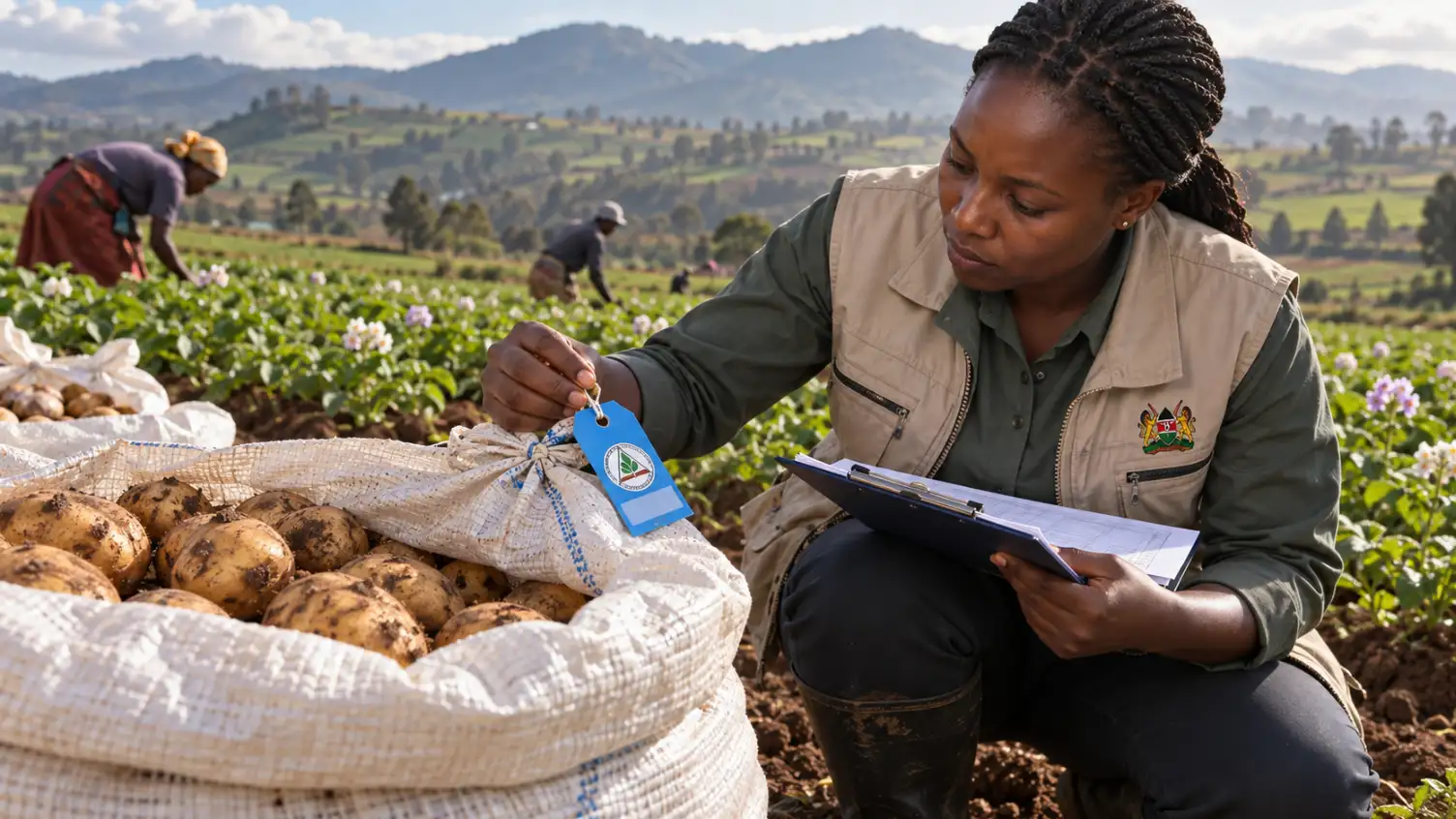
Certified KALRO potato seed can be purchased directly from KALRO Tigoni center in Limuru, authorized distribution centers in Naivasha and Molo, NPCK Viazi Soko platform, or registered KEPHIS agro-dealers nationwide.
Purchasing directly from accredited facilities guarantees seed authenticity and reduces risks associated with fake uncertified seed vendors.
KALRO Tigoni Center
Located in Limuru Sub-County, Kiambu County, KALRO Tigoni serves as the headquarters for national potato research. Farmers can visit the center directly to check field stocks, make payments via official government channels, and collect booked seed tubers.
KALRO Seed Distribution Outlets
KALRO operates research centers across various ecological zones. Seed stock availability varies, and growers should contact specific stations in advance:
- KALRO Naivasha (Delamere Farm station): Multiplies selected basic and certified seed batches suitable for the Rift Valley region.
- KALRO Kitale: Periodically supplies certified seed suited for North Rift farming zones.
- KALRO Perkerra (Marigat): Focuses on seed production for irrigated mid-altitude farming systems.
Can You Buy KALRO Potato Seed Online?
Yes, farmers can view seed availability, price per kilogram, and seed sizes online through the National Potato Council of Kenya (NPCK) digital platform Viazi Soko, and then place direct purchase orders with registered seed merchants.
The Viazi Soko web and USSD framework connects potato growers with registered seed producers. Farmers can trace available varieties, check current seed size stocks (Size 1 or Size 2), evaluate prices, and obtain direct contact details for authorized producers nationwide.
- Access the Viazi Soko digital platform or USSD service code (
*483*331#). - Navigate to the Seed Availability portal.
- Filter by desired potato variety (e.g., Shangi or Unica) and target county.
- View real-time stock balances listed by KALRO, ADC, or licensed private producers.
- Contact the specific seed merchant directly to secure allocations and arrange collection or dispatch logistics.
C1 vs C2 Potato Seed: What Is the Difference?
C1 (Certified Generation 1) seed is multiplied directly from basic seed and offers higher viral resistance and vigor suitable for further on-farm seed saving, whereas C2 (Certified Generation 2) seed is generated from C1 and intended directly for ware potato production.
Selecting between C1 and C2 seed balances upfront seed costs against long-term crop performance and future planting intentions.
What Is C1 Potato Seed?
C1 seed represents the first generation of field multiplication from basic stock. It carries minimal viral accumulation and robust genetic stability. Commercial farmers purchasing C1 seed can harvest a portion of their yield to serve as clean farm-saved seed for an additional season, provided strict rogueing and disease isolation are maintained.
What Is C2 Potato Seed?
C2 seed is produced by planting C1 seed stock. It complies fully with KEPHIS disease thresholds and yields excellent commercial crop volumes. However, tubers harvested from C2 crops should not be kept for seed again, as viral loads and bacterial contamination risk rising sharply in subsequent seasons.
Is C1 Better Than C2 for a Farmer?
For standard commercial table potato production, C2 seed provides an economical choice that lowers initial planting costs while maintaining high yields. If the farmer intends to establish a dedicated seed-multiplication plot or run multi-season harvesting schedules, investing in C1 seed provides better crop health longevity.
How to Identify Genuine KALRO Certified Potato Seed
Genuine certified potato seed must feature an official tamper-proof KEPHIS label specifying variety name, lot number, certification class, seed size, packing date, and official seal stitched along the bag seam.
Fake seed remains a major threat to potato enterprise profitability in Kenya. Growers must verify safety features on every purchased sack before releasing funds.
- KEPHIS Certification Label: Look for a distinct, official green or blue KEPHIS tag stitched firmly across the bag top closure. The tag cannot be removed without ripping.
- Seed Generation Details: Label clearly states class (e.g., C1 or C2) alongside the registered producer name (e.g., KALRO Tigoni).
- Lot Number Traceability: A unique lot number is stamped on every tag, allowing direct verification with KEPHIS database registers.
- Uniformity and Sprouting: Genuine seed tubers display uniform size grading (Size 1 or Size 2) with healthy, firm apical sprouts, free from rotting, scab lesions, or cut wounds.
- Official Payment Receipt: Secure an official institutional receipt carrying registered business paybill or bank account details. Avoid cash payments to unverified field agents.
How Many Bags of KALRO Potato Seed Do You Need Per Acre?
An acre of land requires between 16 and 20 bags of 50kg certified potato seed (800kg to 1,000kg total seed weight), depending on specific tuber size grading and field plant spacing.
Accurate seed calculation prevents field under-stocking or expensive over-purchasing during field preparation.
Potato Seed Requirement Depends on Spacing
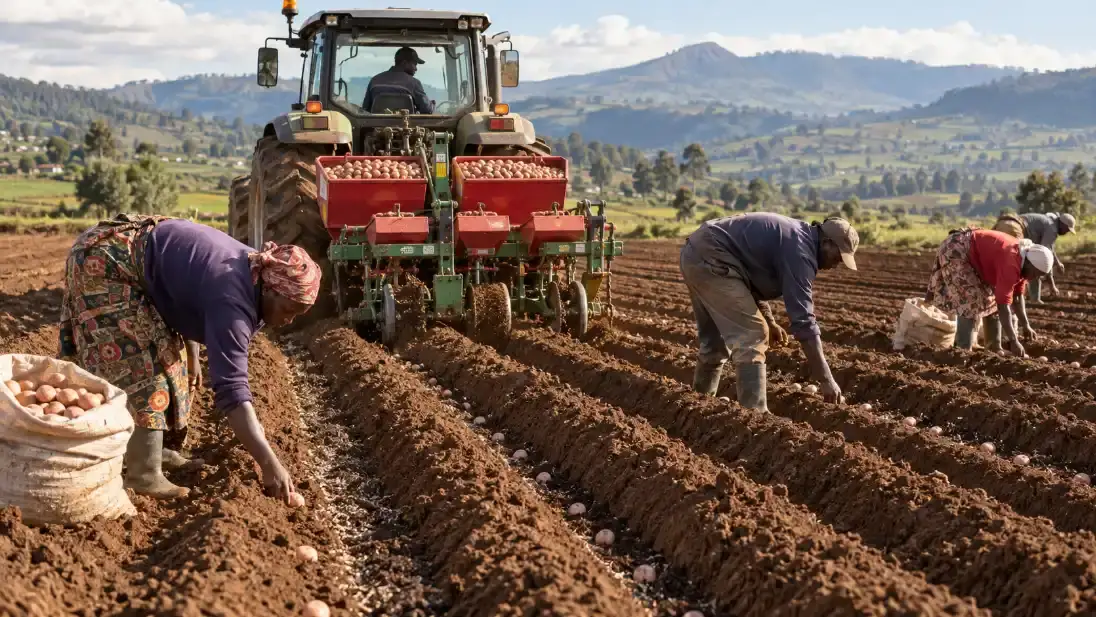
Recommended plant spacing for commercial potato production is 75 cm between rows and 30 cm between plants within the row. This planting pattern yields an optimal population of approximately 17,777 plants per acre.
- Size 1 Seed (30-45mm): Approx. 16 to 18 bags of 50kg per acre (800kg – 900kg total).
- Size 2 Seed (45-60mm): Approx. 20 to 22 bags of 50kg per acre (1,000kg – 1,100kg total) due to larger individual tuber weight.
Example Calculation for Different Acreages
| Land Size | Planting Spacing (Row x Plant) | Size 1 Seed (50kg Bags) | Size 2 Seed (50kg Bags) | Total Seed Weight (Kg) |
|---|---|---|---|---|
| 0.5 Acre | 75 cm x 30 cm | 8 – 9 bags | 10 – 11 bags | 400 – 550 kg |
| 1.0 Acre | 75 cm x 30 cm | 16 – 18 bags | 20 – 22 bags | 800 – 1,100 kg |
| 2.0 Acres | 75 cm x 30 cm | 32 – 36 bags | 40 – 44 bags | 1,600 – 2,200 kg |
| 5.0 Acres | 75 cm x 30 cm | 80 – 90 bags | 100 – 110 bags | 4,000 – 5,500 kg |
KALRO Potato Farming Cost Per Acre in Kenya
The average total cost of producing one acre of certified Irish potatoes in Kenya ranges between KSh 95,000 and KSh 135,000, covering land preparation, certified seed, fertilizers, crop protection chemicals, labor, and harvesting.
The operational production budget breakdown below reflects realistic 2026 market prices for inputs and agricultural service operations across major commercial production regions in Kenya.
| Input / Activity | Quantity / Specifications | Estimated Unit Cost (KES) | Total Cost (KES) |
|---|---|---|---|
| Certified Seed (C2 Class) | 18 bags (50kg) | KSh 3,100 per bag | KSh 55,800 |
| Ploughing & Harrowing | Tractor operations (1 acre) | KSh 6,000 per pass | KSh 10,000 |
| Well-rotted Manure | 3 to 4 tonnes (optional/recommended) | KSh 2,500 per tonne | KSh 7,500 |
| Planting Fertilizer (NPK/DAP) | 2 bags (50kg) | KSh 4,000 per bag (subsidized/market) | KSh 8,000 |
| Top-dressing Fertilizer (CAN) | 2 bags (50kg) | KSh 3,200 per bag | KSh 6,400 |
| Fungicides (Preventive & Curative) | Copper + Ridomil programs | Season package | KSh 8,500 |
| Insecticides (Aphids/Cutworms) | Systemic & contact sprays | Season package | KSh 3,500 |
| Planting & Ridging Labor | Casual labor allocation | Manual ridging | KSh 6,000 |
| Weeding & Earthing-up | Two weeding passes | Manual labor | KSh 5,000 |
| Harvesting & Sorting Labor | 25 to 30 workers day-rate | Per bag rate / day rate | KSh 8,000 |
| Transport to Local Market | Field to collection center | Local logistics | KSh 5,000 |
| TOTAL ESTIMATED COST | Complete Season Budget | 1 Acre Production | KSh 123,700 |
How Much Does It Cost to Plant One Acre With KALRO Potato Seed?
Planting one acre of potatoes using certified KALRO seed requires a minimum initial investment of KSh 70,000 to KSh 80,000 just to cover land preparation, seed procurement, and initial planting fertilizers before ongoing seasonal management.
Capital investments vary based on farm mechanization level, location, and input sourcing strategies:
- Low-Budget / Smallholder Model (KSh 85,000 – KSh 95,000): Uses family labor, manual land preparation, baseline subsidized fertilizer, and basic preventive fungicide schedules.
- Standard Commercial Model (KSh 115,000 – KSh 135,000): Employs tractor ploughing and ridging, 18 bags of C1/C2 certified seed, full NPK planting and CAN top-dressing regimes, and comprehensive preventive disease management.
- High-Input Intensive / Irrigated Model (KSh 140,000 – KSh 160,000): Involves full mechanization, high-density planting, advanced fertigation systems, specialized bio-stimulants, and contract processing varieties. Yield outputs often top 18 to 22 tonnes per acre.
Which KALRO Potato Variety Should You Choose?
Select Shangi for fast turn-around table markets, Unica for heat tolerance and processing, Sherekea for disease resistance and high yields, or Dutch Robijn/Markies for specialized factory crisp and chip processing contracts.
Matching variety performance with specific farm ecological conditions and end-buyer preferences prevents post-harvest losses and guarantees market uptake.
| Farmer Goal | Recommended Variety | Primary Selection Factor |
|---|---|---|
| Fast market turn-around (3 months) | Shangi | High immediate buyer demand in urban markets |
| High drought/heat tolerance | Unica | Stable yield performance under dry spells or irrigation |
| Heavy late blight disease zone | Sherekea / Kenya Karibu | Genetically strong late blight field tolerance |
| Processing French fries (Chips) | Unica / Tigoni / Markies | Low reducing sugars, long tuber shape, high dry matter |
| Crisp manufacturing factories | Dutch Robijn / Arka | High dry matter content, uniform round tubers |
| Long distance transport / Storage | Sherekea / Kenya Karibu | Thick skin, long natural tuber dormancy |
Best Potato Seed for Different Markets in Kenya
Fresh table markets prefer fast-cooking varieties like Shangi, fast-food outlets choose Unica and Tigoni for French fries, processing factories require contract varieties like Markies, and high-altitude growers rely on Sherekea.
Securing market off-take agreements before selecting seed prevents sales bottlenecks at harvest time.
- Fresh Table / Wholesale Markets (Wakulima, Kongowea, Kibuye): Shangi dominates over 70% of open-air retail trading due to consumer preference for fast boiling and mashing.
- Fast Food Restaurants & Hotels: Require varieties with high dry matter and low sugar content that produce crispy French fries without turning dark brown. Unica and Tigoni lead this category.
- Industrial Processing Factories: Require specific contract-grown varieties such as Markies, Dutch Robijn, or Destiny that maintain strict size and dry matter specifications.
When Is the Best Time to Buy Potato Seed in Kenya?
The best time to buy certified potato seed is 4 to 6 weeks before the onset of the main rainy season, allowing sufficient time to secure stock allocations and complete controlled green-sprouting.
Waiting until heavy rains begin leads to high seed prices, stock depletion at research stations, and unsprouted seed deliveries that delay crop establishment.
- Long Rains Season (March – May): Book seed orders between January and mid-February.
- Short Rains Season (October – December): Book seed orders between August and early September.
- Irrigated Production: Order seed 6 weeks prior to planned field land preparation.
How to Store Certified Potato Seed Before Planting
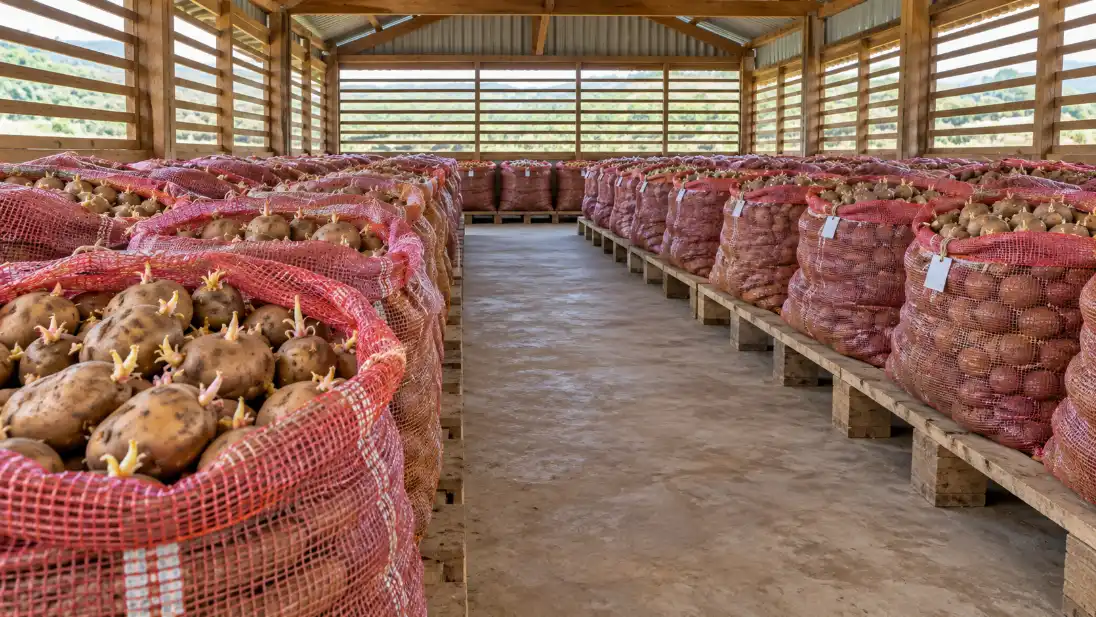
Store seed potatoes in a well-ventilated Diffuse Light Store (DLS) arranged in thin layers on slatted wooden shelves to encourage strong, green, sturdy apical sprouts before field planting.
Read Also: 2026 Seeds & Seedling Price List Kenya: KALRO, Kakuzi & ICIPE Certified Sources
Improper seed storage causes weak, white etiolated sprouts, seed rot, and severe yield reductions.
- Diffuse Light Access: Expose seed tubers to indirect, diffused light (never direct hot sunlight). Light hardens sprouts, turns them green, and slows down excessive tuber weight loss.
- Air Circulation: Ensure continuous airflow through slatted timber trays or shallow wooden crates. Never store seed potatoes in sealed plastic or tightly stacked gunny bags.
- Layering Depth: Keep tuber layers 2 to 3 deep to allow uniform sprout growth and easy identification of rotting tubers.
- Sanitation: Regularly inspect storage racks and discard any tubers showing signs of soft rot, dry rot, or aphid infestation.
Common Mistakes Farmers Make When Buying Potato Seed
Common mistakes include buying uncertified seed from roadside traders, planting unsprouted or over-sprouted tubers, ignoring seed generation classes, choosing varieties without market buyers, and buying extended 90kg bags.
Avoiding critical procurement errors protects farm capital and ensures high harvest yields.
- Purchasing “Ware” Potatoes as Seed: Buying cheap eating-potatoes from local open markets exposes fields to permanent bacterial wilt contamination.
- Ignoring KEPHIS Labels: Failing to verify the presence of an unbroken KEPHIS certification tag on seed sacks.
- Delaying Seed Procurement: Sourcing seed at the last minute forces reliance on poor-quality residual seed stocks.
- Over-Looking Tuber Size Grades: Purchasing mixed tuber sizes leads to uneven plant populations and irregular field emergence.
- Failing to Plan Market Outlets: Growing specialized processing varieties without prior off-take contracts.
KALRO Potato Seed Price Updates for 2026
Potato seed price updates reflect periodic seed generation cycles, field release dates, and changing production input costs. This market guide is updated regularly to provide reliable pricing, verified contact logistics, and accurate seed availability for potato growers across Kenya.
Last Price Audit: January 2026. Seed prices and stock volumes should be confirmed directly with official KALRO station management or NPCK Viazi Soko portals prior to dispatching transport.
Final Advice Before Buying KALRO Potato Seed
Before completing payments for potato seed stock, verify the following essential checklist:
- Confirm the variety suits your farm location altitude and target buyer market.
- Verify the presence of an intact, blue or green KEPHIS certification label stitched onto every 50kg sack.
- Inspect the seed batch for uniform size grading, firm green sprouts, and zero soft rot symptoms.
- Ensure payments are made exclusively through official institutional paybill numbers or direct bank accounts, and demand an official receipt.
- Book seed orders 4 to 6 weeks early to allow proper green-sprouting in a diffuse light store before field planting.
Frequently Asked Questions About KALRO Potato Seed
Where Can I Buy Certified Potato Seeds in Kenya?
Certified potato seeds can be bought from KALRO Tigoni, ADC Molo, Kisima Farm, FreshCrop Ltd, Agrico Potato Services, and KEPHIS-licensed seed stockists listed on the NPCK Viazi Soko digital platform.
Where Can I Buy KALRO Certified Irish Potato Seeds in Kenya?
You can buy KALRO certified potato seeds directly at KALRO Tigoni center in Limuru, or through official distribution hubs at KALRO Naivasha, Kitale, and licensed regional partner stockists.
What Is the Price List for KALRO Potato Seeds in 2026?
In 2026, KALRO certified seed costs approximately KSh 3,200 to KSh 3,700 for C1 class and KSh 3,000 to KSh 3,200 for C2 class per 50kg bag. Per kilogram prices range from KSh 60 to KSh 70.
How Much Is a 90kg Bag of KALRO Certified Potato Seed?
90kg bag of KALRO certified potato seed ranges between KSh 3,700 and KSh 7,500 depending on the seed generation class.
What Are the Prices of C1 and C2 Certified Potato Seeds in Kenya?
C1 certified potato seed costs approximately KSh 3,200 to KSh 3,700 per 50kg bag, while C2 certified seed costs KSh 3,000 to KSh 3,200 per 50kg bag across major producers.
What Are the Certified Shangi Potato Seed Prices in Kenya?
Certified Shangi potato seed costs between KSh 3,000 and KSh 3,500 per 50kg bag at KALRO Tigoni and ADC Molo, depending on generation class and seed size grading.
Which KALRO Potato Seed Varieties Are Available in Kenya?
Available KALRO varieties include Shangi, Tigoni, Unica, Sherekea, Kenya Karibu, Arka, and Kenya Mavuno, each adapted to different growing ecological zones and end uses.
How Much Is the Price of Irish Potato Seed in Kenya in 2026?
Irish potato seed prices in 2026 range from KSh 3,000 to KSh 3,800 per 50kg bag for certified seed from institutional producers like KALRO, ADC, and Kisima Farm.
Where Can I Buy Certified Shangi, Unica and Sherekea Potato Seeds in Kenya?
Certified Shangi, Unica, and Sherekea seeds are available directly at KALRO Tigoni, ADC Molo, Kisima Farm Timau, and verified stockists accessible via the NPCK Viazi Soko portal.