

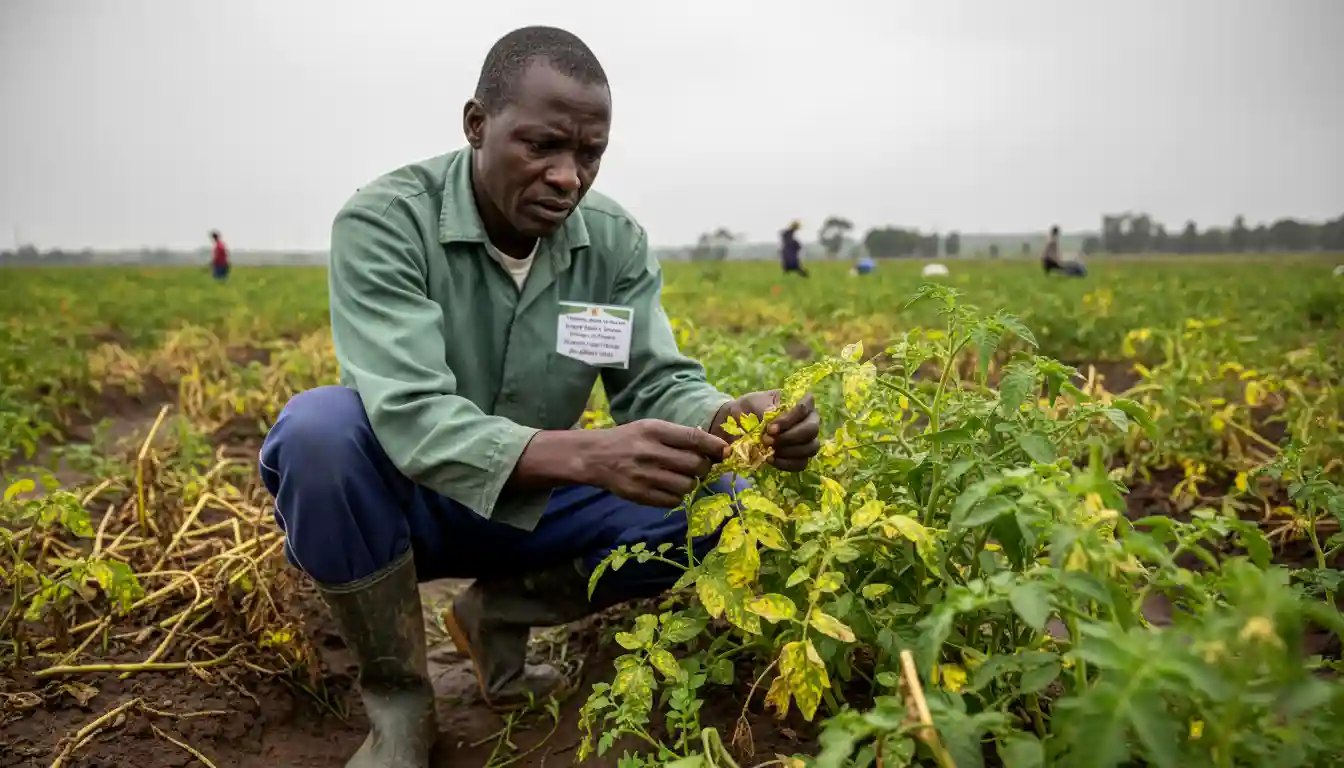
- Identify Fast: Yellow leaves spreading rapidly after heavy rains usually signal late blight, which can destroy fifty percent of your crop in under three days.
- Stop the Spread: Cease all overhead irrigation immediately and apply a strong systemic fungicide within the very first twenty four hours.
- Use a Sticker: Always mix your chosen fungicide with a high quality sticker to prevent the intense Kenyan long rains from washing away your expensive chemicals.
Table of Contents
If you are seeing yellowing leaves during the long rains, you have hours, not days. Fungal infections in solanaceous crops do not wait for the weekend, and they certainly do not forgive delays. This guide shows exactly what to do in the next forty eight hours to stop crop loss.
Confirm the Problem in Two Minutes Without Guessing
Yellowing leaves indicate either early blight or late blight. Early blight starts low with target pattern brown spots, while late blight causes dark wet patches with white mould underneath. Fast spreading after rain means late blight, requiring immediate systemic chemical treatment.
Before you run to the nearest agrovet, you must know exactly what fungus is attacking your crops. Guessing leads to buying the wrong chemicals, which wastes money and allows the disease to spread rapidly. Most beginners in Kenya struggle with diagnosing leaf yellowing because they rely on bad advice from unqualified neighbours.
Read Also: 2026 Fertilizer Guide: Understanding NPK Ratios for Maximum Maize Yields
The two main culprits during the Kenyan rainy season are early blight and late blight. Early blight is slower and usually begins on the older lower leaves of the plant. Late blight is highly aggressive, moves fast, and thrives in cool wet conditions.
👉 If it is spreading fast after rain = treat as late blight immediately.
Recognizing Early Blight Characteristics
Early blight typically reveals itself as brown spots with distinct concentric rings looking much like a target board. The plant tissue around these specific spots turns a bright sickly yellow as the fungus consumes the leaf. This disease usually starts on the lower leaves closest to the wet soil.
While early blight can drastically reduce your yields, it moves relatively slowly compared to other aggressive pathogens. It is often triggered when soil splashes onto the lower leaves during heavy rainstorms. Proper crop spacing and heavy organic mulching are your best natural defences against this specific fungus.
Recognizing Late Blight Dangers
Late blight remains the absolute biggest threat to Kenyan tomato and potato farmers today. It manifests as dark wet looking patches on the leaves that quickly turn brown and necrotic. If you check the underside of these leaves early in the morning, you will often see a white fuzzy mould.
This fungus spreads explosively after periods of heavy rain, thick fog, or high environmental humidity. In farming areas like Nakuru, Kisumu, or Kajiado, a single foggy morning can trigger a massive outbreak. If not controlled within three days, your total yield loss can easily exceed fifty percent.
The First Twelve Hours Require Total Farm Quarantine
Halt all overhead irrigation immediately to prevent water splashing. Do not touch wet plants or move between infected and healthy sections of the farm. Quarantine the diseased zones physically to stop spores from transferring via farm labour.
The first twelve hours after spotting yellow leaves are purely about strict containment and damage control. Fungal spores rely on free water and physical movement to travel from one plant to another. If you fail to lock down the farm, no amount of expensive chemical spraying will save your harvest.
Read Also: 2026 Seeds & Seedling Price List Kenya: KALRO, Kakuzi & ICIPE Certified Sources
From what many farmers experience, the biggest mistakes happen right here during the panic phase. Panic causes farmers to rush blindly into the field, inadvertently spreading the disease on their clothes and bare hands. You must establish strict farm hygiene rules the moment you identify late blight.
👉 Most farmers spread the disease themselves. Do not be that guy.
Stop Overhead Irrigation Immediately
Fungal spores literally swim in water droplets to infect new plant cells across your field. If you are using sprinklers or overhead irrigation, you are giving the fungus a free ride across your shamba. Turn off the water immediately and rely solely on drip lines if irrigation is absolutely necessary.
In many Kenyan regions, unpredictable rains already provide too much moisture during the month of April. Adding overhead irrigation to wet foliage is a guaranteed recipe for a complete blight explosion. You must keep the plant canopy as dry as humanly possible.
Do Not Touch Wet Plants
Never walk through your tomato or potato field when the leaves are wet from morning dew or recent rain. Brushing against wet infected leaves transfers millions of microscopic spores onto your clothing instantly. When you brush against the next healthy plant, you have just infected it with the pathogen.
Wait until the strong midday sun has dried the foliage entirely before entering the field to assess the damage. If you must enter the field during wet conditions, wear waterproof gear that can be easily washed with harsh bleach. Farm hygiene is arguably just as important as your chemical intervention.
Mark Infected Zones Clearly
Take some brightly coloured tape or wooden stakes and visibly mark off the infected sections of your farm. Instruct your workers to avoid these marked areas entirely until the official spray time. You must isolate the active outbreak just like a biological quarantine zone.
Do not move farm tools from the infected zone to the healthy zone without disinfecting them first. A simple bucket of water mixed with household bleach is enough to clean your tools effectively. Always treat the heavily infected area last to protect the rest of your healthy crop.
The Spray Plan Demands Strict Twelve to Thirty Six Hour Action
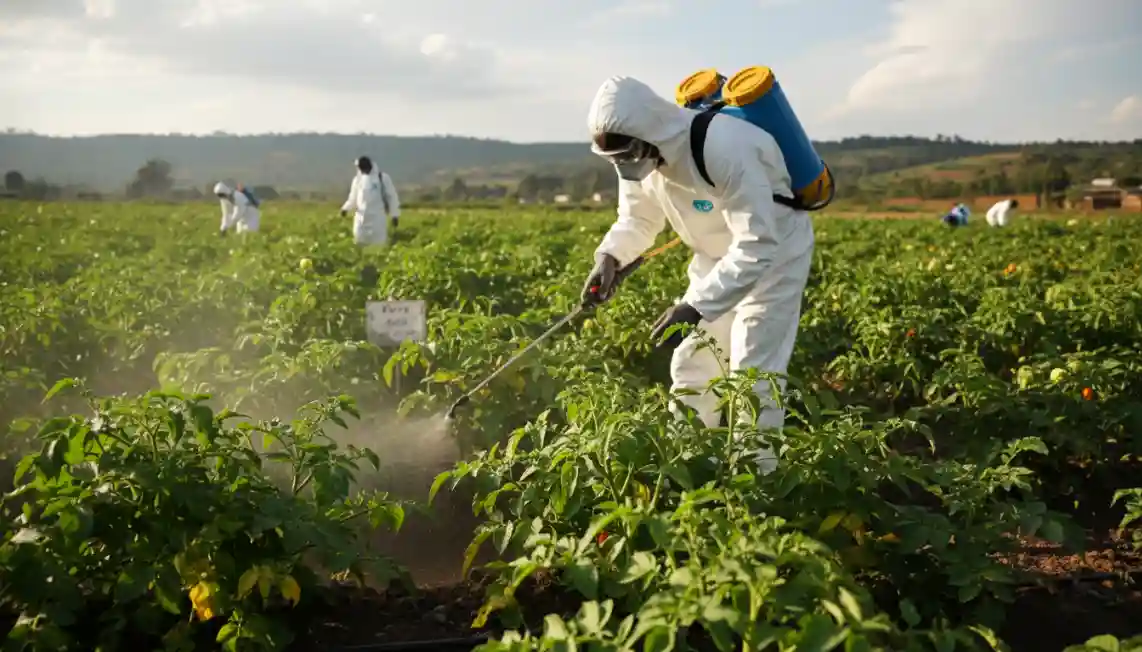
Apply a strong systemic fungicide to cure existing internal infections. Always mix your chemical with a reliable agricultural sticker to prevent rain wash off. Spray early in the morning or late evening for maximum leaf absorption.
Once you have successfully contained the physical spread, it is time to deploy your chemical counterattack. You cannot rely on cheap contact fungicides once the fungus is already multiplying inside the plant tissue. You need true systemic action to kill the disease from the inside out.
Agrovet scams are unfortunately common in Kenya, with middlemen pushing expired or entirely ineffective chemicals. Always buy sealed branded products from reputable licensed suppliers to guarantee product authenticity. The following steps outline the exact chemical strategy you need for April 2026.
Step One Involves Systemic Curative Fungicides
A systemic fungicide is absorbed directly into the plant sap and transported throughout the internal tissues. This means it can actively kill fungal infections that have already penetrated the leaves and green stems. For an active outbreak, utilizing systemic action is absolutely non negotiable.
Read Also: How to Find a Trusted Agrovet Near Me in Kenya (2026 Guide to Genuine Farming Inputs)
As of April 2026, highly rated systemic options in Kenya include Ridomil Gold MZ 68 WG, Absolute 375 SC, and Trinity Gold 452 WP. Ridomil Gold uses Metalaxyl M to rapidly enter the green plant parts within thirty minutes. Absolute 375 SC relies on Azoxystrobin to disrupt the fungus energy production completely.
Step Two Requires Adding a Quality Sticker
Most beginners in Kenya struggle with blight because they spray expensive chemicals only for the afternoon rain to wash them away. A sticker binds the chemical tightly to the leaf surface, ensuring it stays exactly where it is needed. If you skip this step during the long rains, you are literally pouring your money into the soil.
Products like Integra Sticker or Aquawet are highly effective and relatively cheap at most local agrovets. You only need a few millilitres per twenty litre knapsack sprayer to ensure complete rainfastness. Rain will definitely wash your chemical away if you ignore this crucial addition.
Step Three Enforces Strict Application Rules
Timing your spray application is critical for overall chemical effectiveness and general plant safety. Always spray early in the morning before the sun gets too hot, or late in the evening. Spraying under intense midday heat can cause severe chemical burns on your already stressed leaves.
Ensure you achieve full coverage, meaning you must spray both the top and the underside of all leaves. Fungal spores often hide and multiply rapidly on the shaded undersides where moisture lingers longest. Lastly, do not spray if dark clouds indicate heavy rain is coming within the next two hours.
Step Four Defines The Repeat Strategy
A single chemical spray will never eradicate a severe blight outbreak entirely. You must spray again after five to seven days to kill any newly hatched spores and protect new leaf growth. However, you must actively rotate your chemicals to prevent the fungus from building genetic resistance.
If you used Ridomil Gold for your first spray, switch to a completely different active ingredient for your second spray. Fungi mutate rapidly, and using the same chemical repeatedly acts as a training ground for super pathogens.
👉 If you repeat the same fungicide, the disease will come back stronger.
Damage Control and Recovery Between Thirty Six to Forty Eight Hours
Remove and destroy up to thirty percent of the worst infected leaves to reduce the immediate spore load. Bury or burn all infected plant debris far from your main crop. Avoid fertilizers that push soft vegetative growth.
By the thirty six hour mark, your systemic fungicide is actively working inside the plant sap. Now, you must shift your strict focus to cleaning up the farm and helping the surviving plants recover. Dead and heavily infected leaves will not heal, and leaving them attached only drains the plant energy.
Recovery requires a delicate ongoing balance of physical pruning and targeted nutritional support. You want the plant to regain its strength without pushing it into a soft vulnerable state. Follow these strict rules to ensure your valuable harvest survives the recovery phase.
Remove Infected Leaves Safely
Take clean disinfected pruning shears and carefully cut away the heavily spotted and yellowing leaves. You can safely remove up to thirty percent of the plant foliage without killing the main stem. Focus primarily on the lower leaves where airflow is poorest and moisture is dangerously high.
Place the removed leaves gently into a secure plastic bag to avoid dropping spores as you walk out of the field. Never toss infected leaves onto the pathways or between the crop rows under any circumstances. This is a common but fatal error that practically guarantees a secondary massive outbreak.
👉 If you leave infected leaves on the ground, you are reinfecting your farm.
Burn or Bury Farm Waste Immediately
The Phytophthora infestans pathogen can easily survive on dead plant tissue and in the top soil for months. You must destroy the infected leaves completely to permanently break the destructive disease cycle. Dig a deep hole far away from your main shamba and bury the debris, or burn it completely.
Never add blighted leaves to your standard organic compost pit. Most traditional compost pits in Kenya do not reach temperatures high enough to effectively kill late blight spores. Using infected compost later will simply spread the disease straight to your next crop of delicate seedlings.
Top 5 Fungicides for Emergency Blight Control (Kenya 2026)
When your tomato or potato crop is under active attack from late blight during the long rains, you need high performance chemicals that offer both systemic (internal) and contact (external) protection. The following five fungicides are currently the most effective options available in the Kenyan market for rapid intervention.
1. Ridomil Gold MZ 68 WG (Syngenta)
This is the industry standard for late blight. It contains Metalaxyl M for systemic action and Mancozeb for contact protection. It penetrates the plant within thirty minutes, making it highly effective even if it rains shortly after application.
- Active Ingredients: Metalaxyl M (40g/kg) + Mancozeb (640g/kg)
- Best For: Fast internal curative action during high disease pressure.
- Where to Buy: Purchase Ridomil Gold at Agroduka
2. Absolute 375 SC (Greenlife)
A powerful triple action fungicide that prevents, cures, and eradicates fungal diseases. It is excellent for managing early blight and late blight simultaneously while providing long lasting protection to new growth.
- Active Ingredients: Azoxystrobin (200g/L) + Difenoconazole (150g/L) + Hexaconazole (25g/L)
- Best For: Total eradication of existing infections and protecting new leaves.
- Where to Buy: Purchase Absolute 375 SC at Jojemi Agro
3. Trinity Gold 452 WP
Trinity Gold is a specialized fungicide and bactericide. Since heavy rains often bring both fungal blight and bacterial diseases, this dual action product provides a broad shield for your vegetables.
- Active Ingredients: Copper Oxychloride + Systemic components
- Best For: Mixed infections where both fungus and bacteria are suspected.
- Where to Buy: Purchase Trinity Gold at Imagine Care
4. Mastercop 60 SC (Syngenta)
This is a high tech copper fungicide. Unlike traditional copper powders that can be easily washed away, Mastercop is a liquid formulation that adheres better to the leaf surface and has better bioavailability to kill pathogens.
- Active Ingredient: Copper Sulfate Pentahydrate (60g/L)
- Best For: Broad spectrum protection and preventing spore germination on leaf surfaces.
- Where to Buy: Purchase Mastercop 60 SC at Agroduka
5. Milestone 250 SC
A highly effective systemic fungicide from the strobilurin family. It is particularly strong against late blight and helps keep the plant green for longer, which can help in yield recovery after a disease attack.
- Active Ingredient: Azoxystrobin (250g/L)
- Best For: Systemic protection of the entire plant, including unsprayed parts.
- Where to Buy: Purchase Milestone 250 SC at Agropests
Pro Tip: Always check the manufacture date on the packaging. In 2026, many distributors are clearing old stock. Ensure your chemicals are fresh to guarantee the active ingredients are at full potency for your 48 hour rescue plan.
The Recommended Anti Blight Spray Schedule for Prevention
Transition to a preventive schedule using a strict three week rotation cycle. Apply a systemic fungicide in week one, a cheaper contact fungicide in week two, and a different systemic in week three. This rotation prevents chemical resistance entirely.
Once you have survived the forty eight hour emergency, you must transition from crisis management into a controlled prevention system. You cannot afford to patiently wait for yellow leaves to appear before you spray again. Prevention is always significantly cheaper and far more effective than a desperate emergency cure.
Farmers want simple repetitive cycles that are easy to remember and execute with farm labour. Overcomplicating your spray calendar leads to skipped days and incredibly costly mistakes. The following three week rotation is highly effective for the unpredictable Kenyan long rains.
Week One Employs Systemic Fungicides
Start your monthly cycle with a powerful systemic fungicide to clear out any hidden dormant infections. Products containing Metalaxyl M or Azoxystrobin are absolutely perfect for this specific protective role. Always remember to add your sticker, especially if the forecast predicts heavy afternoon showers.
Systemic chemicals provide excellent internal protection from the inside out for several consecutive days. This ensures that even if you miss a small section during spraying, the plant still absorbs the active ingredients. This important step sets a very strong baseline for the rest of the month.
Week Two Relies on Contact Fungicides
In the second week, switch to a purely contact fungicide like Mancozeb or a copper based product. Contact fungicides do not enter the plant sap, but they create a highly toxic shield on the leaf surface. Any fungal spore that randomly lands on this chemical shield dies instantly upon contact.
Contact chemicals are generally much cheaper than systemic ones, which critically helps lower your overall monthly production costs. Ensure you cover the plant completely, as contact chemicals only protect the exact spots they touch physically. Reapply immediately if unexpectedly heavy rains wash the protective chemical layer away.
Week Three Shifts to a Different Systemic
For the third week, go back to a systemic fungicide, but use a completely different active ingredient from week one. If you used Ridomil Gold earlier, confidently switch to Absolute 375 SC now. This specific rotation keeps the fungal population guessing and completely prevents genetic resistance.
By rotating your chemical classes, you successfully extend the commercial lifespan of these valuable products on your farm. Continue this alternating cycle until the heavy rains subside and the dry season drastically lowers the blight pressure. Consistency in application is the true secret to highly profitable commercial vegetable farming.
Why Your Farm Got Hit and How to Fix It
Fungal outbreaks are usually caused by extremely poor spacing, overhead irrigation, and failing to spray preventively. Allowing leaves to remain wet overnight creates the perfect breeding ground for aggressive blight. Fixing basic farm management is the only permanent cure.
Surviving a blight attack is a massive relief, but it is also a harsh wake up call regarding your farm management. Blight spores are virtually everywhere in the environment, but they only destroy farms that provide the perfect breeding conditions. If you do not fix the root causes immediately, the fungus will return the moment you turn your back.
Read Also: Beyond Maize: 7 Drought-Resistant “Smart Crops” to Plant This Season
What amateur guides rarely tell you is that chemical sprays are just a temporary bandage for bad agricultural practices. You must actively analyze your farm layout, your irrigation habits, and your daily worker routines. The hard unvarnished truth is that persistent blight is rarely just bad luck.
👉 Blight is not bad luck. It is poor farm management.
Poor Spacing and Zero Airflow
Financial greed often pushes farmers to pack way too many seedlings into a small space to maximize yields. However, dense canopies actively block the wind, creating a dark humid microclimate trapped between the plants. This stagnant damp air is exactly what Phytophthora infestans actively needs to multiply rapidly.
Always stick rigorously to the recommended spacing for your specific commercial tomato or potato variety. Good natural airflow ensures that morning dew dries quickly, robbing the fungus of the water it desperately needs to survive. Prune excess branches in tomatoes routinely to maintain an open breathable canopy.
Wet Leaves Left Overnight
Watering your crops late in the evening is easily one of the most dangerous mistakes you can make. The sun goes down, temperatures drop sharply, and the delicate leaves stay wet for ten to twelve hours straight. This massive window of surface moisture allows fungal spores to germinate and penetrate the plant tissue unchallenged.
Always irrigate early in the morning so the rising sun has plenty of time to dry the foliage completely by midday. If you are using greenhouse farming, ensure you open the side vents very early to release trapped overnight condensation. Dry leaves simply do not get infected by late blight.
No Preventive Spraying Done
Patiently waiting for yellow spots to actually appear before buying fungicides is a strategy guaranteed to fail completely. Commercial farming demands that you apply protective contact fungicides before the long rains even officially begin. A protective chemical shield stops the very first arriving spores from establishing a colony.
Watch the local weather forecasts very carefully during the wet months of April and November. If the meteorological department predicts unusually heavy rainfall, spray your contact fungicides two clear days prior. Prevention costs a mere fraction of what you will eventually spend trying to cure an active outbreak.
Top Tomato and Potato Varieties Resistant to Blight
Selecting the right genetic variety drastically reduces your chances of a severe fungal wipeout. Shangi potatoes are highly susceptible, whereas Dutch Robijn offers better tolerance. For tomatoes, Kilele F1 and Anna F1 provide stronger resilience against common environmental diseases.
Before you ever plant a single seed, your choice of crop variety dictates your entire chemical budget for the season. Some older heirloom varieties have absolutely zero genetic defence against modern aggressive strains of late blight. Choosing hybrid seeds bred specifically for disease tolerance is your very first line of genuine defence.
Farmers who blindly plant cheap seeds often spend triple the amount of money on expensive curative fungicides later. While no variety is completely immune to a massive late blight attack, some buy you crucial extra days to react. Here is a breakdown of common Kenyan varieties and their blight resilience.
Potato Variety Comparisons
The famous Shangi potato is loved across Kenya for its extremely fast maturity and excellent cooking qualities. However, it is notoriously weak against late blight and will collapse entirely within days if unsprayed. Farmers growing Shangi must strictly adhere to the rigorous preventive spray schedules mentioned above.
Alternatively, varieties like Dutch Robijn and Unica offer noticeably better field tolerance to fungal diseases. Dutch Robijn is highly sought after by the potato crisp processing industry and holds up better during the long rains. Unica is incredibly hardy, tolerating both heat stress and moderate blight pressure exceptionally well.
Tomato Variety Comparisons
Open pollinated tomato varieties like Rio Grande are cheap to establish but require intense chemical protection during wet seasons. Greenhouse farmers often prefer Anna F1, which boasts strong resistance to several viral and fungal pathogens, though ventilation remains crucial. For open field farming, Kilele F1 is widely celebrated for its robust tough foliage.
Zara F1 is another increasingly popular commercial choice that shows impressive resilience during periods of high humidity. By selecting strong F1 hybrids, you effectively slow down the rate of fungal spread across your farm. This genetic advantage gives your applied systemic chemicals much better odds of saving the crop.
Fertilizer Guidelines for Rapid Post Infection Plant Recovery
Apply a light foliar fertilizer low in nitrogen to help the plant recover without forcing soft weak growth. Focus on potassium and calcium rich feeds to strengthen cellular walls. Strong cells act as a physical barrier against future fungal attacks.
Once the disease is halted, your plants need a specific nutritional boost to overcome the chemical and biological stress. Apply a high quality foliar fertilizer, but ensure it is extremely low in nitrogen. High nitrogen fertilizers force the plant to produce rapid soft green growth that fungi love to attack.
Soft growth is structurally weak and incredibly vulnerable to a second wave of aggressive fungal infection. Instead, use a foliar feed rich in potassium, calcium, and essential micronutrients to strengthen the plant cell walls. Stronger cell walls act as a vital physical barrier against any future fungal attacks.
The following table outlines the recommended fertilizer types for post infection plant recovery. Always confirm the exact NPK ratios before purchasing any product from your local agrovet.
| Fertilizer Component | Purpose During Recovery | Application Method |
|---|---|---|
| Nitrogen (Low levels) | Prevents excessive soft foliage growth while maintaining basic metabolic functions. | Avoid foliar sprays. Apply minimal amounts via soil drip if necessary. |
| Potassium (High levels) | Thickens cell walls and improves overall disease resistance across the plant. | Foliar spray applied early morning for rapid leaf absorption. |
| Calcium (Moderate levels) | Strengthens plant structural integrity and prevents blossom end rot in tomatoes. | Foliar spray applied alongside potassium feeds. |
Where to Buy Verified Agrochemicals in Kenya (2026)
Procure your systemic fungicides, high quality stickers, and premium resistant seeds only from verified national distributors. Major agrovet chains in Nairobi, Nakuru, and Eldoret stock the genuine branded products required for this 48 hour emergency plan.
Executing an effective response requires instant access to authentic chemicals. Buying counterfeit products from unverified roadside vendors is a guaranteed path to total crop failure. You must build relationships with authorized distributors who guarantee product quality. For full spray calendars and detailed cost breakdowns, farmers should refer to the Vegetable Commercialization Handbook.
Source your emergency chemicals from these verified providers. Always demand an official receipt to verify your batch numbers.
Greenlife Crop Protection Africa Ltd
- Core Products: Absolute 375 SC, Integra Sticker, Quality Foliar Feeds
- Phone: +254 722 563 698
- Official Website: www.greenlife.co.ke
- Physical Address: Athi 55 Complex, Warehouse No. 6, Mombasa Road, Nairobi (Opposite Signature Mall)
Syngenta East Africa Ltd
- Core Products: Ridomil Gold MZ 68 WG, Premium Tomato Seeds (Kilele F1, Anna F1)
- Phone: +254 703 018 000
- Official Website: www.syngenta.co.ke
- Physical Address: Matumbato Road, off Kiambere Road, Nairobi
Kenya Seed Company
- Core Products: Certified blight tolerant potato seed tubers and specialized fertilizers
- Phone: +254 722 205 144, +254 726 141 856
- Official Website: www.kenyaseed.com
- Physical Address: Mbegu Plaza, Kijana Wamalwa Street, Kitale (Branch offices available in Nairobi and Nakuru)
Regional Reality Check for Blight Outbreaks Across Kenya
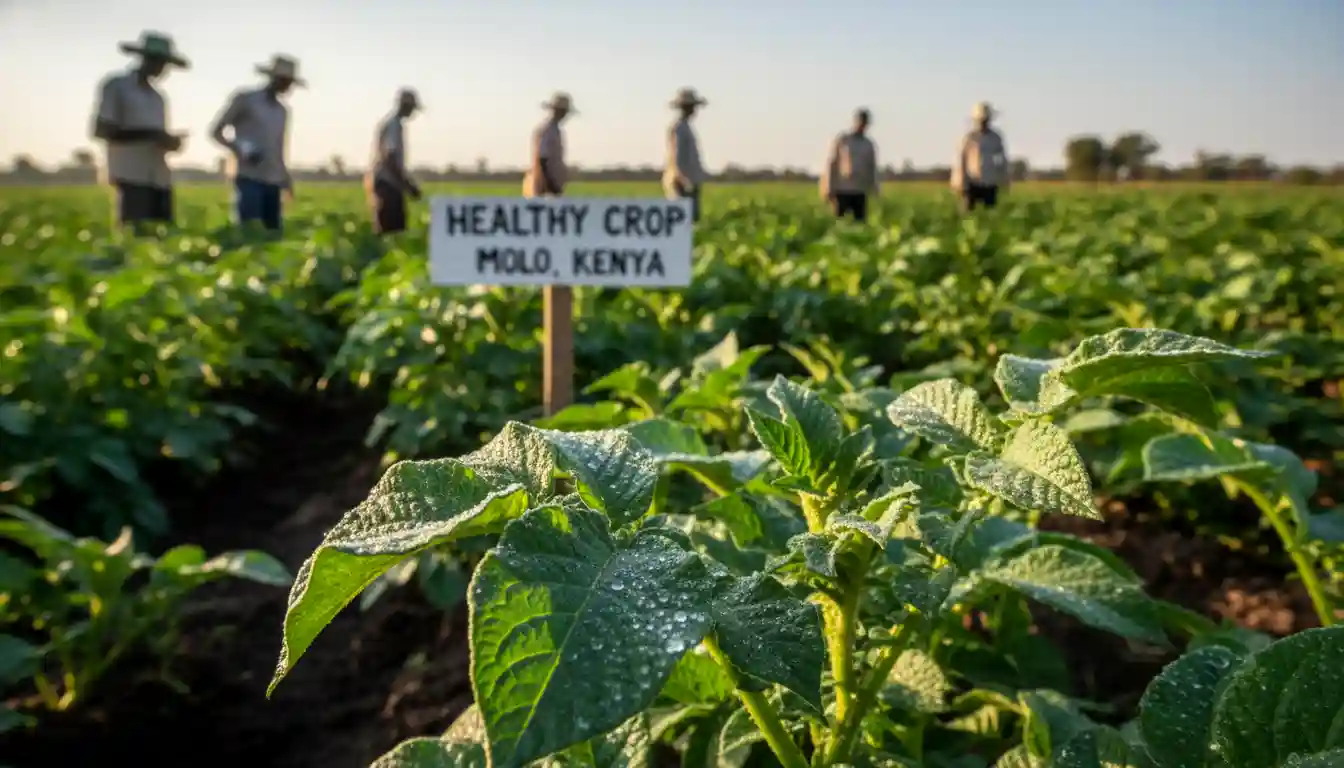
Blight pressure varies dramatically by region. Molo faces high risks due to cold wet conditions, while Kajiado struggles with humidity trapped inside poorly ventilated greenhouses. Kirinyaga farmers battle rapid fungal spread during the warm wet rainy seasons.
Kenya features diverse geography meaning that a forty eight hour fungus control plan looks slightly different depending on your county. A farmer in the cold highlands faces distinct environmental challenges compared to a farmer in the warm semi arid regions. Understanding your local microclimate allows you to effectively anticipate blight before it ever strikes.
Local agro market behaviour also dictates exactly how quickly you can source authentic curative chemicals. If you farm far from major agricultural hubs, you must stockpile systemic fungicides well before the wet season starts. Here is exactly how blight behaves across three major Kenyan commercial farming zones.
The Cold and Wet Highlands of Molo and Nyandarua
In high altitude areas like Molo and Nyandarua, the unique combination of near freezing nights and persistent drizzle creates a blight paradise. The disease pressure here is incredibly high, and early blight often transitions seamlessly into devastating late blight. Farmers in these specific zones must stick strictly to five day spray intervals during peak rains.
Because ambient temperatures remain extremely low, morning dew stays on the plant leaves well into the late morning. Farmers must prioritize early morning manual ventilation if using greenhouses and aggressive foliage pruning in open fields. Investing in premium systemic chemicals like Ridomil Gold is absolutely mandatory here.
The Warm and Humid Hubs of Kirinyaga
Kirinyaga is a massive tomato producing county, characterized by warm ambient temperatures and heavy seasonal rainfall. The heat acts as a massive incubator, making fungal growth exceptionally rapid once a minor infection officially begins. A severe blight outbreak here can easily decimate an entire acre in less than forty eight hours.
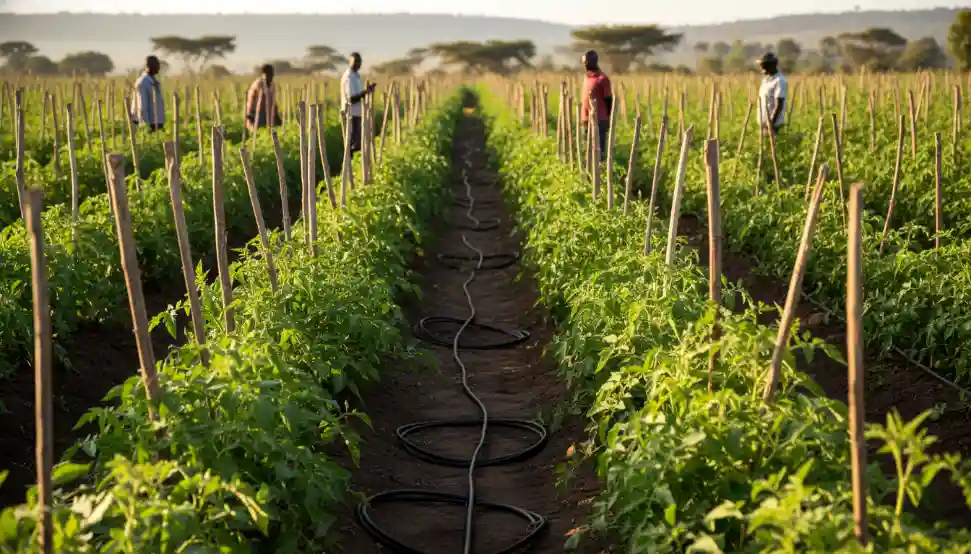
Farmers in these warm zones must focus heavily on regular crop rotation and eliminating common weed hosts like wild nightshade. Overhead irrigation is particularly deadly in Kirinyaga because the warm water splashes spores rapidly across the dense green foliage. Drip irrigation remains the only truly safe watering method in these specific conditions.
Greenhouse Farming in ASALs like Kajiado
While areas like Kajiado are naturally very dry, greenhouse tomato farming introduces its own unique and severe fungal risks. Greenhouses trap rising heat and moisture, creating an artificial highly humid environment that blight absolutely loves. If a farmer fails to roll up the greenhouse sides in the early morning, condensation drips heavily onto the plants.
Read Also: Top 10 Hass Avocado Diseases in Kenya: Causes, Symptoms & Treatment Guide (2026)
The primary control method here is purely mechanical ventilation and incredibly strict indoor humidity management. Because natural rain does not wash off the chemicals inside a greenhouse, farmers can actually rely more on cheaper contact fungicides. However, if late blight actively enters the structure, a strong systemic curative is still immediately required.
Cost Reality and Financial Planning for Fungus Control
Controlling aggressive blight costs between KES 10,000 and KES 15,000 per acre monthly depending strictly on the severity. Systemic fungicides are quite expensive but absolutely prevent total crop failure. Budgeting for these chemicals is essential for maintaining profitable farmgate returns.
Transparency regarding actual production costs is exactly where most agricultural guides fail Kenyan farmers miserably. Blight control is inherently expensive, and you must budget for it precisely to understand your actual final profit margins. If you do not factor chemical costs into your initial business plan, you will run out of money mid season.
The detailed tables below reflect verified agrovet market prices for essential inputs in Kenya as of April 2026. Keep in mind that agrovet retail prices vary slightly depending on your exact proximity to Nairobi or Eldoret. Always calculate your expected return on investment to ensure the heavily infected crop is actually worth saving.
The following table outlines the estimated monthly cost of actively managing a moderate to severe late blight outbreak on a one acre farm.
| Input or Farm Activity | Unit Cost Estimate (KES) | Quantity Needed per Month | Total Monthly Cost (KES) |
|---|---|---|---|
| Systemic Fungicide (e.g., Ridomil Gold 1kg) | 2,850 to 3,200 | 2 kg | 5,700 to 6,400 |
| Contact Fungicide (e.g., Mancozeb 1kg) | 1,000 to 1,200 | 2 kg | 2,000 to 2,400 |
| Sticker or Adjuvant (e.g., Integra 1L) | 1,500 | 1 Litre | 1,500 |
| Farm Labour (Spraying twice a week) | 500 per day | 8 days | 4,000 |
| Total Estimated Cost | Not Applicable | Not Applicable | 13,200 to 14,300 |
Understanding the Return on Investment
Spending up to KES 15,000 a month on chemicals feels very painful, but you must compare it to the total value of your harvest. A well managed acre of hybrid tomatoes can produce yields worth over KES 300,000 at peak farmgate prices. Losing fifty percent of that precious crop to unchecked blight means effectively throwing away KES 150,000.
Investing heavily in high quality fungicides and strict labour management is a vital protective insurance policy for your invested capital. Cutting corners by buying cheap counterfeit chemicals from back alley agrovets basically guarantees a deeply negative return on investment. Commercial farming consistently rewards those who spend money strategically on proven high quality inputs.
Risks and Reality Check for Kenyan Vegetable Farmers
Farming carries immense risks including sudden market gluts, the presence of counterfeit agrochemicals, and volatile climatic shifts. Even with perfect chemical application, extreme prolonged flooding can completely rot your root systems. Financial prudence is required to survive these farming realities.
While controlling blight is entirely possible, it is incredibly important to understand the broader risks associated with commercial farming in Kenya. Selling a fairy tale of guaranteed returns does an immense disservice to hardworking farmers putting their capital on the line. The reality is that farming remains one of the most unpredictable businesses you can enter.
Market gluts are incredibly common during the rainy season because everyone is harvesting their crops at the exact same time. You could successfully save your entire tomato crop from severe blight only to find market prices have completely crashed. Farmers must secure solid market linkages or consider value addition to survive these brutal price drops.
Counterfeit agricultural chemicals remain a massive systemic issue across many rural Kenyan counties today. Unscrupulous dealers frequently repackage cheap chalk dust or diluted chemicals into premium branded containers. If you unknowingly apply fake systemic fungicides during a severe blight outbreak, your entire crop will fail regardless of your excellent timing.
KALRO Updates and the Future of Blight Resistance
KALRO is finalizing the release of the late blight resistant genetically modified 3R Shangi potato in 2026. This massive biotech advancement promises to reduce fungicide application costs significantly, hugely boosting smallholder profitability across Kenya.
While aggressive chemical control is currently your only real defense, the ultimate future of Kenyan farming lies in advanced genetic resistance. For over twenty years, the Kenya Agricultural and Livestock Research Organisation has battled intensely to find a permanent solution to late blight. In 2026, those immense national efforts are finally coming to incredible fruition.
Working alongside the International Potato Centre, KALRO is finalizing regulatory approvals for the genetically modified 3R Shangi potato. The traditional Shangi variety is Kenya’s most popular potato, but it is notoriously susceptible to aggressive late blight. By introducing durable late blight resistance, farmers will see a massive positive shift in their production economics.
Once officially released to the public, this biotech potato is projected to reduce systemic fungicide use by over ten percent. This cost reduction, combined with a thirty four percent estimated yield gain against conventional varieties, will radically transform smallholder profitability. Until then, aggressive chemical management and strict farm hygiene remain your only true safeguards.
Quick Action Checklist to Save Your Kenyan Crops
Identify the disease rapidly, stop overhead watering, and apply a systemic fungicide mixed with a sticker immediately. Remove and bury infected leaves, then shift to a strict three week chemical rotation to completely prevent costly reinfection.
When farm panic sets in, having a clear step by step checklist prevents highly costly operational mistakes from occurring. Use this detailed breakdown to direct your farmworkers during the incredibly critical forty eight hour window. Print this out and stick it securely inside your farm store.
- Identify disease: Check undersides of leaves early for white mould indicating late blight.
- Stop irrigation: Turn off sprinklers instantly, relying only on drip or natural rain.
- Spray systemic and sticker: Deploy Ridomil Gold or Absolute 375 SC mixed with Integra.
- Remove infected leaves: Cut off dead foliage carefully and bury it very deep.
- Rotate fungicides: Switch active ingredients next week to actively stop chemical resistance.
Conclusion on Managing Fungal Outbreaks and Securing Profits
Tomato and potato farming remains highly profitable in Kenya if you master severe disease control completely. Yield losses from aggressive blight wipe out unprepared beginners, but highly disciplined farmers who budget for premium fungicides secure excellent financial returns.
Read Also: Top 7 Best AI Apps for Kenyan Farmers in 2026: Fight Crop Diseases, Cut Costs and Boost Yields
Tomato and potato farming in Kenya is absolutely not for the faint hearted or the casually unprepared. The heavy seasonal rains bring massive market demand, but they also bring absolutely relentless fungal pressure. If you execute the strategies in this guide properly, you can actively prevent massive financial ruin.
The hard truth is that agriculture is a highly technical business, not a casual weekend hobby. If you refuse to scout your fields daily, buy proper chemicals, or aggressively manage your workers, you will fail entirely. However, if you respect the serious science of crop protection, the financial rewards at the Wakulima market remain massive.
👉 If you are serious about avoiding losses this season, get the full Vegetable Commercialization Handbook with spray calendars, cost breakdowns, and supplier contacts.
Farmers Also Ask (FAQ)
How can I tell the difference between early blight and late blight on tomatoes and potatoes?
Early blight forms slow growing brown spots with target like rings on lower leaves. Late blight spreads rapidly forming dark wet patches with white fuzzy mould underneath the infected leaves.
What is the fastest way to stop fungal spread during heavy rains?
Immediately stop all overhead irrigation, quarantine the infected farm zones physically, and apply a strong systemic fungicide mixed with a quality sticker.
Which fungicide works best for late blight in Kenya during April rains?
Top systemic choices include Ridomil Gold MZ 68 WG, Absolute 375 SC, or Trinity Gold 452 WP. They must always be applied with a premium agricultural sticker.
How soon should I spray after noticing yellowing leaves?
You must spray within the first twelve to twenty four hours. Late blight can easily destroy over fifty percent of your entire crop in under three days.
Can rain wash away fungicide, and how do I prevent that?
Yes, heavy rain easily washes off expensive chemicals. You must mix your spray with an agricultural sticker like Integra to bond the fungicide tightly to the leaves.
How often should I repeat fungicide spraying during the rainy season?
Spray every five to seven days during periods of heavy rains. Always rotate different chemical active ingredients weekly to stop the fungus from building genetic resistance.
Should I remove infected leaves or leave them on the plant?
Cut off heavily infected leaves safely. You can actively remove up to thirty percent of the foliage. Bury or burn them far away to destroy all surviving spores.
Can I mix fungicides with foliar fertilizers during treatment?
Do not mix curatives with high nitrogen foliars during an active outbreak. Wait until the outbreak stops, then apply a potassium rich foliar feed to strengthen cell walls.
What are the common mistakes farmers make when controlling blight?
Farmers fail repeatedly by guessing the disease, skipping chemical stickers, spraying during extreme midday heat, and dropping wet infected leaves on farm pathways.
How much does it cost per acre to control fungal diseases in tomatoes and potatoes in Kenya?
Managing severe blight costs between KES 10,000 and KES 15,000 per acre monthly. This estimate thoroughly covers premium systemic fungicides, quality stickers, and manual labor.