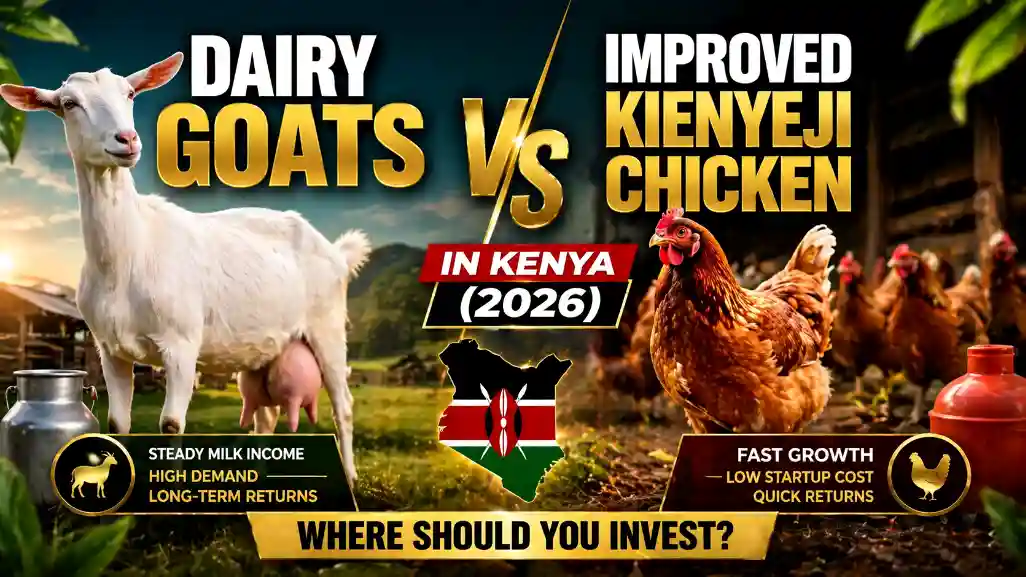

- Improved Kienyeji chickens deliver fast cash flow within four to five months, making them highly ideal for beginners seeking quick financial returns.
- Dairy goats provide stable daily income and long-term wealth, generating an average net profit of KES 60,000 to KES 120,000 per doe annually.
- Starting a 100-bird chicken flock requires roughly KES 85,000, while a basic high-grade dairy goat setup demands over KES 180,000 in capital.
Table of Contents
Choosing between poultry and dairy livestock remains the biggest dilemma facing beginner farmers in Kenya today. The rising costs of commercial feeds have forced agribusiness investors to closely evaluate the real profitability of every single animal on their farm. This guide breaks down the actual 2026 numbers, startup costs, and market realities to help you decide exactly where to put your money.
The agricultural landscape in Kenya has shifted dramatically due to volatile global supply chains. Walk into any agrovet in Nakuru or Kiambu, and the new economic reality hits you immediately. A standard 70-kilogram bag of growers mash now costs roughly KES 4,800, while a 50-kilogram bag of quality layers mash has crossed the KES 3,900 mark.
Many beginners fail because they enter livestock farming based on outdated advice, only to get crushed by high input costs. This comprehensive manual gives you real market numbers, not outdated textbook theories. By the end of this deep dive, you will have a clear, data-backed roadmap to decide whether your capital is best spent on clucking hens or bleating does.
The 2026 Farming Investment Dilemma
Farmers in Kenya face record-high input costs in 2026, making the choice between fast-maturing poultry and high-yield dairy livestock a critical financial decision. Deciding where to invest requires analyzing current feed prices, available capital, and your timeline for expecting returns.
The conversation among Kenyan farmers has shifted from simply deciding what to keep to analyzing what can actually survive current economic realities. Dairy goats and Improved Kienyeji chickens have emerged as top contenders because of their resilience and high-value market outputs. However, both ventures require completely different management styles, land requirements, and financial expectations.
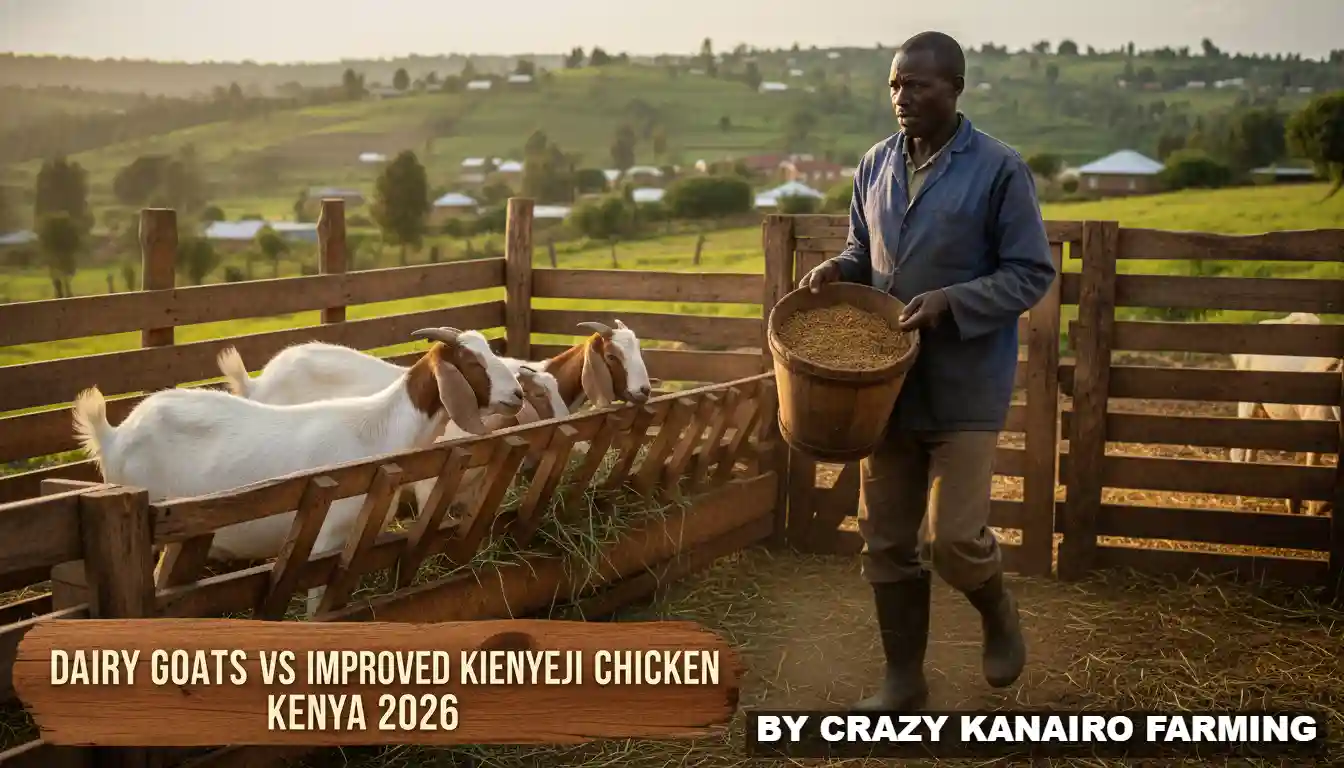
The commercial feed trap occurs when store-bought feed consumes over two-thirds of your operational costs, completely wiping out any potential net profit. Poultry farmers are particularly vulnerable to this trap because chickens rely heavily on formulated grain mashes. Conversely, dairy goats offer an alternative route by primarily relying on roughage and farm-grown fodder.
From what many farmers experience in regions like Murang’a and Machakos, blindly jumping into either venture without a clear business plan leads to immediate losses. We will break down exact feed costs, realistic yields, and hidden risks associated with both ventures. This ensures you step into the market with your eyes wide open and your capital fully protected.
Quick Verdict Summary: Who Should Choose What?
Dairy goats suit patient investors wanting stable daily income and long-term asset growth. Improved Kienyeji chickens are best for beginners with smaller budgets who need fast cash turnovers within five months.
Every successful farming business begins by clearly aligning the project with the farmer’s financial capacity and lifestyle. Dairy goats are the ultimate wealth-building assets for farmers who have land dedicated to growing fodder. They require immense patience, as breeding and milk production take time to scale properly.
On the other hand, Improved Kienyeji chickens act as an agricultural cash machine for those who understand poultry cycles. Varieties developed locally mature quickly and command premium meat prices in almost all local butcheries. They fit perfectly into the strategic plans of an urban or peri-urban farmer who wants to inject capital and see returns in a single season.
If your goal is to build generational farming wealth with lower daily feed inputs, pick dairy goats. If you need to flip your capital quickly to pay immediate bills or school fees, start with a flock of chickens. The smartest investors often combine both, using fast chicken profits to slowly buy high-grade dairy goats.
Top Varieties of Dairy Goats and Kienyeji Chickens
The most profitable dairy goat breeds in Kenya include the Alpine, Toggenburg, and Saanen varieties. For poultry, the KALRO Improved Kienyeji, Kuroiler, and Rainbow Rooster are the undisputed champions for fast growth and high egg yields.
Premium Dairy Goat Breeds in Kenya
Selecting the right goat breed heavily dictates your daily milk yields and overall farm profitability. The German Alpine is incredibly popular in central Kenya because it adapts well to both cold and moderate climates while producing rich milk.
They are excellent foragers and respond beautifully to zero-grazing management systems.
The Toggenburg breed, characterized by its brown coat and white facial stripes, is another massive favorite among serious dairy farmers. Originating from Switzerland, these goats are hardy, disease-resistant, and can easily produce up to three liters of milk daily under premium care. Saanen goats are the heavy producers of the group, yielding the highest milk volumes, but they require strict shade management due to their pale skin.
Superior Kienyeji Chicken Genetics
Gone are the days when farmers relied on slow-growing traditional village chickens that took a whole year to mature. The KALRO Improved Kienyeji chicken has revolutionized the sector by retaining the tough, disease-resistant nature of local birds while growing twice as fast. They produce high-quality, yellow-yolked eggs that are highly coveted in urban supermarkets.
Kuroilers are heavy feeders but reward the farmer with rapid meat accumulation, making them perfect for the December festive season markets. Rainbow Roosters serve as an excellent dual-purpose bird, offering fantastic meat weights alongside a highly respectable egg-laying percentage. Choosing the right genetic line protects your investment and ensures your end product matches local consumer demands.
Where to Buy Dairy Goats and Improved Kienyeji Chicken in Kenya (2026)
Always source breeding stock from registered members of the Dairy Goat Association of Kenya (DGAK) to ensure genetic purity. Buy day-old Improved Kienyeji chicks directly from KALRO (Kenya Agricultural and Livestock Research Organization) research centers or their verified commercial partners.
Dairy Goat Sourcing (DGAK)
Do not buy from open-air markets. Authenticity is non-negotiable. If you purchase a crossbreed disguised as a purebred, you will waste capital and feed on an animal that will never hit production targets.
- Association Contact: Contact the Dairy Goat Association of Kenya (DGAK) directly to find the nearest branch coordinator in your county.
- P.O Box 1218-10100
TEL: 0721398906
Email: [email protected] | [email protected]
Offices at Wambugu Agricultural Training Centre-Nyeri - Verification: Insist on viewing the mother’s milking records and official pedigree certificates held in the Kenya Stud Book.
- Regional Branches: DGAK operates through regional branches (Nyeri, Murang’a, Embu, West Kenya, Kirinyaga, and Nakuru). Reach out to your specific branch to identify reputable breeders.
Improved Kienyeji Poultry Sourcing (KALRO & Certified Hatcheries)
The market is saturated with “fake” KALRO chicks sold by middlemen. These birds carry no health guarantees and often harbor diseases like Marek’s.
Pro Tip: If you are a beginner, consider buying month-old chicks. While the unit cost is higher (KES 280–300), you bypass the most critical and high-mortality brooding phase.
KALRO Naivasha (Dairy & Non-Ruminant Research Institute): Contact the institute directly for information on current chick availability and training schedules.
Official Address: P.O. BOX 25-20117, Naivasha.
Direct Inquiries: +254 708 620095 / +254 708 620097.
Vetted Commercial Hatcheries: If you cannot reach a research center, source only from hatcheries that provide vaccination history for Marek’s and Gumboro diseases. Reputable private suppliers like Ziwani Poultry (Thika) or other certified partners have established supply chains, but always verify their current certification status before transferring funds.
This table outlines the safest and most reliable procurement channels for both livestock categories in Kenya.
| Livestock Type | Best Sourcing Channels | Expected Cost (KES) |
|---|---|---|
| Improved Kienyeji Chicks | KALRO Naivasha, Certified County Hatcheries | 100 to 130 per day-old chick |
| Mature Kienyeji Hens | Verified commercial farmers, Wakulima groups | 800 to 1,200 per mature bird |
| Purebred Dairy Goats (Kids) | DGAK Registered Breeders, Wambugu Farm | 10,000 to 15,000 per weaned kid |
| In-Milk Dairy Does | Private Pedigree Farms, County Agri-shows | 25,000 to 45,000 per mature lactating doe |
Startup Cost Comparison for 2026 Kenya Estimates
Starting a 100-bird Kienyeji flock costs roughly KES 85,000, covering chicks, commercial feeds, and basic deep-litter housing. A starter herd of five high-grade dairy goats demands a much larger investment of KES 184,000 for purebreds, a buck, and a raised unit.
Core Expenses for Poultry Setup
Capital strongly dictates how you enter the agricultural market and what scale you can comfortably manage. For Improved Kienyeji chickens, day-old chicks currently retail at KES 100 to KES 130 each across most hatcheries. Buying an initial flock of 100 chicks immediately costs roughly KES 12,000 inclusive of transport boxes.
Related: Dairy Farming in Kenya: Complete Beginner’s Guide, Costs, Profits and Best Breeds
You must also factor in essential brooding equipment, a series of viral vaccines, and chick mash for the critical first eight weeks. Feeding 100 birds up to point-of-lay or market weight will consume approximately KES 50,000 to KES 60,000 in commercial feeds alone. A simple deep-litter wooden structure will add another KES 15,000 to your overall budget.
Capital Allocation for Dairy Goats
Dairy goats require a substantially heavier initial cash injection from the farmer. A quality Toggenburg or Alpine doe that is already in-milk costs between KES 25,000 and KES 35,000 depending on the breeder. A professional starter flock of five purebred does and one unrelated breeding buck will cost roughly KES 120,000.
Housing is a major expense because dairy goats absolutely cannot sleep on damp dirt floors. Adding a raised, slatted timber house specifically designed to prevent foot rot requires about KES 40,000 in materials and carpentry labor. Establishing Napier grass or Boma Rhodes fodder on your land pushes the total startup budget near KES 184,000.
The table below provides a realistic breakdown of initial setup expenses for both farming options based on current market rates.
| Expense Category | 100 Kienyeji Chickens (KES) | 5 Dairy Goats + 1 Buck (KES) |
|---|---|---|
| Livestock Purchase | 12,000 (Day-old chicks) | 120,000 (Mature high-grade stock) |
| Housing Structure | 15,000 (Deep litter coop) | 40,000 (Raised slatted timber unit) |
| Feeds and Fodder (First 4 Months) | 55,000 (Commercial mash) | 15,000 (Fodder establishment) |
| Veterinary and Vaccines | 2,500 (Core poultry vaccines) | 4,000 (Deworming and supplements) |
| Equipment (Drinkers, Troughs) | 4,000 | 5,000 |
| Total Estimated Startup | 88,500 | 184,000 |
Time to First Income and Cash Flow
Improved Kienyeji chickens generate income rapidly in four to five months when sold for meat, or when they start laying eggs. Dairy goats take 12 to 18 months to yield milk if you buy young kids, but provide immediate liquidity if you purchase mature, in-milk does.
Cash flow speed is a literal matter of survival for beginner farmers operating on tight budgets. Poultry farming offers incredibly rapid financial cycles that keep money moving through your bank account. If you buy KALRO Improved Kienyeji chicks in early January, you can comfortably sell mature roosters for meat by late May.
This fast turnover allows you to reinvest your capital up to three times a year, compounding your initial investment rapidly. Dairy goats, however, operate on a much slower, more agonizing timeline unless you have high starting capital. If you buy weaned four-month-old kids to save money, you must feed and house them for nearly a year before they can safely be served by a buck.
After a five-month gestation period, you finally get milk and a new kid to potentially sell. However, buying an already lactating doe entirely bypasses this frustrating waiting period. While an in-milk Alpine costs more upfront, she will give you two to three liters of milk the very next morning, creating instant daily liquidity.
Income Potential Comparison and Monthly Earnings
A well-managed dairy goat generates KES 6,000 to KES 9,000 monthly from consistent milk sales alone. A flock of 100 Improved Kienyeji hens laying at 70 percent capacity generates roughly KES 35,000 to KES 42,000 monthly in gross egg revenue.
Maximizing Goat Milk Revenue
Understanding revenue potential requires looking closely at daily production outputs and local market pricing. A purebred dairy goat, fed properly with quality roughage and high-yield dairy meal supplements, produces about 2.5 liters of milk per day. Goat milk is a premium, highly sought-after product in Kenya, often retailing between KES 80 and KES 120 per liter.
At a conservative average of KES 100 per liter, one strong doe brings in KES 250 daily, translating to KES 7,500 per month. If you maintain a small herd of five lactating does, your monthly gross revenue easily hits KES 37,500. Additionally, you earn substantial lump-sum income by selling twin kids every year, which can fetch KES 10,000 to KES 15,000 each.
Calculating Poultry Cash Returns
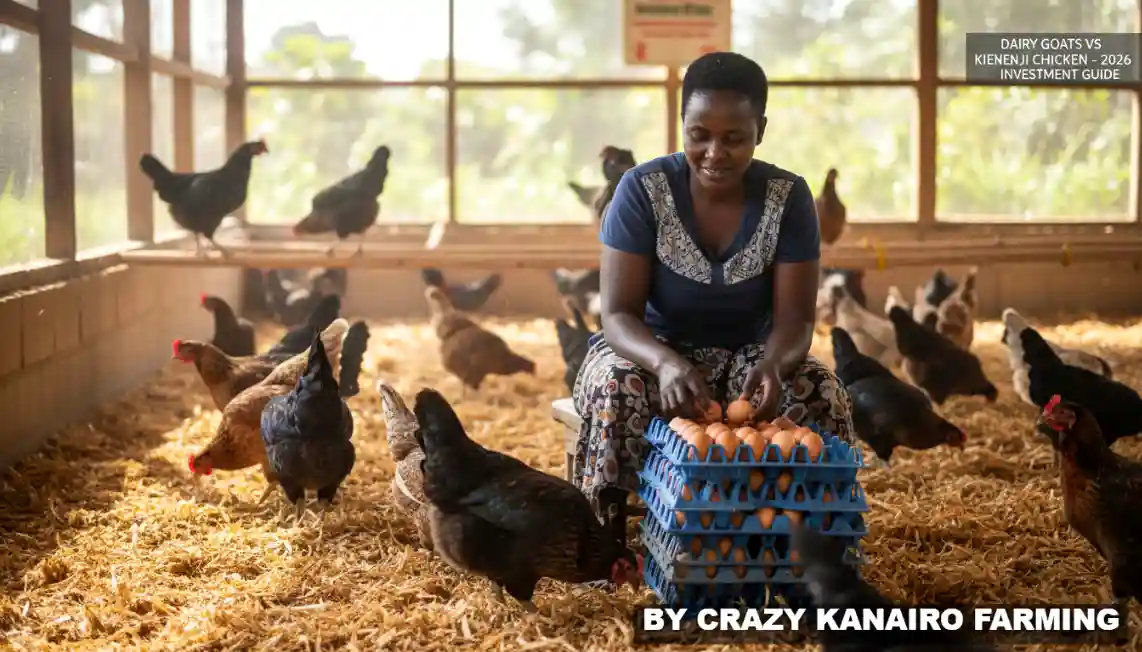
For chickens, massive revenue depends entirely on whether your strategic focus is on meat sales or egg production. Selling 100 mature Kienyeji roosters at KES 800 each yields an instant lump sum of KES 80,000 at the end of a cycle. If you decide to keep layers, 100 hens producing 70 eggs daily will give you 2,100 eggs a month.
Related: Improved Kienyeji Chicken Farming in Kenya 2026: Complete Guide to Breeds, Housing, Feeding and Profits
Selling these organic, yellow-yolked eggs at KES 20 each results in KES 42,000 in monthly gross revenue. However, consistent egg production requires strict lighting management and ensuring the birds never run out of clean drinking water. Any disruption in their routine causes an immediate, sharp drop in daily egg collection.
Profitability Breakdown and Net Monthly Reality
Net profit is heavily dictated by your monthly feed costs. Goats offer higher profit margins because they rely mostly on cheap farm-grown fodder, leaving up to 70 percent of revenue as profit. Chicken margins are much tighter, usually hovering around 20 to 30 percent.
The High Cost of Poultry Feeding
Gross revenue looks exciting on paper, but net profit is what actually feeds your family and expands the farm. The profitability of commercial chickens has taken a massive hit in 2026 due to skyrocketing grain prices. If 100 laying hens generate KES 42,000 monthly, they will aggressively consume roughly KES 25,000 worth of layers mash in that same period.
After deducting essential multivitamins, fresh sawdust, and minor labor costs, your true net profit might only be KES 12,000 to KES 15,000. The secret to maximizing poultry profits today lies entirely in clever alternative feed formulation. Farmers making their own feeds using Azolla, Black Soldier Fly larvae, and locally milled grains are the only ones securing high margins.
The Low-Cost Goat Advantage
Goat farming beautifully flips this frustrating expense ratio in favor of the farmer. Because goats are natural ruminants, their primary diet consists of roughage like Napier grass, desmodium, and dry hay. You can easily grow all these fodder crops on your own half-acre piece of land.
You only need to buy a small amount of commercial dairy meal and mineral licks, costing perhaps KES 2,000 per goat monthly. This means from a goat’s KES 7,500 monthly revenue, you keep over KES 5,000 as pure net profit. This low-input, high-output model makes dairy goats incredibly resilient against national economic inflation.
The comparative table below highlights the realistic monthly profit ranges per unit based on current Kenyan market conditions.
| Financial Metric | 100 Improved Kienyeji Hens (Layers) | 5 Lactating Dairy Goats |
|---|---|---|
| Monthly Gross Revenue | KES 35,000 to KES 42,000 | KES 35,000 to KES 45,000 |
| Monthly Feed & Vet Costs | KES 25,000 to KES 30,000 | KES 8,000 to KES 12,000 |
| Estimated Net Profit | KES 10,000 to KES 12,000 | KES 27,000 to KES 33,000 |
Fertilizer Guide for High-Yield Goat Fodder
Successfully feeding dairy goats requires maximizing your farm’s fodder yield through proper soil fertilization. Using a strategic mix of well-composted manure, basal DAP during planting, and CAN for top dressing guarantees rapid Napier grass regeneration.
Basal Application for Fodder Establishment
You cannot achieve high milk yields from your dairy goats if your planted fodder is weak, yellow, and nutritionally deficient. Before planting your Boma Rhodes or Napier grass canes, the soil must be heavily conditioned with organic matter. Experienced dairy farmers highly recommend incorporating at least two tons of well-composted animal manure per quarter-acre.
During the actual planting phase, using a basal fertilizer like Diammonium Phosphate (DAP) is incredibly crucial. DAP encourages explosive root development, ensuring the young grass establishes a deep root system to survive upcoming dry seasons. Apply roughly one teaspoon of DAP per planting hole, mixing it thoroughly with the soil to avoid burning the fresh cuttings.
Top Dressing Techniques for Rapid Growth
Once your fodder crops are established and actively growing, they demand high amounts of nitrogen to produce lush, leafy green material. Calcium Ammonium Nitrate (CAN) is the preferred top-dressing fertilizer for Kenyan fodder crops because it does not acidify the soil over time. You should top-dress your Napier grass immediately after every harvest cycle right before the rains begin.
Alternatively, liquid foliar fertilizers can be sprayed directly onto the grass leaves during the growing season for an extra nutritional boost. Proper fertilization ensures you harvest heavy, nutrient-dense grass every eight weeks, drastically cutting down your need to buy commercial dairy meal.
The table below summarizes the best fertilizer practices for establishing a high-yield dairy goat fodder field.
| Fertilizer Type | Application Stage | Primary Benefit for Fodder |
|---|---|---|
| Composted Manure | Land preparation (one month before planting) | Improves soil structure and moisture retention. |
| DAP (Diammonium Phosphate) | During planting in the holes | Promotes aggressive, deep root system development. |
| CAN (Calcium Ammonium Nitrate) | Top dressing after every grass harvest | Forces rapid, lush leafy green growth for high yields. |
Risks and Reality Check in 2026
Chicken farming faces incredibly high risks from Newcastle disease, feed price volatility, and power outages affecting young chicks. Dairy goats are highly susceptible to dampness, fatal pneumonia, and severe internal parasite infestations if not dewormed regularly.
Navigating Poultry Disease Outbreaks
Every agribusiness guide highlights the money, but very few discuss the heartbreaking disasters that can strike at any moment. The biggest risk in poultry farming today remains aggressive viral outbreaks like Newcastle and Gumboro diseases. If you miss your strict vaccination schedule by even a few days, an entire flock can be wiped out in a weekend.
Additionally, logistics and infrastructure present massive hurdles for beginner poultry farmers. Unpredictable power outages by KPLC are notorious for ruining delicate brooding operations, freezing day-old chicks to death overnight. You must have a reliable backup solar heating system or a traditional, well-ventilated charcoal jiko ready at all times.
Managing Goat Health Threats
Dairy goats have their own fragile realities that demand strict, uncompromising management. They are incredibly sensitive to dampness, making a raised, slatted floor absolutely mandatory to prevent foot rot and fatal pneumonia. Goats also suffer terribly from Contagious Caprine Pleuropneumonia (CCPP), a deadly respiratory disease that spreads quickly through an unventilated herd.
Furthermore, internal parasites like stomach worms multiply rapidly in zero-grazing units if hygiene is ignored. Farmers must stick to a rigorous quarterly deworming schedule to keep their animals healthy and producing milk. Finding a quality, unrelated purebred buck for serving your does also remains a massive logistical challenge in rural areas.
Dealing with Market and Crop Failures
Beyond animal diseases, both ventures face external environmental and market-driven threats. For goat farmers, a prolonged drought means your farm-grown fodder stops regenerating, forcing you to buy expensive dry hay. For poultry farmers, national maize shortages occasionally drive commercial feed prices up by twenty percent without any prior warning.
Space and Management Requirements
Dairy goats strictly require a zero-grazing unit and at least half an acre of planted fodder for a small productive herd. Improved Kienyeji chickens thrive beautifully in small backyard spaces, needing only a well-ventilated deep litter coop.
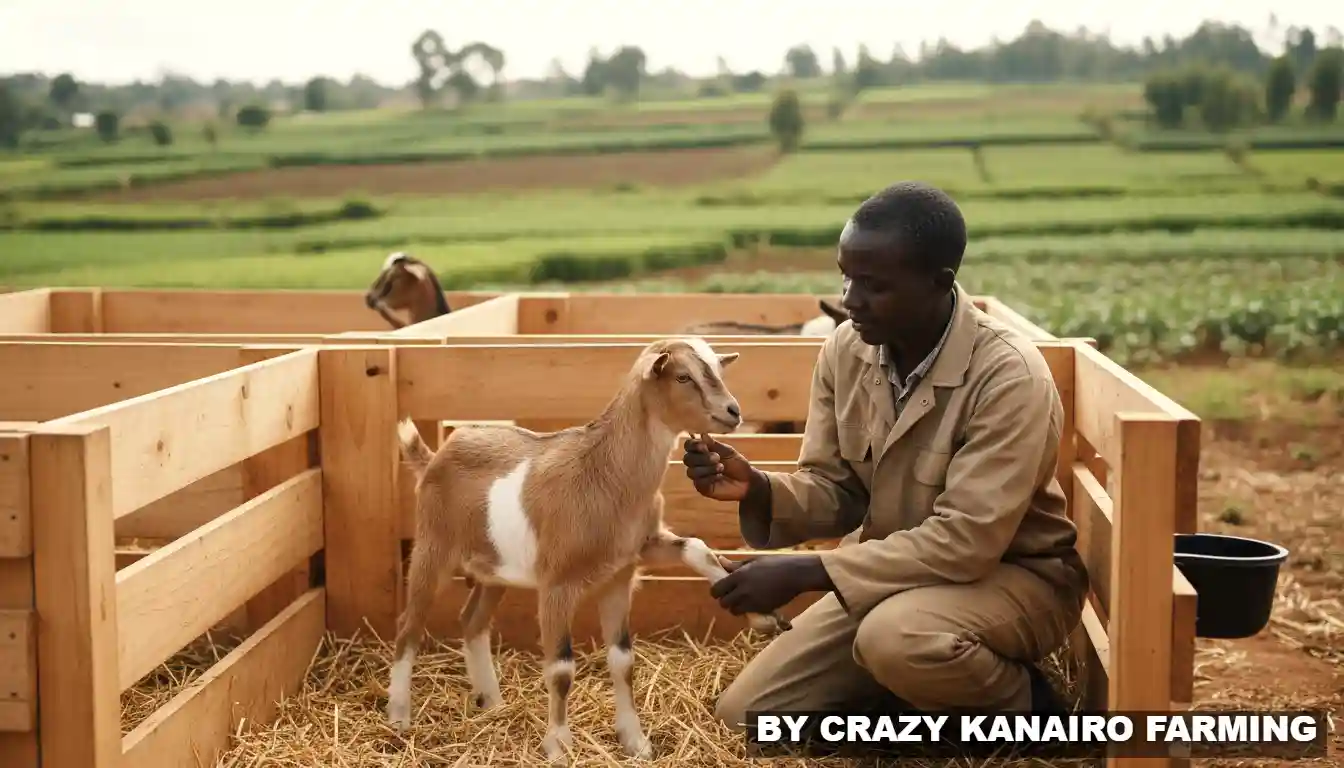
Designing a Zero-Grazing Goat Unit
Land availability strictly dictates which livestock venture you can safely and profitably pursue in Kenya. Dairy goats are absolutely not suitable for crowded, concrete urban environments. Even under zero-grazing, where the goats stay permanently inside a raised timber pen, you must have accessible land to grow their food.
A minimum of half an acre of Napier grass or Boma Rhodes is required to sustain five goats year-round without buying external hay. Goat management is also highly labor-intensive when it comes to daily feed preparation. You must cut, wilt, and finely chop the fodder daily before feeding it to the animals to prevent wastage.
Setting Up a Deep Litter Poultry Coop
Chickens, on the other hand, are the undisputed kings of urban and peri-urban backyard farming. A profitable flock of 100 birds can live completely comfortably in a small 15 by 15-foot wooden structure in a suburban setting. The deep litter system, which uses a thick layer of dry wood shavings, absorbs moisture and keeps the coop odorless.
Related: 15 Most Profitable Agribusiness Ideas in Kenya to Start in 2026
Management is incredibly straightforward as long as strict biosecurity protocols, like footbaths at the door, are maintained. Providing clean water, topping up the hanging feeders, and changing wet sawdust can easily be managed by a part-time farm worker. This makes poultry the superior choice for professionals balancing a day job with farming.
Market Demand in Kenya for 2026
Goat milk experiences high unmet demand in urban households willing to pay premium prices for its health benefits. Improved Kienyeji chicken meat and eggs dominate local restaurants as consumers aggressively prefer their organic, rich taste over soft commercial broilers.
The Lucrative Goat Milk Niche
Goat milk occupies a specialized, highly lucrative niche in the Kenyan agricultural market. It is highly sought after for its proven medicinal properties, often recommended by doctors for infants, the elderly, and patients with compromised immunity. Because very few commercial farmers produce it at scale, you can easily monopolize your local neighborhood market.
Customers are more than willing to pay KES 100 to KES 150 per liter for fresh, hygienic goat milk. Furthermore, male goat kids are heavily demanded for meat, especially during the December holidays and cultural ceremonies. Securing a steady goat milk market simply requires creating a small WhatsApp group for your local estate or partnering with nearby clinics.
The Mainstream Kienyeji Demand
The Kenyan middle class has become incredibly health-conscious and discerning about their food choices in 2026. There is a massive, permanent shift away from soft, fast-grown broiler meat toward the leaner, heavily textured meat of Kienyeji chickens. Hotels, local eateries, and high-end restaurants actively source authentic Kienyeji birds to satisfy this growing customer preference.
During festive seasons, the retail price of a mature Kienyeji rooster easily shoots up to KES 1,200. Authentic Kienyeji eggs, known for their deep yellow yolks and firm whites, retail at KES 20 to KES 25 each. Finding a ready market for these products is rarely a problem if you utilize social media and maintain consistent production.

Scaling Potential: Which Grows Faster?
Improved Kienyeji chickens offer rapid and explosive scaling, allowing ambitious farmers to increase flock sizes by hundreds every few months. Dairy goats scale incredibly slowly due to a five-month gestation period, strongly limiting rapid herd expansion.
The Rapid Expansion of Poultry
Scaling an agribusiness simply means multiplying your units of production to increase your overall profit margins. Chickens scale with aggressive, almost frightening speed if managed correctly. Once you master the delicate art of brooding 100 chicks successfully, you can easily purchase 500 chicks the very next month.
With the right housing structures and steady capital flow, a poultry farm can explode from a tiny backyard hobby to a massive commercial enterprise in a single year. You are only limited by your ability to secure reliable markets and purchase commercial feeds in bulk. This rapid scaling is why poultry creates so many millionaire farmers in Kenya.
The Slow Accumulation of Dairy Goats
Dairy goats demand extreme patience and a long-term strategic mindset from the farmer. A healthy doe will typically give birth to twins only once a year under normal management. If you start with a small foundation herd of five does, you might only add ten kids to your herd after twelve long months.
Furthermore, half of those newborn kids will likely be males, which are eventually sold for meat rather than kept for milking. To scale a goat farm quickly, you must have deep pockets to continuously buy expensive, mature does from other breeders. Most successful goat farmers rely on slow, organic growth over five to ten years to build their genetic empire.
Which Livestock Venture Should You Choose?
Choose Kienyeji chickens if you are a beginner with limited capital, small space, and need fast cash turnovers. Choose dairy goats if you own agricultural land, can easily grow your own fodder, and want steady, high-margin daily income.
For the Beginner and Low Capital Farmer
The final decision ultimately boils down to your specific farmer profile, budget, and risk tolerance. If you are an absolute beginner with less than KES 100,000 and live on a small quarter-acre plot, poultry is your only realistic option. It allows you to learn the harsh ropes of animal husbandry while actually turning a profit in a few short months.
You can start small, make a few affordable mistakes, and quickly recover your capital by selling the mature birds. Poultry teaches you strict record-keeping, biosecurity, and local marketing without requiring you to buy extra land. It is the perfect training ground for anyone entering the demanding world of Kenyan agribusiness.
For the Investor with Land
If you are a retiring civil servant, or a dedicated investor who owns rural land in favorable areas like Nyeri or Embu, dairy goats are far superior. You can easily dedicate an acre to planting high-protein Boma Rhodes grass and desmodium. This massive resource practically eliminates your daily commercial feed costs, giving you an unbeatable financial advantage.
Goats will heavily reward this low-cost, self-sustaining setup with high-margin milk day after day. The daily labor is manageable, the long-term asset value of the herd constantly appreciates, and the market demand for milk remains perpetually stable. It is a peaceful, highly profitable venture for those who are not desperate for immediate overnight cash.
Final Verdict: Where to Invest in 2026
The most profitable strategy in 2026 is to start with Improved Kienyeji chickens for rapid capital generation, then systematically use those profits to build a high-grade dairy goat herd for generational wealth.
For sheer business survival in an increasingly tough Kenyan economy, short-term cash flow is absolute king. Improved Kienyeji chickens confidently win the battle for quick returns and capital multiplication. They act as the perfect entry point into agribusiness, allowing you to turn small amounts of money into substantial lump sums within a highly predictable five-month window.
However, dairy goats are the undisputed heavyweight champions of sustainable, low-risk profitability. Because they effectively bypass the dangerous commercial feed trap by eating farm-grown grass, their net profit margins are completely unbeatable. Once a pedigree goat farm is properly established and producing, it becomes an unstoppable engine of rural wealth.
The smartest and most resilient farmers do not simply choose just one venture. They strategically use the aggressive, fast-paced cash cycles of poultry to fund the expensive infrastructure and purchasing costs of pedigree dairy goats. This brilliant hybrid approach guarantees you have money in your pocket today while quietly building immensely valuable assets for tomorrow.
Common Mistakes Beginners Make in Kenya
Beginners frequently fail by buying fake breeding stock, ignoring strict biosecurity protocols, and falling into the “Mama Mboga trap” of relying entirely on cheap vegetable waste to feed commercial livestock.
Buying Poor Genetics
The agricultural graveyard in Kenya is filled to the brim with farmers who tried to cut critical corners. The most devastating mistake is buying poor genetics to save a few thousand shillings. Many beginners buy cheap crossbreeds from open livestock markets, only to realize later they bought low-yielding animals that produce half a liter of milk a day.
The Mama Mboga Trap
Another massive error that ruins beginners is the infamous “Mama Mboga Trap.” Many farmers falsely believe they can raise 200 chickens or feed five lactating goats entirely on leftover cabbage leaves sourced from the local market. While fresh vegetable scraps are decent minor supplements, commercial livestock strictly require high-protein, perfectly balanced diets to produce eggs or milk profitably.
Scaling Without a Market
Finally, scaling too fast destroys farm cash flow completely. A farmer successfully raises 50 chickens and immediately takes an expensive bank loan to buy 1,000 birds without securing a bulk buyer first. When the massive flock reaches maturity, the desperate farmer is forced to sell at a crushing loss just to stop buying expensive daily feed.
Break-Even Timeline Comparison
Improved Kienyeji chickens typically hit their break-even point within six to eight months after selling the first major batch of meat birds. Dairy goats take roughly 18 to 24 months to break even, factoring in expensive infrastructure costs and the initial slow breeding cycle.
Understanding exactly when your farm actually pays for itself is incredibly crucial for maintaining your mental sanity and financial planning. With Kienyeji chickens, your expected break-even point is incredibly sharp and fast. If you invest KES 85,000 in a meat flock, selling them at five months for KES 100,000 means you have successfully recovered your capital immediately.
Dairy goats absolutely require a much longer, more patient financial runway from the investor. The heavy upfront cost of KES 184,000 for quality breeding stock and timber housing cannot possibly be recovered in a single month of milking. It takes roughly two solid years of consistent milk sales and selling the first generation of weaned kids to fully recoup your initial capital.
However, the magic happens right after that 24-month mark is crossed. The goat farm begins operating almost entirely on pure profit because the infrastructure is fully paid for, and the fodder regenerates naturally. The chickens, conversely, will always require you to buy expensive new chicks and fresh commercial feeds for every single production cycle.
Best Choice Based on Budget
Budgets strictly under KES 50,000 are only suited for small-scale Kienyeji poultry projects. Budgets between KES 50,000 and KES 150,000 allow for decent commercial chicken farming, while capital above KES 150,000 safely unlocks full commercial dairy goat potential.
If you have less than KES 50,000 in your bank account, do not even attempt to buy dairy goats. You will inevitably end up with poor-quality local animals, substandard housing, and zero money left over for emergency veterinary care. Instead, build a highly simple structure and safely raise 50 Improved Kienyeji birds to grow your capital slowly.
With a medium budget ranging from KES 50,000 to KES 150,000, you have exciting strategic options. You can comfortably set up a highly profitable 150-bird poultry operation with proper biosecurity and guaranteed feed supply. Alternatively, you can build a small goat pen and purchase two high-quality, in-milk does to begin testing the local dairy market.
If your available budget comfortably exceeds KES 150,000, you are solidly in the serious investor category. You can easily afford a high-grade dairy goat herd of five purebred does and one pedigree buck. You can invest in professional zero-grazing structures, plant quality fodder, and still retain a healthy cash reserve for vital feed supplements.
Take the Next Step: Start Your Agribusiness Journey
Success in Kenyan agriculture requires continuous, aggressive learning and professional networking with other serious investors. Do not rely on dangerous guesswork; secure proven operational blueprints and connect with experienced local farmers before investing a single shilling of your capital.
Reading extensively about farming is an excellent first step, but executing it correctly on the ground requires practical, hands-on support. If you have decided that fast cash flow is your main priority, you need to master feed formulation and biosecurity immediately. Download a localized Kienyeji Chicken Profit Plan today to completely avoid the expensive, heartbreaking mistakes most beginners make.
If building long-term wealth through high-yielding dairy goats is your ultimate goal, securing authentic genetics is your primary mission. Seek out a comprehensive Dairy Goat Startup Blueprint that lists verified, DGAK-approved breeders currently operating in your specific county. Never buy expensive animals blindly from open markets without a trusted veterinary expert present to verify their health.
Profitable farming is incredibly difficult to achieve in isolation. Join a dedicated WhatsApp Farmers Market Group in your region today to build your network. Connecting with bulk buyers, sharing real-time market feed prices, and learning from the daily operational challenges of other Kenyan farmers will guarantee your success in 2026.
Farmers Also Ask (FAQ)
Which is more profitable in Kenya in 2026: dairy goats or Improved Kienyeji chicken?
Dairy goats offer higher long-term profit margins due to cheap farm-grown fodder. Chickens provide faster cash flow but have tighter margins caused by expensive commercial feeds.
What is the minimum capital required to start dairy goat farming versus kienyeji chicken farming?
A 100-bird chicken flock requires about KES 85,000 to cover chicks, feeds, and basic housing. A starter herd of high-grade dairy goats demands roughly KES 180,000 for full setup.
Which venture gives faster returns for a beginner: dairy goats or kienyeji chickens?
Kienyeji chickens generate faster returns, with meat birds ready for market in just five months. Dairy goats take over a year unless you purchase expensive mature lactating does.
How much profit can I realistically make from 100 Improved Kienyeji chickens in Kenya?
After deducting high commercial feed expenses, a well-managed flock of 100 laying hens realistically generates a net monthly profit of KES 10,000 to KES 15,000 in Kenya today.
What is the average monthly income from dairy goats in Kenya?
One lactating dairy goat producing two liters of milk daily can generate KES 6,000 per month. Net profit averages KES 4,000 per doe after deducting minor supplement costs.
How long does it take for dairy goats to start producing milk?
Purchasing young weaned kids means waiting 12 to 18 months for them to mature and kid. Buying an already pregnant or lactating doe provides immediate milk production.
How much land is required for dairy goats compared to kienyeji chickens?
Chickens thrive in tiny backyard spaces measuring just 15 by 15 feet. Dairy goats need at least half an acre of dedicated land to grow sufficient Napier grass and fodder.
Which livestock venture is more risky in terms of disease outbreaks in Kenya?
Poultry carries higher disease risk because viral outbreaks like Newcastle can kill an entire flock overnight. Goats are hardier but still susceptible to fatal pneumonia.
How does market demand compare between goat milk and kienyeji eggs and meat in Kenya?
Kienyeji meat and eggs have massive, mainstream demand in local eateries. Goat milk enjoys a lucrative, specialized niche market driven by health-conscious urban consumers.
Can I successfully integrate dairy goats and kienyeji chickens on the same small farm?
Yes, integrating both maximizes resources. Chicken manure acts as excellent fertilizer for goat fodder fields, while poultry profits help cover long-term goat farm expenses.