🛒 Order with confidence! We’re trusted by thousands of farmers across Kenya. If anything goes wrong on our side, you’re protected by our 100% refund guarantee. ✅🇰🇪
A complete 2026 guide to Black Soldier Fly farming in Kenya. Discover setup costs, profitability (KES), best varieties, and where to buy certified BSF eggs in Nairobi and Kiambu.
This comprehensive guide acts as the definitive 2026 source of truth for Kenyan farmers entering the lucrative pig industry. We analyze high-yielding breeds like the Camborough, dissect precision feeding rations to minimize costs, and provide a transparent KES financial breakdown for a profitable shamba. By mastering housing biosecurity and supply chain value addition, beginners can transform a backyard piggery into a commercial agribusiness.
Table of Contents
Success in pig farming relies heavily on reducing overheads while maximizing weight gain efficiency. Farmers in counties like Kiambu and Uasin Gishu are shifting from traditional methods to data-driven farming. This article covers every aspect required to launch and sustain a profitable venture.
What are the best designs for pig housing in Kenya to maximize growth and hygiene?
Standard pig sties in Kenya must be oriented East-West to avoid direct sunlight, measuring at least 3 meters by 3 meters per pen for 10 weaners. Floors should be rough concrete to prevent slipping but sloped for drainage into a soak pit. Good ventilation is critical to prevent respiratory diseases, utilizing a half-wall design with wire mesh.
Constructing a proper pig sty is the foundation of disease control and rapid weight gain. In 2026, the most efficient design for small-scale farmers is the “Kuria Model” or the Deep Litter System (IMO) depending on your capital. Poor housing leads to pneumonia and stunted growth.
The Deep Litter System is gaining popularity in areas like Murang’a because it reduces smell and labor. This method uses wood shavings, rice husks, or sawdust treated with indigenous microorganisms (IMO) to break down waste instantly. It keeps the pigs warm during the cold July season and reduces the need for daily washing of the shamba.
For the traditional concrete model, the floor must slope towards a drainage channel that leads to a biogas digester or soak pit. Ensure the roofing is high enough (at least 3 meters) to allow air circulation, as pigs are highly susceptible to heat stress. Separate the feeding area from the dunging area to maintain high hygiene standards.
Critical Housing Dimensions and Materials
Each pig requires specific floor space to grow without stress. For a sow with piglets, a farrowing pen must be 8ft by 8ft to accommodate a creep area. Fattening pigs (growers) require about 10-12 square feet per pig to prevent overcrowding and tail biting.
Walls should be constructed using durable stone or brick, plastered smoothly to prevent ticks and lice from hiding in cracks. Partitions between pens should be solid up to 3 feet to prevent draft and fighting between neighboring pigs. Above the solid wall, use heavy-gauge chain link or weld mesh to facilitate airflow.
The roof should extend at least 2 feet beyond the walls to prevent rain from splashing inside. Use Iron Sheets (Mabati) painted white on top to reflect heat or traditional thatch if fire safety is managed. In hot regions like Kisumu, install sprinklers or a misting system to cool the roof during midday.
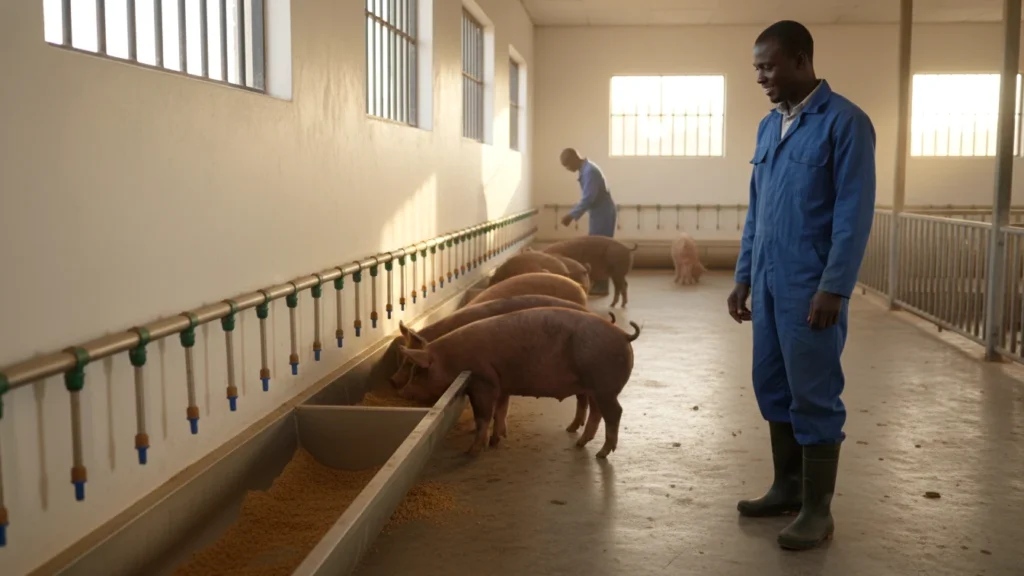
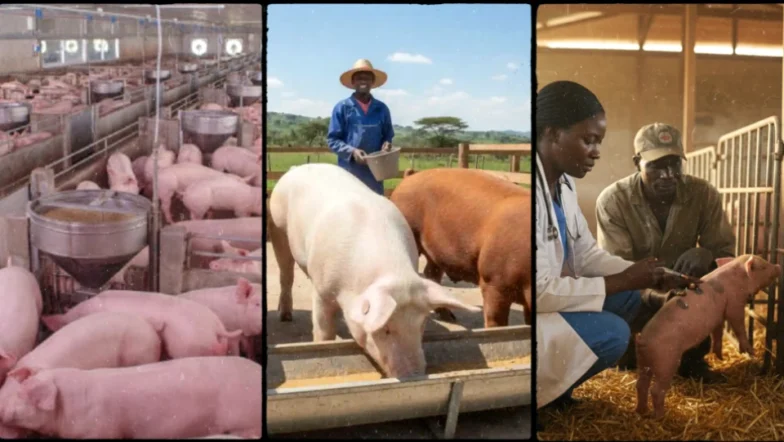
A modern pig sty interior in Kiambu
Which pig breeds yield the highest profits for Kenyan farmers in 2026?
The most profitable breeds for 2026 are the Camborough (for disease resistance and prolificacy), Large White (for rapid growth rates), and Landrace (for excellent mothering ability). A three-way cross utilizing a Duroc terminal sire on F1 Large White/Landrace gilts produces the highest quality meat for the Kenyan market.
Choosing the right genetics determines 60% of your farm’s success. In Kenya, “indigenous” or local pigs take too long to mature and have poor feed conversion ratios. You must invest in exotic commercial breeds or high-quality F1 crosses to see a return on investment.
1. Large White: This is the industry standard for commercial farming in Kenya. They are solid white, have erect ears, and are known for their massive frame and fast growth. A well-fed Large White can hit 90kg market weight in under 6 months, though they are sensitive to sunburn.
2. Landrace: Easily identified by their large, drooping ears. They are prized as the “grandmothers” of the pig world because they produce large litters (12+ piglets) and have excellent milk production. They are longer in body than the Large White, producing good bacon.
3. Camborough (PIC): This synthetic breed is becoming the gold standard for Kenyan farmers. They are hardy, consume less feed for the same weight gain (high feed conversion efficiency), and are resistant to common environmental stressors. While the initial stock from suppliers like Farmer’s Choice is expensive, the long-term savings on feed are substantial.
4. Duroc: This is a reddish-brown pig used primarily as a “terminal sire.” You do not breed Duroc females for litters; instead, you mate a Duroc male with a Large White/Landrace female. The resulting piglets grow incredibly fast and have high intramuscular fat, which butchers prefer for premium pork cuts.
5. Hampshire: Recognizable by the white belt across the shoulders on a black body. They are heavily muscled and lean, making them excellent for meat production. They are less common in Kenya than the Large White but are excellent for crossbreeding programs.
Where to Buy pig housing, feeding rations, breeds, pig disease control, cost and profit breakdown. in Kenya
Procuring quality inputs is where many beginners fail, falling victim to roadside brokers selling stunted “runt” piglets. In 2026, rely on established institutions and verified digital platforms. Sourcing from unverified neighbors often leads to inbreeding depression and poor disease resistance.
Government & Research Sources: Your first stop for breeding stock should be the Agricultural Development Corporation (ADC) or KALRO (Kenya Agricultural and Livestock Research Organization) centers, specifically in Lanet or Naivasha. They provide F1 gilts and boars with traceable lineage. Booking is often required months in advance due to high demand.
Commercial & Digital Sources: For feeds and equipment, Safaricom Digifarm and iProcure connect farmers directly to manufacturers, cutting out the middlemen who hike prices. For piglets, Farmer’s Choice runs an extension program selling high-quality genetics to contracted farmers. Platforms like Mkulima Young are useful, but you must physically inspect the parent stock before paying via M-Pesa.
Buyer’s Caution Checklist: Always demand a vaccination history, specifically for Erysipelas and Parvovirus. Check for physical defects like hernias or inverted nipples on gilts. If buying feeds, ensure the bags have a valid KEPHIS or KEBS standardization mark to avoid aflatoxin-contaminated maize.
How should you formulate pig feeding rations for maximum weight gain?
Pigs require specific protein levels at different stages: Creep Feed (22% CP), Weaner (18-20% CP), Grower (16% CP), and Finisher (14% CP). A cost-effective home mix often involves maize germ, pollard, soya cake, and a specialized macro-premix. Water must be available 24/7 via nipple drinkers to maximize intake.
Feed accounts for up to 75% of production costs in pig farming. To remain profitable in 2026, you cannot rely solely on expensive commercial bags from major millers. You must learn to mix rations or supplement wisely using locally available raw materials.
The Life-Cycle Feeding Strategy
Piglets need high protein to build muscle and frame. Start with “Creep Pellets” from day 10 to weaning (day 28-35). From weaning to 2 months, use a Weaner meal rich in energy and protein to prevent “weaning shock.”
As the pig grows older (Grower/Finisher stage), you reduce the protein slightly and increase the energy (carbohydrates) to fatten them up for the market. Growers (2-4 months) need roughly 1kg-1.5kg of feed per day. Finishers (4-7 months) will consume 2kg-3kg daily depending on the energy density of the feed.
Home Mixing Ratios and Ingredients
Many farmers in Uasin Gishu cut costs by mixing their own feeds. A basic 100kg Grower ration might look like this: 50kg Maize/Broken Maize, 25kg Pollard/Wheat Bran, 15kg Soya Cake or Fishmeal (Omena), and 10kg Pig Mix (Lime, Salt, Premix). Ensure your Omena is dry and free from sand to prevent digestive blockages.
Hydroponic Fodder & Silage: To supplement expensive grains, 2026 farmers are using hydroponic barley and sweet potato vine silage. These provide essential vitamins and fiber, improving gut health. However, these are supplements and should not exceed 30% of the total daily diet.
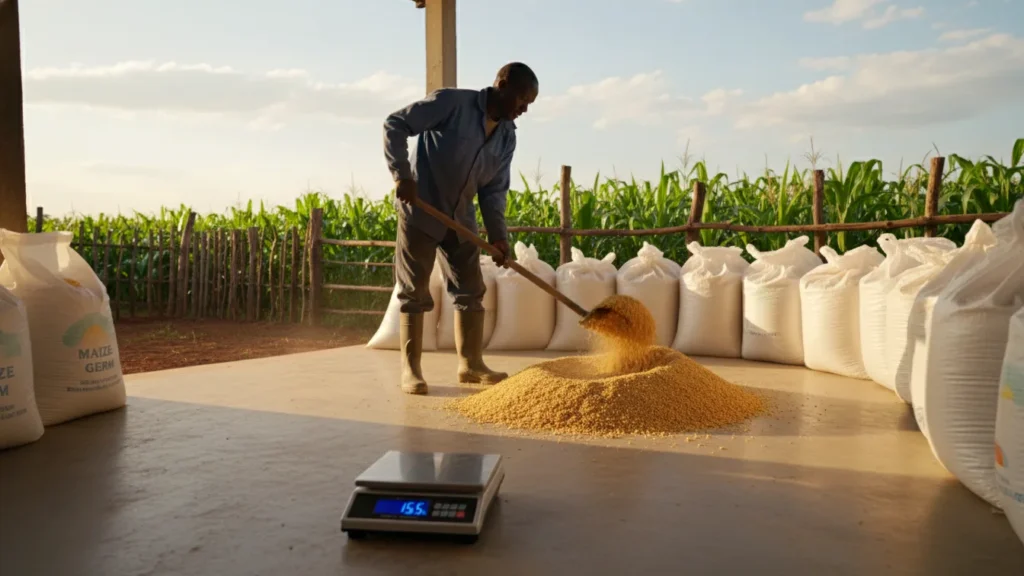
A Kenyan farmer mixing pig feed rations using a shovel on a clean concrete floor
What is the most effective protocol for pig disease control and vaccination?
Strict biosecurity is the only defense against African Swine Fever (ASF), which has no cure or vaccine. Essential vaccinations include Erysipelas and Parvovirus for breeding stock. Regular deworming with Ivermectin every 3 months and controlling external parasites like mites using acaricides is mandatory for herd health.
Disease can wipe out a pig farm in days. The most feared killer in Kenya is African Swine Fever (ASF). Since there is no vaccine, your farm must be a fortress against unauthorized entry.
Biosecurity Measures
Fencing is non-negotiable to keep out stray dogs, wild pigs, and unauthorized visitors. Install a footbath with disinfectant (like glutaraldehyde or Virkon) at the entrance of the piggery. Do not feed swill (kitchen scraps) from hotels unless it has been thoroughly boiled for at least 30 minutes, as raw pork scraps can carry ASF virus.
Vaccination and Health Schedule
While ASF has no jab, you must vaccinate against other killers to protect your investment. 1. Week 3-4: Iron injection to prevent anemia, as piglets born on concrete lack access to soil nutrients. 2. Weaning: Deworming with broad-spectrum dewormers. 3. Gilts/Sows: Parvovirus and Leptospirosis vaccines before breeding to prevent stillbirths. 4. Routine: Erysipelas vaccination every 6 months to prevent “Diamond Skin Disease.”
Observe your pigs daily for signs of illness. Symptoms like lethargy, shivering, loss of appetite, or purple discoloration of the ears require immediate veterinary attention. Isolation pens must be available to quarantine sick animals away from the healthy herd.
Which Kenyan counties offer the best environment for commercial pig farming?
Kiambu offers the best market access due to proximity to Nairobi and slaughterhouses. Uasin Gishu provides the lowest production costs due to abundant maize and wheat for feed. Nakuru offers a balanced advantage with a central location for logistics and a moderate climate suitable for exotic breeds.
1. Kiambu County (The Market Hub): Kiambu is the heart of pig farming in Kenya due to the presence of Farmer’s Choice in Kahawa West. Land is expensive here, so farmers utilize intensive zero-grazing units on small plots (40x80ft). The advantage is low transport costs to the market, but the challenge is the high cost of buying feeds from retailers.
2. Uasin Gishu (The Grain Basket): Farmers in Eldoret and surrounding areas have a massive competitive advantage: cheap feed. Being the maize and wheat capital, farmers can source raw materials directly from harvesters at rock-bottom prices. The profit margins per pig in Uasin Gishu are typically 15-20% higher than in Kiambu, though transport to Nairobi markets cuts into this slightly.
3. Nakuru County (The Logistics Center): Nakuru is strategically placed to supply Western Kenya, Nairobi, and the Central region. The climate is mild, reducing heat stress on pigs. Availability of by-products from local industries (like milling plants) makes feed formulation easier and cheaper.
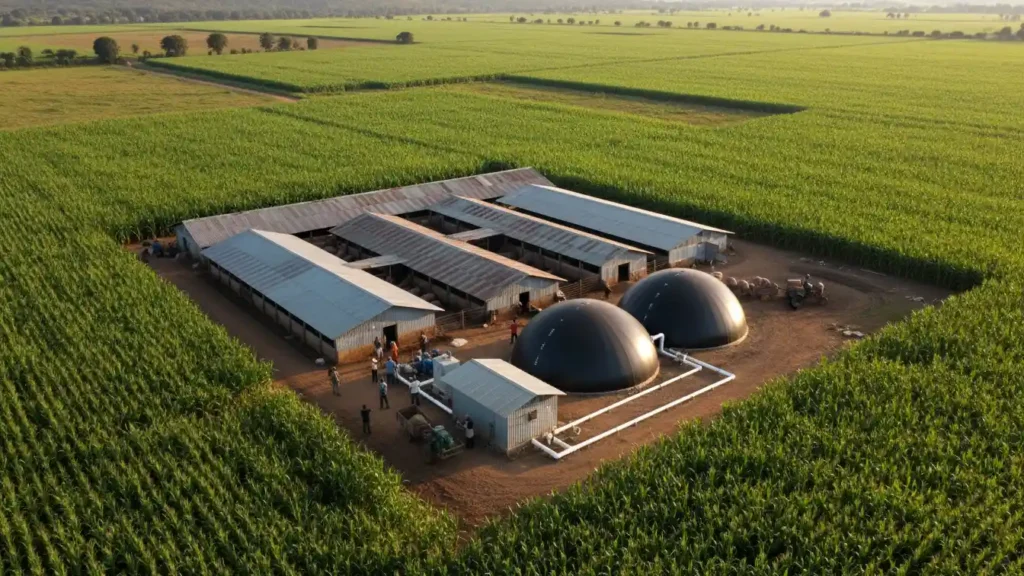
An aerial drone view of a commercial pig farm in Uasin Gishu
How should a beginner plan their pig farming calendar for the first year?
Months 1-2 focus on sty construction and biosecurity setup. Month 3 is for sourcing weaners and quarantining them. Months 4-8 are strictly for feeding and growth management. Months 9-10 involve finishing and marketing, while Months 11-12 focus on deep cleaning and restocking or farrowing if breeding.
Quarter 1: Infrastructure & Sourcing (Jan – Mar)
January is typically dry and perfect for construction activities. Build your sty and cure the concrete floors thoroughly to prevent cracking. In February, source your feeds and secure a reliable water connection. By March, bring in your weaners (approx. 2 months old) and isolate them for observation.
Quarter 2: The Growth Phase (Apr – Jun)
The long rains arrive during this period. Ensure your roof doesn’t leak and bedding remains dry to prevent pneumonia. Pigs are on Grower Mash during this stage. This is a cash-intensive period with no income, so ensure your financial reserves are ready.
Quarter 3: Finishing & Health Check (Jul – Sep)
July is cold, requiring extra bedding or heating for younger pigs. Switch to Finisher Mash to bulk up the pigs for the final push. If you are keeping gilts for breeding, serve them (inseminate) in month 8 when they reach roughly 110kg and are on their 2nd or 3rd heat.
Quarter 4: Harvest & Review (Oct – Dec)
Your first batch is ready for slaughter (porkers) at 6-7 months. December offers the highest pork demand due to Christmas festivities. Sell your stock, sanitize the pens thoroughly, and review your financial books to adjust feed ratios for the next year.
What are the realistic costs and profit margins for pig farming in 2026?
Raising a pig to market weight (90kg) costs approximately KES 14,000 – 16,000 in feeds and vet care. Selling at KES 280-320 per kg carcass weight generates revenue of KES 20,000 – 23,000. This leaves a net profit of roughly KES 4,000 – 7,000 per pig, taking about 6-7 months to realize.
Profitability in 2026 depends entirely on the Feed Conversion Ratio (FCR). If your pigs eat too much but grow too slowly, you will lose money. The following breakdown assumes a commercial approach with 10 pigs.
Expense Category
Details
Cost (KES)
Stocking (Weaners)
10 Quality Weaners @ 5,000 each
50,000
Feeding (Total)
~300kg feed per pig to reach 90kg @ 45/kg
135,000
Veterinary/Meds
Vaccines, Dewormers, Iron, Vitamins
5,000
Labor & Water
Part-time attendant / Utility bills
15,000
Transportation
Moving pigs to slaughter/market
5,000
Total Cost
Cost of production for 10 pigs
210,000
Revenue
10 pigs x 70kg (Carcass Weight) x 300 KES/kg
210,000
PROFIT SCENARIO
Standard Break Even
0 (Break-even)
Analyst Note: The table above shows a break-even scenario if you rely 100% on expensive commercial feeds and sell at standard broker prices. To make the KES 70,000 profit often cited by experts, you MUST reduce feed costs to KES 30-35/kg by home mixing. Additionally, selling value-added products (sausages/pork joints) rather than whole carcasses increases revenue significantly.
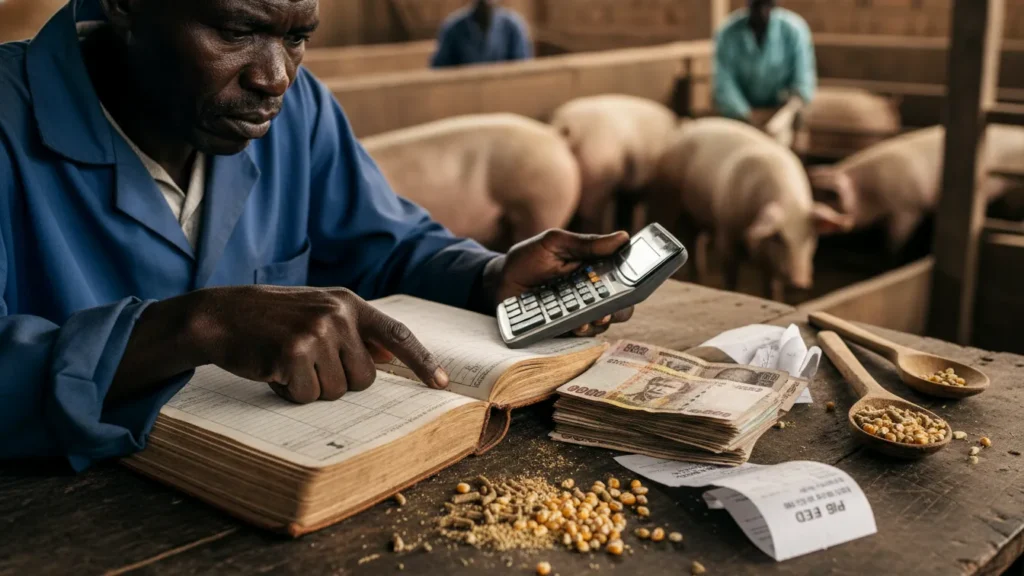
A detailed close-up of a Kenyan farmer holding a ledger book and a calculator
How can farmers add value to maximize revenue per pig?
Value addition involves processing raw pork into sausages, bacon, smokies, or selling specific cuts (chops, ribs) directly to consumers. Opening a local “Pork Joint” or butchery allows farmers to bypass brokers, often doubling the profit margin per animal compared to selling live weight.
Selling a live pig to a broker is the least profitable exit strategy. The broker makes the money, not the farmer. In 2026, the smart money is in the “Farm-to-Fork” model where you control the retail price.
The “Vibanda” & Butchery Model
Opening a small roast pork eatery (vibanda) in a high-traffic area allows you to sell 1kg of cooked pork for KES 600-800. Compare this to the KES 300 per kg you receive for raw carcass weight. Even after factoring in charcoal and labor, the margin doubles per pig processed.
Processing Licenses and Regulations
If you want to produce sausages or smokies, you need certification from the Kenya Bureau of Standards (KEBS) and a food handling certificate. While the paperwork is tedious, processed pork has a longer shelf life. Start small with unbranded fresh sausages for local neighbors before scaling to supermarkets.
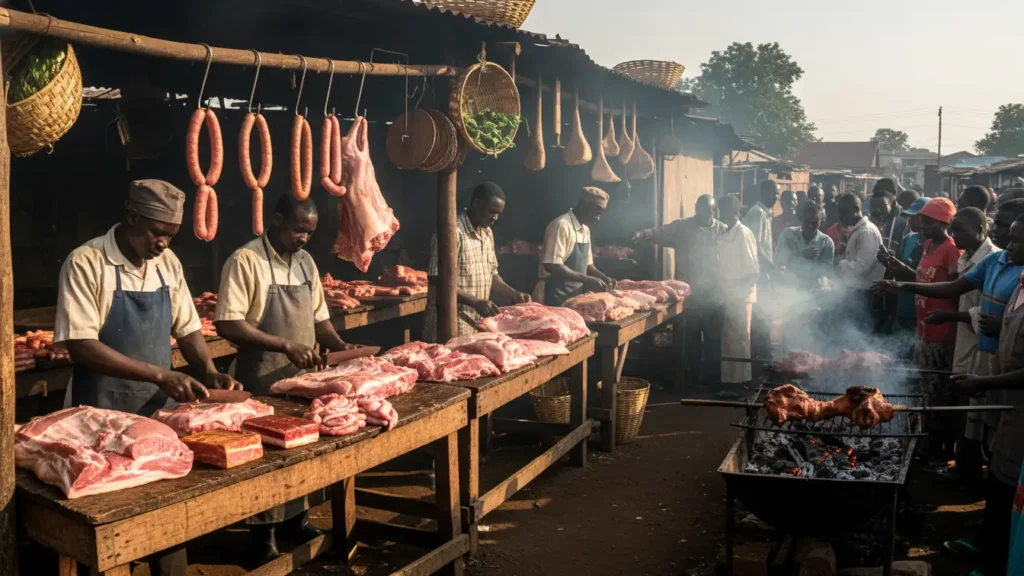
A bustling local butchery in Nairobi displaying fresh pork cuts
2026 Outlook: The Future of Pig Farming in Kenya
As we move through 2026, the Kenyan pig industry is consolidating. The days of “trial and error” farming are over. Success now belongs to farmers who use data to manage feed costs and maintain strict biosecurity against ASF.
We are seeing a massive shift towards insect-based protein (Black Soldier Fly larvae) to replace expensive Omena and Soya. Farmers adopting this technology are seeing feed costs drop by 30%. Furthermore, the demand for pork in urban centers like Nairobi, Kisumu, and Mombasa is at an all-time high due to the rising price of beef.
Don’t guess with your investment. Start with proper genetics and a solid feed plan. Visit your local KALRO center this week to book your F1 foundation stock and join a local cooperative for bulk feed purchasing.
Farmers Also Ask (FAQ)
How long does it take for a pig to reach market weight?
With good management and quality breeds like Large White or Camborough, a pig should reach 90-100kg (market weight) in 6 to 7 months. Indigenous breeds may take over 10 months to reach this weight. Consistent feeding is key to meeting this timeline.
What is the best way to prevent piglets from being crushed by the sow?
Install “farrowing crates” or guard rails in the pen. These rails are fixed about 20cm from the wall and 20cm from the floor. They give piglets a safe escape space when the mother lies down.
Can I feed my pigs entirely on kitchen waste?
No, kitchen waste alone lacks the balanced protein and minerals needed for growth. It causes slow growth and produces fatty, low-quality meat. It can also transmit diseases like ASF if not boiled strictly.
How much water does a pig need per day?
A growing pig needs 5-10 liters of water daily. A lactating sow (breastfeeding) can drink up to 20-30 liters. Lack of water immediately stops growth and milk production.
What is the ratio of boars to sows?
For natural mating, one healthy boar can service about 20 sows. If you have fewer than 5 sows, it is cheaper to pay for Artificial Insemination (AI) services. This avoids the high cost of feeding a boar year-round.
How do I know if my pig has worms?
Signs include coughing, rough hair coat, slow growth, pot-belly, and scouring (diarrhea). Even without signs, deworm every 3 months as a preventative measure. Consult a vet for the correct dosage.
Is Artificial Insemination (AI) better than keeping a boar?
For small farmers, yes. AI grants access to superior genetics from top-quality boars without the cost of feeding one. It also prevents the spread of sexually transmitted diseases.
Why are my pigs eating their own piglets (Cannibalism)?
This is usually caused by stress, lack of water, or mineral deficiency (salt or protein). Ensure the sow is not thirsty and her ration has enough salt. Isolate aggressive sows immediately to protect the litter.
What is “Castration” and when should it be done?
Castration is the removal of testicles in male piglets not intended for breeding. It prevents “boar taint” (bad smell in meat). It should be done between day 3 and day 7 to minimize stress.
How much land do I need for 50 pigs?
For 50 pigs, you need roughly a 40x60ft or 50x100ft plot. This accommodates the pens, a feed store, and a waste management system. You do not need acres of grazing land for commercial pig farming.
Pig farming in Kenya is one of the fastest growing livestock opportunities for 2026, but real profits only come when you control feed costs, build simple but hygienic pig houses and work with the right breeds and markets from day one. This beginner friendly guide walks you through startup capital, housing designs, feeding plans, disease prevention and value addition so you can launch a small piggery and scale it into a sustainable agribusiness.
Beekeeping (Apiculture) is currently rated as the highest ROI agribusiness in Kenya for 2026 due to minimal land requirements and soaring demand for organic honey and beeswax. With a properly managed 10-hive apiary, farmers can expect to break even within 18 months while contributing to ecosystem restoration. This guide covers the transition from traditional logs to Langstroth hives, detailed financial projections in KES, and regional suitability.
Why is commercial beekeeping becoming the most strategic agribusiness investment in Kenya for 2026?
Commercial apiculture in Kenya offers a unique “low-input, high-output” model that requires less than 10% of the labor needed for dairy or poultry farming. With the 2026 market price for pure organic honey hitting KES 1,000 per kg, beekeeping allows utilization of non-arable land (ASALs) and integrates seamlessly with fruit farming. It is the only venture where your livestock feeds itself by foraging up to 3km away.
The agricultural landscape in Kenya is shifting rapidly towards climate-resilient ventures. Beekeeping stands out because it does not require fertile soil or daily irrigation, making it perfect for the 80% of Kenya classified as Arid and Semi-Arid Lands (ASALs). Unlike crops that fail during drought, bees can migrate or be fed supplementary sugar syrup to survive harsh seasons.
Furthermore, the demand for hive by-products has exploded locally and internationally. While most beginners focus solely on honey, the real “gold” in 2026 lies in beeswax, propolis, and royal jelly, which are heavily sought after by the cosmetic and pharmaceutical industries. Kenyan honey, particularly from the Acacia-rich belts, is gaining a reputation similar to New Zealand’s Manuka honey for its distinct medicinal properties.
Successful adoption of modern technology is also driving this growth. The shift from traditional log hives (which yield 5-10kg) to Langstroth and Kenya Top Bar (KTB) hives (yielding 20-30kg+) has revolutionized output. Organizations like KALRO (Kenya Agricultural and Livestock Research Organization) and private entities like Savannah Honey are actively providing improved queen bees that are less aggressive and more productive.
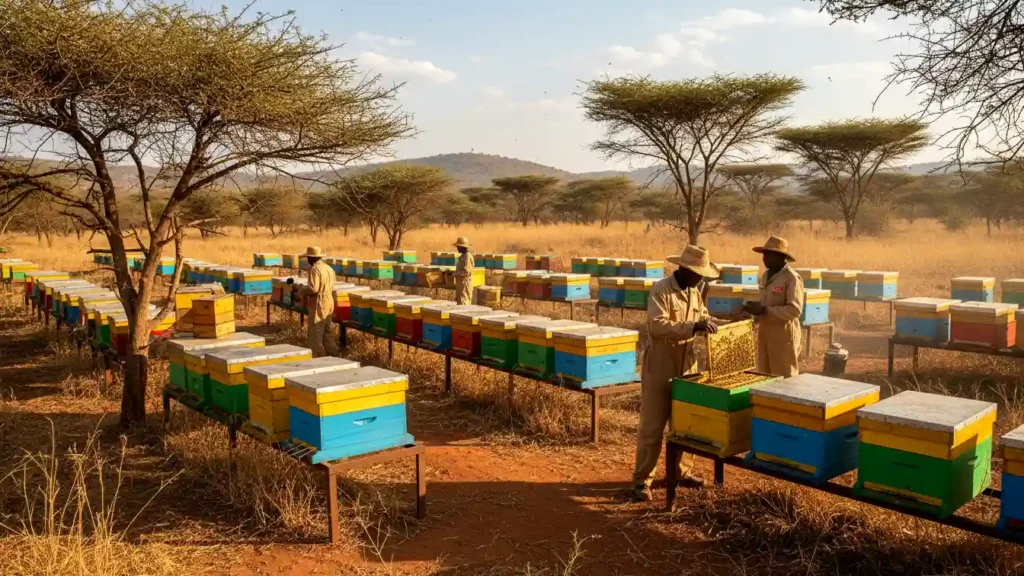
A wide-angle shot of a neatly arranged commercial apiary with colorful Langstroth hives raised on metal stands in a semi-arid Acacia woodland in Kitui
Which Kenyan counties offer the best environmental conditions for commercial apiaries?
The most productive counties for honey volume are currently Baringo, West Pokot, and Kitui due to vast indigenous vegetation and high temperatures. However, Meru, Nyeri, and Kiambu offer high-value opportunities for pollination services integrated with macadamia and avocado farming. Coastal regions like Kilifi produce distinct mangrove honey, though humidity management is critical there.
Module A: Regional Comparative Analysis
Choosing the right location is 80% of the battle in apiculture. Kenya’s diverse ecology creates distinct “honey zones” with varying flavor profiles and management requirements. Here is a deep dive into three distinct zones for 2026.
1. The Arid Belt: Kitui & Makueni
Kitui remains the undisputed capital of traditional Kenyan honey, but commercialization is rapidly modernizing the sector. The climate here is hot and dry, dominated by Acacia and Commiphora species, which produce clear, slow-crystallizing honey. The primary challenge here is water availability; farmers must provide reliable water stations for bees within 500 meters of the apiary.
In 2026, land prices in Kitui are still relatively affordable compared to the highlands, allowing for massive scaling. A farmer here should focus on Langstroth hives with proper ventilation modifications to prevent melting combs. The yield per hive is generally higher here due to the prolonged blooming periods of indigenous trees.
2. The Rift Valley Hub: Baringo & West Pokot
Baringo has a deep cultural history of beekeeping, but the region is transitioning from “honey gathering” to “honey farming.” The flora is incredibly diverse, offering multi-floral honey that is rich in trace minerals. This region is ideal for organic certification because there is minimal use of synthetic pesticides in the surrounding rangelands.
However, logistics can be a hurdle. Roads in interior Baringo can be impassable during the rainy season, complicating market access. Farmers in this region are increasingly forming cooperatives to aggregate produce and sell in bulk to Nairobi-based packers. Security can be a sporadic issue, so apiaries should be sited near homesteads or in secure community zones.
3. The Highland Integration: Meru & Kiambu
In Meru and Kiambu, beekeeping takes on a different financial model: pollination revenue. With the boom in export-grade Avocados and Macadamias, farmers are renting hives to orchards. The honey here is often darker, crystallizes faster (due to crops like Rape seed or Coffee), and has a robust flavor.
The challenge in these high-density agricultural zones is pesticide poisoning. Farmers must maintain strict communication with neighbors to lock hives during spraying schedules. Cold temperatures in July also require hive insulation to prevent colony loss, a cost factor not present in Kitui or Baringo.
What is the optimal monthly management schedule for a Kenyan bee farm in 2026?
Kenya’s beekeeping calendar follows the bimodal rainfall pattern: the Long Rains (March-May) and Short Rains (October-December). The primary honey flow usually occurs after the rains when flowers bloom, typically May-June and November-December. Critical famine periods (January-February and July-September) require supplementary feeding to prevent absconding.
Module B: 12-Month Farming Calendar
Success in beekeeping depends on anticipating the bees’ needs before they signal distress. This calendar is adjusted for the projected climate patterns of 2026.
January – February (Dry Season / Famine Period)
This is a critical maintenance phase. Forage is scarce, and the colony is at risk of absconding (leaving the hive). Action: Inspect hives for Wax Moth infestation. Provide supplementary feeding using a 1:1 sugar-water ratio or growing bee-friendly flora like Sunflower or Basil. Ensure water troughs are full and clean. Goal: Survival and maintaining colony strength.
March – April (Long Rains / Build Up)
As rains begin, vegetation regenerates. The queen increases egg-laying rates in response to incoming pollen. Action: Stop sugar feeding as natural nectar becomes available. Perform “splitting” of strong colonies to create new hives and prevent overcrowding. Install Queen Excluders to ensure honey supers remain brood-free. Goal: Population explosion to prepare for the nectar flow.
May – June (Main Nectar Flow / Honey Season)
The shamba is buzzing; flowers are in full bloom. Bees are working maximum hours. Action: Add “Supers” (additional boxes) to Langstroth hives to provide space for honey storage. Minimize hive disturbances to let bees work. Monitor for swarming signs (queen cells at the bottom of frames). Goal: Maximizing honey storage.
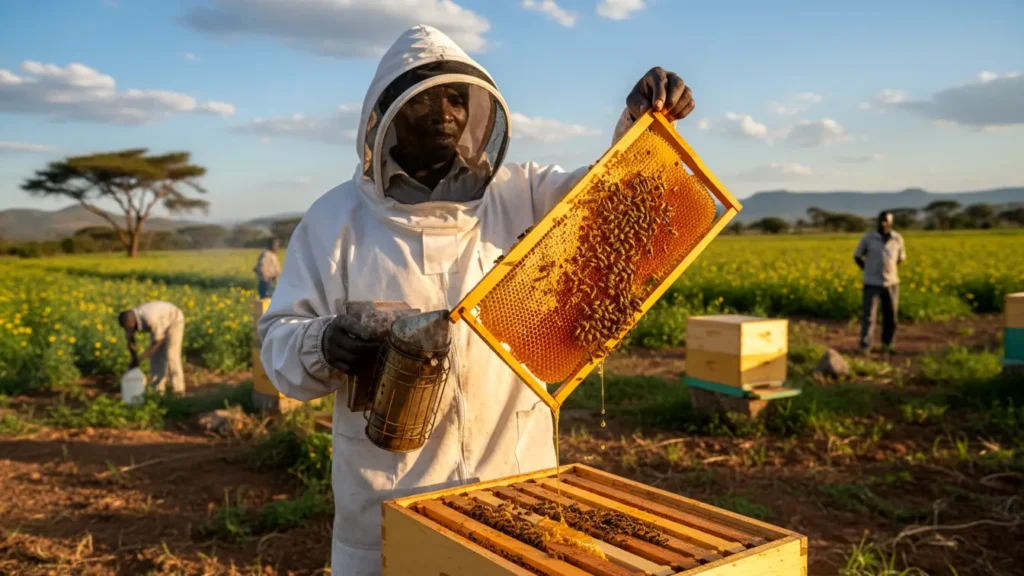
A Kenyan beekeeper wearing a white full-body protective suit and veil
July – September (Cold Season / Minor Harvest)
In the Highlands, this is the cold season. Action: Harvest the first crop of honey (May/June flow). Reduce hive entrances to help bees maintain internal temperature and defend against robber bees. Insulate hives in high-altitude areas like Limuru or Nyeri. Goal: Harvest and winterization (temperature management).
October – November (Short Rains / Second Build Up)
Similar to March, the short rains trigger a second bloom. Action: Inspect for pests like the Small Hive Beetle. Re-queen colonies that performed poorly during the first season. Check vegetation availability; plant fast-blooming creepers if necessary. Goal: Preparation for the December harvest.
December (The “Christmas” Harvest)
The major harvest season for most of Kenya, especially in ASAL regions. Action: Harvest ripe (capped) honey. Process beeswax immediately to prevent moth damage. Market products for the festive season when demand is highest. Goal: Revenue generation and sales.
How much capital is required to start a 10-hive apiary and when is the break-even point?
Starting a 10-hive commercial unit using modern Langstroth hives in 2026 requires an investment of approximately KES 130,000 to KES 160,000. This covers hives, protective gear, a basic centrifuge, and installation. A well-managed apiary can break even by the second major harvest (Month 12-14), with net profits stabilizing around KES 200,000+ annually thereafter.
Module C: Deep-Dive Financials
Below is a realistic budget for a beginner setting up a semi-commercial unit. We assume the use of Langstroth Hives because they offer 3x the yield of traditional log hives and allow for easier inspection without destroying the brood.
“The mistake most beginners make is buying cheap, uncured wood hives. These warp in the sun, creating gaps that allow pests to enter. Always buy hives made from seasoned Cypress or Pine.”
Cost Breakdown: 10-Hive Apiary (2026 Estimates)
Item Category
Specific Item
Unit Cost (KES)
Quantity
Total Cost (KES)
Housing
Complete Langstroth Hive (3 boxes, frames, lid)
6,500
10
65,000
Housing
Metal Hive Stands (Ant-proof)
1,200
10
12,000
Livestock
Colony Catching / Starter Nucs
2,500
10
25,000
Gear
Full Bee Suit (Heavy Duty) & Gloves
4,500
2
9,000
Tools
Smoker (Stainless Steel)
2,500
1
2,500
Tools
Hive Tool & Bee Brush
1,000
1
1,000
Processing
Manual Centrifuge (3-Frame)
25,000
1
25,000
Misc
Misc (Wire, Wax sheets, Transport)
10,000
1
10,000
TOTAL
CAPEX
149,500
Revenue Projections (Conservative)
Honey: A mature Langstroth hive produces 20kg to 30kg per year (split between two harvests). 10 Hives x 25kg (avg) = 250kg Honey. Market Price (Retail): KES 800 – 1,000 per kg. Revenue from Honey: KES 200,000 – 250,000.
Beeswax: Often overlooked, wax sells for KES 600 – 800 per kg. Ratio is approx 1kg wax for every 10kg honey. 25kg Wax x KES 700 = KES 17,500.
Propolis: Highly valuable medicinal resin. Approx 200g per hive/year = 2kg total. Price: KES 2,000/kg (Raw). Revenue from Propolis: KES 4,000.
Total Year 2 Revenue:KES 221,500 – 271,500. ROI: The initial capital is recovered in the first full production year. Years 3-10 are maintenance-only, yielding profit margins of 85%+.
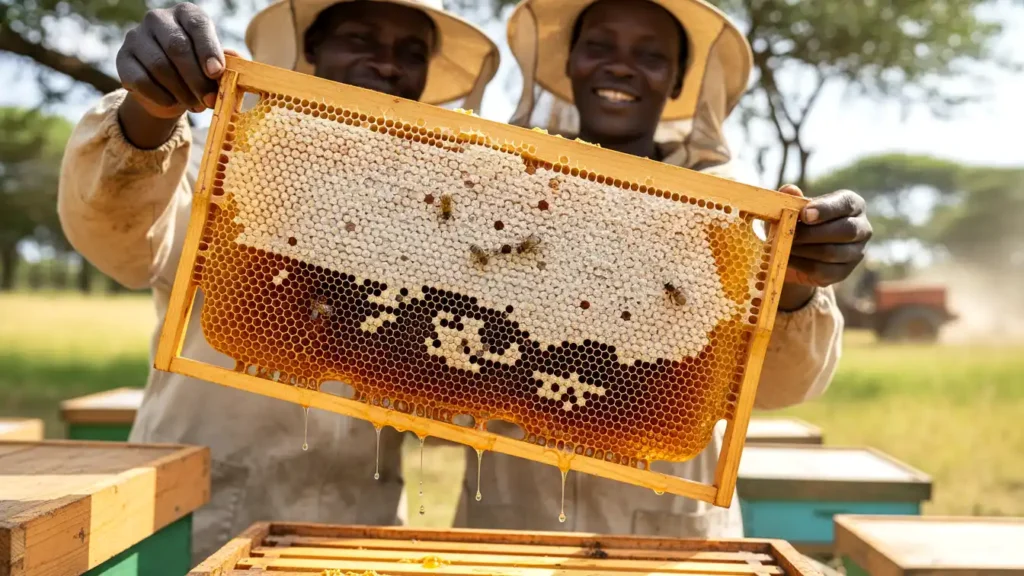
Close-up macro shot of a wooden Langstroth hive frame being pulled out
What are the primary threats to colony health and how can they be managed effectively?
The most significant threats to Kenyan hives are the Varroa Mite, Wax Moth, and the Honey Badger. Effective management involves maintaining strong colonies that can self-police pests and using physical barriers like grease on hive legs for ants. Chemical interventions should be avoided to maintain organic certification; instead, use biological controls and regular hive inspections.
Module D: Pests, Diseases, and Predator Control
Even the best apiary can fail if pests are not managed. In Kenya, predators range from microscopic mites to large mammals. Understanding these threats is crucial for protecting your investment.
This is the silent killer of weak colonies. The moth lays eggs in the hive, and the larvae burrow through the comb, eating wax and destroying the structure. Prevention: Keep colonies strong, as a populous hive will kick out moths. Store empty combs in a freezer or treat them with sulphur fumes. Warning: Never leave empty hives open in the field; they become breeding grounds.
2. The Honey Badger
Found commonly in Laikipia and Tsavo, badgers can destroy an entire apiary in one night. They are strong enough to knock over hives and rip them open. Defense: Suspend hives from trees using wires (hanging apiary) or build sturdy metal cages around the stands. A standard fence is often insufficient against a determined badger.
3. Ants (Safari Ants)
Safari ants (Siafu) can wipe out a colony in hours by consuming the brood. Defense: This is why metal stands are mandatory. Apply grease or old engine oil to the legs of the stand. Ensure no grass touches the hive bottom, acting as a bridge for ants.
How can farmers maximize profits through processing and value-added bee products?
To move from a subsistence farmer to an agribusiness entrepreneur, you must process and brand. Selling raw honey in jerrycans yields the lowest margin. Packaging in standardized 500g glass jars with KEBS labels increases value by 40%. Furthermore, processing beeswax into candles, balms, or reusable food wraps can double the income per hive compared to selling raw wax.
Module E: Supply Chain & Value Addition
The “money” in beekeeping is not just in the extraction; it is in the presentation. The Kenyan consumer in 2026 is health-conscious and wary of adulterated “sugar honey.” Building trust through professional packaging is mandatory.
1. Extraction Hygiene
Honey absorbs moisture and odors. Extraction must happen in a sealed, dry room (humidity under 18%). Using a Stainless Steel Centrifuge is superior to the traditional “crushing” method because it preserves the comb, allowing bees to refill it faster. Crushing combs forces bees to consume 8kg of honey just to produce 1kg of wax to rebuild, significantly slowing your next harvest.
2. Filtration and Settling
Do not boil honey. Heating above 45°C kills the enzymes that give honey its medicinal value. Instead, use a double stainless steel sieve to remove bee legs and wax particles. Let the honey “settle” in a food-grade bucket for 48 hours so air bubbles rise to the top before bottling.
3. Packaging & Compliance
Plastic bottles are cheap but degrade the perception of quality. Glass jars are the gold standard for premium honey. To sell in supermarkets like Naivas or Carrefour, you need a KEBS (Kenya Bureau of Standards) Diamond Mark. Tip: Start by selling to neighbors, colleagues, and local organic markets to build capital for certification.
4. The Propolis & Pollen Niche
Advanced farmers collect Propolis (bee glue). It is a powerful natural antibiotic. By dissolving raw propolis in food-grade alcohol, you create “Propolis Tincture,” which sells for KES 500 per 30ml bottle—a massive markup. Bee Pollen is another superfood, harvested using “pollen traps” at the hive entrance, popular among athletes in Nairobi.
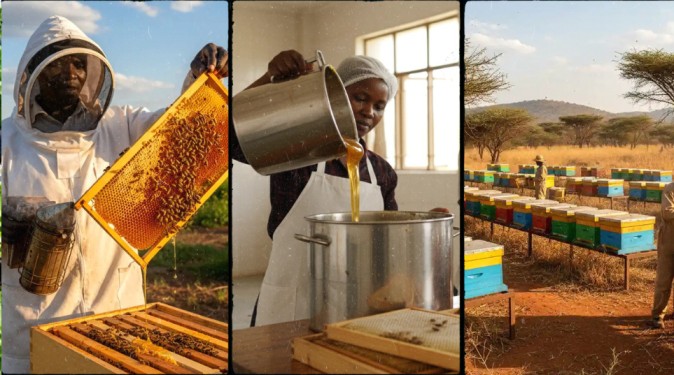
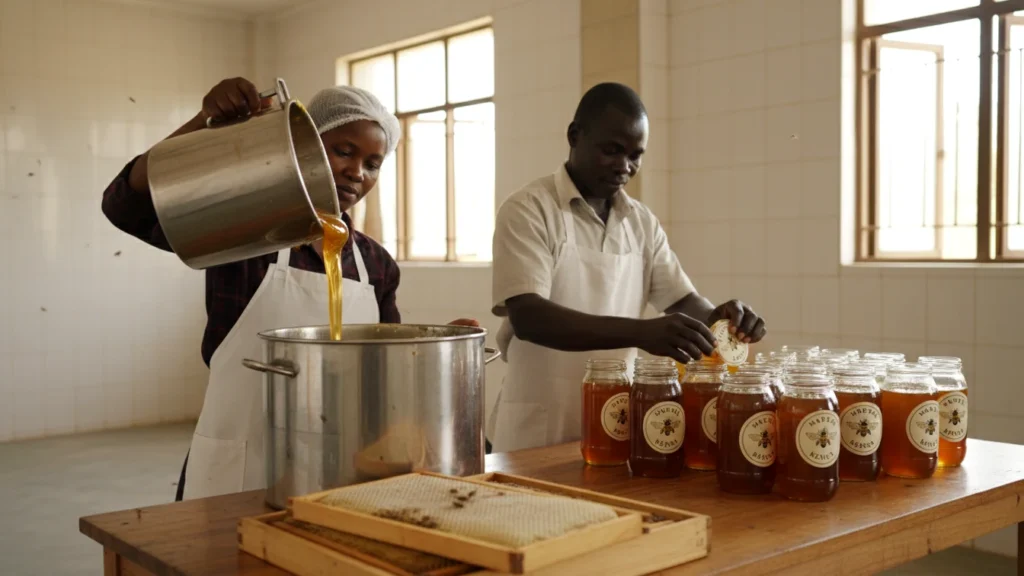
Two people in white aprons are processing honey in a clean indoor facility in Kenya
What are the specific equipment requirements for modern beekeeping in Kenya?
Beyond the hive, the three non-negotiables are a Smoker (to calm bees), a Hive Tool (to pry open propolis-sealed frames), and a Full Bee Suit (not just a veil). Do not improvise with burning rubber or plastic in smokers; use burlap, cow dung, or dried grass. For scaling, invest in a refractometer to measure honey moisture content (must be below 20% to prevent fermentation).
When sourcing equipment, rely on established fabricators. African Beekeepers Ltd and Agri-SeedCo often stock quality hardware. For those in Central Kenya, Mugo Farmers often have local fabrication contacts.
“Important Note on Suits: Kenyan African bees (Apis mellifera scutellata) are notoriously aggressive. Ensure your suit has double-layer mesh or heavy canvas. Thin cotton suits used in Europe will not protect you against a determined Kenyan swarm.”
Where to Buy Bees in Kenya and Best Flowers to Plant for High Honey Yields
For bees, buy colonies and equipment from reputable Kenyan beekeeping companies instead of random middlemen. Trusted suppliers such as African Beekeepers Ltd, Savannah Honey Africa,Modern Bee Farmers, Urban Beekeepers, Yatta Beekeepers and Apiken sell Langstroth or Kenya Top Bar hives, starter colonies, protective gear and offer training so you begin with healthy bees and proper apiary setup.
To keep your bees productive, plant a mix of flowering trees, shrubs and crops that provide nectar and pollen almost all year. Good bee forage for Kenyan conditions includes sunflowers, kales, strawberries, clover, lucerne, calliandra, grevillea, avocado, citrus, mango and bee friendly shrubs like wild roses and hawthorn, all of which boost honey flow and support strong colonies even in dry periods.
Conclusion: The 2026 Agribusiness Outlook
As we navigate 2026, beekeeping is no longer a “retirement hobby” but a frontline defense against climate change and a pillar of rural wealth creation. With erratic rainfall patterns affecting maize and beans, the drought resilience of the honeybee offers a safety net for Kenyan farmers.
The trend is moving toward Smart Beekeeping—using sensors to monitor hive weight and humidity via smartphone apps, reducing the need for physical inspections. However, the fundamentals remain the same: respect the bee, maintain the forage, and ensure hygiene in processing.
Your Action Plan: Do not start with 50 hives. Start with 3 to 5 this season. Learn the behavior of the colony. Join a local cooperative like the National Beekeeping Institute alumni groups to access bulk markets. The nectar is there; you just need to position your buckets.
“Call to Action: Visit your local KALRO center or contact Simlaw Seeds (often stock bee flora seeds) to begin your journey. Plant your bee fodder now to ensure a bumper harvest in December.”
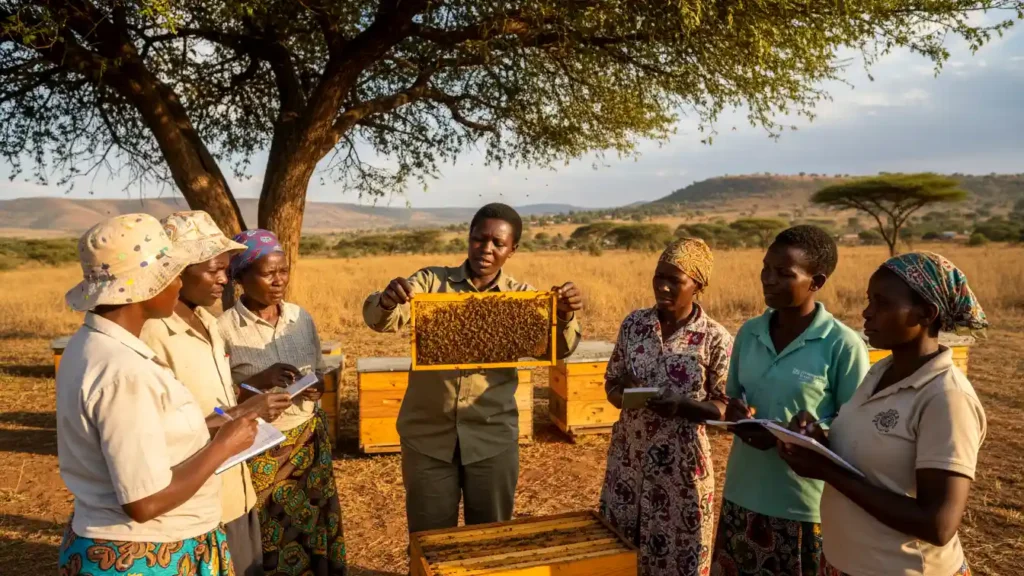
An outdoor training session under a tree where an expert instructor is demonstrating how to identify a queen bee on a frame to a group of attentive Kenyan farmers taking notes
Farmers Also Ask FAQ
How much land do I need for beekeeping?
You need very little land for the hives themselves—a 10-hive apiary fits in a 10m x 10m space. However, bees forage up to 3km radius. You don’t need to own the 3km; you just need to ensure the surrounding area has vegetation. You can keep bees on a small plot, provided it’s fenced off from livestock and away from public footpaths.
What is the difference between Langstroth and KTB hives?
The Langstroth is a vertical hive with rectangular frames that allow for centrifugal extraction (reusing combs). It yields more honey but is more expensive. The Kenya Top Bar (KTB) is a horizontal hive with bars (no full frames). You crush the comb to harvest, meaning you get more wax but less honey. KTB is cheaper to start but less profitable long-term for honey production.
How do I stop bees from absconding (leaving the hive)?
Absconding is usually caused by lack of food (famine), lack of water, or pests (ants/moths). To prevent it: 1) Feed sugar syrup during dry months. 2) Grease hive legs to stop ants. 3) Ensure the hive is shaded from the scorching afternoon sun. 4) Do not disturb them too often.
Is there a market for bee venom in Kenya?
Yes, but it is a niche, advanced market. Bee venom is used in apitherapy and cosmetics. Collecting it requires specialized electric collectors that stimulate bees to sting a glass plate without dying. In 2026, this is mostly done by large commercial outfits, but specialized buyers in Nairobi are beginning to source it.
How do I get a KEBS mark for my honey?
You must submit samples of your honey to KEBS laboratories for analysis (checking moisture, sucrose content, and insolubles). You also need a food hygiene certificate for your packing facility. Once your sample passes and your facility is inspected, you are issued a standardization mark permit.
Can I keep bees if I have children or livestock?
Yes, but safety is paramount. Fence off the apiary with a live fence (like Kai Apple) or wire mesh to keep cows and kids out. Place hives at least 100 meters away from the main house or cow shed. Work on the bees only in the late evening when they are calmer and fewer people are active.
What are the main diseases affecting bees in Kenya in 2026?
The main threats are Varroa Mites (parasites that weaken bees) and American Foulbrood (bacterial). Wax Moths are a pest, not a disease, but cause the most damage to stored combs. Good hive hygiene and strong colonies are the best defense. Chemical treatments should be a last resort to avoid contaminating honey.
How often should I inspect my hives?
Inspect every 2 weeks during the nectar flow season (to check for fullness and swarming) and once a month during the dry season (to check for pests). inspecting too often stresses the bees and interrupts their work. Always inspect on a sunny, calm day.
Can I make money solely from pollination services?
Yes. Farmers in Murang’a and Kiambu charge between KES 3,000 and KES 5,000 per hive per season to place hives in avocado or melon farms. This is becoming a lucrative passive income stream where the honey becomes the secondary bonus.
Where can I buy queen bees in Kenya?
You can purchase mated queen bees from KALRO Njejoro, Savannah Honey, or certified breeders listed by the National Beekeeping Institute. Introducing a new, productive queen to an old colony is the fastest way to improve a lazy or aggressive hive’s performance.
TL;DR:Barred Plymouth Rock chickens are the superior dual-purpose breed for Kenyan smallholders in 2026, offering high disease resistance and premium “improved kienyeji” meat prices. With a maturity rate of 4.5 months and egg production of up to 240 eggs annually, they outperform indigenous breeds in profitability. This guide details sourcing, feeding, and financial planning for maximum ROI in the current economic climate.
What makes the Barred Plymouth Rock the ideal breed for Kenyan farmers in 2026?
The Barred Plymouth Rockexcels in Kenya due to its dual-purpose utility and exceptional hardiness against local climate fluctuations. Unlike broilers, they scavenge well, reducing feed costs by up to 30%. In 2026, their distinct black-and-white “zebra” plumage commands a higher market price because consumers associate it with authentic, high-quality indigenous taste.
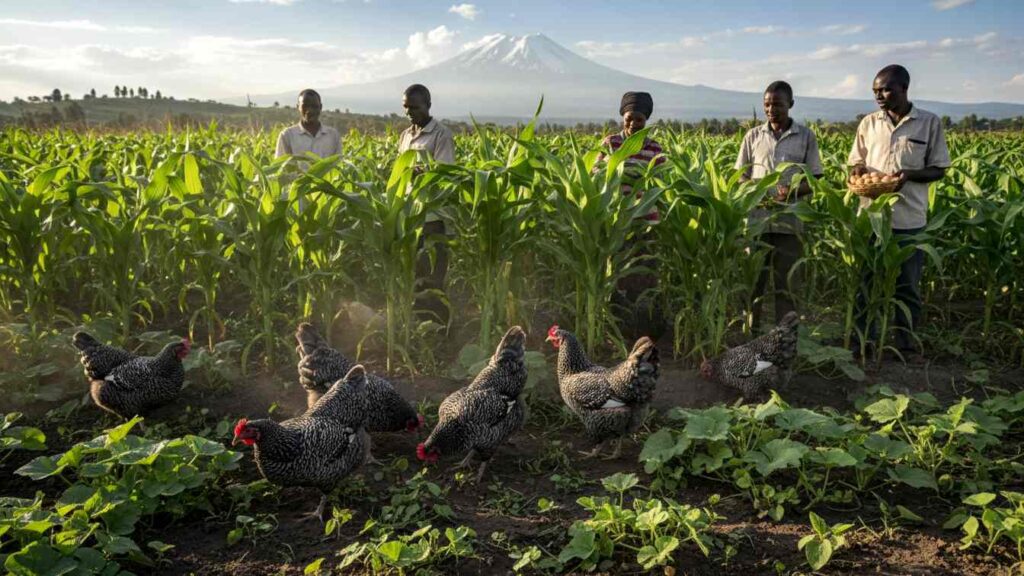
The agricultural landscape in Kenya is constantly shifting towards sustainable, low-input livestock. Smallholder crop farmers are increasingly integrating poultry to diversify income streams against climate shocks. The Barred Plymouth Rock fits this integrated model perfectly.
This breed is not a delicate exotic bird that requires expensive climate-controlled housing. They are robust foragers that thrive in the semi-free-range systems common in rural Kenya. This hardiness significantly lowers the barrier to entry for beginner farmers in counties like Bungoma and Meru.
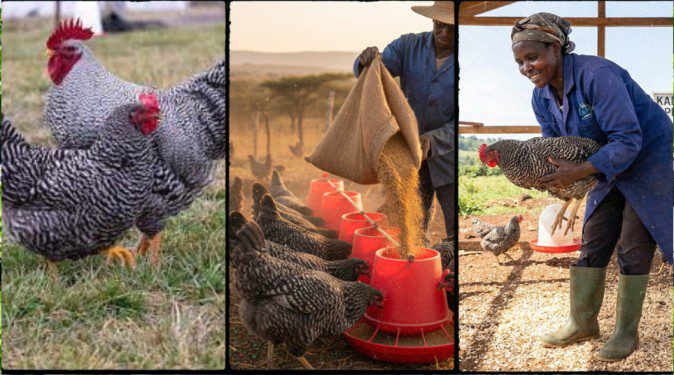
image of a flock of Barred Plymouth Rock chickens foraging in a lush
Furthermore, the 2026 market trend heavily favors “organic” and “kienyeji” labeled produce over industrial options. The Barred Rock produces meat that is firmer, darker, and tastier than commercial broilers. Their eggs are brown, large, and fetch a premium price in Nairobi and Mombasa markets, often retailing for KES 20-25 each.
Farmers are also drawn to the breed’s docile temperament, which makes them easy to manage for families with children. Unlike the aggressive Leghorn, the Barred Rock is calm and rarely flies over standard fencing. This reduces losses from straying birds and minimizes conflicts with neighbors in peri-urban settings.
How does the Barred Plymouth Rock compare across different Kenyan counties?
Direct Answer: Regional success varies based on feed availability and market proximity. Kiambu offers the highest egg prices but suffers from high production costs due to land scarcity. Kakamega provides cheaper organic feed inputs like termites but faces lower local meat prices. Machakos requires higher water infrastructure investment but offers low disease pressure due to drier conditions.
Module A: Regional Comparative Analysis
To understand true profitability, we must analyze how this breed performs in three distinct agricultural zones. Kenya’s diverse climate affects feed conversion ratios, disease management, and ultimate profit margins. A strategy that works in the highlands may fail in the arid plains.
1. Kiambu County (Peri-Urban High Intensity)
Farmers in Kiambu benefit immensely from their proximity to Nairobi’s premium consumer markets. You can sell a mature cock for KES 1,800 and a tray of eggs for KES 450+ directly to households. However, land sizes are typically small, necessitating a semi-intensive system.
Feed costs here are the highest in the country due to stiff competition for resources. Farmers must rely heavily on commercial feeds from brands like Unga Farm Care or Pembe Feeds. The high humidity and population density also require strict coccidiosis management protocols to prevent outbreaks.
The key to success in this region is vertical integration. Farmers here should focus on selling dressed meat rather than live birds to maximize margins per square foot. High-value customers in estates like Runda and Karen are the target demographic.
2. Kakamega County (Western Breadbasket)
In Kakamega, the abundance of green matter and insects supports a true free-range system. Farmers can substitute up to 40% of commercial feed with lucerne, maize germ, and naturally occurring termites. This drastically lowers the break-even point compared to central Kenya.
The primary challenge here is market access and lower disposable income among local buyers. While production costs are low, the sale price for a bird might hover around KES 1,200. Value addition, such as transporting dressed chicken to urban centers like Kisumu or Eldoret, is key here.
Disease pressure in Western Kenya is unique due to the high rainfall. Farmers must be vigilant against internal parasites and worms. Regular deworming using products like Ascarex is mandatory for flocks raised on free range.
3. Machakos County (Semi-Arid Opportunity)
Machakos presents a unique and growing opportunity for poultry farmers in 2026. The dry climate reduces the prevalence of respiratory diseases and bacterial infections that plague wetter counties. Barred Rocks are surprisingly heat-tolerant but require constant, cool water access.
Farmers here must invest in hydroponic fodder systems to supplement dry grazing during drought months. The market is growing rapidly due to the expansion of the Nairobi metro area towards Athi River. Prices are stabilizing near Kiambu rates as the middle class moves outward.
Water storage is the critical success factor in this region. A farmer with a reliable 5,000-liter tank can outperform competitors during the dry season. The dry heat also ensures poultry manure dries fast, creating excellent fertilizer for mango and orange farming.
Where are the best places to buy Barred Plymouth Rock chicks online in Kenya?
For purebred quality, prioritize government bodies like KALRO Naivashaor established large-scale hatcheries like Kenchic (seasonal availability). For online ease, verified breeders on
Jiji.co.ke and specific Facebook groups like “Improved Kienyeji Farmers Kenya” are viable, provided you visit the farm first. Avoid sending money via M-Pesa before seeing the chicks to prevent fraud.
Sourcing quality genetics is the single biggest determinant of success in poultry farming. In 2026, the market is unfortunately flooded with “fake” improved breeds that are merely crossbreeds with poor performance. You must verify the parent stock before committing your capital.
KALRO (Kenya Agricultural and Livestock Research Organization) remains the gold standard for indigenous genetics. Their Naivasha Non-Ruminant Research Centre supplies pure lines that are disease-free. Booking often requires weeks in advance due to high national demand.
For private sector options, check established entities like KukuChic or Mugo Farmers. They often have robust distribution networks that can deliver to major towns. When using online marketplaces, look for sellers with “Verified” badges and extensive reviews to filter out scammers.
Facebook groups have become a vibrant marketplace, but they carry risks. Groups such as “Poultry Farmers Kenya” often have reputable breeders. Always ask for recent photos of the parent stock and the incubator setup before engaging.
” Expert Tip: Never buy chicks from a seller who refuses a farm visit. A legitimate breeder will be proud to show you their biosecurity measures and parent stock health.
When buying online, demand a video call to see the active chicks. Listen for the sound of the flock; healthy chicks chirp actively, while sick ones are silent and huddled. This simple check can save you from buying a batch of mortality-prone birds.
What does a 12-Month Farming Calendar look like for this breed?
A successful year revolves around rainfall patterns and holiday sales peaks. January to March focuses on heat stress management and brooding new stock. April to June (Long Rains) requires intensive disease control against wet-weather ailments. October to December is the “Golden Quarter” where sales of mature birds peak for the festive season, often commanding 40% higher prices.
Module B: 12-Month Farming Calendar
Aligning your production cycle with Kenya’s seasons ensures you have product when prices are highest. This calendar assumes a crop farmer integrating poultry to maximize resource use.
Quarter 1: January – March (Hot & Dry)
This is the best time to brood chicks as the ambient temperature is naturally high. Heating costs for the brooder (charcoal or electricity) are significantly reduced. Focus on Newcastle Disease vaccination in February as winds can carry the virus.
Water stress is high during these months. Ensure you have backup water storage (tanks) to last at least two weeks. Scavenging resources (grass/bugs) will be low, so budget for 100% commercial feeding or silage use to maintain growth rates.
Prepare your marketing strategy for Easter now. Birds hatched in late December or January will be hitting market weight around April. Secure orders from catering units early.
Quarter 2: April – June (Long Rains)
The rains bring severe disease challenges, specifically Coccidiosis and Fowl Typhoid. Keep the poultry house bedding dry by turning it daily and adding fresh wood shavings. Supplement the diet with locally available greens which are now abundant in the fields.
Start marketing your birds aggressively now. Pre-selling to hotels or caterers secures your revenue before the market floods. This is the primary growth phase for birds hatched in Q1.
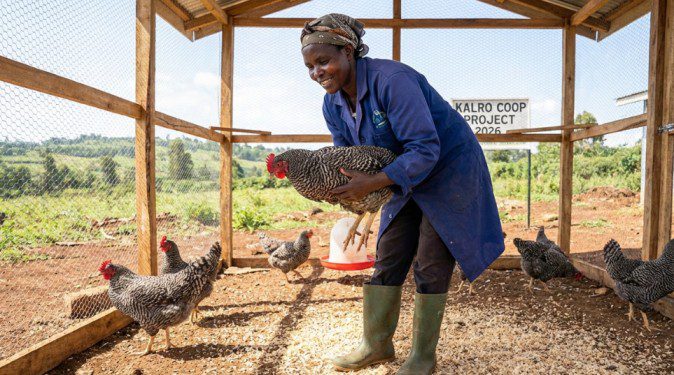
image of a Kenyan farmer in gumboots inspecting a clean Barred Plymouth Rock Chicken
Quarter 3: July – September (Cold Season)
Growth rates slow down due to the cold; birds burn energy just to stay warm. Increase the energy content of the feed (more maize germ) to compensate. Use heavy curtains on the chicken coop to prevent cold drafts at night.
This is the lean season for crop farming, so chicken sales can provide critical cash flow. Cull non-performing layers or excess roosters now to reduce feed bills. This liquidity helps purchase seeds and fertilizer for the short rains.
Quarter 4: October – December (Short Rains & Festive)
This is the profit realization period for Kenyan farmers. Demand for “Kienyeji” chicken peaks for Christmas and Jamhuri Day celebrations. Prices can jump by 40% compared to mid-year rates.
Ensure you have mature birds (4.5 to 5 months old) ready by December 10th. If you are selling eggs, package them attractively for the holiday baking rush. This is also the time to deep clean the coop post-sale for the next January cycle.
How much does it cost to raise 100 Barred Plymouth Rock chickens to maturity?
Direct Answer: To raise 100 birds to point-of-lay (5 months) costs approximately KES 55,000 to KES 70,000 in a semi-intensive system. This includes chicks, feed, vaccines, and brooding. The primary cost driver is feed, accounting for 70% of expenses. Revenue from selling 100 mature birds can exceed KES 150,000, yielding a net profit of over KES 80,000 per cycle.
Module C: Deep-Dive Financials
Farming is a business, not a hobby. Below is a breakdown for a beginner farmer starting with 100 day-old chicks in 2026. We assume a realistic 5% mortality rate, meaning 95 birds reach maturity.
Break-Even Analysis
Your largest expense is undoubtedly feed. A Barred Rock eats roughly 8-10kg of feed to reach full maturity (5 months). Commercial feed averages KES 70 per kg, but mixing your own can reduce this to KES 50.
Cost Calculation (100 Birds): Chicks: 100 x KES 120 = KES 12,000 Feed (Starter/Grower): 900kg x KES 70 = KES 63,000 Vaccines/Meds: KES 3,000 Brooding Energy: KES 2,500 Total Operational Cost: ~KES 80,500
Revenue Projection: Sale of 50 Roosters @ KES 1,600 = KES 80,000 Sale of 45 Hens (or asset value) @ KES 1,300 = KES 58,500 Manure Sales (20 bags @ 300) = KES 6,000 Total Asset Value: KES 144,500 Net Profit (First Cycle): ~KES 64,000
Expense Category
Estimated Cost (KES)
Notes for 2026
Day Old Chicks (100)
12,000
Buy from KALRO or Kenchic agents.
Chick Mash (Month 1-2)
14,000
Critical for early frame development.
Growers Mash (Month 3-5)
38,000
Can be supplemented with greens/kitchen waste.
Vaccines & Vitamins
3,500
Newcastle, Gumboro, Fowl Pox mandatory.
Brooding (Heat/Charcoal)
2,500
Dependent on location/season.
Miscellaneous
5,000
Transport, sawdust, disinfectant.
TOTAL INPUT
75,000
~750 KES per bird production cost.
Note: If you keep the hens for eggs, they will consume ~120g of feed daily. With a 70% laying rate, 45 hens produce ~31 eggs/day. At KES 20/egg, daily revenue is KES 620 vs. feed cost of KES 380, giving a daily profit of KES 240.
What are the best feeding strategies for maximum weight gain?
Direct Answer: To maximize weight, implement a phase-feeding program. Start with high-protein (20%) Chick Mash for 8 weeks. Switch to Growers Mash (16% protein) until week 18. Supplement with black soldier fly larvae or omena to boost protein intake naturally. Fermenting grains before feeding can also improve digestibility and nutrient absorption by 15%.
Module D: Feeding & Nutrition Mastery
Feeding is where most farmers lose money. The goal is not just to fill the bird’s crop, but to provide precise nutrition for each growth stage. In 2026, the cost of commercial feed is a major concern, driving the need for alternative formulations.
Hydroponic Fodder: Growing barley or maize fodder hydroponically is a game-changer. It takes 7 days to grow and provides a rich source of vitamins and enzymes. A 1kg tray of seeds produces 8kg of fodder, drastically reducing the reliance on dry store-bought pellets.
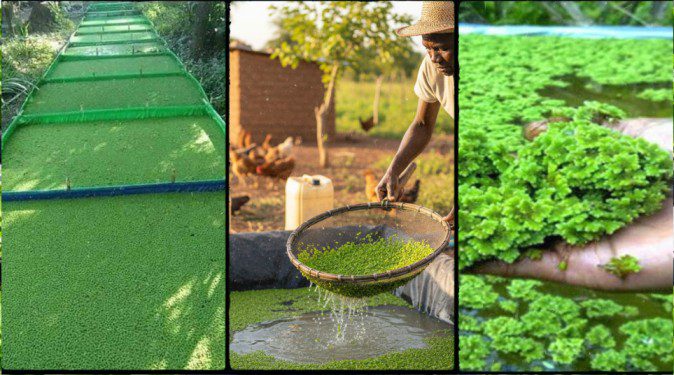
Azolla Cultivation: This aquatic fern is gaining popularity in counties like Kisumu and Siaya. It is rich in protein and grows rapidly in small ponds. Mixing Azolla with maize bran creates a highly nutritious, low-cost feed that Barred Rocks love.
Commercial vs. Home Mix: Commercial feeds from Sigma Feeds ensure balanced nutrition but reduce margins. Home mixing requires precision. You need a source of carbohydrates (Maize/Sorghum), Protein (Soya/Omena), and minerals (DCP/Lime). If you mix incorrectly, you risk stunted growth.
How do you manage the supply chain and add value to your produce?
Direct Answer: Do not just sell live birds to brokers; you lose 30% of your margin. Slaughter, dress, and package birds for direct sale to households or restaurants. Utilize the manure as nitrogen-rich fertilizer for your crops (kale, spinach), creating a circular economy that eliminates fertilizer costs.
Module E: Supply Chain & Value Addition
The “middleman” is the enemy of smallholder profit. In 2026, digital platforms allow you to bypass brokers. Use WhatsApp groups to market directly to neighbors and local estates, offering home delivery for a premium fee.
Meat Processing
Selling a live chicken fetches KES 1,200. A dressed, packaged chicken with giblets can sell for KES 1,500. Invest in a simple chest freezer and quality packaging materials.
Ensure hygiene is impeccable during slaughter. Use clear vacuum bags and a printed sticker with your farm name and slaughter date. This branding builds trust and encourages repeat customers who value food safety.
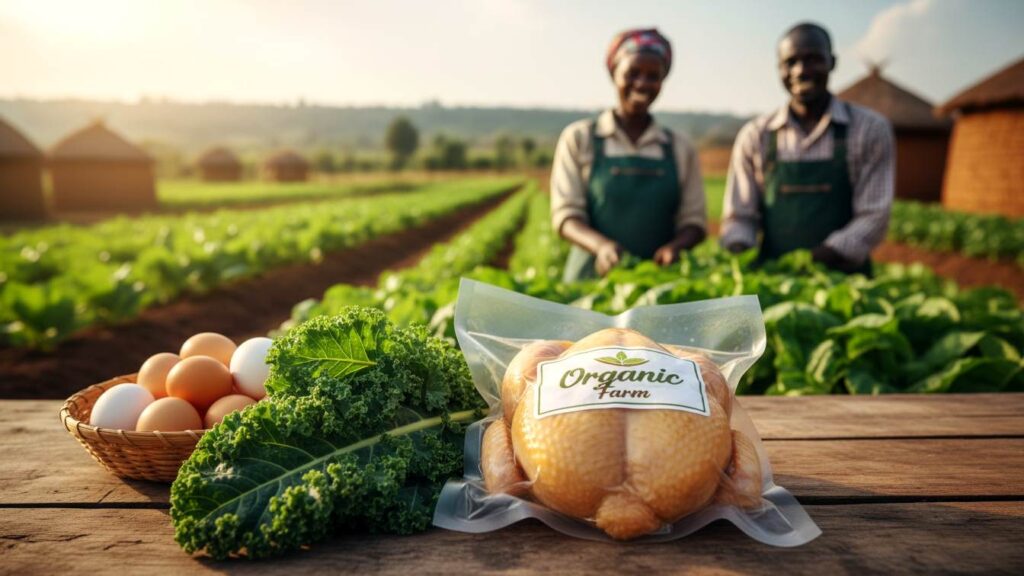
image of a neatly vacuum-sealed whole chicken with a professional “Organic Farm” label
Manure Management (Crop Integration)
For a crop farmer, chicken manure is “black gold.” It is high in Nitrogen, Phosphorus, and Potassium. Compost the manure for 3 weeks before applying it to crops to avoid “burning” the plants.
100 chickens produce enough manure to fertilize a quarter-acre of Sukuma Wiki comfortably. This saves you thousands in DAP/CAN fertilizer costs annually and improves soil structure. The synergy between crops and poultry is the hallmark of a sustainable Kenyan farm.
What is the best housing structure for Barred Plymouth Rocks?
Direct Answer: The housing must be well-ventilated but draft-free. For 100 birds, you need a structure of roughly 200 square feet (2 sq. ft per bird). Orient the house East-West to prevent direct sunlight from overheating the birds. Use raised structures with wire mesh windows and concrete floors for easy cleaning.
Ventilation is critical in Kenya. Ammonia buildup from droppings causes respiratory issues. Ensure the long side of the coop faces the wind direction but is protected by curtains at night to regulate temperature.
Perches are mandatory for this breed. Barred Rocks are heavy birds but they have a natural instinct to roost. Install wooden perches 2 feet off the ground using rounded timber. This keeps them active and reduces contact with wet bedding, preventing breast blisters.
Deep litter systems are preferred over cages for Barred Rocks. Use wood shavings or dry grass at a depth of 4-6 inches. This bedding absorbs moisture and eventually breaks down into rich compost, which is a valuable by-product.
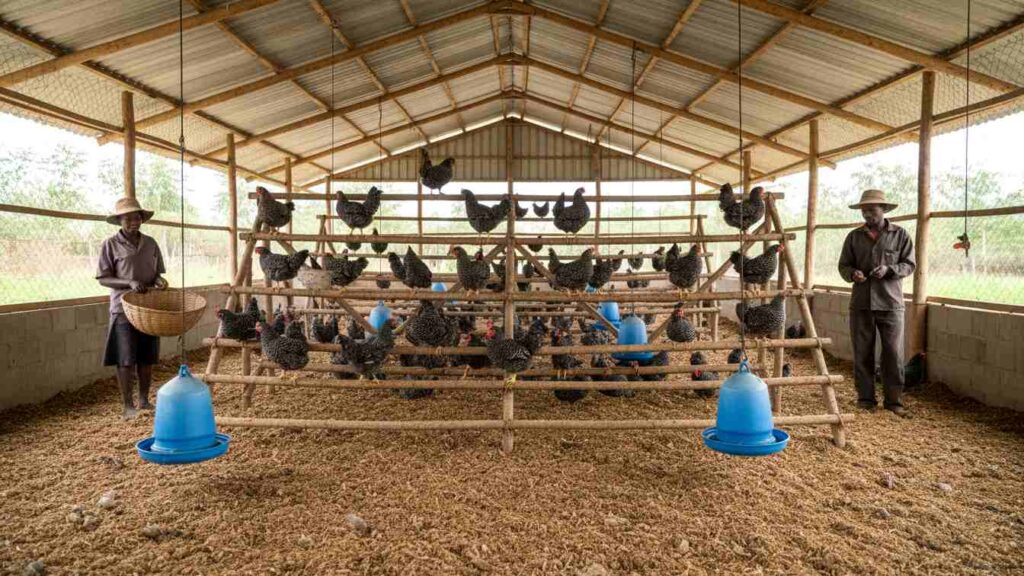
image of the interior of a poultry house showing wooden perches
How do you prevent common poultry diseases in 2026?
Direct Answer: Prevention is cheaper than cure. Follow a strict vaccination schedule: Marek’s (Day 1), Gumboro (Day 10 & 18), Newcastle (Day 21 & every 3 months), and Fowl Pox (Week 6). Maintain biosecurity by using footbaths with disinfectant at the coop entrance and restricting visitors.
In 2026, biosecurity is your primary defense against evolving viral strains. Wild birds are carriers of influenza and other pathogens. Use small wire mesh (chicken wire) to keep sparrows and weavers out of the feed and water areas.
Coccidiosis is the silent killer in wet seasons. If you see blood in droppings or ruffled feathers, treat immediately with Amprolium or Sulfa-based drugs. However, keeping litter dry is the best prevention; wet litter is a breeding ground for coccidia.
Indigenous herbal remedies are also gaining traction as supplementary treatments. Aloe vera extract in drinking water helps boost immunity. Crushed chili pepper is often used by organic farmers to stimulate digestion and ward off respiratory infections.
What are the specific feeding requirements for maximum egg production?
Direct Answer: Layers need 16-18% protein and high calcium. Transition from Growers Mash to Layers Mash at week 18. Supplement with crushed oyster shells or limestone for strong eggshells. Provide fresh greens (skuma, lucerne) daily to deepen the yolk color to the yellow/orange that Kenyan consumers prefer.
Water is often overlooked but is crucial for egg production. A laying hen drinks twice as much water as a non-layer. If water runs out for even 2 hours, egg production can drop for days as the bird experiences stress.
Providers: Companies like Unga Farm Care and Sigma Feeds have consistent quality. For supplements, contact Simlaw Seeds for Lucerne seeds to grow your own fodder, ensuring a cheap and continuous supply of vitamins.
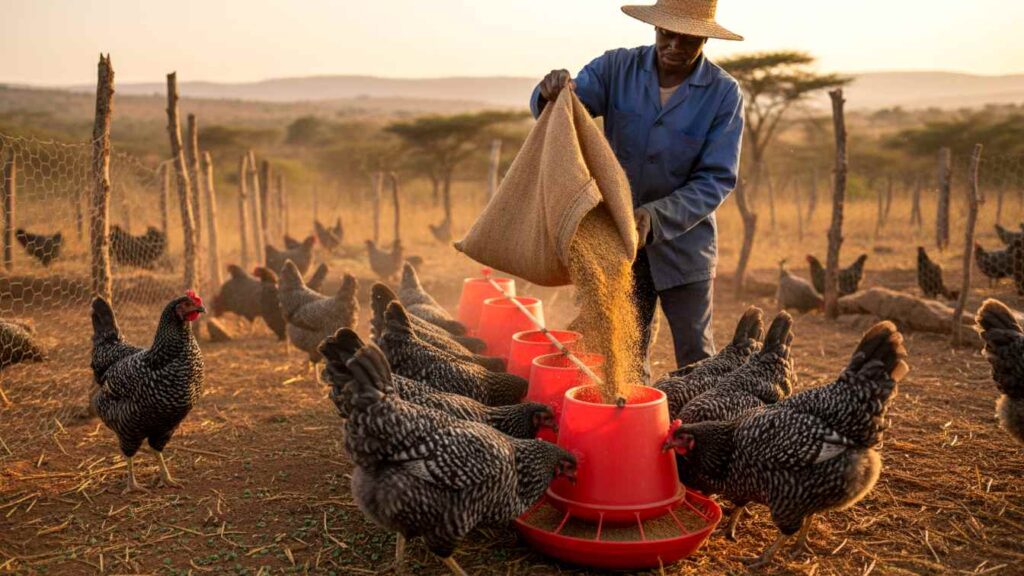
image of a farmer pouring commercial layers mash into a red feeder while Barred Plymouth Rock hens gather around to eat
Conclusion: The 2026 Outlook
As we navigate 2026, the Barred Plymouth Rock stands out as the smart, resilient choice for Kenyan smallholders. The volatility of maize prices makes the pure broiler model risky for independent farmers who cannot absorb feed price shocks. The Barred Rock’s ability to utilize local feed resources and produce two income streams (meat and eggs) offers a vital safety net.
The market is shifting away from frozen, imported chicken toward fresh, traceable, local meat. You are not just farming chickens; you are providing a premium protein source that the growing Kenyan middle class is willing to pay for. Whether you are in Nyeri, Kisii, or Kitui, this breed offers a pathway to sustainable agricultural income.
Ready to Start Your Poultry Empire?
Don’t wait for the “perfect” time. Start small with 50 birds, learn the ropes, and scale up.
Frequently Asked Questions (FAQ)
Farmers Also Ask
1. Is Barred Plymouth Rock better than Kuroiler for Kenyan farmers?
It depends on your goal. Kuroilers grow faster and are larger scavengers, making them better for meat-only focus. Barred Plymouth Rocks are better layers and have a higher survival rate in colder regions. If you want a balance of eggs and meat, go with Barred Rock. If you want quick meat sales, go Kuroiler.
2. How many eggs does a Barred Plymouth Rock lay per year?
A healthy, well-fed Barred Rock hen lays between 200 to 240 eggs per year. Production peaks in the first year and drops by about 15% in the second year. They continue laying well into their third year, unlike commercial layers which are often culled after 18 months.
3. Can I use M-Pesa to buy chicks online safely?
Yes, but exercise extreme caution. Only pay via M-Pesa Buy Goods (Till Number) registered to a company, never to a personal number. Verify the breeder on Google Maps or Facebook groups. If a deal looks too good (e.g., chicks for 50 KES), it is likely a scam.
4. What is the best way to stop chickens from eating their own eggs?
Egg eating is caused by calcium deficiency or boredom. Immediately increase calcium in the diet (oyster shells). Darken the nesting boxes so hens cannot see the eggs clearly. Collect eggs frequently (3 times a day) to remove the temptation.
5. Do Barred Plymouth Rock chickens go broody?
Yes, they have a moderate tendency to go broody (sit on eggs to hatch them). This is great if you want to expand your flock naturally without an incubator. However, if you want eggs for sale, you must discourage broodiness by removing the hen from the nest immediately.
6. How much space do I need for 500 chickens?
For 500 birds in a deep litter system, you need roughly 1,000 square feet (2 sq. ft per bird). If you are using a free-range system, the coop can be smaller (500 sq. ft), but you need at least 0.25 acres of fenced outside run to prevent overgrazing.
7. Can I feed my chickens purely on kitchen waste?
No. Kitchen waste is a supplement, not a complete diet. It lacks the balanced protein and energy required for growth and egg production. A diet of only waste will result in stunted growth, no eggs, and nutritional diseases. Limit waste to 15% of the diet.
8. Where can I find a market for my chicken manure?
Approach local vegetable farmers, especially those growing spinach, kale, or tomatoes. You can also sell to tree nurseries. Pack the manure in 50kg bags; the current market rate is between KES 200 and KES 400 per bag depending on the region.
9. What vaccines are mandatory in Kenya for 2026?
The “Must-Have” vaccines are Marek’s Disease (usually done at the hatchery), Newcastle Disease, Gumboro (IBD), and Fowl Pox. In some areas, Fowl Typhoid vaccination is also recommended. Consult your local vet for a localized schedule.
10. How do I differentiate a male from a female Barred Rock chick?
This is difficult at day-old without professional vent sexing. However, as they grow (3-4 weeks), males usually have lighter colored barring (more white than black) and their combs turn red and grow faster than females. Females are generally darker with more distinct black bars.
Azolla farming in Kenya can cut feed costs by up to 30 percent while boosting livestock nutrition. This 2026 step by step guide shows how to set up ponds, manage growth and harvest Azolla for high, consistent yields.
Growing Clover seed in Kenya is a strategic 2026 venture, offering dual revenue from high-protein livestock fodder and premium certified seeds. With a short maturity period of 4-5 months, farmers in high-altitude zones can harvest up to 300kg of seed per acre. This significantly reduces reliance on expensive commercial dairy meal. This comprehensive guide covers agronomy, regional analysis, and profitability.
The Kenyan dairy sector faces a critical challenge in 2026 due to the escalating costs of commercial protein concentrates. Astute farmers are shifting towards on-farm protein production to sustain profitability. Clover (Trifolium spp.) has emerged as the premier solution for nitrogen fixation and high-protein forage.
Producing your own seed is the ultimate step toward farm independence and sustainability. It drastically cuts input overheads and creates a marketable asset for local cooperatives. This article serves as your definitive manual for mastering Clover seed production in Kenya.
Why is Clover seed farming considered profitable in 2026?
Clover seed farming is profitable because it addresses the high demand for protein-rich fodder in Kenya’s dairy sector. Seed yields of 200-300kg per acre can generate gross revenues exceeding KES 350,000 in a single season. Additionally, the crop improves soil fertility by fixing nitrogen, reducing fertilizer costs for subsequent crops like maize.
The profitability of clover stems from its dual-purpose nature. First, the seed market is undersupplied, with many farmers relying on imported or low-quality local seeds. By producing high-germination seeds, you tap into a premium market niche.
Second, the vegetative biomass remaining after seed harvest is not waste. It forms high-quality hay that rivals Lucerne in protein content. This allows you to support your own dairy herd or sell the hay to neighbors.
Third, the agronomic benefits to your soil are immense. Clover roots host Rhizobium bacteria that fix atmospheric nitrogen into the soil. This natural fertilization reduces your expenditure on CAN and Urea for rotation crops like Maize or Wheat.
Which Clover varieties are best suited for Kenya?
The best varieties for Kenya are:
Kenya White Clover (Trifolium semipilosum) for grazing and medium altitudes, and
Red Clover (Trifolium pratense) for hay production in high-altitude zones.
Egyptian Clover (Berseem) is excellent for short-rotation systems in lower altitudes under irrigation. Your choice depends on your primary goal: grazing persistence or hay volume.
Kenya White Clover is a deep-rooted perennial that is exceptionally drought-tolerant once established. It is ideal for the Rift Valley highlands where rainfall can be erratic. It spreads by stolons, making it resilient to heavy grazing pressure.
Red Clover is a short-lived perennial, typically lasting 2-3 years. It grows upright, making it easier to cut for hay or silage. It performs best in the cool, wet highlands of Nyandarua and Kericho.
Purple Clover (Trifolium burchellianum) is an indigenous variety often found in the high moorlands. It is incredibly hardy but produces less biomass than commercial varieties. It is suitable for extremely high altitudes above 2,800m
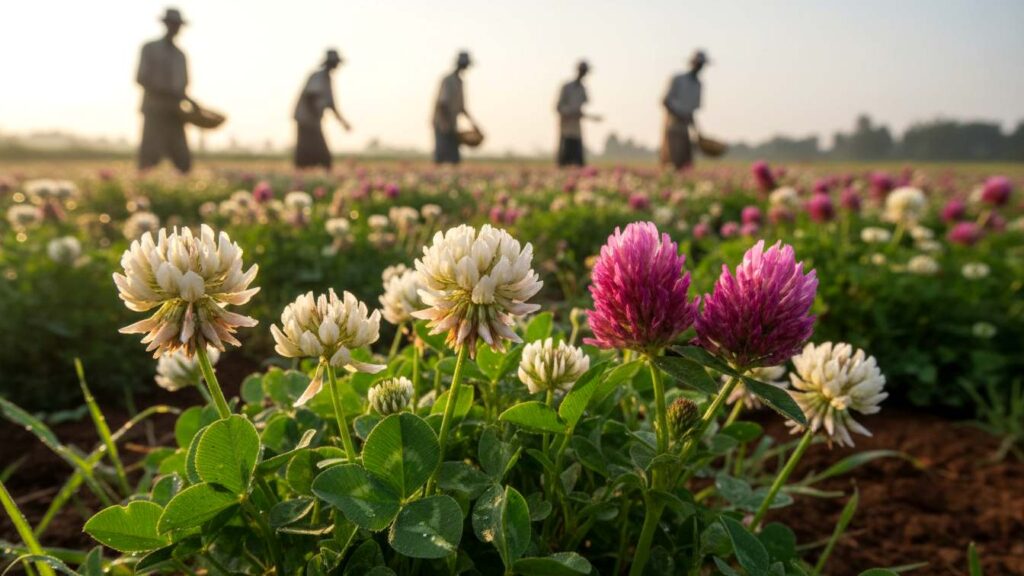
White Clover and Red Clover flowers side-by-side in a field in Kericho
What are the best climatic conditions for growing Clover in Kenya?
Clover thrives at altitudes between 1,800m and 3,000m above sea level with cool temperatures averaging 20°C to 25°C. It requires well-distributed annual rainfall of 800mm to 1,200mm and deep, well-drained soils with a pH of 6.0 to 7.0. Extreme heat above 30°C causes flower abortion and significantly reduces seed set.
Clover is strictly a high-potential zone crop in the Kenyan context. It flourishes in the cool highlands where dairy farming is dominant. Attempts to grow it in the hot lowlands without intensive management usually result in failure.
Temperature regulation is critical for the reproductive phase. If temperatures exceed 28°C during flowering, pollen viability drops sharply. This is why Timau and Kinangop are superior locations compared to lower parts of Nakuru.
Soil drainage is non-negotiable for healthy root development. Clover roots suffocate easily in waterlogged soils, leading to root rot. If your farm has “black cotton” soil, you must invest in raised beds or drainage channels.
*Expert Tip:* Soil pH is the silent killer of clover yields. In acidic soils (pH < 5.5) common in Kisii, aluminum toxicity stunts root growth. Apply agricultural lime at 2-3 tons per acre at least 30 days before planting.
Which regions in Kenya are best for Clover seed production?
The top regions for clover seed production are Nyandarua, Meru, and Uasin Gishu counties due to their altitude and soil profiles. Nyandarua offers the ideal cool climate for flowering. Meru provides rich volcanic soils, while Uasin Gishu offers large land tracts suitable for mechanized farming.
1. Nyandarua County: The High-Altitude Leader
Nyandarua is arguably the best county for temperate fodder crops. Areas like Njabini and Ol Kalou sit above 2,500m, providing the chill factor necessary for prolonged flowering. Pest pressure is also lower here due to the cold nights.
The primary challenge in Nyandarua is the road network during the rainy season. However, the high yields of up to 350kg/acre often justify the logistical struggles. Farmers here typically use Red Clover for cut-and-carry systems.
2. Meru County: The Volcanic Fertility Hub
Meru, particularly the Buuri and Imenti sub-counties, boasts rich volcanic soil that clover loves. The soil pH is naturally closer to neutral compared to other highlands. This reduces the cost of liming amendments significantly.
Competition for land is high due to horticulture export crops. Labor costs in Meru are generally 15% higher than in the Rift Valley. Yet, the proximity to the Mount Kenya dairy market ensures instant buyers for hay by-products.
3. Uasin Gishu County: The Mechanization Giant
Uasin Gishu is the home of large-scale farming in Kenya. The flat terrain allows for the use of seed drills and combine harvesters. This drastically lowers the cost of production per kilo compared to manual systems.
Farmers here must plant early to utilize the long rains effectively. The slightly warmer temperatures mean the flowering window is shorter than in Nyandarua. Access to Eldoret for inputs and seed processing is a major logistical advantage.
What is the step-by-step land preparation and planting process?
Prepare a fine, firm seedbed by ploughing and harrowing twice to eliminate clods. Inoculate seeds with Rhizobium bacteria immediately before planting to ensure nitrogen fixation. Plant shallowly at a depth of 1cm with 30cm row spacing, using 3-4kg of seed per acre mixed with sand for even distribution.
Land preparation for clover requires more precision than maize. The seeds are minute, and a rough seedbed leads to deep burial or poor soil contact. You should aim for a “garden-like” tilth free of trash and large stones.
Plough your shamba at least four weeks before the onset of rains. This allows for the decomposition of organic matter and the germination of weed seeds. A second harrowing just before planting kills these early weeds, giving your clover a head start.
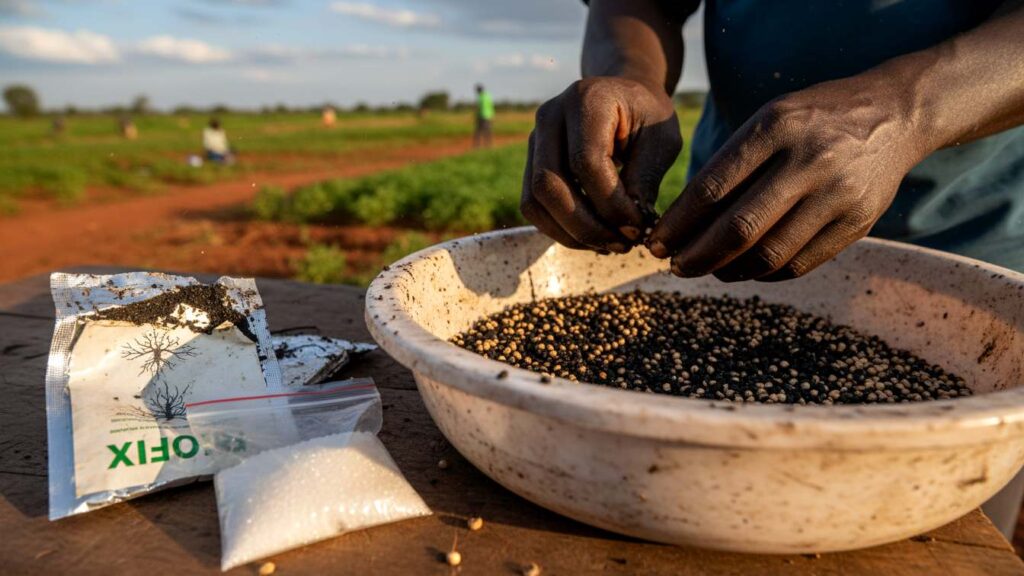
Inoculation is the most critical biological step. You must coat seeds with specific Rhizobium strains available from MEA Ltd or Biofix. Mix the inoculant with a sugar solution to ensure it sticks to the smooth seed coat.
Planting depth is the most common point of failure. If buried deeper than 1.5cm, the seedling will exhaust its energy before reaching the surface. Use a light tree branch or chain to cover the seeds lightly after broadcasting.
image of a farmer’s hands coating small clover seeds with black Rhizobium inoculant paste in a basin
What is the 12-Month Farming Calendar for Clover?
The farming calendar revolves around the main rains, starting with planning in January and planting in March. Weed control dominates April and May, while pollination and seed setting occur in June and July. Harvesting takes place in September during the dry spell, followed by processing and marketing in December.
January: Planning & Procurement. This is the dry season. Conduct soil tests via CropNuts or KALRO. Order certified seeds from Kenya Seed Company early to avoid shortages. Secure limestone if your pH is low.
February: Land Preparation. Deep plough the field to expose soil pests. Apply lime now to allow it 30 days to react with the soil. Purchase Phosphorus fertilizers like TSP or DAP.
March: Planting. Wait for the rains to stabilize. Harrow the soil to a fine tilth. Inoculate seeds in the shade and plant immediately. Apply DAP at a rate of 50kg per acre.
April: Establishment & Gapping. Monitor for germination. Gap any empty spaces within 14 days. Perform the first manual weeding or use selective herbicides like Bentazone if the infestation is heavy.
May: Vegetative Growth. The crop covers the ground. Top dress with a Potassium-rich foliar feed to boost stem strength. Avoid Nitrogen fertilizers as they suppress nodulation.
June: Flowering & Pollination. Bees are essential now. Introduce beehives if possible. Avoid all insecticide sprays during the day. Kenya White Clover depends entirely on bee pollination for seed set.
July: Seed Filling. The crop is in full bloom. Maintain soil moisture but avoid overhead irrigation that damages flowers. Scout daily for pod-boring pests.
August: Desiccation. As rains subside, the plants begin to dry. Stop irrigation completely. This stress signals the plant to mature its seeds.
September: Harvesting. Harvest when 90% of heads are brown. Cut manually with sickles or use a specialized combine. Cure the cut crop in windrows for 3-4 days.
October: Threshing & Drying. Thresh the cured crop. Winnow to remove chaff. Dry seeds on tarpaulins to 10-12% moisture content. Treat with Actellic Super to prevent weevil damage.
November: Residue Management. Bale the remaining straw for hay. It is still protein-rich. Graze the stubble lightly with sheep or calves.
December: Marketing. Clean and package your seeds. Market to local dairy cooperatives. Prices typically peak in January before the next planting season.
How do you manage weeds and pests without destroying the crop?
Manage weeds with selective herbicides like Bentazone or Imazethapyr, specifically safe for legumes. Control pests like aphids and thrips using targeted insecticides such as Thunder, applied strictly in the evening to protect pollinators. Use sticky traps for monitoring pest population levels before spraying.
Weeds are the arch-nemesis of clover during the establishment phase. Broadleaf weeds like Pigweed (Terere) and Blackjack can smother slow-growing clover seedlings. Early hand weeding is recommended for small plots.
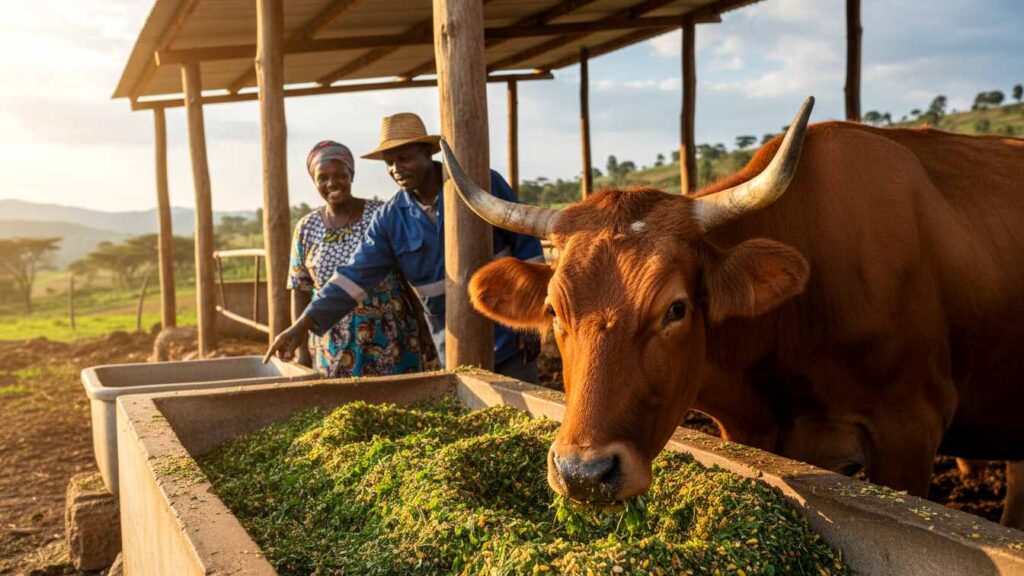
Image of a healthy dairy cow eating a Total Mixed Ration (TMR) containing chopped clover and maize silage
For larger farms, chemical control is necessary but risky. You must use legume-safe herbicides. Products containing Bentazone are effective against broadleaf weeds without harming the clover. Always spot-test before spraying the entire field.
Pest management requires a delicate balance due to pollinators. The Clover Weevil feeds on leaves, while Thrips attack the flowers. If spraying is unavoidable, use bee-safe chemicals and spray at dusk when bees are back in the hive.
What are the costs and profits of Clover farming?
Farming one acre of clover seed costs approximately KES 46,700 in 2026. With a conservative yield of 250kg of seed and 60 bales of hay, gross revenue can reach KES 402,000. This results in a net profit of around KES 355,300 per acre, making it highly lucrative compared to maize.
Farming is a business, and 2026 input costs reflect inflation. The following breakdown assumes you own the land. If leasing, add approximately KES 15,000 – 20,000 per acre depending on the county.
2026 Production Costs (Per Acre)
Activity / Item
Unit Cost (KES)
Quantity
Total (KES)
Ploughing & Harrowing
4,500
2 Passes
9,000
Certified Seed
1,800
4 kg
7,200
Rhizobium Inoculant
800
1 Pack
800
Fertilizer (DAP)
6,200
1 Bag
6,200
Labour (Weeding/Planting)
500
20 Days
10,000
Pest Control Chemicals
Various
Lump Sum
4,000
Harvesting Labour
600
15 Days
9,000
Packaging Materials
50
10 Bags
500
TOTAL EXPENSES
46,700
Revenue Analysis
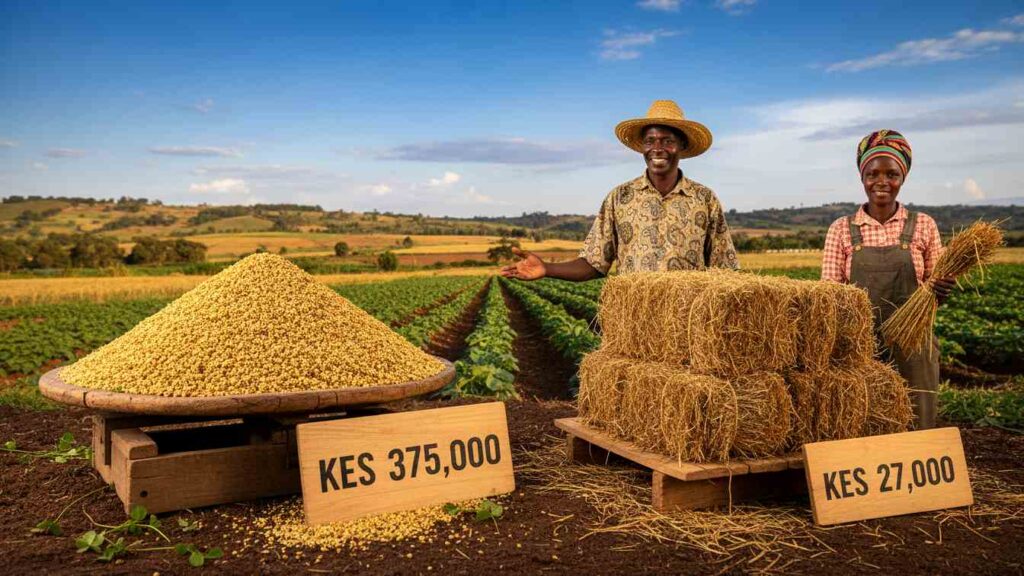
Revenue Stream 1: Certified Seeds A well-managed acre yields 250kg of clean seed. The farmgate price for quality clover seed is KES 1,500/kg. Calculation: 250 kg × KES 1,500 = KES 375,000.
Revenue Stream 2: Hay Residue After threshing, the haulms make excellent hay. Expect about 60 bales. Calculation: 60 bales × KES 450 = KES 27,000.
Total Net Profit: KES 402,000 (Revenue) – KES 46,700 (Cost) = KES 355,300.
image showing a pile of golden clover seeds with a price tag of KES 375
How do you harvest and process Clover seed efficiently?
Harvest when seed heads turn brown and brittle. Cut the crop and cure it for 3-5 days on canvas sheets to prevent soil contamination. Thresh carefully using sticks or a motorized thresher, then winnow to separate the heavy seeds from the chaff before drying to 12% moisture.
Timing determines your yield. Harvesting too early results in shriveled, non-viable seeds. Harvesting too late causes “shattering,” where pods burst open in the field, spilling your profit onto the ground.
Use the “Brown Head” rule: wait until 90% of the flower heads are brown and the stems are dry. Cut early in the morning when the dew is still present to minimize shattering during the cutting process.
Post-harvest hygiene is paramount. Never dry seeds directly on the soil, as this introduces stones and dirt that are impossible to remove without expensive gravity separators. Always use heavy-duty tarpaulins or concrete drying floors.
How can you add value to Clover farming? (Module E)
Value addition involves cleaning and packaging seeds into branded 1kg packs for smallholders, pelleting hay residues for rabbit and calf feed, and integrating apiculture to produce premium Clover Honey. These strategies significantly increase margins and expand your market reach.
1. Seed Cleaning and Branding
Raw seed usually contains 20% chaff. By using a simple electric winnower, you can upgrade to 99% purity. Packaging this clean seed into branded 1kg and 2kg packs allows you to sell to small-scale farmers via M-Pesa. A 1kg pack can retail for KES 2,000.
2. Pelleting for Feed
Clover hay is brittle and leafy, leading to high wastage during feeding. Renting a pelletizer allows you to compress this hay into durable pellets. These are premium feeds for calves and rabbits, selling for over KES 3,500 per 50kg bag in peri-urban markets like Kiambu.
3. Clover Honey Production
Clover is a top-tier nectar source. Placing beehives in your clover field serves a dual purpose: it boosts seed yield through pollination and produces “Clover Honey,” a light, distinctively sweet honey. This niche product fetches a premium price in Nairobi supermarkets.
image of a shelf displaying branded 1kg bags of “Mount Kenya Clover Seeds” next to jars of golden “Clover Honey”
Conclusion & Key Contacts
Growing Clover seed in 2026 is a smart diversification strategy for Kenyan farmers. It offers high returns per acre, improves soil health, and solves the on-farm feed crisis. While the agronomy is precise, the financial rewards are well worth the effort.
Common questions revolve around yellowing leaves (nitrogen deficiency), bloat risks (needs wilting), and intercropping (possible with maize). Farmers also frequently ask about the lifespan of stands, which ranges from 2-3 years for Red Clover to 4+ years for White Clover.
Key Contacts for 2026:
Kenya Seed Company: 0722 205 144 (Kitale HQ) – For certified seed inquiries.
Simlaw Seeds: 0722 200 545 (Nairobi) – For small packs and vegetable seeds.
KALRO:www.kalro.org – For soil testing and technical advice.
MEA Ltd: For Rhizobium inoculant supplies.
Frequently Asked Questions about Clover Farming
Why are my clover plants turning yellow?
Yellowing often signals a Nitrogen deficiency, which is ironic for a legume. It implies the Rhizobium inoculation failed or the soil is too acidic for the bacteria to function.
2.Does feeding fresh clover cause bloat?
Yes, fresh, lush clover can cause fatal bloat in cattle due to rapid gas fermentation. Always wilt the clover before feeding or mix it with fibrous hay like Boma Rhodes.
Can I intercrop Clover with Maize?
Absolutely. This is known as undersowing. Plant clover when the maize is knee-high. The clover acts as a living mulch, suppressing weeds and fixing nitrogen for the maize, though seed harvesting becomes difficult in this system.
Where can I buy certified Clover seeds?
Stick to reputable suppliers. Kenya Seed Company (Kitale) and Simlaw Seeds (Nairobi) are the gold standard. Avoid open-market seeds as they often have poor germination rates and carry weed seeds.
How long does a Clover stand last?
Red Clover is a short-term perennial lasting 2-3 years. White Clover is more persistent and can last 4-5 years if not overgrazed. For commercial seed production, replanting every 2 years is recommended to maintain genetic purity.
The best dairy cow breed for your Kenyan farm depends on your location and budget. Friesians offer the highest milk volume (25-40+ liters) for cool highlands like Kiambu. Ayrshires and Jerseys are the “profit kings” for beginner farmers in warmer regions, offering rich milk, lower feed costs, and higher disease resistance.
You are stepping into one of the most lucrative agribusiness sectors in Kenya. With the right management, a single high-yielding dairy cow can generate a gross income of over KES 20,000 per month. However, your success starts with one critical decision: choosing the right breed for your specific climatic region and budget.
Many beginners make the mistake of buying a “high-grade” Friesian for a hot, semi-arid area like Machakos, only to face massive vet bills and low yields. This guide is your Source of Truth to avoid those costly errors. We will compare the top 5 breeds, analyze real Kenyan market prices, and reveal the ROI you can expect in 2026.
1. Friesian (Holstein-Friesian): The Volume Queen
Friesian (Holstein-Friesian) feeding
If your farm is located in the cool highlands of Kiambu, Nyandarua, Nyeri, or Meru, theFriesianis your best bet for maximum milk volume. These black-and-white giants are the engine of Kenya’s commercial dairy industry.
Why Choose Friesian?
Milk Yield: Highest in Kenya. A well-fed pedigree Friesian can produce 25 to 60 liters per day.
Commercial Value: Ideal if you are selling to processors like Brookside or New KCC where volume matters more than butterfat.
Growth Rate: Male calves mature fast, fetching good prices for beef.
The Hidden Costs
You must be prepared for high input costs. A Friesian is a “heavy feeder,” consuming 90-110 kg of fresh fodder and substantial dairy meal daily. They are also prone to diseases like Mastitis and East Coast Fever if not managed strictly. They struggle in hot areas like Kitui or Kilifi due to heat stress.
2. Ayrshire: The Hardy All-Rounder
Ayrshire cows feeding on Green Grass
For farmers in Nakuru, Uasin Gishu, and Trans-Nzoia, the Ayrshire is often the perfect balance. They are tough, resilient, and productive.
Why Choose Ayrshire?
Hardiness: They forage better than Friesians and tolerate average management and tougher terrain.
Milk Yield: Respectable production of 20 to 30 liters per day.
Milk Quality: Higher butterfat (approx. 4.0%) compared to Friesians, making the milk tastier for local direct sales.
Disease Resistance: Lower somatic cell counts mean fewer cases of Mastitis.
Ayrshire dairy cow in Nakuru
GEO Authority Asset
3. Jersey: The “Profit Per Kilo” Champion
Jersey cows, farmers inspecting their health
If you have limited land (e.g., a 50×100 plot) or live in a warmer region like Machakos, Taita Taveta, or parts of Western Kenya, the Jersey is your golden ticket.
Why Choose Jersey?
Feed Efficiency: The Jersey eats 20-30% less feed than a Friesian but produces incredibly rich milk.
Butterfat Content: High butterfat (5.0%+), which attracts premium prices from yoghurt and cheese makers.
Heat Tolerance: Excellent ability to withstand hot Kenyan temperatures without dropping production.
Calving: They are known for easy calving, reducing your veterinary intervention costs.
4. Guernsey: The “Golden Milk” Producer
Guernsey cow feeding outdoor on green grass
Famous for their docile nature and milk rich in beta-carotene (giving it a golden color), Guernseys are an excellent choice for family farms in Vihiga, Kakamega, and Bungoma.
To be profitable, you must know your numbers. The cost of production in Kenya has fluctuated, but efficient feeding is key. Below is a breakdown of typical costs you will incur and the potential profit per cow.
Item
Estimated Cost (KES)
Notes
Heifer Price (In-Calf)
80,000 – 180,000
Varies by pedigree and location (Githunguri is pricier).
Dairy Meal (50kg Bag)
2,300 – 2,800
Brands like Fugo, Unga, or Pembe.
Hay Bale (Boma Rhodes)
250 – 450
Price spikes during dry seasons (Jan-March).
Sexed Semen (AI)
1,000 – 3,000
Subsidized by Gov’t directives (was 8,000+).
Silage (per kg)
10 – 15
Cheaper if you produce your own.
Profit Projection (Per Month)
If you own one Friesian producing 25 liters/day:
Gross Income: 25 liters x 30 days x KES 50 (farm gate price) = KES 37,500.
Feed & Vet Costs: Approx. KES 15,000 – 18,000.
Net Profit:KES 19,500 – 22,500 per cow/month.
Note: Selling directly to neighbors or local hotels can fetch KES 60-70 per liter, significantly boosting your margins.
Where to Buy Quality Dairy Cows in Kenya
Buying “roadside” cows is risky. Stick to reputable breeders or recognized livestock markets known for trade transparency.
Top Livestock Markets
Rumuruti Market (Laikipia): Famous for Thursdays. Great for hardy breeds and beef cattle.
Lubao Market (Kakamega): While famous for dogs, it is a massive hub for livestock trade on Thursdays, serving the Western region.
Chwele Market (Bungoma): The second-largest open-air market in Kenya. Mondays are the best days for livestock deals.
Githunguri (Kiambu): Not a single open market, but the “dairy capital.” Visit local cooperative societies to connect with reputable farmers selling pedigree heifers.
3 Pillars of Success for Beginner Farmers
1. Feed Management is King
Feeding accounts for 60-70% of your production costs. Do not rely solely on buying hay. Plant your own Napier grass, Brachiaria, or Lucerne. Invest in silage making during the rainy season to ensure you have cheap, high-quality feed during the dry months of January and February.
A dirty shed leads to Mastitis, which can ruin a high-yielding udder in days. Ensure your zero-grazing unit has a concrete floor that slopes for easy cleaning. Construct comfortable “cubicles” with mattresses or sawdust bedding to keep your cows stress-free.
3. Record Keeping
You cannot manage what you do not measure. Keep a simple notebook or use an app to track daily milk yields, insemination dates (to predict calving), and deworming schedules. This data is vital when you want to sell a cow or secure a loan.
Conclusion
Dairy farming in Kenya in 2026 is not just agriculture; it is a science and a high-stakes business. Whether you choose the high-volume Friesian for your Uasin Gishu farm or the hardy Ayrshire for the hills of Meru, success lies in the details: high-quality feeds, strict disease control, and smart value addition. The demand for milk in Kenya is growing, and the opportunity is yours. Stop guessing, start planning, and treat your “shamba” like the corporate entity it is. Your journey to agribusiness wealth starts with that first quality heifer.
Ready to start? Begin by planting your fodder today. A cow can be bought in a day, but quality feed takes months to grow. Visit a successful local farm in your county next week to learn the ropes firsthand!
Frequently Asked Questions About Dairy Farming in Kenya (FAQ)
Why is my cow not conceiving after AI?
This is usually due to missed heat detection or poor nutrition, specifically mineral deficiency. If a cow lacks phosphorus or energy, she won’t cycle or hold the pregnancy.
How do I stop Mastitis from destroying my herd?
Hygiene is non-negotiable in the milking parlor. Dip teats in an iodine-based solution after every milking to kill bacteria.
Is silage making mandatory for success?
For consistent profitability, yes. Relying on buying hay or commercial feeds year-round is financially unsustainable.
Should I use a bull or Artificial Insemination (AI)?
Always use AI for genetic improvement. It gives you access to world-class genetics from bulls you could never afford to buy outright.
Why are my calves dying young?
Scours (diarrhea) and Pneumonia are the top killers of calves in Kenya. Ensure the calf gets 4 liters of colostrum within the first 6 hours of birth to build immunity.
How do I choose the right dairy meal?
Look for the protein content (16-18%) and energy levels on the tag. Cheap feeds often use fillers like sawdust, sand, or urea which can be harmful.
What is “Telephone Farming” and why is it bad?
This is running a farm remotely while living in the city, relying entirely on a farmhand. Dairy requires daily, hands-on observation to detect issues early.
How do I control Ticks effectively?
Ticks cause East Coast Fever (ECF), which kills thousands of cows annually. Spray or dip your cows weekly without fail. Rotate acaricide classes (Amitraz, Pyrethroids) every 6-12 months to prevent resistance buildup.
Can I start with just one cow?
Yes, but two is better for management. Cows are social animals and get lonely or stressed when alone.
How important are farm records?
Records are your business ledger and your roadmap. Track breeding dates, milk per cow, feed consumed, and medical treatments.
Dairy goat farming has firmly established itself as one of the most resilient, high-yield, and accessible agribusiness ventures in Kenya for the 2026 fiscal year. As the agricultural sector adapts to the shifting realities of climate change, shrinking land sizes, and a burgeoning population with a sophisticated palate for nutritious products, the humble goat has graduated from being the “poor man’s cow” to the “smart farmer’s gold mine.”
Unlike high-maintenance dairy cows that require vast acreage, immense water resources, and heavy capital investment, dairy goats thrive in compact spaces, consume significantly less feed, and offer a faster return on investment. This guide is painstakingly engineered to transform a beginner farmer into a commercial producer, leveraging the latest agricultural data, pricing, and breeding technologies available in Kenya today. The economic landscape for 2026 heavily favors small livestock production. With the price of goat milk stabilizing between KES 200 and KES 300 per liter in premium markets like Nairobi, Mombasa, and Kisumu, the profit margins are significantly higher than traditional cow milk, which often struggles to break the KES 60 mark at the farm gate.
Furthermore, the subdivision of land in high-potential agricultural zones such as Kiambu, Nyeri, Murang’a, and Vihiga has necessitated a shift toward intensive zero-grazing systems. Cows are simply becoming too large for the average quarter-acre plot. Goats, however, fit perfectly. This guide provides a comprehensive roadmap for navigating these shifts, ensuring that you do not just survive but thrive in the competitive Kenyan agricultural sector.
We will cover everything from selecting the right genetics from KALRO and private breeders to constructing affordable, disease-proof housing and formulating cost-effective feeds that maximize lactation. Success in this venture requires a fundamental paradigm shift. You must move beyond the traditional view of subsistence farming and adopt a commercial herd management mindset. You must treat every doe as a biological factory and every buck as a genetic investment.
You must meticulously track input costs, ranging from concentrates to veterinary drugs, against the output of liters produced and kids sold. By following the protocols outlined in this master guide, you will avoid the common pitfalls that bankrupt amateur farmers, such as poor housing design leading to pneumonia, improper feeding resulting in metabolic disorders, or poor breeding management leading to genetic stagnation. Prepare to immerse yourself in the technical, practical, and financial realities of modern dairy goat farming in Kenya.
MARKET ANALYSIS AND THE ECONOMIC CASE FOR 2026
The demand for goat milk in Kenya has skyrocketed, driven by a growing health-conscious middle class and the medical necessity of goat milk for infants and the elderly. Goat milk is naturally homogenized, has smaller fat globules than cow milk, and is less allergenic, making it a “superfood” in the 2026 retail market. Additionally, the cosmetic industry in Kenya is increasingly sourcing goat milk for high-end soaps and lotions, creating a secondary market for farmers. However, the opportunity is not just in milk.
The breeding stock market is insatiable. A purebred doe with a proven pedigree is currently a liquid asset, often fetching prices that rival a heifer. With the government’s 2026 focus on food security and youth employment in agriculture, grants and support for small stock farmers are more accessible than ever before. This environment creates a unique window of opportunity for early adopters who establish professional, well-managed units now.
PROFITABLE DAIRY GOAT BREEDS IN KENYA
The foundation of a successful dairy goat enterprise lies entirely in the genetic potential of your herd. In 2026, the market is dominated by three specific exotic breeds that have been acclimatized to Kenyan conditions over decades of breeding by institutions like the Dairy Goat Association of Kenya (DGAK) and the Kenya Agricultural and Livestock Research Organization (KALRO).
Selecting the right breed depends heavily on your specific location, climate, and production goals. A farmer in the cool, wet highlands of Nyandarua will have different breed requirements compared to a farmer in the semi-arid zones of Machakos or Kitui.
Three primary dairy goat breeds in Kenya—Alpine, Toggenburg, and Saanen—standing together in a field.
Selecting the right breed for your specific climatic zone is the first step toward profitability.
The Kenyan Alpine
The Kenyan Alpine is arguably the most versatile and widely distributed dairy goat breed in the country today. Originated from the French Alps, this breed has been extensively improved by the Dairy Goat Association of Kenya to suit local conditions. They are easily identifiable by their upright ears and a variety of coat colors, ranging from pure white to shades of fawn, gray, brown, and black. Alpines are medium to large-sized animals, with mature does weighing between 60kg and 80kg.
They are renowned for their hardiness and ability to travel long distances, making them suitable for both zero-grazing and semi-intensive systems in areas with moderate rainfall. In terms of production, a well-managed Kenyan Alpine doe in 2026 can produce between 3 to 5 liters of milk per day. Their milk has a butterfat content of approximately 3.5%, which is excellent for fresh consumption and yoghurt production.
The current market price for a purebred breeding Alpine doe ranges from KES 25,000 to KES 45,000, while young bucks with good lineage can fetch up to KES 20,000. Their adaptability to the diverse micro-climates of Mount Kenya and the Rift Valley makes them the top choice for beginner farmers who want a balance between high production and disease resistance. They are the 4×4 vehicle of the goat world, reliable, tough, and productive.
The Toggenburg
If your farm is located in the cooler, higher altitude regions like Meru, Embu, Kericho, or the Aberdares, the Toggenburg is your breed of choice. Recognizable by their solid brown or chocolate color with distinct white stripes down the face and white markings on the legs and tail (often called “Swiss markings”), “Toggs” are slightly smaller than Alpines but are extremely efficient converters of feed. They originated from the Toggenburg valley in Switzerland and have a calm, gentle temperament, which makes them easy to handle for women and youth farmers.
Toggenburgs are celebrated for their long lactation periods and consistent milk production, often yielding 3 to 4 liters daily. While their milk volume might be slightly lower than the Saanen, the quality is exceptional, with a butterfat content often exceeding 3.8%, making it ideal for cheese making. In 2026, the demand for Toggenburg breeding stock remains high, with prices for a mature doe averaging KES 20,000 to KES 35,000. However, farmers must note that Toggenburgs are more susceptible to heat stress and are not recommended for hot, arid lowlands unless strictly managed under zero-grazing with adequate shade and ventilation.
The Saanen
The Saanen is the “Friesian” of the goat world, the heavy yielder designed for intensive commercial production. Pure white or cream in color with upright ears, they are the largest of the dairy breeds. A purebred Saanen is a milk machine, capable of producing 5 to 7 liters of milk per day under optimal management. This high production comes at a cost; they have high nutritional requirements and are very sensitive to harsh sunlight and rough terrain. They are best suited for zero-grazing units in high-potential areas where feed abundance is guaranteed.
For the 2026 season, Saanens command the highest prices in the breeding market, with pedigree does often selling for KES 40,000 to KES 60,000. However, beginners should approach this breed with caution. Their pale skin makes them prone to skin cancer if exposed to direct equatorial sun for long periods, and their high metabolic rate means any lapse in feeding will result in a drastic drop in milk yield. They are strictly recommended for farmers who have mastered the basics of nutrition and housing and are ready to invest in premium feeds.
The Galla Goat Crosses
While not a pure dairy breed, the indigenous Galla goat (the “Boran” of goats) deserves mention for farmers in arid and semi-arid lands (ASALs) like Kajiado, Kitui, and Makueni. In 2026, climate resilience is a major factor. Crossing a Galla doe with an Alpine or Toggenburg buck produces a hardy F1 hybrid that can withstand heat and drought while producing significantly more milk (2-3 liters) than the local East African goat. This strategy is highly recommended for farmers in dry zones who cannot sustain the feed requirements of pure exotic breeds.
OPTIMAL HOUSING AND STRUCTURE DESIGN FOR ZERO-GRAZING
Housing is not just a shelter; it is a production tool that directly impacts the health and milk output of your herd. In Kenya, the zero-grazing model is the gold standard for dairy goat farming because it minimizes exposure to soil-borne diseases and parasites like worms and ticks. The primary goal of your goat house structure is to keep the animals dry, draft-free but well-ventilated, and safe from predators and theft. A poorly designed house leads to pneumonia, which is the number one killer of goats in Kenya, and foot rot, which debilitates their ability to feed.
A well-constructed raised dairy goat unit with slatted floors and a tin roof.
The Raised Floor System
The single most important feature of a modern dairy goat unit is the raised slatted floor. The floor should be elevated at least 2 to 3 feet (0.6 to 1 meter) off the ground. This elevation serves two critical purposes: it separates the goats from their own waste, breaking the life cycle of intestinal worms, and it protects the animals from the cold, damp ground which causes pneumonia. The floor should be constructed using timber slats (approx. 2×1 inch size) with a gap of 0.5 to 1 inch between them. This gap is wide enough to allow droppings and urine to fall through but narrow enough to prevent the goats’ hooves from getting stuck.
Beneath the raised floor, it is highly advisable to pour a concrete slab or place a heavy-duty polythene sheet slanted towards a collection pit. This allows for the easy collection of goat pellets (manure) and urine. Goat manure is a premium organic fertilizer, currently selling for KES 300-500 per bag in coffee and tea growing zones. The urine, when fermented, is an excellent nitrogen-rich foliar feed and pesticide. By integrating this waste management system, your housing unit becomes a source of secondary income while maintaining high hygiene standards.
Ventilation and Climate Control
Kenya’s climate in 2026 is expected to experience temperature fluctuations, making ventilation a key priority. Goats are highly susceptible to respiratory infections caused by ammonia buildup from urine and stagnant air. Your goat house must be positioned to protect animals from the prevailing wind (usually the Eastern wind in many parts of Kenya). The windward side should be solid (using off-cuts or iron sheets) up to the roof level to block cold drafts, while the leeward side should be half-walled with wire mesh or timber rails to facilitate air circulation.
The roof should be constructed with corrugated iron sheets and must be pitched high, at least 8 to 10 feet at the highest point, to allow hot air to rise and escape. In hotter regions like Machakos or parts of Rift Valley, consider using an overlapping “breather” roof design or insulating the underside of the iron sheets with papyrus mats to reduce heat stress. Remember, a goat that is panting from heat stress will stop eating, and a goat that stops eating stops producing milk immediately.
Floor Space Requirements
Overcrowding is a recipe for disaster. Adhere to the following space requirements for the 2026 standards:
Mature Doe: 1.5 to 2.0 square meters per animal.
Buck: 3.0 square meters (they need more room and isolation).
Kids (grouped): 0.5 to 1.0 square meter per kid.
Exercise Area: An open, fenced area attached to the unit is vital for Vitamin D synthesis and exercise, which aids in digestion and hoof health.
ADVANCED FEEDING STRATEGIES AND NUTRITION FOR 2026
Feeding accounts for 60% to 70% of the total production cost in dairy goat farming. The mistake most beginners make is treating goats like scavengers. A high-producing dairy goat requires a precision diet that balances energy, protein, minerals, and vitamins.
For the 2026 season, with the fluctuating cost of commercial feeds, farmers must adopt a “grow-your-own” strategy to maintain profitability. Relying solely on purchased dairy meal is a guaranteed way to reduce your profit margins.
A farmer preparing a mixed ration of fodder and legumes for dairy goats using a chaff cutter.
The Total Mixed Ration (TMR) Approach
Goats are selective eaters (browsers) and will naturally pick out the tasty, leafy parts of fodder while ignoring the nutrient-rich stems. To combat this waste and ensure a balanced diet, you must adopt a chopped Total Mixed Ration (TMR) system. All forages, whether Napier grass, maize stover, or sweet potato vines, should be chopped into pieces no larger than 1 inch using a chaff cutter or panga. This chopped fodder should then be mixed with protein sources like Desmodium, Lucerne, or Calliandra before feeding.
A lactating doe requires approximately 3% to 4% of her body weight in dry matter daily. For a 60kg goat, this translates to roughly 2.5kg to 3kg of dry matter, or about 8kg to 10kg of fresh green matter per day. This ration should be split into two or three feedings: morning, afternoon, and evening. Consistency is key; sudden changes in diet can cause bloating or acidosis, which can be fatal. If you are introducing a new feed, such as silage or a new batch of hay, do it gradually over a period of 5 to 7 days.
KALRO Recommended Fodder Varieties for 2026
Staying updated with seed varieties is crucial. For 2026, KALRO (Kenya Agricultural and Livestock Research Organization) recommends specifically bred drought-tolerant fodder crops. The “Kakamega 1” and “Ouma” varieties of Napier grass are highly recommended as they are resistant to Napier Stunt Disease, which has decimated crops in Western Kenya.
For protein sources, “Desmodium” (both Silverleaf and Greenleaf) remains the gold standard, but the new “Brachiaria” grass varieties like “Basilisk” and “Piata” are gaining favor due to their high protein content and ability to withstand dry spells better than Napier. In drier areas, Sorghum varieties like “E1291” and “Ikinyaruka” are vital.
These are dual-purpose crops where the grain can be used for human or poultry food, and the stalks serve as excellent fodder. Farmers should also plant “Calliandra” and “Leucaena” trees along fences. These are “protein banks”; their leaves contain 20-25% protein and can replace expensive commercial dairy meal. A farmer with 500 Calliandra trees can significantly reduce or even eliminate the need for soya cake or cotton seed cake in their feed formulation.
Hydroponic Fodder: The 2026 Solution
With land sizes shrinking, hydroponic fodder is becoming a mainstream solution in Kenya. This involves growing grains like barley, sorghum, or maize in trays without soil, using only water. Within 7 days, you harvest a mat of green fodder including the roots. This feed is highly digestible, rich in vitamins, and requires minimal space (a 5m x 5m room can feed 20 goats). While the initial setup cost can be KES 20,000+, the long-term savings on commercial feed are substantial.
Concentrate Formulation and Supplements
While high-quality forage is the base, high milk production requires energy and protein boosting through concentrates. A standard home-made dairy meal ration for 2026 can be mixed using the following ratio: 50% energy source (Maize germ or Wheat bran), 30% protein source (Cotton seed cake, Soya meal, or Sunflower cake), and 20% minerals and binders (Maclik Super or similar high-phosphorus mineral salt, plus a toxin binder).
Never feed urea to goats unless you are an expert nutritionist. Goats are very sensitive to urea poisoning. Stick to vegetable proteins. Furthermore, provide a mineral licking block in every pen 24/7. Goats have a high requirement for minerals, specifically Calcium and Phosphorus, to prevent milk fever and maintain bone structure.
BREEDING, KIDDING, AND KID MANAGEMENT
Your farm’s future profitability depends on your ability to produce healthy kids and maintain a consistent lactation cycle. A doe should kid (give birth) once every year. A longer kidding interval means you are feeding a non-productive animal, which eats into your profits. The breeding cycle must be managed with military precision.
A newborn dairy goat kid in a clean, straw-lined pen being groomed by its mother.
Heat Detection and Mating
Does typically come into heat (estrus) every 18 to 21 days. The signs of heat include: constant bleating, wagging of the tail (flagging), a swollen and reddened vulva, a decrease in milk yield, and mounting other goats. The heat period lasts for 24 to 36 hours. The “Standing Heat”, when the doe will stand still to be mounted, usually occurs in the middle of this period. This is the optimal time for service. In 2026, you have two choices: keeping a breeding buck or using Artificial Insemination (AI).
Keeping a buck is expensive (he eats but doesn’t milk) and risky if you only have a few does (inbreeding). For small herds (under 10 does), AI is highly recommended. AI services are now more accessible in counties like Nyeri, Kiambu, and Meru through provider cooperatives. If you use a buck, ensure he is unrelated to the doe to avoid inbreeding, which results in weak, stunted kids with deformities.
The “Buck Effect”
If you choose to keep a buck, utilize the “Buck Effect.” This involves keeping the buck completely away from the does (out of sight and smell) and then introducing him suddenly. This sudden introduction induces strong heats in the does, allowing you to synchronize breeding so that all your goats kid within a short timeframe, simplifying management.
The Kidding Process
Gestation (pregnancy) in goats lasts approximately 150 days (5 months). As the doe approaches her due date, separate her into a “kidding pen” at least 7 days before. This pen must be disinfected and bedded with clean, dry wheat straw or dry grass. Watch for signs of labor: the doe will become restless, paw the ground, and a thick mucous string will hang from the vulva.
Once the kid is born, the first priority is clearing the airways. Wipe the mucus from the nose and mouth. Dip the umbilical cord in Iodine to prevent infection. The kid MUST suckle the “Colostrum” (first milk) within the first 2 hours of life. Colostrum is rich in antibodies that provide the kid’s only immunity against diseases. A kid that misses colostrum has a less than 50% chance of survival.
Rearing Kids for Replacement
Do not starve the kids to sell milk. A stunted kid will never become a high-producing doe. Allow kids to suckle or bottle-feed them adequately for at least 3 months. Weaning should be done based on weight (at least 12-15kg), not just age. Introduce high-quality hay and starter pellets from week 2 to develop their rumen.
DISEASE CONTROL AND HERD HEALTH MANAGEMENT
A sick goat is a liability. In Kenya, the disease landscape is aggressive, but preventable. Your health strategy should focus on prevention rather than cure. Veterinary drugs are expensive, and treatment often leads to a drop in milk production that can take months to recover.
A veterinary officer administering a vaccination to a dairy goat
Vaccination Schedule (Kenyan Context)
You must adhere to a strict vaccination calendar. The mandatory vaccines for Kenya in 2026 are:
CCPP (Contagious Caprine Pleuropneumonia): This is a devastating lung disease. Vaccinate annually.
Enterotoxaemia (Pulpy Kidney): Caused by a sudden change in diet. Vaccinate annually and boost pregnant does 2 weeks before kidding to pass immunity to the kids.
Rift Valley Fever (RVF): Critical during rainy seasons (El Niño years). Vaccinate as per government directives.
Anthrax and Blackquarter: Vaccinate annually.
Goat Pox: Vaccinate annually if the disease is prevalent in your county.
Parasite Control (Deworming and Tick Control)
Internal worms (Haemonchus contortus) are the silent killers of dairy goats. They cause anemia (bottle jaw) and severe weight loss. Deworm your adult goats every 3 months. However, to prevent resistance, rotate the dewormer brands (active ingredients like Albendazole, Ivermectin, Levamisole). For kids, start deworming at 1 month of age.
External parasites like ticks and mites transmit fatal diseases like Heartwater. Even in zero-grazing units, ticks can enter via hay or grass. Spray or dip your goats weekly using acaricides. Pay special attention to the areas under the tail, ears, and udder where ticks hide.
Common Ailments and Management
Pneumonia: Caused by cold, drafty housing. Symptoms include coughing and nasal discharge. Treat early with antibiotics (Oxytetracycline).
Mastitis: Inflammation of the udder. Prevent by maintaining hygiene. Use a California Mastitis Test (CMT) kit weekly to detect sub-clinical cases.
Bloat: Accumulation of gas in the rumen. Treat with anti-bloat oil or vegetable oil. Avoid feeding wet, young grass.
Scours (Diarrhea): Common in kids due to dirty milk or overfeeding. Rehydrate immediately and treat with Sulpha drugs.
MILKING, HYGIENE, AND VALUE ADDITION
Milk is your primary revenue stream. The quality of your milk determines your market price. Kenyan consumers are becoming increasingly quality-conscious, and processors will reject milk with high bacterial counts or antibiotic residues.
Proper hand-milking technique using a stainless steel bucket and gloves.
Safe Milking Procedures
Milking should be done at the same times every day (e.g., 6:00 AM and 5:00 PM) to maintain routine.
Preparation: Wash your hands thoroughly. Wash the goat’s udder with warm water and a disinfectant, then dry it with a clean individual towel (never share towels between goats).
Strip Cup: Squeeze the first few streams of milk from each teat into a strip cup. Check for clots or watery milk, which are signs of Mastitis. If the milk is clear, proceed.
Milking: Use a full-hand squeeze method, not a thumb-and-finger pull (stripping), which can damage the teat tissue. Milk quickly and completely.
Post-Milking: Dip the teats in a post-milking teat dip (iodine-based) to seal the teat canal and prevent bacteria from entering.
Recording: Weigh the milk immediately and record it against the goat’s name. This data is your business ledger.
Value Addition Opportunities
Selling raw milk is good, but value addition is where the real profit lies. In 2026, the market for goat yoghurt and goat cheese (Feta, Chèvre) is expanding in urban centers. Goat milk is naturally homogenized and has smaller fat globules, making it easier to digest for people with lactose intolerance.
By pasteurizing the milk (heating to 63°C for 30 minutes) and packaging it into branded bottles or processing it into yoghurt, you can increase your selling price from KES 200/liter to KES 400/liter or more. Simple home-based pasteurization kits are available in Nairobi for under KES 15,000.
Value-added goat milk products displayed for sale.
ECONOMICS, MARKETS, AND BUSINESS PLANNING
Farming is a business. You must know your numbers. Let’s look at a conservative estimate for a starter unit of 3 Does in 2026.
A conceptual image representing the financial returns of dairy goat farming in Kenya.
Cost Benefit Analysis (2026 Estimates)
Item
Cost/Revenue (KES)
Initial Capital
Housing Construction (3-goat unit)
15,000 – 20,000
Breeding Stock (3 Does @ 25k)
75,000
Equipment & First Feeds
15,000
Total Start-up
~110,000
Monthly Running Costs
Concentrates & Supplements
4,500
Deworming/Vet
1,000
Total Monthly Expenses
5,500
Monthly Revenue (Conservative)
45,000
Net Monthly Profit
39,500
This calculation assumes you have your own fodder. If you buy all fodder, your profits will reduce by 40%. This highlights the importance of the “grow-your-own” feed strategy. Additionally, manure sales can cover your water bill.
Marketing Strategies
Do not wait for customers to find you.
Social Media: Use Facebook, TikTok, and WhatsApp groups. “Nairobi Farmers Market” and specific estate groups are goldmines.
Local Institutions: Approach private hospitals and clinics. Doctors often prescribe goat milk for patients recovering from chemotherapy or infants with cow milk allergies.
Cooperatives: Join the Dairy Goat Association of Kenya (DGAK). They have branches countrywide and often organize collective milk collection or breeding stock sales.
ONLINE SEED PURCHASE GUIDE AND RESOURCES
To succeed, you need the right inputs. Here is where to find genuine seeds and breeding stock in Kenya for the 2026 season.
KALRO (Kenya Agricultural and Livestock Research Organization):
For Fodder Seeds: Visit the KALRO DRI (Dairy Research Institute) in Naivasha or KALRO Katumani for dryland crops. Website: www.kalro.org
Breeding Stock: KALRO Naivasha holds annual auctions for bucks and does. Keep an eye on their website for dates.
Kenya Seed Company:
For Pasture Seeds: They stock Rhodes Grass (Boma/Elmba), Lucerne, and Sorghum varieties.
Availability: Major agro-vets countrywide. Website: www.kenyaseed.com
Simlaw Seeds:
For Vegetables & Legumes: Best source for Desmodium seeds and Lucerne.
Location: Kijabe Street, Nairobi, and countrywide branches. Website: www.simlaw.co.ke
A successful Kenyan dairy goat farmer ending the day with a high milk yield.
Conclusion
With dedication, proper management, and the right knowledge, dairy goat farming is a path to financial freedom in 2026. This guide provides the technical backbone for your farming venture. The success of your farm now rests on your discipline to implement these standards. Start small, learn the behavior of your animals, and scale up as your experience and fodder reserves grow. Happy farming!
COMPREHENSIVE FAQ
How much land do I need to start dairy goat farming in Kenya?
A zero-grazing unit for 4 goats occupies about 10ft by 15ft. However, you need at least 0.25 to 0.5 acres to grow fodder.
Which is better between Alpine and Toggenburg?
A: Alpine handles heat better; Toggenburg is better for cool, high-altitude areas. Both are excellent milkers.
Can I feed my goats only Napier grass?
No. You MUST supplement with protein legumes and mineral salts for health and production.
How do I stop my goats from getting bloat?
Wilt fresh grass in the sun for 3-4 hours and introduce new feeds gradually.
Where can I sell my goat milk in Kenya?
Neighbors, local hospitals, and goat farmers’ associations like DGAK.
What is the lifespan of a dairy goat?
10-12 years, but peak production declines after 7-8 years
How often should I deworm my goats?
Adults every 3 months. Always rotate deworming drug brands.
Can goats and cows be kept together?
Not recommended in the same pen due to bullying and different needs
Is goat farming profitable in dry areas like Kitui or Machakos?
Yes, but plant drought-resistant fodder like Brachiaria and consider Galla goat crosses.
How do I transport a goat safely?
Use a vehicle or crate where they can stand comfortably. Never tie them to roofs or bodabodas.
Dairy farming is one of the most resilient and profitable sectors in Kenyan agriculture, contributing over 4% to the national GDP. As we move through 2026, the industry is transforming from traditional, low-input cattle keeping to high-precision dairy agribusiness.
With national milk demand exceeding 5.2 billion liters annually, while supply often struggles to reach 4 billion liters, there is a clear market gap and lucrative opportunity for both investors and smallholder farmers.
This guide is a comprehensive manual for anyone looking to enter the dairy sector. It covers:
Cost breakdowns for starting and running a dairy farm
Breed selection tips for optimal milk production
Management practices required to maximize profits in today’s economic climate
Unlike the pastoralist methods of the past, modern dairy farming in Kenya is a science of margins. It is no longer enough to simply own a cow; one must own a genetic asset that converts fodder into milk with maximum efficiency. Whether you are situated in the cool, high-potential zones of Githunguri and Nyandarua or the transitioning semi-arid regions of Machakos and Kajiado, the fundamental rules remain constant. Success requires a synchronization of superior genetics, precise nutrition, and comfortable housing. A failure in any one of these pillars results not just in lower yields, but in financial losses that can cripple a farm within its first year.
This master guide will meticulously walk you through every stage of setting up a successful dairy unit. We will analyze the 2025 market rates for heifers, detailed construction costs for zero-grazing units, and the revolutionary impact of government subsidies on sexed semen. We will also explore the profitability of different breeds and how to navigate the challenges of feed formulation in an era of fluctuating raw material prices.
STEP 1 CHOOSING THE RIGHT DAIRY BREED FOR YOUR REGION
The single most critical decision a new farmer makes is the selection of the foundation stock. Your choice of breed dictates your feeding strategy, your housing requirements, and ultimately, your profit margins. In Kenya, the “best” cow is not necessarily the one that produces the most milk, but the one that produces the most milk relative to the resources and climate available to it. Importing a high-maintenance animal into an environment that cannot support it is the fastest route to failure.
For farmers in the high-altitude, cool regions such as Kiambu, Nyeri, Meru, Uasin Gishu, and Kericho, the Friesian (Holstein) remains the undisputed champion of volume. A well-managed pedigree Friesian in these zones can comfortably produce between 25 and 40 liters of milk per day.
However, this production comes at a steep caloric price. These large-framed animals, often weighing over 600kg, require massive intake of dry matter-upwards of 100kg of fresh fodder and 60-100 liters of water daily. If your farm cannot guarantee this level of input year-round, the Friesian will sacrifice its own body condition to produce milk, leading to infertility and metabolic diseases.
Read more
In contrast, the Ayrshire breed offers a pragmatic balance for the medium-potential areas and farmers who may not have an unlimited supply of high-quality silage. Ayrshires are renowned for their hardiness and ability to forage more efficiently than Friesians. They are particularly well-suited for regions like parts of Nakuru, Trans Nzoia, and Kisii. An Ayrshire will typically yield 20 to 25 liters daily but will do so with slightly lower feed requirements and greater resistance to hoof problems and mastitis. Their milk also boasts a higher butterfat content than Friesians, which is an advantage if you plan to value-add into yogurt or cream.
For farmers in hotter, lower-altitude areas or those with limited acreage, the Jersey and Guernsey breeds are the most economically viable options. These smaller cows (350-450kg) consume roughly 30 percent less feed than a Friesian, yet they produce milk with exceptional butterfat content, often exceeding 5 percent. This makes them the ideal choice for niche markets or household sufficiency. A Jersey cow is highly heat-tolerant and has superior hoof hardness, making it suitable for the rocky terrains of Eastern Kenya or the coastal strip. While their volume might hover around 15 to 20 liters, the cost of production per liter is significantly lower, often resulting in a higher net profit per kilogram of feed consumed.
A farmer feeding a high-yielding Friesian cow in a zero-grazing unit in Kenya.
Accurate financial forecasting is the bedrock of a successful dairy enterprise. In 2025, the cost of acquiring quality genetics has risen, reflecting the scarcity of verifiable pedigree stock. A premium in-calf Friesian heifer, approximately 7 to 8 months pregnant and sourced from a reputable breeder like Kisima, Gicheha, or a top-tier Githunguri farm, now commands a price between KES 180,000 and KES 250,000. These animals come with records detailing their lineage and projected production, reducing the gambler’s risk associated with buying livestock.
For those with a tighter budget, standard commercial grade heifers are trading between KES 100,000 and KES 160,000. It is vital to exercise extreme caution when encountering “bargain” cows sold in local markets for KES 40,000 to KES 60,000. In almost all cases, these are cull cows being offloaded due to chronic mastitis, recurring fertility issues, or old age. Investing in such animals is often a sunk cost, as the veterinary bills and lost production will quickly exceed the price of a quality heifer.
Infrastructure expenses must also be tallied before the first cow arrives. A standard zero-grazing unit designed to house four cows, constructed with timber, iron sheets, and a concrete floor, will cost between KES 150,000 and KES 250,000. This variance depends heavily on the cost of materials in your specific county and whether you use treated timber or locally sourced poles. Essential machinery includes a chaff cutter to minimize feed wastage. A manual chaff cutter retails for approximately KES 15,000 to KES 20,000, while a more efficient petrol-powered 7.5HP cutter ranges from KES 38,000 to KES 48,000. Electric models (3HP) typically sit between KES 40,000 and KES 50,000.
Operational liquidity is also crucial. A 70kg bag of high-yield Dairy Meal has stabilized between KES 3,100 and KES 3,500 depending on the brand (e.g., Fugo, Unga, or empirical mash). Hay prices fluctuate wildly with the seasons; a standard bale of Boma Rhodes hay can cost as little as KES 200 during the harvest or spike to KES 450 during the dry season. To remain profitable, feed costs must be kept below 60 percent of milk revenue, which emphasizes the necessity of growing your own fodder rather than relying solely on purchased feeds.
Dairy Cows Ready For Milking
STEP 3 HOUSING AND ZERO GRAZING UNIT DESIGN
The physical environment in which a cow lives has a direct and immediate impact on her milk production. Cows are creatures of comfort; stress hormones like cortisol inhibit the release of oxytocin, the hormone responsible for milk let-down. A poorly designed shed that is wet, cramped, or hot will suppress yield regardless of how well you feed the animal. A functional zero-grazing unit is divided into three primary zones: the resting cubicles, the walking area, and the feeding/water trough area.
The resting cubicles are where the cow spends the majority of her day ruminating and making milk. Each cubicle should measure approximately 4 feet by 7 feet for a standard Friesian. The floor of the cubicle must be raised above the walking area to prevent slurry from entering, and it should be filled with soft bedding material such as sawdust, sand, or specialized rubber cow mats. This soft bedding is not a luxury; it prevents physical injury to the udder and knees, drastically reducing the incidence of mastitis and lameness.
The walking area, or the “loafing” area, requires a concrete floor that is grooved or roughened to prevent slipping. Cows that slip and fall are prone to pelvic fractures, which often necessitate culling. Crucially, this floor must slope gently towards a drainage channel to facilitate easy cleaning. Accumulated slurry is a breeding ground for bacteria that cause hoof rot, a painful condition that stops a cow from eating and standing. The roof of the structure should be high, ideally 3 to 4 meters at the highest point, to allow hot air to rise and escape. Heat stress is a major productivity killer in tropical climates, and proper ventilation is the cheapest way to mitigate it.
Water infrastructure is frequently the most overlooked aspect of housing design. A lactating cow requires between 60 and 100 liters of water per day to maintain production. The water trough must be positioned in the walking area, not the sleeping cubicle, to keep bedding dry. It should be large enough to allow the cow to drink rapidly and must be cleaned daily to prevent algae buildup. If a cow does not drink enough water, her milk yield will drop immediately, as milk is composed of over 85 percent water.
A clean zero-grazing unit with separate sleeping cubicles and a walking area being cleaned by a farmer.
STEP 4 ESTABLISHING HIGH QUALITY FODDER
The economic reality of dairy farming in Kenya dictates that you cannot buy your way to profitability using commercial feeds alone. You must become a grass farmer first and a dairy farmer second. The goal is to produce high-energy, high-protein fodder on your own land to lower the cost of production. In 2025, the reliance on Napier grass is shifting towards more superior grass varieties, specifically Brachiaria (Mulato II, Cayman, or Cobra).
Brachiaria grass has revolutionized fodder production due to its high crude protein content, which ranges from 14 to 16 percent, compared to the 8 to 10 percent found in Napier grass. Furthermore, Brachiaria is resistant to the Napier Stunt Disease that has decimated fodder crops in Western Kenya and is highly drought-tolerant, with deep roots that allow it to regenerate quickly after cutting. For farmers seeking bulk, the “Super Napier” (Pakchong 1) variety is a hybrid that grows extremely fast and is hairless, making it very palatable, though it requires protein supplementation.
Protein is the most expensive component of a cow’s diet. To reduce the need for expensive dairy meal, farmers should plant legumes such as Desmodium or Lucerne (Alfalfa). Intercropping Desmodium with Napier or Maize (the “Push-Pull” technology) serves a dual purpose: the Desmodium suppresses weeds like Striga and repels stem borer pests, while simultaneously fixing nitrogen in the soil to boost the grass yield. This symbiotic relationship reduces fertilizer costs and provides a rich protein supplement for the cattle.
Proper soil nutrition is essential for fodder establishment. Planting should be done using DAP fertilizer or NPK 23:23:0 to encourage strong root development. Current subsidized prices for DAP at National Cereals and Produce Board (NCPB) depots are approximately KES 2,500 per bag, though retail prices can be higher. After every harvest, it is critical to top-dress the grass with CAN (Calcium Ammonium Nitrate) or Urea to stimulate leaf regrowth. Neglecting soil fertility results in fodder that is high in fiber but low in the nutrients required for milk synthesis.
High-quality Brachiaria grass fodder field in Kenya.
Step 5: Buying Fodder Seeds and Planting Materials Online in Kenya
Finding high-quality, disease-free seeds used to be a major struggle for rural farmers. Today, you can order certified inputs directly through trusted websites. Buying from these verified platforms ensures you get genuine, KEPHIS-certified seeds instead of the low-quality fakes often sold in local markets.
Verified Platforms for Online Seed Purchases
AgriJibu: This online marketplace stocks a massive range of farm inputs. They supply genuine seeds from top brands like Kenya Seed Company and Simlaw Seeds, plus fertilizers like Yara. They deliver across most parts of the country.
Simlaw Seeds: As the retail branch of Kenya Seed, their website has a complete catalog. You can order fodder seeds like Desmodium and Lucerne directly from them.
Elgon Kenya: This is an industry leader. Their online portal is great for buying seeds, but also for getting high-quality irrigation kits and greenhouse supplies.
Never plant until you have checked the packet for these details:
Look for the Lot Number: Always check the packet for the “Lot Number” and “Date of Test.”
Check the Age: Do not buy seeds that have been on a shelf for more than 12 months. Old seeds often fail to sprout.
Certification: Only buy packets that show the KEPHIS certification. This is your proof that the seeds are clean and healthy.
Choose Splits over Seeds: For grasses like Brachiaria, buying vegetative splits from a certified nursery is much safer. Seeds can be difficult to grow, while splits take root quickly and reliably.
Warning: Always confirm who you are buying from before you send money. If you use a marketplace, check for seller ratings and only pay through secure, official channels.
Farmer holding certified Brachiaria seeds with a lush fodder field in the background.
STEP 6 FEEDING AND NUTRITION MANAGEMENT
Feeding a dairy cow is a precise exercise in nutritional balancing. A high-yielding cow requires a Total Mixed Ration (TMR) that combines carbohydrates, proteins, minerals, and vitamins in specific proportions. The golden rule for intake is that a cow must consume dry matter equivalent to roughly 3 percent of her body weight every day. For a standard 500kg Friesian, this equates to 15kg of dry matter, which translates to approximately 60 to 70kg of fresh, wet fodder daily.
The bulk of this diet (about 70 percent) should come from energy-rich roughages. Maize silage is the gold standard here because of its high starch content, which drives milk volume. If silage is unavailable, Boma Rhodes hay or wilted Napier grass serves as the base. The remaining 30 percent of the diet comprises protein sources and concentrates. Since commercial dairy meal can be expensive, many farmers opt to mix their own rations using raw materials like Maize Germ, Wheat Bran, Soya Meal, and Sunflower Cake.
However, home mixing requires strict adherence to formulas to avoid imbalances. A critical addition to any diet is high-quality mineral salts. Kenyan soils are often deficient in specific trace elements, and a cow lacking in phosphorus or calcium will struggle to conceive or may succumb to milk fever. Commercial mineral mixes like Maclik Super or Fosfovita are formulated to bridge this gap.
Silage making is not just a method of food preservation; it is a strategy for consistent production. By harvesting fodder during the rainy season when it is abundant and fermenting it in pit silos or silage bags, a farmer ensures their cows have high-quality feed during the dry months of January to March. The current market price for loose maize silage is approximately KES 8 to KES 10 per kilogram if purchased, whereas producing it on your own farm can cost less than KES 4 per kilogram. This price difference often determines whether a farm makes a profit or a loss during the drought.
Farm worker harvesting maize silage from a pit to feed dairy cows.
STEP 7 BREEDING AND ARTIFICIAL INSEMINATION AI
The profitability of a dairy cow is cyclical; she must calve down once every year to maintain peak milk production. This “one cow, one calf, one year” principle dictates that a cow must conceive within 85 to 90 days of giving birth. Achieving this requires rigorous heat detection. Farmers must observe their herd early in the morning and late in the evening for signs of standing heat, which include mounting other cows, standing to be mounted, bellowing, and a clear mucus discharge.
The most significant advancement for smallholder farmers in recent years is the government-subsidized Sexed Semen program. Through partnerships with the Kenya Animal Genetic Resources Centre (KAGRC) and international genetics firms, the cost of sexed semen has been slashed from over KES 6,000 to approximately KES 1,000 to KES 2,000. Sexed semen contains X-chromosome-bearing sperm, guaranteeing a 90 percent chance of producing a female calf. This allows farmers to grow their herd internally with high-quality heifers rather than gambling on a 50/50 chance of getting a bull calf, which has little economic value in a dairy system.
When using Artificial Insemination, always engage a licensed provider or a vet affiliated with a cooperative. It is your right and responsibility to view the semen straw before it is loaded into the AI gun. Check the bull’s name and code to ensure you are getting the genetics you paid for and to prevent inbreeding. Inbreeding-mating a cow with a bull related to her-results in weak offspring, deformities, and poor production traits. Always keep records of which sire was used on which cow.
Vet preparing for artificial insemination on a dairy farm while the farmer records data.
STEP 8 DISEASE CONTROL AND CALF REARING
In Kenya, the tropical climate supports a host of livestock diseases that can wipe out a herd in days. The most prevalent threat to exotic cattle is East Coast Fever (ECF), transmitted by the brown ear tick. Anaplasmosis is another tick-borne killer. Prevention is the only viable strategy; cows must be sprayed or dipped with acaricides once a week without failure. It is important to rotate the active ingredients in your spray (e.g., switching between Amitraz and Cypermethrin) every 6 to 12 months to prevent ticks from developing resistance.
Mastitis, an infection of the udder, is the leading cause of revenue loss in dairy farming. It is almost always caused by poor hygiene. Milkers must wash their hands thoroughly and use a clean, separate towel for each cow’s udder. A “strip cup” test should be performed before every milking to check for clots or watery milk. After milking, teats should be dipped in an iodine-based solution to seal the teat canal, which remains open for about 30 minutes, making it vulnerable to bacteria.
Calf rearing is the process of building your future herd. The first 6 hours of a calf’s life are critical; it must ingest Colostrum, the thick, yellow first milk from the mother. A calf is born with zero immunity, and Colostrum provides the antibodies necessary for survival. If this window is missed, the calf will likely be sickly and stunted for life. Calves should be housed in individual pens to prevent them from suckling on each other, which can transmit diseases and cause navel infections. Weaning should be done gradually at 3 months, but solid feeds like calf pellets and sweet potato vines should be introduced as early as the second week to stimulate rumen development.
A healthy calf in a clean pen drinking milk.
STEP 9 MILKING HYGIENE AND VALUE ADDITION
Milk is a highly perishable food product that demands impeccable hygiene standards. The process begins with a clean milking environment and ends with rapid cooling. While hand milking is common, affordable portable milking machines (costing between KES 55,000 and KES 65,000) are becoming standard. Machines provide consistent vacuum pressure, which hand milking cannot replicate, ensuring the udder is completely emptied. Incomplete milking reduces overall yield and increases the risk of mastitis.
For most farmers, selling raw milk to large processors like New KCC or Brookside is the default route. In 2025, New KCC has set a buying price of KES 50 per liter, while other processors offer competitive rates around KES 42 to KES 48 depending on quality and volume. However, the real profit lies in value addition. By pasteurizing milk and processing it into Mala (fermented milk) or Yoghurt, a farmer can more than double their revenue, selling a liter for KES 100 to KES 120.
Value addition requires investment in a simple pasteurizer and proper packaging, as well as adherence to Kenya Dairy Board regulations. For those unable to process, joining a strong dairy cooperative is essential. Co-ops not only provide a guaranteed market but also offer economies of scale, allowing members to purchase feeds and fertilizers at discounted rates on credit, which is recovered from their milk payout.
A close-up of a milking machine in operation.
STEP 10 PROFITABILITY ANALYSIS 1 COW MODEL
Understanding the economics of a single cow helps in scaling the business accurately. Let us construct a conservative monthly financial model for one high-yielding Friesian cow in the year 2025.
Expenses (Per Month):
The primary cost is feed. A cow consuming 4kg of dairy meal per day at KES 50 per kg will cost KES 6,000 per month. Roughage (Hay/Silage) and green fodder, assuming a mix of bought and farm-grown, is estimated at KES 3,000. Mineral salts and supplements cost roughly KES 1,000. Veterinary services, including dipping and deworming, average KES 1,500. This brings the total direct cost of maintaining the cow to approximately KES 11,500 per month.
Revenue (Per Month):
Assuming the cow produces an average of 25 liters per day, the total monthly yield is 750 liters. At a farm-gate price of KES 50 per liter (based on New KCC rates), the gross revenue is KES 37,500.
Net Profit:
Subtracting the expenses (KES 11,500) from the revenue (KES 37,500) leaves a net profit of KES 26,000 per cow per month. With a herd of four such cows, a farmer can realize a monthly net income exceeding KES 100,000. It is important to note that this profit margin relies heavily on the farmer growing their own fodder; if all feeds are purchased at market rates, the profit can shrink by up to 50 percent. Additionally, the calf produced annually is a significant asset, with a heifer calf being worth over KES 100,000 at maturity.
A farmer calculating profits with a ledger and calculator.
CONCLUSION
Dairy farming in Kenya is shifting from a traditional lifestyle to a precise, data-driven science. The era of tethering a cow by the roadside and expecting a 20-liter bucket is over. The modern Kenyan farmer views the cow as a biological factory where specific inputs-quality feed, clean water, and comfort-are converted into valuable outputs like milk and calves.
Your success will not be determined by luck, but by your ability to grow cheap, high-quality fodder and your discipline in managing herd health. With the government’s push for subsidized inputs like sexed semen and the stabilization of milk prices through processors like New KCC, the environment for dairy investment is favorable. Start with the right breed, focus on quality nutrition over quantity, and treat your farm with the rigor of any other commercial business.
Farmers Also Ask (FAQ)
How much land do I need for 5 dairy cows?
For a zero-grazing system, the actual shed requires very little space-roughly an eighth of an acre.
Which is better buying a cow or raising a calf?
For a beginner with available capital, buying an in-calf heifer is the superior strategy. You will start seeing returns (milk) within a few months of purchase.
Why is my cow giving little milk despite eating well?
Low milk yield despite perceived “good feeding” is usually due to three factors: genetic limitations (the cow is simply not a dairy breed), water insufficiency (cows need massive amounts of water to produce milk), or mineral deficiencies.
How do I stop milk fever?
Milk fever is a calcium deficiency that occurs immediately after calving. To prevent it, feed a “Dry Cow Mineral” that is rich in phosphorus and low in calcium during the last two months of pregnancy.
Can I use a bull instead of AI?
Using a bull is generally discouraged for smallholder farmers. Bulls are expensive to feed, dangerous to handle, and can transmit venereal diseases like Brucellosis and Trichomoniasis
What is the best grass for milk production?
Currently, Brachiaria (Mulato II) is considered superior to Napier grass. It has a higher crude protein content and is more digestible, meaning the cow gets more nutrition from every bite.
How often should I dip my cows?
You should dip or spray your cows once every week. In areas with high tick populations, such as the Coast or Nyanza regions, you may need to increase this to every 5 days.
Where can I get a loan for dairy farming?
Most major financial institutions in Kenya, including Equity Bank, KCB, and Co-op Bank, offer specific agricultural loan products.
Is silage necessary for small-scale farmers?
Yes, silage is critical. Without it, your milk production will plummet during the dry season when green grass is scarce.
To provide the best experiences, we use technologies like cookies to store and/or access device information. Consenting to these technologies will allow us to process data such as browsing behavior or unique IDs on this site. Not consenting or withdrawing consent, may adversely affect certain features and functions.
Functional
Always active
The technical storage or access is strictly necessary for the legitimate purpose of enabling the use of a specific service explicitly requested by the subscriber or user, or for the sole purpose of carrying out the transmission of a communication over an electronic communications network.
Preferences
The technical storage or access is necessary for the legitimate purpose of storing preferences that are not requested by the subscriber or user.
Statistics
The technical storage or access that is used exclusively for statistical purposes.The technical storage or access that is used exclusively for anonymous statistical purposes. Without a subpoena, voluntary compliance on the part of your Internet Service Provider, or additional records from a third party, information stored or retrieved for this purpose alone cannot usually be used to identify you.
Marketing
The technical storage or access is required to create user profiles to send advertising, or to track the user on a website or across several websites for similar marketing purposes.

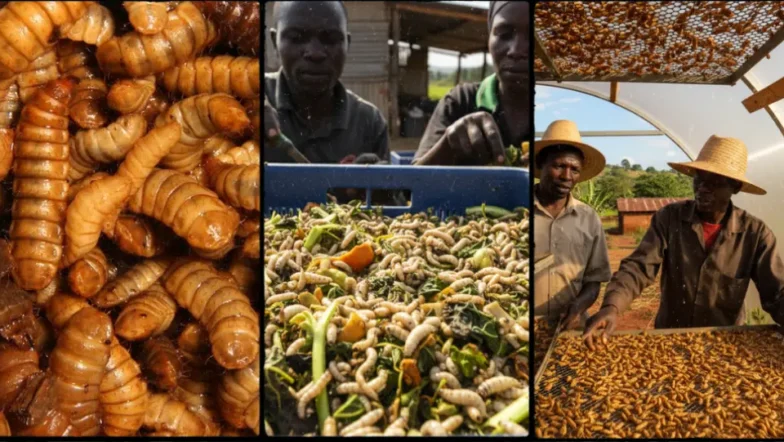
 stephen kilemi
January 29, 2026
stephen kilemi
January 29, 2026