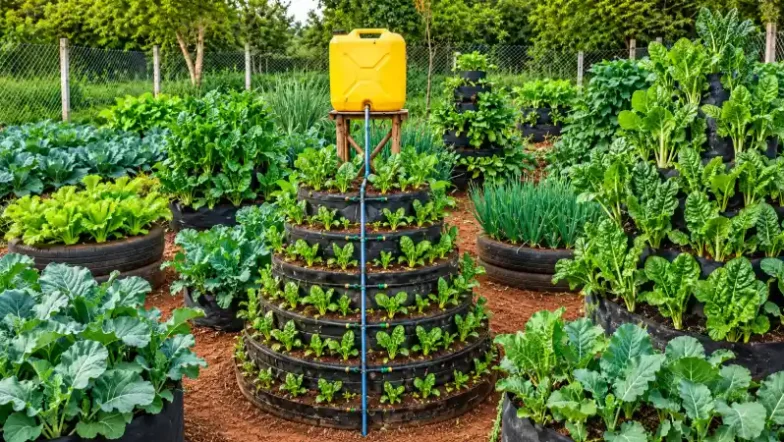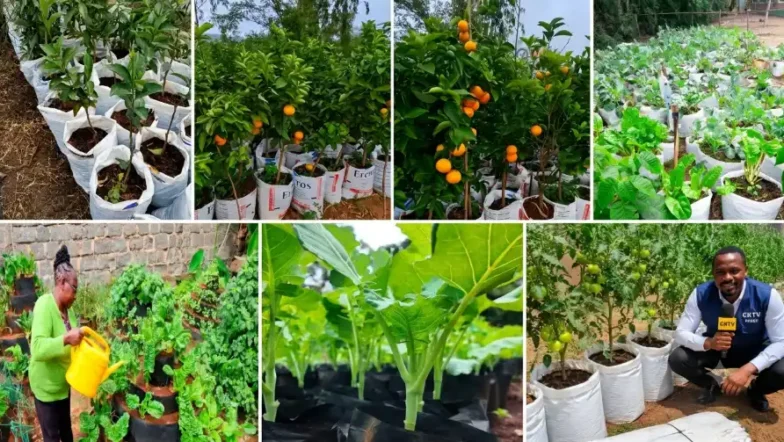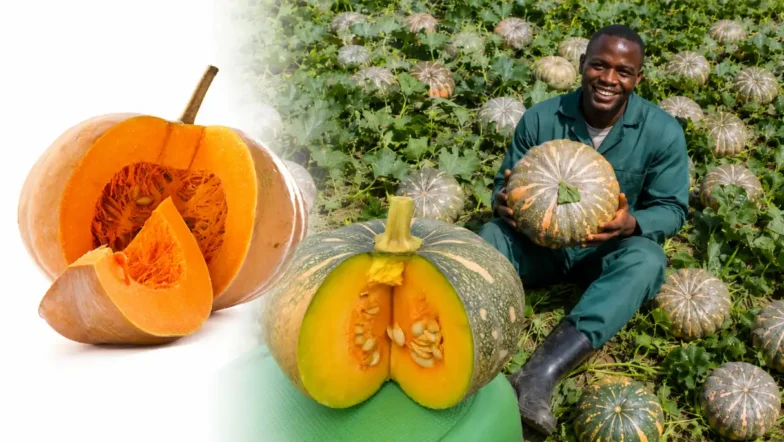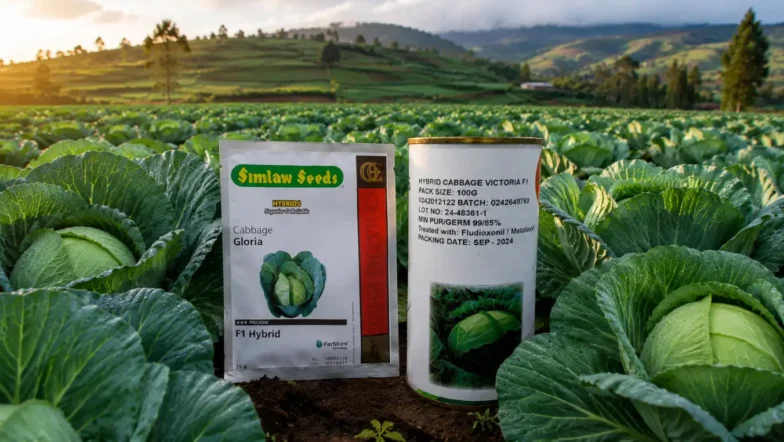
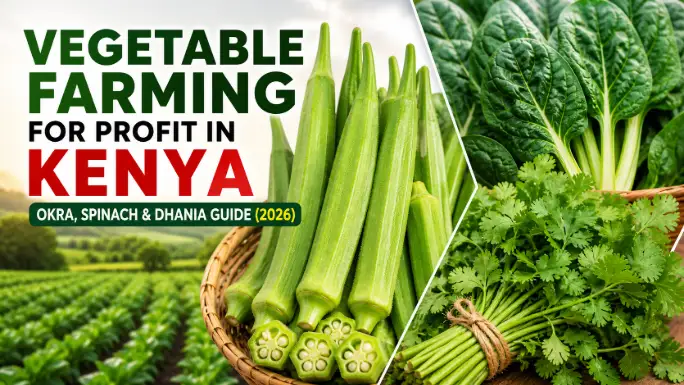

- Fastest Money: Dhania matures in just four to six weeks. This allows for rapid capital turnover and multiple harvest cycles per year.
- Safest Income: Spinach offers a highly reliable weekly cash flow. Daily household consumption guarantees a steady market for fresh leaves.
- Highest Profit: Okra yields massive margins per acre. Targeting coastal buyers and export markets generates premium revenue.
Table of Contents
Vegetable farming in Kenya provides massive financial opportunities. The market demands fresh produce every single day. However, beginners often fail because they focus on planting rather than selling. This updated 2026 master guide cuts through the noise. We reveal how to turn okra, spinach, and dhania into a highly predictable commercial agribusiness. We focus strictly on market timing, cost control, and securing buyers.
Vegetable Farming in Kenya: The 2026 Reality Check
Commercial vegetable farming thrives on daily urban consumption across Kenyan cities. Farmers still lose money by planting without guaranteed buyers and relying on unpredictable rain. Success requires treating your farm as a strict commercial logistics operation. Urban populations in major cities consume thousands of tonnes of fresh vegetables daily.
This demand literally never stops. Households purchase spinach, dhania, and okra every single day. This daily consumption creates a highly liquid market for fresh produce. It makes vegetable farming look incredibly easy. However, the reality on the ground is completely different. From what many farmers experience, financial losses happen every season. The primary reason is planting without a secured buyer. A farmer in Machakos will plant three acres of dhania and wait for maturity. They only start looking for brokers after harvesting.
Read Also: Dairy vs Poultry vs Vegetable Farming in Kenya: Which Is Best for Beginners?
By the time they locate a buyer, the crop has bolted and lost its entire value. You must solve the selling problem first. Relying on rain is another devastating trap. Rain-fed agriculture guarantees that you will harvest exactly when everyone else harvests. This creates massive market gluts at Wakulima Market. Prices crash instantly, and your profit margins completely disappear. Commercial farming strictly requires irrigation to target the dry seasons.
Best Vegetables for Profit in Kenya (2026)
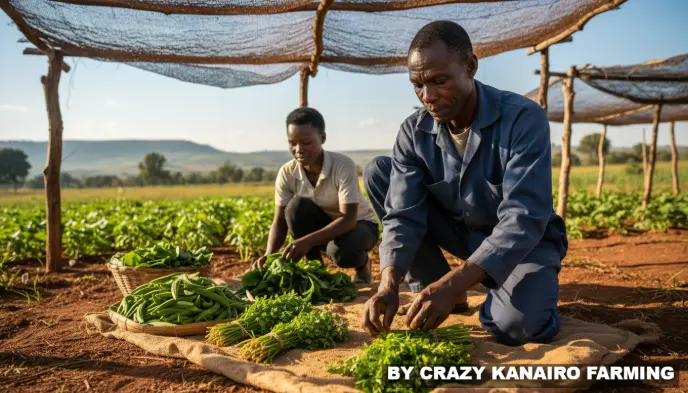
The most profitable vegetables for 2026 include Okra, Spinach, Dhania, Managu, Terere, and Kunde. These specific crops balance fast maturity periods with incredibly high market demand. Profitability depends on selecting the exact variety your target market prefers.
Choosing the right crop is your first critical business decision. You cannot plant what you simply like. You must plant what the local market demands. Export agents are actively buying specific varieties of okra. In 2026, the focus has shifted to fast-maturing, high-turnover crops. Okra offers massive profit potential but carries higher management risks.
Spinach acts as your safety net by providing consistent weekly income. Dhania remains the ultimate fast cash crop despite its high price volatility. Indigenous vegetables like managu and terere represent a hidden goldmine. They require extremely low input costs to produce.
The following table compares the top profitable vegetables based on maturity, demand, and risk profiles in 2026. This data helps you align your crop choice with your risk tolerance.
| Crop Type | Maturity Period | Demand Level | Risk Level | Profit Potential |
|---|---|---|---|---|
| Dhania | 4 to 6 weeks | Daily / Very High | High (Price crashes) | High turnover |
| Spinach | 45 to 60 days | Daily / High | Low | Consistent cashflow |
| Okra | 45 to 60 days | Export / Coastal | Medium | Very High margins |
| Managu | 60 days | High locally | Low | Excellent ROI |
| Terere | 3 to 4 weeks | High locally | Low | Fast turnover |
| Kunde | 60 to 70 days | Medium | Low | Steady income |
If You Have KES 10K, 30K, or 100K: A Decision Framework
Allocate KES 10,000 exclusively to dhania and spinach for fast capital turnover. Use KES 30,000 to mix multiple crops and stagger your planting dates. A budget of KES 100,000 allows you to install drip irrigation and target direct commercial buyers.
Available capital strictly dictates your farming strategy. Do not stretch a small budget over a massive piece of land. If you only have KES 10,000, your single goal is rapid capital multiplication. Focus entirely on a fast turnover strategy using dhania and a small spinach plot. Buy certified seeds, secure a local Mama Mboga, and flip the crop fast.
Read Also: Tomato & Potato Leaves Turning Yellow? 48-Hour Fungus Control Plan (Kenya April 2026)
If you have KES 30,000, you have room to actively manage risk. Use this exact budget to mix all three crops. More importantly, use this capital to stagger your planting schedules. Plant a quarter acre of dhania every two weeks. This guarantees you never face a total loss if weekend prices crash. With KES 100,000 or more, your strategy completely changes.
You move from basic survival to commercial market dominance. Do not just buy more fertilizer and seeds. Invest heavily in a basic drip irrigation system and secure water storage. This budget allows you to farm during the lucrative dry season.
Okra Farming in Kenya: High Value Export Strategy
Okra is a highly profitable export crop that faces very little local competition. Varieties like Clemson Spineless yield heavily under consistent irrigation. Plant at a standard spacing of 60cm by 30cm to maximize your pod harvest.
Okra remains one of the most underrated commercial crops in Kenya. Most beginners ignore it because it is not widely consumed in the central highlands. However, okra faces almost zero competition compared to tomatoes or cabbages. It boasts massive local demand in coastal regions like Mombasa.
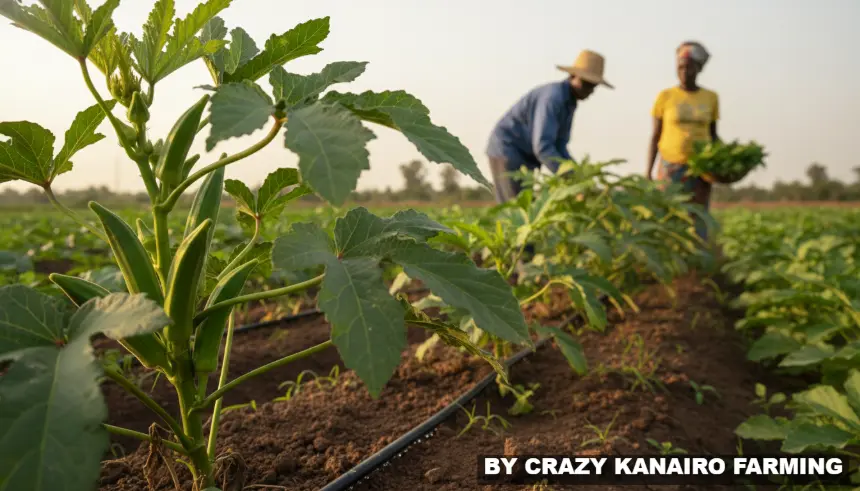
Furthermore, strong export demand exists from the Middle East. Land preparation must be incredibly thorough. Plough the land deep and raise beds if your soil retains too much water. Plant seeds at a spacing of 60cm between rows and 30cm between plants. You will need roughly three kilograms of certified seeds per acre. Excellent varieties include Pusa Sawani or Clemson Spineless.
Export Requirements for Okra
Exporting okra requires strict adherence to international standards. You must obtain a phytosanitary certificate from KEPHIS before exporting. Your farm must pass maximum residue limit tests for pesticides. Partnering with established export agents simplifies this rigorous regulatory process.
Management dictates whether you make a profit or record a loss. Pests like aphids and whiteflies absolutely love young okra leaves. You must spray appropriate insecticides early before populations multiply. Harvesting requires extreme discipline and strict timing. You must harvest pods when they are exactly three to four inches long. Overgrown pods become fibrous and completely lose their Grade A market value.
Spinach Farming in Kenya: Building Consistent Cashflow
Spinach provides a steady and reliable weekly income rather than a single massive payout. Plant hardy commercial varieties like Ford Hook Giant. Maintain strict watering schedules and harvest weekly to secure continuous monthly cash flow.
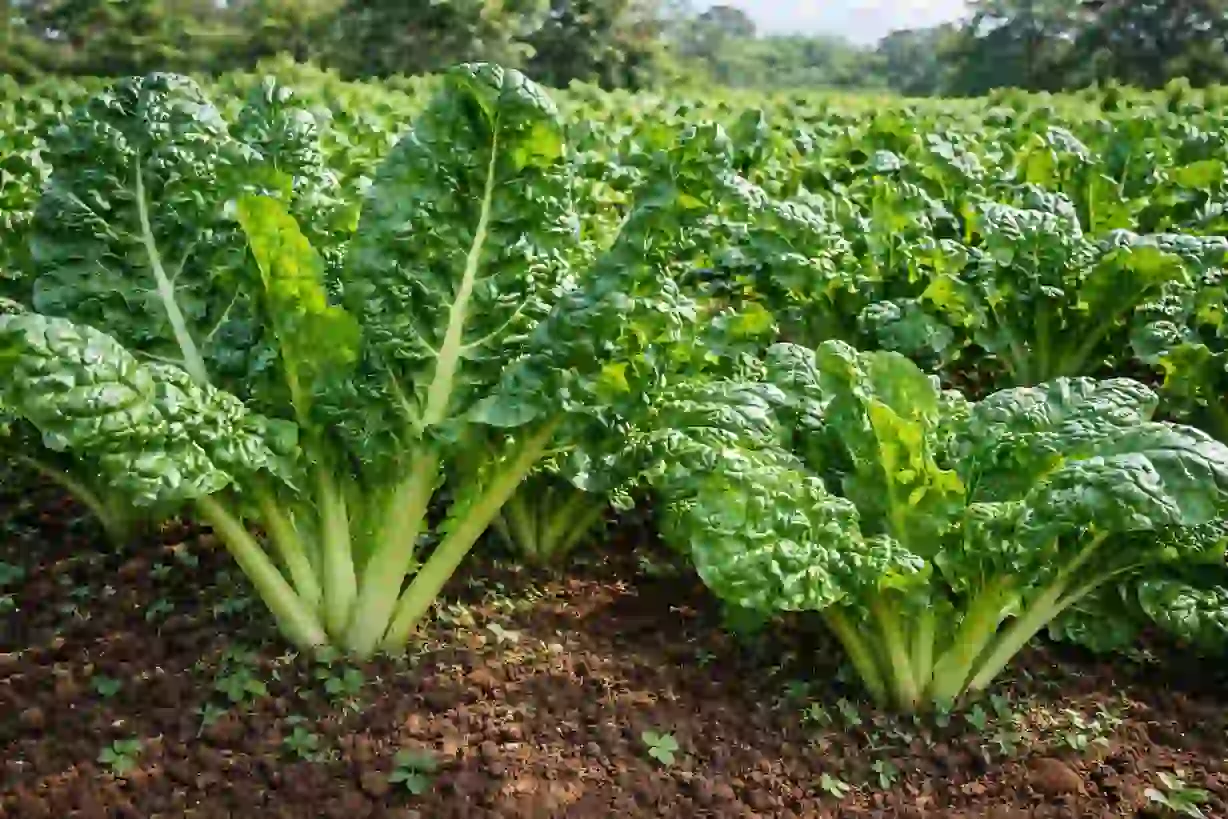
The hard truth about spinach farming is that it rarely creates instant wealth. It does not offer the massive single-harvest payouts of bulb onions or watermelons. Instead, spinach provides highly consistent and reliable cash flow. It pays the farm workers and buys the routine agricultural chemicals.
It keeps your entire operation running smoothly. Planting requires precision and excellent soil nutrition. The Ford Hook Giant variety dominates the Kenyan market because of its large resilient leaves. Spacing should be strictly 45cm between rows and 30cm between plants. Spinach growth is driven entirely by water and nitrogen. You must water the crop heavily to maintain leaf weight and crispness.
Post-Harvest Handling
Fresh spinach loses moisture very quickly after cutting. You must harvest extremely early in the morning before the sun gets hot. Keep the harvested leaves in a cool shaded area immediately. Transport the produce using well-ventilated crates to prevent heat build-up.
Read Also: Top 5 High-Yield 3-Month Crops in Kenya (2026 Profit Guide + ROI Breakdown)
The harvest cycle acts as your core profit engine. Once the crop matures at 45 days, you can cut leaves weekly for several months. This repeated harvest model creates a highly predictable monthly income. The absolute best buyers are local hotels, boarding schools, and estate vendors. Secure these institutional contracts early and deliver fresh leaves daily.
Dhania Farming in Kenya: The Fastest Cash Crop
Dhania dominates the market because it matures in three to four weeks. It carries high risks of severe sudden price crashes. Plant in small staggered weekly batches to avoid market gluts and guarantee a steady selling price. Dhania is the undisputed king of fast cash in Kenyan agriculture. No other legal crop allows you to plant a seed and pocket cash in under a month.
It enjoys massive daily demand across every single household in the country. From local butcheries to high-end restaurants, everyone buys fresh dhania daily. However, this incredible speed comes with brutal market risks. Dhania prices are incredibly volatile and unpredictable. A sack can sell for KES 5,000 on a Tuesday and crash to KES 800 by Friday.
Market gluts happen instantly when rains prompt every farmer to harvest simultaneously. If you hold the crop waiting for better prices, it bolts and becomes completely worthless. The only smart planting strategy is continuous staggering.
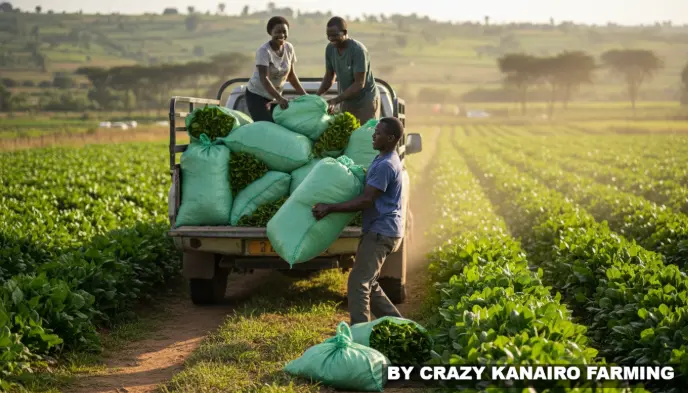
Never plant your entire field of dhania on the same exact day. Plant small manageable batches every single week. If the price crashes during your week one harvest, your week three harvest might catch a market shortage. Your profit relies entirely on avoiding these gluts.
Managu, Terere & Kunde: The Underrated Goldmine
Indigenous vegetables offer incredible profit margins due to extremely low input costs. They face minimal commercial competition while enjoying huge local demand. Target residential estates and traditional markets for the best commercial returns.
While beginners rush to plant expensive tomatoes, smart farmers are quietly making fortunes. They focus entirely on indigenous African leafy vegetables. Crops like managu, terere, and kunde are powerful because they are native to our specific climate. They naturally resist many local pests and fungal diseases. This natural resistance significantly drops your chemical costs.
Demand for these traditional vegetables has skyrocketed in major urban centers. Middle-class consumers actively seek them out for their proven nutritional value. Improved seed varieties developed by KALRO offer exceptional high yields. They also feature excellent drought tolerance. They require minimal hand-holding compared to fragile exotic vegetables.
These crops perform exceptionally well in specific target zones. You must target high-density residential estates and traditional open-air markets. Because your initial input costs are so low, your profit advantage remains massive. Even if the market price dips slightly, your break-even point protects you from losses.
Timing Strategy: This Is Where The Money Is Made
Market timing is the single most critical factor in vegetable farming. Plant your crops just before the dry season begins using irrigation. Avoid planting during peak rainy seasons to escape inevitable market gluts and price crashes.
Farming is twenty percent agronomy and eighty percent market timing. Most beginners fail spectacularly because they blindly follow the rains. When it rains, every idle piece of land in Kenya is planted with vegetables. Two months later, the entire market floods completely.
Read Also: Improved Kienyeji Chicken Farming in Kenya 2026: Complete Guide to Breeds, Housing, Feeding and Profits
Prices crash to the point where farmers literally feed their spinach to cows. The commercial secret is strictly counter-cyclical planting. You must plant your seeds when no one else is planting. The absolute best time to plant is just before the severe dry season begins. You will definitely need irrigation infrastructure, which increases your setup costs. However, you will harvest when the rain-fed farmers have nothing left to sell.
Understanding the Market Glut Phenomenon
A market glut occurs when supply vastly exceeds consumer demand. In Kenya, this happens roughly six weeks after the long rains begin. Brokers use this oversupply to dictate extremely low farm-gate prices. Avoiding this window is your only reliable defense against broker exploitation.
Market timing literally dictates your agricultural wealth. Selling okra or dhania when general supply is critically low allows you to dictate the price. Desperate buyers will visit your farm directly and pay for the transport themselves. Most traditional farmers completely ignore this golden rule. Push hard for dry-season production if you want real profit margins.
2026 Cost Breakdown: Real Numbers in Kenya
Farming one acre effectively requires roughly KES 65,000 to KES 100,000. Key expenses include certified seeds, land preparation, labor, and subsidized fertilizers. Government e-voucher systems have reduced input costs significantly for registered 2026 farmers.
You absolutely cannot run a farm on guesswork or rough estimates. You need hard realistic numbers. In 2026, input prices have stabilized, but labor and water pumping costs remain quite significant. To farm one acre commercially, you must budget accurately and aggressively. Subsidized fertilizers from the government have drastically reduced basal planting costs.
Always secure your national e-voucher early in the season. A fifty-kilogram bag of subsidized DAP costs significantly less than commercial retail prices. Seeds will cost you between KES 3,000 and KES 8,000 depending on the exact crop and variety. Never buy cheap uncertified seeds from open tins at your local market.
Irrigation Setup Costs
Basic drip irrigation kits for one acre cost between KES 80,000 and KES 120,000. This is a one-time capital expenditure that lasts for multiple seasons. A reliable petrol water pump will cost an additional KES 25,000. This infrastructure separates commercial farmers from struggling hobbyists.
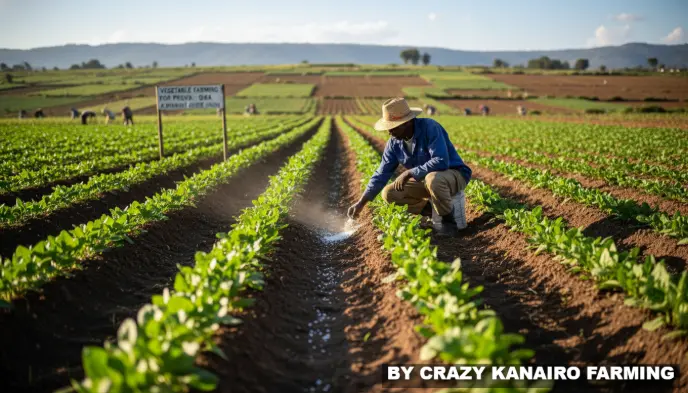
The following table outlines the estimated 2026 cost breakdown for one acre of irrigated vegetable farming. These figures help you prepare an accurate business plan before leasing land.
| Expense Category | Estimated Cost Range (KES) |
|---|---|
| Land Preparation & Leasing | 10,000 – 20,000 |
| Certified Seeds | 3,000 – 8,000 |
| Fertilizer (Subsidized) | 7,500 – 12,000 |
| Pest & Disease Control | 8,000 – 15,000 |
| Labor (Planting to Harvest) | 15,000 – 25,000 |
| Water Pumping / Irrigation Fuel | 10,000 – 20,000 |
| Total Estimated Cost | 53,500 – 100,000 |
Essential Fertilizer Guide for Vegetables
Using the correct fertilizer at specific growth stages dictates your final harvest volume. Agronomists strongly recommend a calculated mix of basal DAP for root establishment and CAN for rapid leafy growth.Applying the correct nutrients ensures your crops survive stress and yield heavily. You cannot use the same fertilizer for every single growth stage. Leafy greens require high nitrogen levels, while fruiting vegetables like okra demand potassium. Using the right combination maximizes your total harvested weight. The following table compares the essential fertilizers recommended for commercial vegetable farming in Kenya. This guide ensures you apply the right product at the correct time.
| Fertilizer Type | Best Used For | Application Stage | Expected Benefit |
|---|---|---|---|
| DAP (18:46:0) | All vegetables | During planting | Strong root development |
| CAN (26% N) | Spinach, Dhania, Terere | Top dressing (Weeks 2-3) | Rapid leafy growth |
| NPK (17:17:17) | Okra | Flowering stage | Pod formation and size |
| Foliar Feeds | All leafy greens | Weekly vegetative stage | Fights stress and boosts color |
Where to Buy farming inputs in Kenya: Okra, Spinach, Dhania & More
Always purchase your farming inputs from certified agricultural suppliers. Buying unverified seeds or fake chemicals guarantees massive crop failure. Reliable companies provide high-quality seeds, approved fertilizers, and modern irrigation equipment.
To succeed in the agribusiness models outlined in this guide, you must source certified inputs. Buying uncertified seeds or substandard fertilizers guarantees massive financial losses. Counterfeit chemicals are rampant in many rural hardware stores. You must protect your investment by dealing exclusively with reputable national distributors.
Below are verified Kenyan suppliers who provide the exact seeds, irrigation kits, and fertilizers required for commercial vegetable farming. Contact them directly to order your commercial farming inputs.
- Simlaw Seeds Company. Phone: +254 722 200 468. Email: [email protected].
- Website: www.simlaw.co.ke.
- Amiran Kenya Limited. Phone: +254 719 095 000. Email: [email protected].
- Website: www.amirankenya.com.
- Kenya Seed Company. Phone: +254 722 205 144. Email: [email protected].
- Website: www.kenyaseed.co.ke.
- Osho Chemical Industries. Phone: +254 711 045 000. Email: [email protected].
- Website: www.oshochem.com.
Profit Per Acre: Realistic 2026 Scenarios
A smart farmer using irrigation and proper timing can net over KES 250,000 per acre. A low-effort farmer relying strictly on rain will struggle to break even. Profitability is determined by maximizing yield and hitting supply shortages.
Let us look closely at the real mathematical breakdown. The financial difference between a low-effort farmer and a smart farmer is truly catastrophic. A low-effort farmer waits for the rains and buys cheap uncertified seeds. They completely ignore early pest control protocols. Their yield per acre is dismal, harvesting barely a thousand kilograms of okra.
This careless farmer then sells during a heavy market glut at KES 30 per kilogram. Their total gross revenue is roughly KES 30,000. They record a devastating net loss and blame the industry. A smart farmer operates completely differently. They use robust irrigation to plant early in January. They buy certified hybrid seeds and apply targeted foliar feeds weekly. They easily harvest four thousand kilograms of premium okra per acre.
Because they hit the dry season perfectly, buyers gladly pay KES 80 per kilogram. Their gross revenue hits KES 320,000, netting them pure profit even after high expenses. Proper timing and high yields remain your only defense against exploitation.
Where to Sell Vegetables in Kenya
Sell vegetables directly to hotels, boarding schools, and major supermarkets to secure stable prices. Alternatively, target major wholesale markets like Wakulima in Nairobi. You must negotiate your prices weeks before your crop is mature.
You must know exactly where your crop is going before you plant a single seed. Major wholesale markets handle the highest daily volumes in the country. Wakulima Market in Nairobi and Kongowea Market in Mombasa swallow tonnes of fresh produce daily.
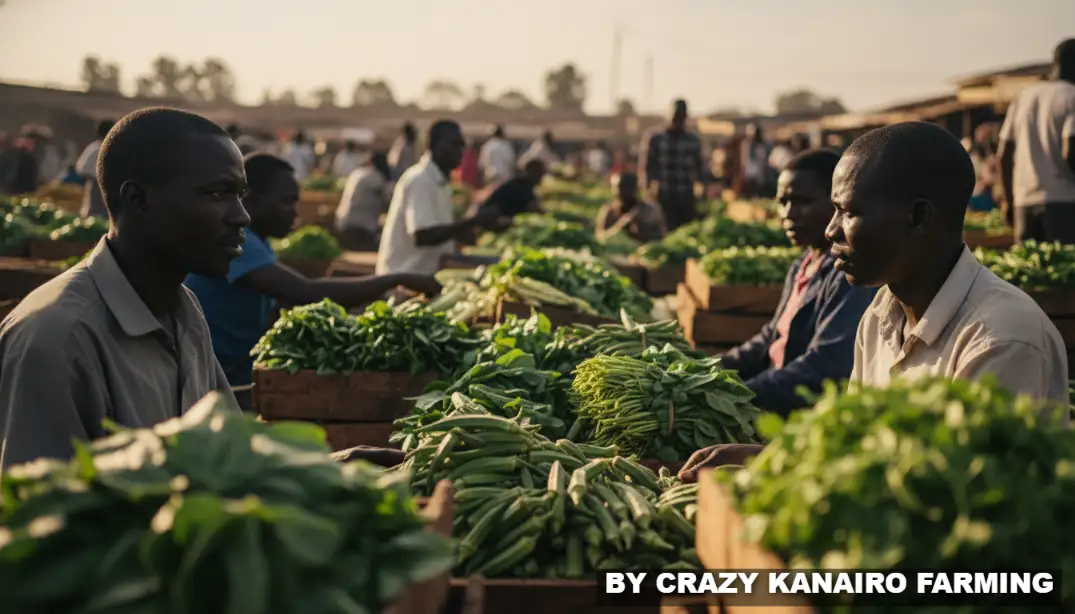
However, these massive markets are controlled by ruthless cartels and brokers. If you show up unannounced with a loaded truck, they will dictate a terrible price. They know you cannot take perishable goods back home. The safer route is securing direct commercial buyers.
Approach local boarding schools, busy hospitals, and mid-tier hotels. They desperately need daily deliveries of fresh spinach and clean dhania. Supermarkets are another excellent option for quality produce.
You May Like: 15 Most Profitable Agribusiness Ideas in Kenya to Start in 2026
However, they require strict hygiene standards and often delay payments for thirty days. Your selling strategy must be fiercely proactive. Go to the market a full month before you harvest. Find a trusted wholesaler, show them pictures of your crop, and negotiate early.
How to Avoid Losses: The Hard Truths
Avoid massive losses by installing irrigation instead of relying on unpredictable rain. Never overplant highly volatile crops like dhania in a single massive batch. Treat pest infestations aggressively the exact moment you spot them.
Most agricultural guides simply sell you a beautiful dream. Here are the brutal hard truths about farming failure in Kenya. Do not rely on natural rain. The regional climate has changed drastically. The rains will either fail completely or flood your fields entirely. If you cannot afford basic drip irrigation, do not start commercial farming yet.
Do not overplant dhania under any circumstances. Pure greed destroys many beginners. You see the price hit KES 100 per kilo, and you aggressively plant two solid acres. By the time you actually harvest, the price crashes to KES 20. You will literally watch your entire investment rot away in the field. Always plant your crops in small calculated phases.
Furthermore, do not wait until harvest day to look for potential buyers. This is the most common and fatal mistake made in Kenya. Finally, never ignore crop pests early on. If you see two whiteflies on your okra leaves, spray immediately. Pests multiply exponentially and cause total crop failure.
Combination Strategy: The Continuous Income System
Combine multiple complementary crops to build a continuous monthly income system. Use dhania for fast weekly cash flow to cover basic farm operations. Cultivate okra for bulk lump-sum profits to reinvest into farm expansion.
Smart commercial farming is entirely about cash flow engineering. You should never rely on a single crop to sustain your entire business. A combination strategy actively protects you from sudden market shocks. If the wholesale price of one crop crashes, the others keep your farm afloat.
Dedicate a small manageable portion of your land to dhania. This acts as your weekly cash engine. It pays the casual farm laborers and buys the fuel for your water pump. Next, plant half an acre of high-quality spinach. This provides your highly stable, predictable monthly income.
It guarantees a reliable check from your institutional hotel contracts. Finally, plant your main large acreage with okra. This serves as your bulk investment money. Because okra yields heavily over a concentrated two-month period, it generates significant revenue. This is the cash crop that buys your next piece of land. Combine them smartly to achieve true financial stability.
Final Checklist Before You Plant
Before planting, verify that you possess reliable permanent water access for the entire growing season. Confirm that you have a committed institutional buyer. Ensure you fully understand market timing to avoid catastrophic seasonal gluts.
Do not buy a single seed until you answer these critical questions honestly. Do you have reliable water? If your local river dries up in February, you simply cannot farm in January. Ensure your specific water source is permanent and clean. Do you have a guaranteed buyer? Write down their exact name and direct phone number.
Do you completely understand market timing? Look closely at the agricultural calendar. Are you about to harvest exactly when the rest of the country is harvesting? If yes, deliberately delay your nursery by three full weeks.
Are you actively planting in staggered phases? Never put all your operating capital into the ground on the same day. If you ignore this basic checklist, you are simply gambling. Agribusiness requires strict operational discipline. Prepare your land thoroughly and test your exact soil pH. Action without preparation in Kenyan agriculture leads straight to immediate bankruptcy.
Is It Worth It? 2026 Outlook and Conclusion
Vegetable farming in 2026 is exceptionally profitable but strictly rewards operational efficiency. Farmers who adopt modern irrigation and secure direct buyers will thrive immensely. Those relying on traditional guesswork will continue to record severe financial losses.
The 2026 outlook for vegetable farming in Kenya is incredibly bright. However, the strict rules of the game have permanently changed. The era of casual guesswork farming is completely dead. Input costs remain high enough to severely punish careless agricultural mistakes.
The modern market strictly demands high quality, consistent supply, and operational reliability. If you refuse to include real mathematical numbers in your planning, you will fail. If you ignore the selling strategy and focus only on the soil, your crops will rot. These are the absolute brutal facts of the agricultural industry today.
However, if you treat your farm exactly like a factory, everything changes. Optimizing your inputs and locking in wholesale buyers early transforms this venture into a wealth-generation machine. Take serious action today. Secure your water source, visit wholesale markets, and execute your dry-season plan flawlessly.
Farmers Also Ask
Is vegetable farming profitable in Kenya
Yes. Commercial vegetable farming yields high returns if you utilize irrigation to target dry seasons. Rain-fed methods often cause massive market gluts and severe financial losses.
How much can I earn from spinach farming
A well-managed acre generates between KES 200,000 and KES 450,000 per season. This requires continuous weekly harvesting and selling directly to commercial institutional buyers.
How long does dhania take to grow
Dhania matures rapidly in just 4 to 6 weeks. This makes it the fastest legal cash crop in Kenya for farmers seeking immediate capital turnover and daily market sales.
Best vegetables for quick profit Kenya
Dhania, terere, and fast-maturing spinach varieties offer the absolute quickest commercial profits. Dhania provides rapid returns in under a month for excellent capital turnover.
Where can I sell vegetables in Nairobi
You can easily sell at Wakulima Market or City Park for wholesale volumes. For better profit margins, target direct institutional buyers like local schools and residential vendors.
How to avoid losses in vegetable farming
Avoid massive losses by deliberately staggering your planting dates. Install reliable drip irrigation instead of relying on unpredictable rain, and secure buyers before planting.
Okra farming profit per acre Kenya
Okra can securely yield a net profit of KES 150,000 to KES 300,000 per acre per season. This is heavily driven by strong coastal demand and lucrative export market pricing.
Best time to plant vegetables in Kenya
The absolute best time to plant is just before the dry season using irrigation. Harvesting during severe dry months guarantees exceptionally low market supply and premium prices.
Which vegetable has highest demand in Kenya
Tomatoes, onions, spinach, and fresh dhania easily share the highest daily demand. They are essential basic ingredients consumed in nearly every single Kenyan household daily.
How to get vegetable buyers in Kenya
Visit major wholesale markets a full month before your harvest date. Approach local schools and modern hotels with crop samples to secure advance purchasing contracts early.